
Heather Bryant

Juneau eyes biggest cruise passenger day

Juneau expects to see the most cruise ship passengers of the season on Tuesday.

Juneau Convention and Visitor’s Bureau president Lorene Palmer says that’s when Juneau will have the most cruise passenger arrivals this summer.

The jump in numbers comes because the Seven Seas Navigator is on its repositioning cruise and will arrive Tuesday instead of its normal Saturday schedule.

Palmer says the city will be looking at a total capacity of 13,224. That number is based on the notion that every ship is sold out with at least two people in every cabin.

Palmer says the actual figures won’t be known until the season statistics are done.

Alaska couple admits to planning judge’s murder

An Alaska couple has admitted to buying a gun, silencer and hand grenades, and having maps to a federal judge’s homes, in what prosecutors say was a murder plot that developed from a dispute over paying taxes.

Lonnie and Karen Vernon of Salcha appeared in U.S. District Court in Anchorage on Monday to change their pleas and admit to conspiring to murder federal officials. Under the signed plea agreements, Lonnie Vernon will spend from 21 to 27 years in prison and his wife more than 15 years.

The judge set sentencing for Nov. 14.

Lonnie Vernon, 56, was a foot soldier in a Fairbanks militia group and convicted earlier this year in a separate murder conspiracy plot in which his wife was not charged. In that trial, Alaska Militia leader Schaeffer Cox also was convicted.

In this murder conspiracy case, the Vernons have signed plea agreements admitting to intending to kill U.S. District Court Judge Ralph Beistline and Internal Revenue Service officer Janice Stowell in 2011 in retaliation for a decision that they owed more than $165,000 in back taxes. Beistline presided over the tax case.

According to the plea agreements, the tax case began in 2008 because the couple had failed to pay taxes for several years. They were slapped with tax liens, and the government moved to sell their home, which was eventually sold.

In 2009, the couple with ties to the militia filed a counterclaim asserting that they are not citizens of the United States and therefore not obligated to pay taxes.

Beistline dismissed the lawsuit, calling the Vernons’ arguments “frivolous.” The couple lost several more legal challenges the following year.

According to Lonnie Vernon’s plea agreement, in February 2011, he traveled from Fairbanks to Anchorage with an undercover informant to buy a silencer. He told the informant, who was working undercover for the government, that he was going to kill the judge and the IRS officer, as well as the judge’s wife and children.

The following month, the couple met again with the undercover informant. This time, according to their plea agreements, they told him they wanted to buy hand grenades and offered to trade Karen Vernon’s jewelry for some. Lonnie Vernon also said he intended to kill Beistline’s daughter and her children, as well as all the Beistlines, and sought the informant’s help.

The plea agreement says the Vernons showed the informant a map with addresses and highlighted routes to the judges’ residences.

It says the couple purchased a pistol with silencer and two hand grenades, not knowing they were inert and provided by the FBI. Karen Vernon put the hand grenades in her purse, the plea agreement says.

The couple also had body armor, two assault rifles, more handguns and several rounds of ammunition at the time, the plea agreement says.

The couple also left a defiant letter to friends and family in case they died.

The letter says, “We will not FREELY GIVE our home, land and personal property to this tyrant, nor will we die cowards, licking their jack-boots. We did not go down without resistance and standing for our rights, the lead deficiency of those who came to take ours from us, was corrected as best we could.”

Warm Arctic sets record for summer sea ice melt

Scientists say critical ice in the Arctic Ocean melted to record low levels this overheated summer.
The National Snow and Ice Data Center reported Monday that the extent of Arctic sea ice shrank to 1.58 million square miles and is likely to melt more in the coming weeks. That breaks the old record of 1.61 million square miles set in 2007. Figures are based on satellite records dating back to 1979.

Data center scientist Ted Scambos says the melt can be blamed mostly on global warming from man-made emissions of greenhouse gases.

Scientists say Arctic sea ice – ocean water that freezes – helps moderate temperatures lower on the globe and is crucial for polar bears. Greenland has also had record melt this year.

Rehabilitated harbor seals head for the ocean

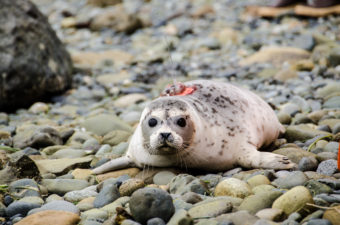
On Friday, two young harbor seals had an audience at False Outer Point as the seals made their way into the ocean for the first time since they were rescued in May.

The seals arrived on the beach in two large crates, greeted by the excited whispers of school kids. Dozens of children from around Juneau were on hand to bid the seals goodbye.

Olympia, a female harbor seal, was found in Haines in early May. The young pup was taken to the Alaska Sea Life Center where she joined Picabo, a seal pup rescued in Juneau. Both seals were born premature and were abandoned.

They spent three months at the SeaLife center recovering and learning how to fish.

The young seals were hesitant to leave their crates but eventually made their way down the beach. The crowd cheered as the two entered the water.

[youtube https://www.youtube.com/watch?v=ZZOGLA_ON8E]

Suspect who ate evidence may dodge charge

The Juneau district attorney says he probably will not file charges against a 24-year-old man suspected of eating a marijuana joint two weeks ago as he was approached by a police officer at a downtown intersection.

Prosecutors considered charging the man with felony evidence tampering, punishable by up to five years in prison and a $50,000 fine.

But District Attorney David Brower says that would have been far more harsh than public possession of marijuana, a misdemeanor with maximum penalties of 90 days in jail and a $2,000 fine.

Brower says that to prove the felony, his office would have had to pay for expert testimony and the convening of a grand jury.

He says the charge would be disproportional to the resources of his office.

Native communities worry about new consultation policy for native corporations

Consultation for ANC’s is an addition to the current policy of tribal consultation that was enacted in December.

“This would allow Alaska Native Corporations at the regional, village and urban level to consult with the Department of Interior on any policies or actions that impact their interests,” said Bryan Newland, senior policy adviser the Bureau of Indian Affairs in Washington, D.C.

That means ANCs’s can consult Interior about issues in any agency within the department; from the Fish and Wildlife Service to the Bureau of Land Management to the National Park Service.

The plan is now in effect, and Newland said Interior will implement it as responsibly and flexibly as possible. And, he added, BIA consulted with Alaska Native Corporations and tribes alike when crafting it, taking into consideration the sensitive issue of nation status.

“We know that this is not the government-to-government relationship that the United States shares with Indian tribes, and Alaska Native Villages are included in that category,” Newland said. “This is a different legal relationship. And this policy was drafted with that in mind, in an attempt to be respectful of that government-to-government, nation-to-nation relationship we have with Indian tribes.”

Mike Williams, Chief of the Yupiit Nation, disagreed with the policy.

“Our position is to keep the integrity of the tribal governments. And to not allow any other governmental or nongovernmental organizations to have the same privileges and same status as our sovereign tribal governments,” Williams said.

Consultation for the Alaska Native Corporations, Williams contends, minimizes the voice of Native communities. And that could have an effect on negotiations with the Department of Interior.

Williams said in his village, Akiak, the Native community institutes the Indian Health Service and the Indian Child Welfare Act.  Because of tribal consultation, they can deal directly with the federal government.

“When we consult with the federal government on federal budget issues, we have the capability of telling the government these budgets are inadequate,” he said. “But it has really generated the spirit of self-determination in our community.”

Some Native Corporations welcomed the news with a bit of skepticism. Jaeleen Araujo, vice-president at Sealaska Corporation, helped draft the policy at the request of the Department of Interior.

She said the corporation is encouraged by any sign indicating the federal government is willing to take into consideration Sealaska’s concerns on decisions that may affect its land, resources and shareholders.

“If some agency in Southeast is going to do something that could impact our ANCSA land, then obviously we have more of a priority in expressing our opinion than potentially some other tribes,” she said.

Araujo said the policy grants Sealaska Corporation that priority. Sealaska is not a tribe, though Araujo maintains it’s important tribes and clans also be heard, especially when dealing with issues of historical land.

The implementation could prove cumbersome. Araujo said the tribal relationship with the government is based on federal trust agreements, whereas the ANC relationship is statutory.

“I can understand their rationale for doing it. I just hope that having two administrative processes doesn’t become too much of a burden,” Araujo said Thursday.

The policy is limited to the Department of Interior.

That means Sealaska won’t be able to directly consult with the federal government one of its primary assets – land in the Tongass National Forest.  The U.S. Forest Service is part of the Department of Agriculture.

Site notifications
Update notification options
Subscribe to notifications