Heather Bryant

New England fisheries battle deadly fishing conditions

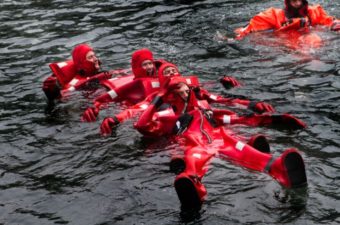
In a formation called "the worm," crewmen link up to be able to paddle against strong waves and winds to a lifeboat. (Photo by Jesse Costa/WBUR)
In a formation called “the worm,” crewmen link up to be able to paddle against strong waves and winds to a lifeboat. (Photo by Jesse Costa/WBUR)

On the fishing-boat piers of New England, nearly everyone knows a fisherman who was lost at sea.

Boat captain Joe Neves remembers when a crew member got knocked overboard. “We heard him screaming ‘Help me!’ ” Neves says, grimacing. “But you know, on the water at night, your head is like a little coconut.” They didn’t find him.

Mike Gallagher discovered a friend who was entangled in still-running hydraulics. “I knew right away he was dead,” he says.

And Fred Mattera was fishing 125 miles off the coast of Cape Cod when the 21-year-old son of a close friend succumbed to poisonous fumes in a nearby boat. “That was a brutal week in this port,” he says.

The Deadliest Catch

The Bureau of Labor Statistics ranks commercial fishing as the deadliest job in the United States. And despite the popular notion from reality TV’s Deadliest Catch, which features Alaskan crab fishermen, the most dangerous American fishery is in the Northeast.

From 2000 to 2009, workers in the Northeast’s multi-species groundfish fishery (which includes fish such as cod and haddock) were 37 times more likely to die on the job as a police officer.

A National Institute for Occupational Safety and Health report shows that 70 percent of those deaths and those in the second-deadliest fishery, Atlantic scallops, followed disasters such as a vessel catching fire, capsizing or sinking. Most of the rest came from onboard injuries or falling overboard — often caused by heavy overhead equipment.

Not one of those who fell overboard and drowned was wearing a life jacket.

An investigation by the Center for Public Integrity, NPR News and WBUR in Boston found that despite earning the odious ranking as America’s deadliest job, commercial fishing in the Northeast operates in a cultural tradition and regulatory environment that thwarts promising safety measures.

Out To Sea, Out Of Mind

Despite the strikingly high fatality rate in the fishing industry, pushes for reform have taken decades to come to fruition. In 1988, Congress required fishing boats to carry life boats, personal flotation devices and other safety equipment.

Yet while the Coast Guard mandates seaworthiness inspections of passenger ferries and other commercial vessels, fishing boats are not inspected.

“We’ve … requested authority to do inspections on vessels,” says Jack Kemerer, chief of the fishing vessels division of the Coast Guard. Congress did not include that power in the U.S. Coast Guard Authorization Act of 2010.

“So I can’t answer why or why not,” Kemerer says. “But, you know, it’s not that we haven’t asked for it in the past.”

The Last Of The Ocean Cowboys

Most fishermen don’t want to be supervised. Some are fatalistic about their life on the seas. New England fishermen used to buy steel-toed boots, believing that if they fell into the frigid Atlantic, it was better to drown faster. Others espouse a rugged individualism and see themselves as the last cowboys on the ocean.

At Chatham Harbor on Cape Cod, Bill Amaru runs one of the last cod-fishing boats from a harbor that used to be so prolific, fish markets labeled cod Chathams. Now, strict federal rules limit how much he can catch. Many other cod fishermen have gone out of business. Amaru doesn’t like the idea of the feds inspecting his boat.

“If there’s a resentment to these kinds of rules,” Amaru says as he moors his boat in the harbor, “it’s based on the overall huge number of regulations that have come down on our industry in the last decade — so much federal ‘nanny state,’ kind of telling us how to operate — when I think I have a pretty good understanding of what I need to do to keep safe.”

Still, the 2010 law requires boat owners like Amaru to prove that their safety equipment is up to date. Coast Guard checks have forced many fishermen to throw out old and disintegrating life rafts, and replace the expired batteries from their emergency signal beacons.

But just because a boat has updated safety gear doesn’t mean the crew knows how to use it.

‘We Will Make This A Safer Industry’

When Fred Mattera raced his boat to help fishermen overcome by poisonous fumes in a nearby boat in 2001, he didn’t know exactly what to do to help them. The radio was no help, either.

“What I heard there was this hodgepodge [of] try this, try that,” Mattera remembers. “And nobody knew for certain.”

When 21-year-old Steven Follett, the son of a close friend, died, Mattera was frustrated. Some people in port called him a hero for trying. “Being a hero is … someone survives,” he says, shaking his head.

Mattera told his friend he would make good come from the loss of life. “I just said, I promise you, we need to change the culture. We will make this a safer industry.”

The incident turned Mattera into a safety evangelist. Earlier this month, he helped the crews of two boats organize a disaster training and man-overboard exercise.

‘Get Your Panic Out Now!’

In one exercise, crew members clumsily put on bright orange-red survival suits. Insulated, watertight and buoyant, the suits cover each fisherman from head to toe; only their faces are exposed. They step off the boat into the calm dockside water. But even in these conditions, wearing what some guys call a “Gumby suit” feels claustrophobic to some, and they thrash around until they get their bearings.

“Get your panic out now!” Fred Matter shouts from the deck. The crew members are practicing abandoning ship in the case of a fire or capsizing. The immersion suits are designed to keep them alive and afloat in the icy Atlantic until someone can rescue them.

Mattera coaches them to link up with each other back-to-back and paddle together over to a life raft and climb in.

When it’s all over, the crew looks winded.

“There’s a ‘Holy crap!’ issue to it,” boat captain Norbert Stamps says of the training. “You jump in, you kind of realize that this isn’t fun and games. This is real serious stuff. And you gotta practice, and you gotta know what to expect.”

Crew member Mike Gallagher says fishermen-organized trainings are becoming more common. “To be honest with you,” he says, “the safety thing hasn’t really been paid much attention to until the past several years. Really, it’s been overlooked.”

Learning From Alaska

Alaskan waters had been viewed as the most hazardous place for commercial fishing — that is, until a closer focus on safety reduced the number of fatalities in those fisheries.

“I believe that fishermen want to be safe,” says National Institute for Occupational Safety and Health epidemiologist Jennifer Lincoln, who’s based in Alaska. “They just want things to be practical. They want the solutions to really address the hazards that exist.”

In Alaska, fishermen, state regulators and the Coast Guard have worked together to make fishing less deadly:

  • Bering Sea crabbing boats now transport fewer crab pots when they head out to sea. In turn, that weight limit prevented capsizing. Fatalities fell by 60 percent.
  • Because capsizing often occurred in deaths of Alaska’s salmon fishermen, skiff operators are now allowed the option of leaving immersion suits off their small boats, as long as they wear a life preserver at all times.
  • Pilot projects with life preservers designed for their working conditions encouraged scallop boats to require crew members to wear them.

That kind of safety progress is what Fred Mattera and others want to replicate in the Northeast, the home of today’s deadliest catch. Since that deadly accident in 2001, Mattera has trained hundreds of fishermen at Point Judith in Narragansett, R.I. But he’s not done.

“I’m just a fisherman,” Mattera says. “That’s what I loved, and that’s what I did for a long time. I promised a family we’d make a difference. [As long as] I’m still breathing, that’s what we’re going to strive to do.”

Mattera hopes that someday, the deadliest job in America will only be as dangerous as it has to be, and not one bit more.

Our stories about dangers in the commercial fishing industry were jointly reported by the Center for Public Integrity, WBUR in Boston and NPR News. The stories are part of CPI’s Hard Labor series on workplace safety.

Alaska sues federal government over Voting Rights Act

Yesterday, state attorneys filed a challenge to the federal Voting Rights Act in district court in Washington, DC.
The suit stems from legal action in June, when some Alaska Native groups sued the state for going forward with election plans before the federal government had given the go-ahead to Alaska’s 2012 redistricting plan.

Assistant state Attorney General Margaret Payton-Walsh says Alaska is only challenging Section Five of the Voting Rights Act.

“We were very concerned that we were not going to be able to hold the primary on time. And because we don’t have a permanent redistricting plan, and the board is going to have to try again, we wanted to avoid a repetition of that whole experience in 2014,” Payton-Walsh said. “We don’t believe the preclearance requirement of Section Five is necessary in Alaska. We don’t believe it’s constitutionally justified. We think that it creates a specific set of problems that led to that sort of crisis moment in June when we were afraid we weren’t going to be able send out advance absentee ballots.”

The June lawsuit by the Native groups became moot when the federal Department of Justice approved Alaska’s redistricting plan. But Payton-Walsh says the state is taking the arguments it planned to make in that case to court to exempt Alaska from the restrictions of Section Five.

“That section requires that the states in the jurisdictions that are covered by — it’s not every state in the union — but the states that are covered have to go to the federal government in Washington, DC every time they want to make any change in their election laws or procedures. And that could be anything from our new redistricting plan down to moving a polling station across the street,” Payton-Walsh said.

The suit also challenges the formula that requires certain states to comply with Section Five. Only eleven states must meet full Section Five requirements, though the Voting Rights Act applies to all states.

Juneau Mayor requests long-term plan for Tulsequah Chief Mine water treatment

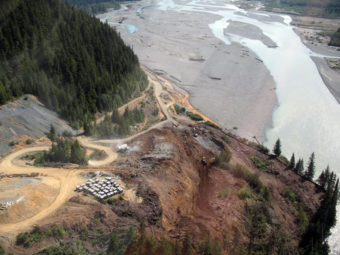
The Tulsequah mine sits above the Tulsequah River which flows into the Taku River. Image from Chieftan Metals website.

Juneau Mayor Bruce Botelho is asking Canadian environmental officials to come up with a plan to treat acid rock drainage from the Tulsequah Chief Mine at the headwaters of the Taku River.

Botelho has joined the growing sentiment on the Alaska side of the salmon-rich river that mine owner Chieftain Metals will not be able to remedy the 60-year-old problem.

“What is the long-term plan, recognizing that there may not be a mine in operation?” Mayor Bruce Botelho asked in a recent letter to Canadian Minister of Environment Peter Kent.

Since Chieftain Metals shut down its water treatment plant in June, after six months of operation, folks downstream are looking for a permanent solution to the acidic discharge.

“Right now, we’re on the dirty end of this,” Chris Zimmer said.

Chris Zimmer is Alaska Campaign Director for the trans-boundary conservation group Rivers without Borders.  His group echoes the sentiment of Botelho, Juneau legislators, the Taku River Tlingit First Nation, and others who want Canadian officials to look outside the mining industry for a solution.

When Chieftain pulled the plug on the treatment plant, Zimmer called for cross-border cooperation.  Now the Canadian law firm Ecojustice  has taken on the campaign, asking the B.C. attorney general to get involved.

“I got to believe that if the river flowed the other way and Canada was on the receiving end of the pollution and problems, that we’d see a much different situation here,” Zimmer said.

Chieftain put itself in violation of its federal and provincial environmental permits, when it stopped the water treatment, based on the cost of operating the plant.

At the time, the B.C. Ministry of the Environment required Chieftain to develop an action plan to get back into compliance.

That plan is now in place, according to B.C. Environmental Protection Regional Director Ian Sharpe.

In an email response to KTOO questions, Sharpe says one requirement is to remove sediment by redirecting runoff and mine site water through settling ponds. He said the clear water is then discharged into the Tulsequah River, which flows into the Taku.

Sharpe has required that the company monitor the discharge weekly.

The company’s mitigation plan indicates sampling began on August 6.  It says Chieftain Metals expects a new feasibility study by the end of the year. The company says that will attract full financing for the mine project, and allow it to resume treating the acid rock drainage by the middle of next year.

A map of the Tulsequah and Taku Rivers watershed from Rivers Without Borders.

Zimmer says the action plan doesn’t ring true, if you look at the company’s current financials, which foretell a far different story.

“Their plan is basically, you know, just trust us,” Zimmer said.

Botelho says it’s time the British Columbia and Canadian national governments show they can enforce their own laws as well as international obligations.

“Part of this is wanting to receive that high level of assurance that there is a long term and not a limited situational response,” Botelho said. “Is there a permanent strategy in place to protect the watershed?”

Chieftain Metals purchased the property two years ago from bankrupt Redfern Resources, acquiring  Redfern’s permits and the condition that it clean up the acid rock drainage.  The Tulsequah Chief Mine has been discharging the acidic water since Cominco closed it in 1957.

Related Story: Tulsequah water treatment plant temporarily shut down

Parnell reiterates pitch for lower oil taxes

Gov. Sean Parnell took to social media Tuesday to reiterate his call for lower oil production taxes.

In a post on Facebook, Parnell cited low oil flow through the trans-Alaska pipeline. He writes that production totaled 430,457 barrels per day last month and 472,424 barrels per day in July 2011. Parnell says the administration plan to reverse the trend is to “ease up on taxes when oil prices are in the higher ranges,” and attract investors back.

While there has been a trend of declining North Slope oil production, the flow of oil is generally lower during summer months as oil companies and the pipeline’s operator do maintenance.

Average flow so far this year has been 560,320 barrels per day.

A Parnell spokeswoman said the administration could use numbers from other months and they would show a year-over-year drop as well.

Kodiak man sentenced to 30 days in jail for forklift theft

A 19-year-old Ouzinkie man who used a city-owned forklift to pull another vehicle out of a ditch has been sentenced to 30 days in jail.
 
Pete Muller Jr. pleaded guilty last week to criminal trespass and vehicle theft.
 
Prosecutors say Muller was under the influence of alcohol April 23 when he took the forklift and a truck.
 
The vehicles received an estimated $1,000 in damage.
 
Muller also was sentenced to probation of three years and 80 hours of community service work. A $1,000 fine was suspended.
 
Ouzinkie is a community of 178 on the west coast of Spruce Island northwest of the city of Kodiak

Another 50 paratroopers returning from Afghanistan

About 50 paratroopers are expected to return to Alaska late Wednesday evening from nearly a year’s deployment in the eastern provinces of Afghanistan.
Joint Base Elmendorf Richardson says the paratroopers are assigned to the 4th Airborne Brigade Combat Team, 25th Infantry Division, based at JBER. 
 
About 220 of the brigade’s 3,500 soldiers already returned from Afghanistan on two flights earlier this month. 
Site notifications
Update notification options
Subscribe to notifications