Heather Bryant

Oil spill from work on Shell’s oil spill containment barge delays drilling

Minor oil spills at Bellingham have plagued construction of an oil spill containment barge needed for Shell Oil to drill exploratory wells in the Arctic Ocean off Alaska.

The Washington Ecology Department says hydraulic systems leaked on July 24, Aug. 4 and Aug. 6, each releasing about a quart of oil into Whatcom Waterway. The department sent a notice of violation to Superior Energy Services, which is building the Arctic Challenger.

Ecology spokeswoman Katie Skipper told The Bellingham Herald the spills could be the result of crews working in haste.

Shell is waiting on the barge to start drilling. The barge will carry a dome-shape containment system that could be lowered onto a leaking well to funnel oil and gas to a barge.

Coast Guard catches up to illegal fishing vessel across the Pacific

The high-seas driftnetter the U.S. Coast Guard chased across the North Pacific Ocean has been turned over to Chinese Fishery Law Enforcement.

The crew from the Hawaii-based cutter Rush, which had been patrolling Alaska waters, boarded the ship, identified as the Da Cheng, just over two weeks ago and found 30 metric tons of illegally-caught albacore tuna and six metric tons of shark and shark fin on board.

While in Kodiak, Coast Guard Admiral Robert Papp called the 177-foot gillnetter a pirate ship, prompting Louisiana Senator Mary Landrieu to call for prosecution of not only the crew, but of the illegal seafood’s buyers.

High seas driftnetting has been outlawed by international treaty for 20 years. The 10-mile nets the Da Cheng and other illegal, unregulated and unreported fishing boats efficiently catch tuna, but also scoop up everything in their path. Some nets are lost and drift for years, killing thousands of fish.

The crew of the Rush turned the Da Cheng over to the Chinese about 850 miles east of Tokyo.

Majority of Alaska schools fall short of education targets

Less than half Alaska public schools made “adequate yearly progress” last year under the federal education law.

The state education department says 236 of Alaska’s 507 public schools met all their targets during the 2011-2012 school year, or about 46.5 percent.

To make “adequate yearly progress,” each school must meet 40 targets, ranging from graduation and attendance rates to the percentage of students who are proficient in specific academic areas.

While the Juneau School District met 94 percent of the targets, fewer individual Juneau schools met overall A-Y-P.

Of the 14 Juneau schools measured, Auke Bay Elementary, Juneau Community Charter School, and Johnson Youth Center met all A-Y-P targets in the last school year.  Four schools met 38 and two schools met 39 of the 40 targets.

AYP is measured in Alaska by Standards Based Assessment (SBA) that tests proficiency in  reading and math for students in grades 3 – 10.

AYP results are available on the DEED website.

The Juneau School District will present the results to the public at the annual School Summit on Aug. 30 at Thunder Mountain High School from 6:30 to 8 p.m.

Former Alaska State Senator Al Adams passes away

Former Alaska State Senator and well-known Native leader Al Adams has died at the age of 70 from cancer.

Former Alaska State Sen. Al Adams, of Kotzebue, died Aug. 13, 2012 of pancreatic cancer.

Adams served the Northwest Arctic, North Slope, and Bering Strait region in both the Alaska House and Senate for 20 years, including several as the powerful chairman of the House Finance Committee. In the Senate, he also served on the Finance Committee as well as Community and Regional Affairs; and Education, Health and Social Services committees.
His sister Sarah Scanlon says he was a lifelong advocate for rural and Alaska Native interests, working for subsistence rights, and funding for education, social services, and infrastructure.

“He wanted to make sure that foremost there was equity in state funding for the rural communities for the basics: water and sewer, health clinics, roads, transportation, those kinds of programs I think in urban Alaska we sometimes take for granted,” Scanlon says. “He wanted to make sure rural Alaskans got their fair share.”

Adams, a Democrat, was known as a tenacious lawmaker, says former Juneau Sen. Jim Duncan, who served with him during his entire legislative career.

“He understood the process very well, was tenacious, knew what he wanted to get done and was very successful at getting it done,” Duncan said. “He knew how to build the coalitions and the relationships that allowed him to do that. And he got himself into a power position in the legislature and was able to maintain that. I think during his period of time on the finance committee he was looked at as one of the more powerful, if not the most powerful, member of the legislature.”

Scanlon says one of his major legislative achievements was the establishment of the Power Cost Equalization program for rural Alaska.

An Inupiaq Eskimo, Adams was from Kotzebue. He graduated from Mt. Edgecumbe boarding school in Sitka, then attended the University of Alaska Fairbanks and RCA Technical Institute.

Upon his retirement from the legislature, he worked as an adviser to the Northwest Arctic and North Slope boroughs, then as a lobbyist primarily representing rural and Alaska Native interests.

He held leadership roles in many other organizations, including Kikiktagruk Inupiat Corporation, NANA Regional Corporation, Alaska Airlines, Arctic Power and Mt. Edgecumbe High School.

A few weeks ago, Adams asked his lifelong friend Pete Schaeffer, of Kotzebue, to build his coffin, something the two of them had done together many times before for family members. Schaeffer says he thinks Adams would want to be remembered for his kindness.

“He was a great guy, a lot of fun to be with, and never lacked to do anything for you,” Schaeffer says. “I mean he bent over backwards to accommodate whatever it is you wanted, everything from snow machine parts to political favors in the later years and that kind of thing.”

Memorial services for Al Adams are scheduled for Wednesday at 11 a.m. at Anchorage ChangePoint Church, and on Friday at Kotzebue High School.

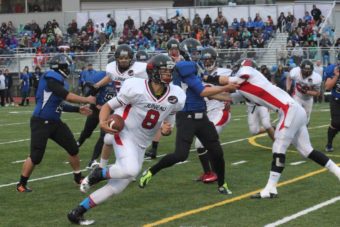
Bears level the Falcons 45 to 7 in Glacier Bowl

The second annual Glacier Bowl between Juneau-Douglas Crimson Bear and Thunder Mountain Falcons. Photo courtesy of Gail Fenumiai.
The Juneau-Douglas Crimson Bears scored in the first couple minutes of the game, setting the tone for the pre-season match up, dubbed the annual Glacier Bowl. It’s an appropriate name, since the Mendenhall Glacier can be seen from both the Thunder Mountain field, or Adair-Kennedy, where JDHS plays.

Saturday’s game was played at Thunder Mountain, and despite the home-field advantage, JDHS beat TMHS 45 to 7.

The two teams have met in pre-season since the new Mendenhall Valley high school fielded its first team four years ago. Both Falcons’ head coach Bill Byouer and Crimson Bears’ head coach Rich Sjoross say the game is a good shake down before the regular season begins.

“It was good for these guys to get a full four-quarter game in, with some good hard-hitting and some variety, a new offense for them,” Sjoross said. “We didn’t have a chance to scout them.”

He said Saturday’s game forced the players to make adjustments “by communicating with each other and starting to recognize formations, tendencies and that kind of stuff.”

The Crimson Bears had several adjustments to make early in the game when senior captain and team leader Phillip Fenumiai suffered a knee injury in the first quarter. Fenumiai is not only quarterback this season, he’s also playing safety. He reportedly hyper-extended his knee on a tackle.

Sophomore quarterback Dorian Isaak came in for Fenumiai and completed 6 of 10 passes for 161 yards, all in the second half, highlighted by a 68-yard touchdown pass to Brian Brassfield. Isaak also rushed for a score in the lopsided win.

“It felt good. I just wanted to stay calm, get out there and make plays. Stay in and show the coach I was ready and I was confident,” Isaak said. “I think the team did great. The line did great blocking. I think I need to work on my reads a little bit better; just be smart and stay cool when I’m back there.”

Bears junior running back Demetrius Campos carried the ball 13 times for 149 yards and a touchdown. Campos also returned a kickoff for a score, and senior Gary Speck scored on a 10-yard interception.

The Falcons’ Chris Mack scored in the first quarter on a 65-yard interception return. In fact, Mack forced four turnovers on defense for the Falcons. But the Falcons’ lone touchdown and extra point were the only scoring plays for the game.

“We got beat on some big plays,” Falcon’s coach Byouer said. “And then our numbers. I started getting kids really winded and hurt, and then the next thing I know I’m with 15 to 16 kids and I’m just sitting there trying to piece it together. We still could move the ball, but pretty much the wind was gone.”

Byouer called the game a step in the right direction as the team goes into the regular season, which begins next week with the Falcons at Sitka. The Falcons are in the small Southeast Conference with Sitka and Ketchikan, created two years ago. The Falcons also will play Kodiak and Skyview this fall.

The Crimson Bears compete in the Railbelt Conference against schools in the Fairbanks and Mat-Su areas. The Bears’ first game of the regular season is in Juneau, against Wasilla.

‘Violence Against Women Act’ Reauthorization Slows In Congress

A reauthorization of the Violence Against Women Act has slowed in Congress. The House and Senate have passed their own versions of the bill, and if the two chambers want to reconcile the two bills, they’ll need to address issues of native sovereignty and tribal courts.

Since it first passed nearly 20 years ago, the Violence Against Women Act has enjoyed broad, bipartisan support. It pays for all sorts of programs for victims and prevention, training for local safety officers and mechanisms to track crime.

And with a name like the Violence Against Women Act, it’s politically hard to oppose. It passed twice by unanimous consent since it was first authorized in 1994.

But this year’s reauthorization came amid partisan rancor. The Democrats charged a so-called Republican “war on women.” And The GOP fired right back, saying the Democrats loaded the bill with provisions to rally their base.

“I kind of went against, I guess, the perspective that my party had taken on this,” Senator Lisa Murkowski said. “They had advanced an alternate measure that I didn’t think was acceptable.”

Murkowski voted with 14 other Republicans and every Democrat in supporting the final bill. The alternative was introduced by Texas Republican Kay Bailey Hutchison. Her plan removed a provision that would allow tribal courts to prosecute some non-natives for domestic crimes committed in Indian Country.

But the bill that passed the Senate retained the tribal authority. And it passed with an amendment from Senators Murkowski and Mark Begich assuring that tribal courts would still be able to issue restraining orders against offenders that was in doubt early on.

“Bottom line for Indian Country? We absolutely must have some form of jurisdiction over perpetrators in our communities,” Jacqueline Johnson-Pata, executive director of the National Congress of American Indians, said.

Johnson-Pata, who is Tlingit, says the Senate version of the bill is a step in the right direction, but the practical effect on Alaska’s tribal courts is small. Because Metlakatla is the only reservation in the state, it’s the only tribal court that will be able to prosecute non-natives for domestic violence committed on their land.

The House version does not have the tribal-prosecution language. So Alaska Attorney General Mike Geraghty says the state supports the Senate version. The state does not believe tribes own land as result of the 1971 Alaska Native Claims Settlement Act.

“It’s not Native land. It doesn’t belong to the tribes. It may belong to a village corporation. It may belong to a native corporation. It may belong to a regional corporation. There are other possibilities. But that’s the point. The tribes don’t own the land,” Geraghty said.

Speaker of the House John Boehner has appointed eight members to serve on the panel that will hash out the differences between the two bills. Senate Majority Leader Harry Reid has not done so yet.

When that happens, Julie Kitka hopes the conference committee will heed her advice. She’s the president of the Alaska Federation of Natives and wants the final bill to allow the federal government to directly pay the regional, tribal groups that manage the village public safety officer program. Right now, the federal government gives money to the state, which oversees the VPSO program. The state would retain authority over the program; the money would just go straight to the tribes.

Kitka says the state doesn’t cover all the costs of the VPSO program, leaving tribes on the hook.

“If you’re contracting for the state or standing in for the state, your costs ought to be fully covered, just like the Indian Health Service or the BIA contracting or whatever,” Kitka said.

The Alaska Federation of Natives is urging Representative Don Young to push the provision. He said he lobbied for a spot on the conference committee, but ultimately, he was not picked.

“I don’t want anything less than the Senate has, and if we can improve on what the Senate has tried to do, I’ll attempt to do so,” Young said.

Young says he expects Congress to take up the measure when it returns in September. If history is a guide, Congress should reauthorize it. But there are major sticking points in the two bills. The Senate extends protections to gays and lesbians, and the House does not.

With an election mere months off, members of Congress will jump at the chance to make political points over just who deserves legal protection. And while that may help in the campaign, it does not help move the bill through Congress.

Site notifications
Update notification options
Subscribe to notifications