Heather Bryant

Woman testifies in Coast Guard court-martial

A court-martial is being held for a Coast Guard fireman charged with sexually assaulting a fellow Coast Guard petty officer.

Prosecutors say the attack occurred Jan. 3, 2011, in Valdez.

The woman took the stand Tuesday in Juneau’s federal building to say she remembers little about what occurred because she had consumed alcohol.

Prosecutors say the woman was sexually attacked on the bathroom floor of a local bar and again attacked on the stairwell of her apartment. Much of their case hinges on eyewitness accounts from the woman’s two co-workers.

Twenty-three-year-old Roque Trevino’s lawyers maintain the sex was consensual.

Trevino is charged with aggravated sexual assault and abusive sexual contact.

If convicted, he faces a maximum 67 years.

Alaska to get more than $1.4 million

The largest health care fraud settlement in U.S. history means more than $1.4 million for Alaska.

The state attorney general’s office says that is Alaska’s share of a settlement with GlaxoSmithKline.

The company agreed to pay a total of $3 billion to resolve allegations that it engaged in various illegal schemes related to the marketing and pricing of 10 drugs.

The lawsuit by federal and state governments alleged that GlaxoSmithKline overcharged the Medicaid program and promoted some drugs for unapproved uses, including the depression drug Paxil for use by children and adolescents. The company also marketed the depression drug Wellbutrin for off-label uses such as weight loss and sexual dysfunction.

Parnell plans state food stockpiles, just in case

Alaska is known for pioneering, self-reliant residents who are accustomed to remote locations and harsh weather. Despite that, Gov. Sean Parnell worries a major earthquake or volcanic eruption could leave the state’s 720,000 residents stranded and cut off from food and supply lines. His answer: Fill giant warehouses full of emergency food and supplies, just in case.
For some in the lower 48, it may seem like an extreme step. But Parnell says this is just Alaska.

In many ways, the state is no different than the rest of America. Most people buy their groceries at stores, and rely on a central grid for power and heat. But, unlike the rest of the lower 48, help isn’t a few miles away. When a fall storm cut off Nome from its final fuel supply last winter, a Russian tanker spent weeks breaking through thick ice to reach the remote town.

Weather isn’t the only thing that can wreak havoc in Alaska, where small planes are a preferred mode of transportation and the drive from Seattle to Juneau requires a ferry ride and 38 hours in a car. The state’s worst natural disaster was in 1964, when a magnitude-9.2 earthquake and resulting tsunami killed 131 people and disrupted electrical systems, water mains and communication lines in Anchorage and other cities.

“We have a different motivation to do this, because help is a long ways away,” said John Madden, Alaska’s emergency management director.

The state plans two food stockpiles in or near Fairbanks and Anchorage, two cities that also have military bases. Construction on the two storage facilities will begin this fall, and the first food deliveries are targeted for December. The goal is to have enough food to feed 40,000 people for up to a week, including three days of ready-to-eat meals and four days of bulk food that can be prepared and cooked for large groups. To put that number into perspective, Alaska’s largest city, Anchorage, has about 295,000 people, according to the U.S. Census Bureau, and Juneau, its third largest, about 31,000.

It’s not unusual for states that routinely experience hurricanes or other large-scale disasters to have supplies like water, ready-to-eat meals, cots and blankets. But Alaska is interested in stocking food with at least a five-year shelf life that meets the nutrition, health and cultural requirements of the state’s unique demographics. That means, as part of the effort, trying to incorporate cultural foods like salmon for Alaska Natives as well as foods that would be more common in urban areas, state emergency management spokesman Jeremy Zidek said.

An estimated 90 percent of commodities entering Alaska are delivered through the Port of Anchorage. Air service is also a critical link to the outside world and generally the only way to reach many rural communities. A volcanic blast emitting a large amount of smoke and ash could disrupt supply lines by air and water for an extended period, Madden said, and an earthquake could knock out airport runways or ports. Those are just some of the disasters that might require emergency supplies.

Parnell has made disaster readiness a priority of his administration. His spokeswoman said he has experienced firsthand the devastation of natural disasters, including heavy flooding that knocked some buildings off foundations in Eagle in 2009, when he was lieutenant governor, and the Joplin, Mo., tornado last year. Parnell and his wife visited Joplin with members of the relief organization Samaritan’s Purse.

Madden said Alaska’s readiness is better than it once was and it continues to improve.

State officials have been working to encourage individual responsibility, with talks at schools and public gatherings. Emergency management officials plan to have a booth at the Alaska State Fair. A statewide disaster drill is planned for October.

Over the past year, the state has acquired or purchased water purification units and generators designed to work in cold climates, including units that could power facilities like hospitals, Madden said. Officials also are determining what the state needs in terms of emergency medical supplies and shelter, he said.

Delivery of the food stockpiles would be staggered over three years. It would be replaced after it’s used or expired, and it’s entirely possible that much of the food will never be needed. It is not clear what the state will do with the expired, unused food.

The project has a budget of around $4 million and hasn’t generated any real controversy.

Allen Geiger, enjoying hot dogs from a street vendor Tuesday in Anchorage’s Town Square Park, said he had no objections to the plan.

“It seems like an OK idea,” Geiger said. “The scale of it is not too huge.”

Correction: The original story stated that the state of Alaska planned to build two warehouses to store food in case of a natural disaster. The state has asked for proposals from contractors, who may build new warehouses or opt to use existing facilities instead. The story has been updated to reflect that change.

Planning commission greenlights cellphone tower on Montana Creek Road

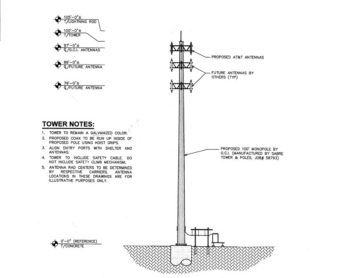
A rendering of the proposed tower.

The Juneau Planning Commission has approved a cellphone tower along Montana Creek Road.

The 105-foot GCI tower will include a 5-foot lightning rod and antennas.

GCI representative Wayne Haerer said the site will enhance the signal strength for voice, digital data and text to the Mendenhall Valley, where the signal is inadequate.  He says he hopes to have a contractor in place before the end of September.

CBJ Community Development planner Laura Boyce said the tower would be seen about 20 to 30 feet about the trees. It must be painted green or brown to blend into the vegetation as much as possible.

The proposed location for the tower.

Many Montana Creek area residents oppose the tower, including CBJ Assembly member Ruth Danner. In a letter to the Planning Commission, Danner said commissioners should delay their decision until the city has developed a cellphone town policy.  She also cited the need to know the health effects of electromagnetic frequencies.

Deputy community Development Director Greg Chaney said municipalities cannot regulate based on health effects.

“Federal communications law prohibits local jurisdictions from regulating strictly on health effects.  Planning commissions, it you want to take that on, you have to be ready to go to the Supreme Court, because it’s a clear provision in federal law,” Chaney said.

Danner has been fighting cellphone towers since before she ran for the Assembly three years ago.  In this case delaying the decision any longer was not feasible, Boyce said, because federal law requires municipalities act on a complete application for a tower within 150 days.

Initiative to re-establish coastal management program fails

Alaska voters have voted against a proposal to re-establish a coastal management program.

With 97 percent of precincts reporting, 61.84 percent of the vote was against Ballot Measure 2 and 38.16 percent for it.

The fight over Ballot Measure 2 became the most expensive campaign in Alaska this election. More than $1.7 million was raised. Most of that was by the opposition group “Vote No on 2.” Resource development and industry groups largely bankrolled the group’s effort. That caused the group behind the initiative, the Alaska Sea Party, to cast funding for the opposition as being led by outside interests.

Alaska had a coastal management program for decades, but it ended last year, after the Legislature and governor failed to come to terms on its reauthorization.

Sen. Begich to introduce legislation creating Arctic Port Authority

The state of Alaska is working with the US Army Corps of Engineers to locate a site for a deep water port.

Alaska Senator Mark Begich says he plans to introduce legislation creating an Arctic Port Authority to facilitate Alaska’s future international shipping needs. Begich made the announcement over the weekend at Arctic Imperative Summit.

Senator Mark Begich is a strong supporter of greater ice breaking capacity in Alaska’s Arctic waters. Begich’s remarks during his talk at the Arctic Imperative Summit pointed to the cooperation of Nome area Sitnasuak Native Corporation and Vitus Marine in bringing life- giving fuel to Nome last winter.

“People back in Washington would say, what’s the latest, what’s happened, what’s going on? It was kind of like the Iditarod of the 21st century on ice. It was kind of an interesting change of events that brought people’s attention to what’s going on. But it also brought to the attention of the administration and others that we have limited icebreaking capacity,” Begich said.

That attention getting moment highlighted the needs of the Arctic for a while. Begich says it’s important to keep national focus on the Arctic

“Do we need a deep water port? Yes. Do we need additional ports? Yes. Better communications systems, weather satellites, helicopter hangers, pipeline activity to move what’s in the Chukchi and Beaufort to our overall pipeline that moves it down to Valdez,” Begich said.

He stressed that the Arctic is becoming a new destination for tourism, too. But lack of infrastructure is the challenge. And Begich says he’s going to do something about that.

“We are an Arctic nation. We need to have the resources to approach this new opportunity for us in the right way with the right infrastructure. When we get back, we’ve been working on a piece of legislation, we’ll introduce it in September. It will create the Arctic Port Authority which will design an area and create an opportunity for us to create an independent, semi – private, U.S. Arctic Deep Water Port Authority to plan, finance and build and maintain such a port. It will be critical for our oil and gas industry and it will also be critical for logistics and for support of the full utilization of what goes on in the Arctic,” Begich said.

In addition he said, the legislation would authorize the port authority to establish sub ports to serve as regional trans- shipment hubs to facilitate commerce in Arctic communities. Begich said the aim is to establish a network of ports to serve future shipping needs.

The Senator pointed out that Shell Oil Company’s plans for the coming years include 22 support vessels. Begich said that in three years, 200 vessels could be serving oil development alone.

Alaska Lieutenant Governor Mead Treadwell, told the group that the state is working with the US Army corps of engineers on locating a site for a deep water port

“If Shell is successful in its exploration, you are going to see a need for developing small ports on the North Slope, for servicing that. So the very interesting question, and I think that the prospect of a port authority is a provocative question to look at, is how should we try to finance these ports together or separately. The question with any port is what throughput is going to pay the bill,” Treadwell said.

According to Treadwell, Trans Arctic shipping depends on cooperation among the international governments involved to help decision makers look at coordinated investment in ports and airports.

Site notifications
Update notification options
Subscribe to notifications