Jacob Resneck is CoastAlaska's regional news director based in Juneau. CoastAlaska is our partner in Southeast Alaska. KTOO collaborates with partners across the state to cover important news and to share stories with our audiences.
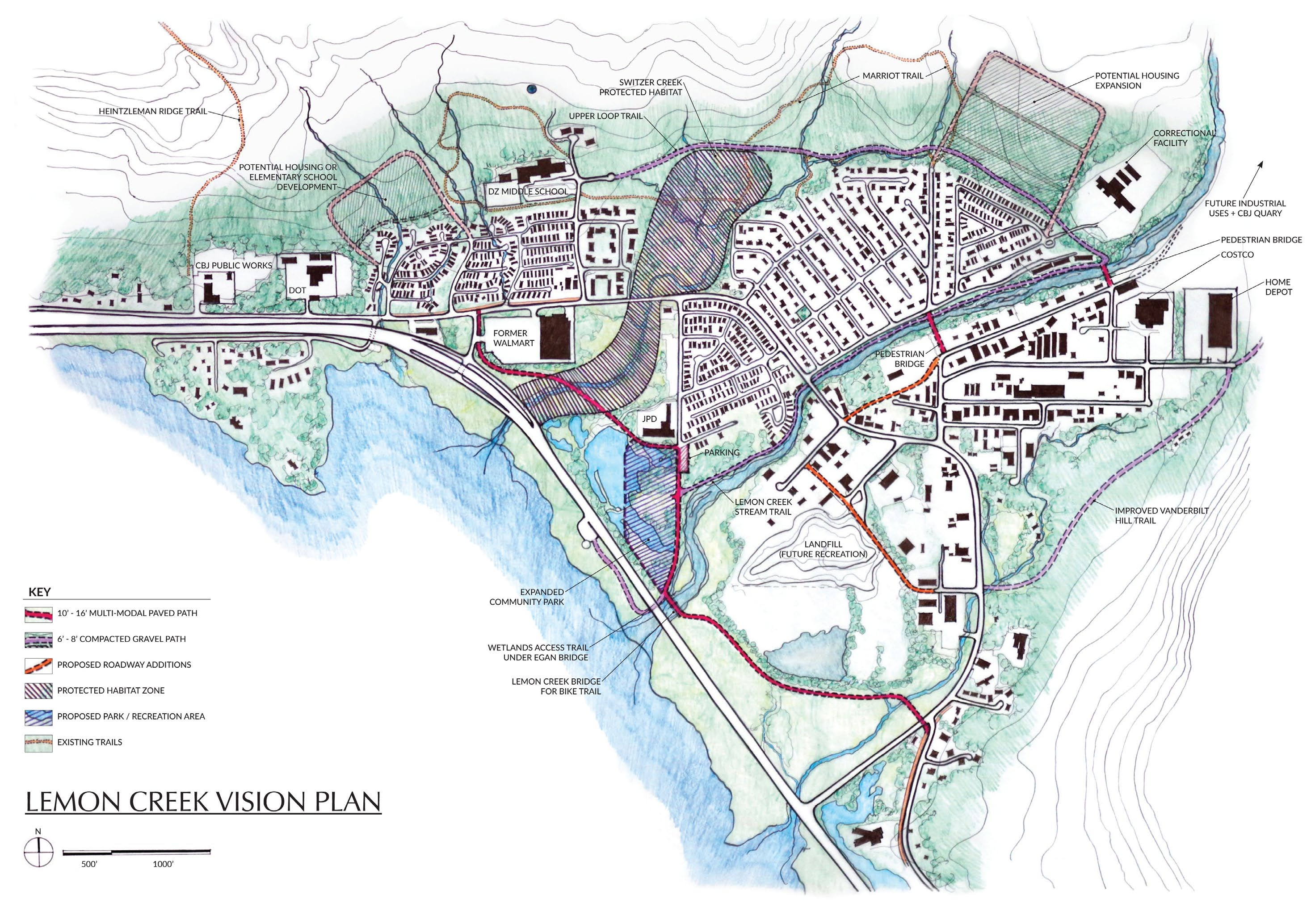
A sketch of future development guidelines for the Lemon Creek area was released July 14 by the City and Borough of Juneau. (Courtesy of City and Borough of Juneau)
The public can give input on how the Lemon Creek area will be shaped over the next 20 years.
Those changes could affect future development going forward.
“Lemon Creek has definitely grown up very organically,” City Planner Jill Maclean said.
Today, south of Lemon Creek is mostly commercial and industrial whereas the north side has a relatively high concentration of residential buildings.
“I think the challenge is making them complement one another rather than compete,” Maclean said.
One idea is more mixed-use areas where people live and work. Better pedestrian and bicycle access also is in the plan as well as developing city parks.
A 12-member steering committee of residents, property and business owners and a planning commission liaison has been meeting over the past year and will review comments received.
The committee will review those comments next month before forwarding ideas to the Juneau Assembly and Planning Commission.
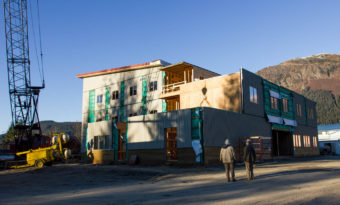
The Housing First Project under construction on Nov. 17, 2016. (Photo by David Purdy/KTOO)
The opening date for the Juneau’s Housing First project has been pushed back again.
Originally slated to open in early summer, the complex of 32 efficiency apartments and a downstairs clinic is now scheduled to open in mid-September. Its goal is to provide 32 homeless people with permanent housing with access to on-site medical care.
Housing First’s project manager Mariya Lovishchuk explained the delay was over finishing the Lemon Creek facility’s parking lot.
“It’s a paving issue,” she said Friday. “We just have to have enough time to finish paving the parking lot. That’s the last remaining item – is the parking lot paving.”
“Projects like this do end up saving money in emergency service utilization,” Lovishchuk said, “and they also really improve the quality of life in the community for both the tenants of the facilities as well as for the general public.”
The housing project also has a new name: Alder Manor. A total of 32 homeless residents are being selected for accommodation based on a vulnerability survey – those chronically homeless and most likely to literally die in the streets.
The first eight residents are expected to move in on Sept. 15.
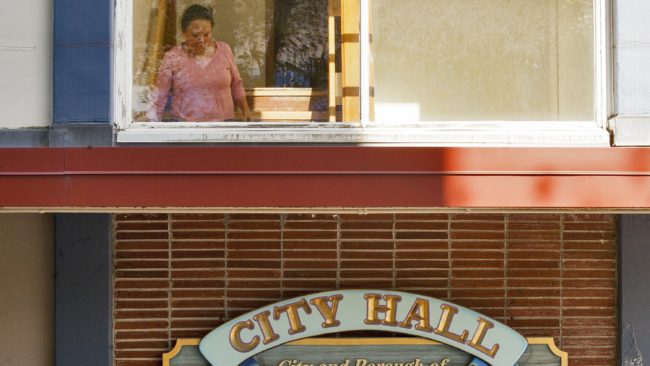
A woman leaves Juneau City Hall on May 10, 2016. (Photo by Rashah McChesney/KTOO)
In vote after vote, a divided Juneau Assembly set its list of sales tax-funded projects. All of this is contingent on voters passing a 5-year extension of 1 percent of the local sales tax in October.
It was never going to be easy. The Juneau Assembly received a wish list of 26 projects totaling about $120 million. But as it only projects about $47 million available over five years there were going to be disappointments.
The city manager’s office recommended borrow through bonds an additional $10 million. But a majority of members shot down that idea.
“I believe that the things that we buy should not be put on credit,” Assemblywoman Debbie White said.
The majority agreed and the bonding idea was scrapped.
That still left $47 million for $120 million worth of requests.
Here are highlights of what voters will be asked to support in October:
$13.5 million for existing wastewater infrastructure,
$3.5 million for maintenance of city-owned buildings,
$4.5 million for existing drinking water infrastructure,
$3 million for federal matching grants for airport improvements,
$5 million towards deferred maintenance of the downtown swimming pool,
$4.5 million towards upgrades at Centennial Hall,
$5 million for building maintenance for the Juneau School District,
$2.5 million towards Rainforest Recovery Center,
$2 million for information technology upgrades,
$2 million for the city’s recycling program,
$2 million for the affordable housing fund,
$1.5 million for rebuilding Aurora Harbor, and
$500,000 for city parks.
At that point the Finance Committee had run out of funds. There was nothing left for helping the community build a new Juneau Arts and Cultural Center, commonly known as the JACC. The nonprofit Juneau Arts and Humanities Council had requested $5 million towards the estimated $26 million project.
Assemblyman Loren Jones proposed raising the hotel bed tax from 7 to 9 percent to allocate $1.6 million toward a new JACC.
Not everyone was on board.
“I have absolutely no appetite to raise the bed tax – none whatsoever,” Deputy Mayor Jerry Nankervis said. “I disagree with the philosophy that you tax people who don’t live here more. As an owner of property somewhere else, I can tell you that they tax me a whole lot more because I don’t live there and that’s baloney.”
In the end, the initiative passed 6-3 with Mayor Ken Koelsch, Deputy Mayor Jerry Nankervis and Assembly woman Mary Becker opposed. A staff-written proposal on raising the hotel bed tax to help fund a new JACC will be brought before the Assembly at its next meeting.
The Assembly will hold a public hearing before it finalizes the overall list. Then it will be up to voters to decide in October whether to extend the 1 percent sales tax.
Voters in Juneau likely will be asked in October to extend 1 percent of the local sales tax for another five years.
That would help raise about $47 million for capital projects. But first, the Assembly’s finance committee will meet Thursday to decide which projects would receive funding.
The Juneau Assembly has ranked wastewater treatment infrastructure as the top priority for future sales tax revenue. (Photo by Rosemarie Alexander/KTOO)
The Juneau Assembly has been sifting through 26 project requests totaling more than $126 million.
But they’ll have to pare it down as the sales tax extension would generate less than $47 million.
In the meantime the public has been weighing in on which projects make the cut.
“Our emails have been alight with comments,” Finance Committee Chairman Jesse Kiehl said. “Lots and lots of folks writing in.”
The Assembly has heard a lot of competing proposals and this month ranked their top 12 projects by ballot.
The finance office scored the results.
“We had staff put this together from weighted rankings just to give us a unified starting point,” Kiehl said. “From here, the committee may go a dozen different directions when we get down to the voting. But at least we have one place to start from.”
Assembly members highly ranked upkeep of city-owned buildings, maintenance for the downtown swimming pool and the city’s water and wastewater treatment plants.Other projects that performed well were upgrades for Centennial Hall and the Rainforest Recovery Center at the hospital.
They also passed over sales tax funding for the city’s downtown seawalk that’s been funded mostly by marine passenger fees.
Finance Director Bob Bartholomew said the finance committee is expected to tackle that task when it meets Thursday.
“They’ll definitely need to have committee votes on which projects they want to move to the ballot and then how much money they want allocated to each project,” he said.
The Assembly will hold a public hearing before it finalizes its list. Then it will be up to voters to decide in October whether to extend the 1 percent sales tax.
The Assembly is expected to propose the ballot question later this summer.
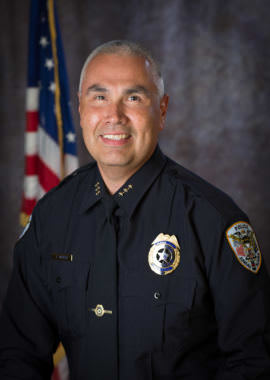
Ed Mercer is a 17-year veteran of the Juneau Police Department. He officially takes the top job on July 28. (Photo courtesy City and Borough of Juneau)
City officials said Ed Mercer was a natural choice given his 17 years experience with the Juneau Police Department. He’s been deputy chief since 2000.
“Any time we have a department head opening, we weigh whether we need to go outside, run a full recruitment or whether there’s somebody we believe is an internal candidate that has skills, abilities and leadership vision to lead the department forward,” said Deputy City Manager Mila Cosgrove. “And in this case we took a hard look at Deputy Chief Mercer and determined that we thought he’s ready to step up and lead the department forward.”
Before coming to Juneau, Mercer was a police officer in Sitka. He replaces Bryce Johnson who had served as police chief since 2013. Johnson recently accepted the police chief job for the city of Idaho Falls.
“The department’s headed in a great direction, he’s worked closely with Chief Johnson and we believe that he will be quite effective stepping up into the police chief role,” Cosgrove added.
City officials said Tuesday that Mercer was traveling out of state and unavailable for comment.
Close
Update notification options
Subscribe to notifications
Subscribe
Get notifications about news related to the topics you care about. You can unsubscribe anytime.