Jamie Diep

Education Reporter, KTOO

"I strive to tell stories that highlight the triumphs, struggles and resilience of students from all backgrounds as they navigate a constantly changing world."

In their free time, Jamie’s probably playing their oboe or exploring the outdoors.
Juneau’s Vera Starbard earns Emmy nomination for ‘Molly of Denali’ Thanksgiving episode

Vera Starbard poses at a slight side profile wearing blue earring and a black dress.
Vera Starbard poses in a KTOO studio in Juneau on Nov. 24, 2025. (Photo by Jamie Diep/KTOO)

Listen here:

Lingít and Dena’ina writer and playwright Vera Starbard recently clinched her fourth Emmy nomination for the PBS Kids show, “Molly of Denali.” She was nominated for Outstanding Writing for a Preschool Animated Series for an episode called “Thanks-for-giving.”

The episode aired last November and follows Molly and her friends as they learn why some Alaska Native people don’t celebrate Thanksgiving. 

Starbard, who is currently Alaska’s State Writer Laureate, said she’d been pitching the episode since early in the show’s creation.

“It was sort of a, ‘let me at it,’” she said. “You know, I want to tell a Thanksgiving episode from a Native perspective. I don’t personally celebrate Thanksgiving.”

In the episode, Grandpa Nat, Molly’s grandfather, talks about why he doesn’t celebrate Thanksgiving and calls it a time of mourning. He talks about “new people” who outlawed many Indigenous traditions and destroyed different cultural pieces.

“Ah, sometimes people do awful things when they don’t understand other people’s way of life,” he says in the episode. “Remembering it makes my heart feel heavy.”

Starbard said the scene explaining that traditions were outlawed was the core of what she wanted to convey with the story.

“It wasn’t something lost, like I think when we hear about it, it’s as if we forgot it, that Native people just sort of blacked it out for some reason. It was taken from us,” she said. “It was very forcefully and violently taken from us. And that is difficult to do in a show like ‘Molly’ when you’re trying to, you know, talk to four year olds and eight year olds. You don’t want to re-traumatize people with it, but you do want to tell the truth, and you want to tell the full truth that really hasn’t been told to us in our history books.“

In the rest of the episode, Molly and her friends host a community-wide celebration highlighting Alaska Native traditions. That includes time to mourn. In the episode, Molly asks her aunt about it. 

“How can you be sad and celebrate?” Molly asks. 

“When we remember our ancestors together and talk about what was lost, we know we’re not alone,” Auntie Merna replies. “Then we can all heal together and celebrate what we have.”

Communal grieving through ceremonies like a Lingít ku.éex’ — also known as a potlatch — was also outlawed. Starbard said she wanted to bring that into the show.

“I don’t see many people talking about communal grief outside of Native communities,” Starbard said. “I think Native communities, we talk about it a lot, and I don’t see that many other places. This, to me, was a gift the Native people could give the rest of the world. This is how you grieve together, and it’s a good thing to grieve together.”

Starbard said this fourth nomination means a lot to her. But it’s a bittersweet moment. She thought about her dad when she learned she was nominated again. She brought her mom and sister to the Emmy ceremony for her previous nomination and wished she could have brought her dad as well.

“He had said, ‘Oh, but next time you’re nominated, I’ll go to that one.’ And he passed away a couple months ago, and that was definitely on my mind, just that he was so confident that I would be nominated again for my work, but also sad that he can’t be there,” she said. 

The winner of Outstanding Writing for a Preschool Animated Series will be announced at the Children’s & Family Emmy Award ceremony March 2.

Juneau teachers union upset over district’s arbitration announcement for contract negotiations

Educators sit and listen during a Juneau School Board meeting at Thunder Mountain Middle School on Nov. 18, 2025. (Photo by Jamie Diep/KTOO)

Listen here: 

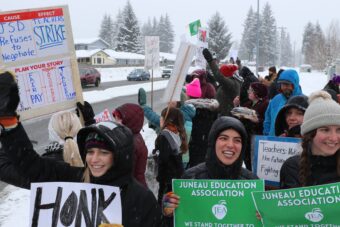
More than 70 educators and community members packed into the Thunder Mountain Middle School library last week during the Juneau School District School Board meeting.

During public testimony, teachers voiced their frustrations about contract negotiations.

“We’re now on the precipice of a true disaster. Dozens of your most experienced educators are waiting to see if they should stay or not,” teacher Amy Lloyd said.

 Auke Bay Elementary teacher Kelley Harvey also spoke.

“It is not fair. It is not right, and you all have the power to solve this,” she said. “If you do not choose to respect your educators, this is what will happen.”

Harvey then stood up and began walking out of the library. A wave of more than 70 teachers silently followed in a mock walkout. 

The teachers’ most recent contract ended at the end of June, but teachers are still working under its terms. The union and the district started negotiations for a new contract in February. Both parties declared an impasse in July and entered mediation, a voluntary process where a neutral third party facilitates discussions between both parties.

The parties had three mediation sessions before the mediator, a federal employee, was furloughed. 

During the government shutdown, the district escalated the negotiation process and announced on its website earlier this month that it was initiating advisory arbitration with the union. During an advisory arbitration, a neutral third party evaluates both parties’ proposals and issues a recommendation on what to do. 

Harvey, who also co-chairs the union’s negotiation support team, said the union was “completely blindsided” by the district’s announcement and that arbitration had not been discussed with the union prior.

Educators exiting Thunder Mountain Middle School after a mock walkout during a Juneau School Board meeting on Nov. 18, 2025. (Photo by Jamie Diep/KTOO)

“We do not feel that we’re at arbitration. We were still working with our mediator. They were furloughed, so we were forced to kind of stop, but we’ve been working,” she said. “We have a proposal.”

Harvey said in her 27 years with the district, she’s never seen the district move forward with arbitration without discussing it with the union.

In response to the district’s unilateral announcement, the union sent a letter saying it had not yet reached the point of arbitration.

In contract negotiations, the main sticking points for the teachers include salaries, health insurance and preparation time for middle school teachers, Harvey said.

The union’s latest proposal, which is for two years, increases salaries by 8% for the first year and 9% for the second year. It also increases the district’s monthly contribution to health insurance premiums by $25 for the first year and by another $271 for the second year.

In contrast, the district’s 1-year offer increases salaries by 3% and only includes a $10 increase to insurance contributions each month. It also cuts down how much time middle school teachers have to prepare lessons by 200 minutes each week.

The union is insured through the Public Employee Health Trust, and Harvey said insurance premiums have increased a lot for teachers, with some on family plans paying $800 more each month compared to last school year.

“Nationally, right, health insurance has gone up exponentially over the years, and contributions just have not kept up with that,” she said.

The district has increased its monthly contribution toward health insurance by $85 since 2016.

Juneau School District Superintendent Frank Hauser said the union’s latest proposal would cost the district about $12 million over the next two years, rather than the $1.84 million for one year with its previous offer. He said the district felt it has reached the right time to move forward with arbitration.

“We have spent almost 100 hours negotiating, and the time has come to schedule an advisory arbitration as required by Alaska statute and we’re ready to move forward again,” he said.

Hauser said arbitration is not a negative step and can help each side articulate what their position is.

“When negotiations is difficult, and it always is when the resources are limited, it frequently takes some kind of external deadline or external accountability,” Hauser said. “Otherwise we’d be negotiating forever to no effect.”

The district and union aren’t required to take the arbitrator’s recommendation, and Harvey, with the union, said it could open the door for the union to strike if they still can’t settle on a contract.  But the union wants to avoid that “at all costs.”

The union and the district are scheduled to meet for another bargaining session Nov. 25.

Juneau School District holds on to $1.05 million in city funds for child care despite ending RALLY program

Steve Whitney sits in front of a partially closed laptop on a wooden table with his face half in view.
Juneau School Board member Steve Whitney listens to public testimony during a meeting at Thunder Mountain Middle School on Nov. 18, 2025. (Photo by Jamie Diep/KTOO)

The Juneau School District Board of Education voted to hold off on returning $1.05 million meant for child care to the city on Tuesday.

The money makes up about two-thirds of the funds left over after the district ended its afterschool and summer child care Relationships and Leadership Learning for Youth program, known as RALLY, last summer. 

Private child care provider Auke Lake Preschool now leases space at three elementary schools to provide care: Harborview Elementary School downtown, Sít’ Eetí Shaanáx – Glacier Valley Elementary School in the Mendenhall Valley and Auke Bay Elementary School.

Board Vice President Elizabeth Siddon said she wants to hold on to the funding in case the district needs to step in to provide afterschool child care again.

“I guess I’m waiting for a sort of an established track record with the Auke Lake Preschool in being successful in delivering good child care in case we have to step in and offer something to our students,” she said.

The board last month discussed ways to use the money for things like bussing students to the new RALLY program, but the district’s Chief Financial Officer Nicole Herbert clarified at Tuesday’s meeting that the bussing comes at no extra cost to the district.

Member Steve Whitney was the sole dissenting vote. He said he supports returning the money to the city to maintain a good relationship. 

“These are dedicated, restricted funds from the city for a service we’re not providing or can’t provide,” he said.

The school board voted 6-1 to table the decision indefinitely. That means the district keeps the funding in the budget for now, but can only use it for child care. Herbert said there is no timeline from the city to return the funds.

Juneau School Board to consider returning $1.05 million in child care funding to the city

A school bus drives away from Juneau-Douglas High School: Yadaa.at Kalé on Aug. 15, 2025. (Photo by Jamie Diep/KTOO)

The Juneau School District Board of Education is considering giving $1.05 million dollars earmarked for child care back to the city at its regular meeting Tuesday.

The money was left over after the district ended its afterschool Relationships and Leadership Learning for Youth program, known as RALLY, last summer. 

Private child care provider Auke Lake Preschool is now running a new program called Auke Lake RALLY, but instead of operating at four neighborhood elementary schools like the district did last school year, it’s at three: Harborview Elementary School downtown, Sít’ Eetí Shaanáx – Glacier Valley Elementary School in the Mendenhall Valley and Auke Bay Elementary School. Sayéik: Gastineau Community School on Douglas Island used to have a program. 

The district is still paying to bus students from schools that don’t have the new RALLY program to schools that do. At the school board’s October meeting, members discussed the possibility of using some of the left over funds to pay for some bus transportation going to the new RALLY sites instead.

The district’s Chief Financial Officer Nicole Herbert said last month she could look into the feasibility of doing that. 

The school board will also decide on its six-year capital improvement plan at Tuesday’s meeting. The proposed plan outlines the deferred maintenance and capital projects the district is prioritizing and requesting funding for over the next six fiscal years. 

The board meets Tuesday at the Thunder Mountain Middle School library. The board will have a work session at 4:30 p.m. to discuss its new strategic plan draft before holding its regular meeting at 6 p.m.

Attendees can sign up to testify in person on a sheet provided by the district before the meeting begins, but anyone can provide public comment when prompted during the meeting.

University of Alaska President Pat Pitney to retire in May

University of Alaska Regent Joey Crum and UA President Pat Pitney listen during a meeting at the University of Alaska Southeast in Juneau on Sept. 4, 2025. (Photo by Jamie Diep/KTOO)

University of Alaska President Pat Pitney will retire this spring. 

Following an Olympic gold medal in air rifle, Pitney began working for the university in 1991 and served in several positions between the system office and the University of Alaska Fairbanks. During that time, Pitney and her then-husband also coached the UAF rifle team. She was also director of the state Office of Budget and Management from 2014 to 2018.

Pitney worked as the state Legislative Finance Director before being appointed as interim president at UA in 2020, following the resignation of Jim Johnsen. She permanently took on the role in 2022, becoming the university’s first permanent female president.

Pitney said she took on the role during a difficult period, thanks to the COVID-19 pandemic and declining state funding.

“There was a lot of uncertainty and a lot of unrest at the university, and just navigating through that to bring the institution back around to enrollment, enrollment growth, and, you know, positive reputation,” she said.

During her time as president, the university increased its enrollment and expanded the UA Scholars Program and Alaska Performance Scholarship.

The university saw enrollment increase by 4% from fall 2022 to fall 2024. Enrollment is projected to keep going up by another 4% this school year.

Pitney said federal uncertainty remains a challenge. According to an update at the UA Board of Regents meeting last week, the federal government has frozen, delayed and terminated close to $25 million in federal grants. That leaves about 95% of the university’s research portfolio intact.

“We’re positioned well and doing well in this environment, and so for the most part, just keeping people focused on what it is that we can do,” she said.

University of Alaska Southeast Chancellor Aparna Palmer was hired during Pitney’s tenure. Palmer says she appreciates Pitney recognizing the importance of all campuses in the university.

“When it comes to UAS, she has been really supportive of our success as an institution, and also really, like, supportive of innovative ideas,” she said.

Palmer said those included UAS’s decision to offer in-state tuition to all undergraduate students starting next year.

The university is contracting with executive search firm WittKieffer to help with finding a new president.

Pitney plans to retire after the May Board of Regents meeting.

Correction: A previous version of this story misidentified UA Board of Regents member Karen Perdue as Pat Pitney in the photo. Regent Joey Crum’s name was also misspelled in the caption and former UA President Jim Johnsen’s name has been corrected. The story has also been updated to reflect that Pitney and her husband are now divorced. 

University of Alaska Board of Regents approves 4% tuition increase for next academic year

The University of Alaska Southeast campus in Juneau on Monday, March. 4, 2024. (Clarise Larson/KTOO)

Listen here:

The University of Alaska will increase tuition for the entire system for a second year in a row, and it’s higher than what its administrators recommended.

The Board of Regents approved increasing tuition across the board by 4% next year during a meeting Friday, despite an initial proposal from administrators of only 3%.

Student Regent Fernando Escobar proposed the additional increase to fund mental health initiatives. He said mental health services have not been funded for five years and suggested higher tuition as another way for the university to meet the need.

“I’m optimistic this legislative session, but I have to be realistic, and I think this may be our best approach for right now in order to support student needs in the system,” he said.

The board is requesting $965,000 in mental health services across the three campuses for the next fiscal year. State funding for the university goes through the Alaska Legislature for approval.

UA President Pat Pitney said the 4% increase is beyond what she considers to be a “modest” increase. She said they recommended the 3% increase as a way to avoid a large increase while factoring in rising costs.

“It also balances that there are anticipated fee increases in housing and dining services as we’re working on our auxiliary enterprises,” she said.

Regent Karen Purdue said she wants to see a way for progress to be made on providing mental health support to students.

“One way to think about this is it could be the students’ skin in the game to go ahead and continue to advocate at the Legislature for some, so some portion of the mental health would, there would be progress made, finally, on this issue,” she said.

Payton Callahan is the chair of the Coalition of Student Leaders, a group that represents students across the university system. She testified that many students already oppose any increase, and that the 4% figure might “blindside” students.

“I don’t know that that aligns with trying to keep retention, because I don’t know that students, frankly, can afford that increase, considering the current economic state,” Callahan said.

Union of Students University of Alaska Anchorage, the student government for the Anchorage campus, passed a resolution last month requesting the board increase the tuition by just 2% instead.

But not every incoming student will see higher tuition next year. Out-of-state undergraduate students at the University of Alaska Southeast will pay in-state tuition for the first time. That’s still a lower rate than what they currently pay.

But UAS Chancellor Aparna Palmer said the additional increase might affect the campus’ ability to recruit Alaskans.

“My sense is that we would still be a great deal in terms of out-of-state students,” she said. “But in terms of in-state students, we may not get that buy-in if we go to 4%”

Regents approved the increase unanimously, with Regent Seth Church absent. The new tuition rates will go into effect next fall.

Site notifications
Update notification options
Subscribe to notifications