Jeremy Hsieh

Local News Reporter, KTOO

I dig into questions about the forces and institutions that shape Juneau, big and small, delightful and outrageous. What stirs you up about how Juneau is built and how the city works?

Joyce Kerttula dies at 91

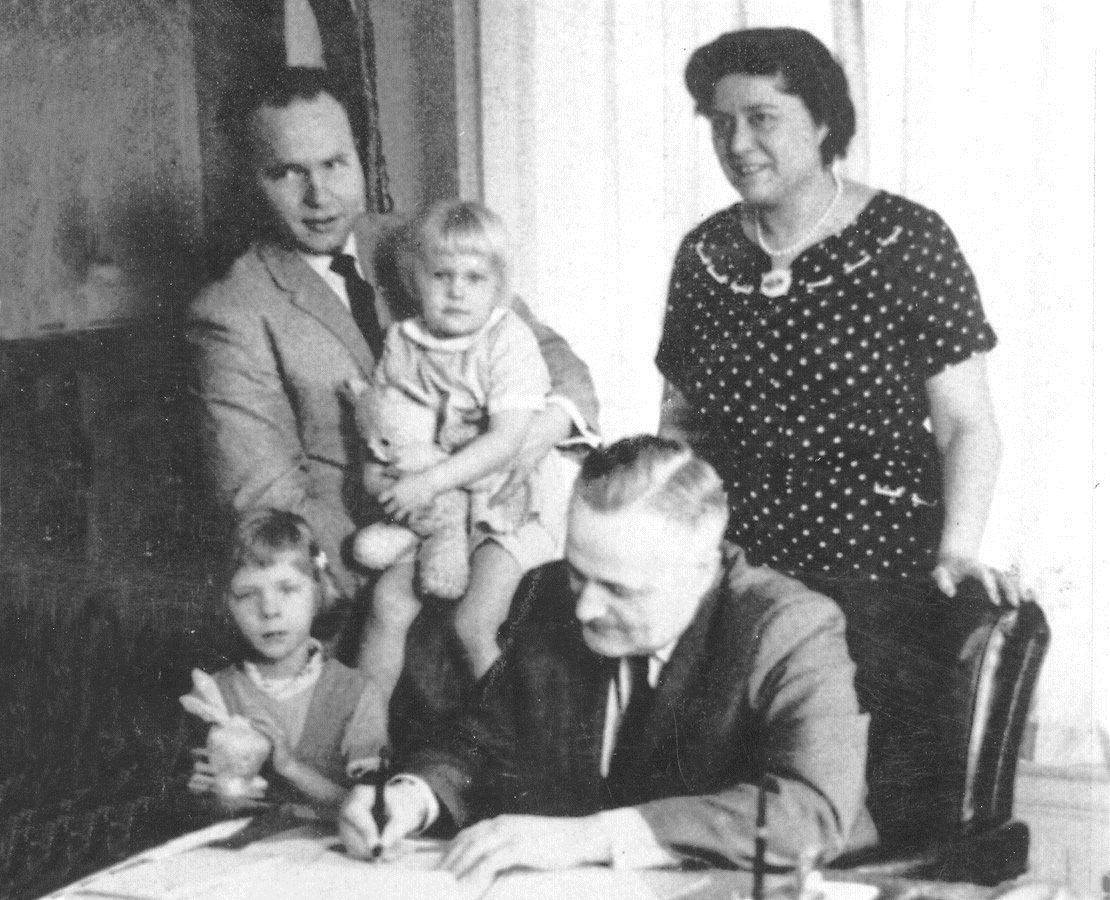
Gov. Bill Egan signs a bill by Rep. Jay Kerttula, holding his daughter Anna, into law. Also pictured, wife  Joyce Kerttula and daughter Beth Kerttula.
Joyce Kerttula stands behind Gov. Bill Egan as he signs a bill by Rep. Jay Kerttula, holding his daughter Anna. Beth Kerttula is standing beside the governor. (Uncredited photo via Alaska House Democrats)

Joyce Kerttula died Monday at age 91 after a long fight with lymphoma, but not before helping two generations of Kerttulas rise to political power in the state.

Beth Kerttula, the girl with the bunny in the photo, likens her mom to a 61st legislator who made Jay Kerttula’s historic rise to power possible.

“My dad’s the only guy to have ever been both speaker and president of the Senate, and I just, I never could figure out how he could have ever done that until I was in and realized, you know, it’s because of my mother. If you have someone working with you who you trust implicitly and who works side by side, and who really is a, frankly a second legislator, you can get a lot done. And that’s what happened. They were a tremendous team,” Kerttula says.

Beth Kerttula represented Juneau in the Alaska House for 15 years.

Joyce Kerttula
Joyce Kerttula in 2013. (Photo courtesy Beth Kerttula)

Jay Kerttula represented Palmer in the Alaska Legislature for 34 years, and Joyce Kerttula worked alongside him as an unpaid volunteer for almost that entire time.

In a 2014 interview, Joyce recalled how her unofficial career in the legislature began with an office visit. His secretary pulled open – then shut – a desk drawer that was full of papers.

“And I said, ‘Would you mind telling me what was in that drawer?’ And she says ‘Oh, that’s letters that I don’t know how to answer and I’ll get to them one of these days.’ And I said would you mind if I looked at one of them?’ And I pulled one out at the bottom and not the top and it was over a month old. And I said this can’t go on.”

Beth Kerttula picks up the story from there.

“And my mom just sat down and started writing, writing letters on one of those old Underwood typewriters. And she just kept going, and that was it,” she says.

Thirty-some years later, she was still at it. Joyce Kerttula handled the legislative offices, the campaigns and constituents. In her obituary, the family calls Joyce Kerttula “the heart and soul” of her husband’s legislative offices.

Originally from Oklahoma, she was born Helen Joyce Campbell in 1923. After finishing college, she left Oklahoma to be a personal assistant to a scientist working on the Manhattan Project in New Mexico, where she witnessed a test detonation of an atomic bomb.

She moved to Alaska in 1954 and taught English at Palmer High School. She met and married Jay in 1955. Joyce Kerttula’s unofficial career in the Alaska Legislature began after he was sworn into office in 1961.

An Alaska memorial service is in the works for the summer. She had been living in Palmer, but was in Palm Springs, Calif., for medical care when she died.

“My mother used to say, you’ve got to live every day. And I, I’m going to try to emulate that a little bit better,” Beth Kerttula says.

Joyce Kerttula is survived by her husband, daughters, a sister, two grandchildren and a large extended family.

Beth Kerttula shared her mom’s full obituary in this Facebook post:


Rosemarie Alexander contributed to this story.

Pot moratorium signals local zoning in October

medical marijuana grow operation
Flowering cannabis plants under green light in an air-conditioned, indoor hydroponic grow operation in Oakland, Calif. (Creative Commons photo by Rusty Blazenhoff)

Aspiring pot entrepreneurs in Juneau can tentatively expect to have local zoning and land use rules that address legal operations in October.

The Juneau Assembly adopted a moratorium Monday that gives city planners and officials until Oct. 19 to get the rules in place.

That’s sooner than the one-year moratorium first proposed, which would have put the deadline in February 2016. That’s about the same time a state agency must begin accepting applications from prospective marijuana businesses.

Giono Barrett, who wants to start a pot farm, told the Assembly that isn’t enough time to be ready to file an application with the state on day one.

“Zoning is a big issue big for us as well, as a farm. We want to know where we can prospectively look into property and know that when we apply with the state we have everything that we need in a row. So it does actually prolong our situation quite a bit when having to wait that long to figure out where the city is at with zoning,” Barrett said.

Assemblyman Jesse Kiehl set the October date by amendment. He picked the date because it was 6 months from the scheduled adjournment of the Alaska Legislature, which is expected establish a regulatory board and tinker with the November initiative that legalized pot in the state.

“We as a city aren’t gonna know what those looks like until the legislature is done on the 19th of April,” Kiehl said. “And I think that gives our Planning Commission and the Assembly a little time, but not a whole lot of time, to come up with a full set of zoning regulations for this activity in our community.”

Barrett was one of eight people to speak up during the public hearing on the ordinance. They were all against the moratorium or said it was too long. No one spoke in favor of it. The critics included a University of Alaska Southeast student, an elementary school teacher, a lawyer, a bartender and a restaurateur.

The end date of the moratorium isn’t necessarily fixed, noted Assemblywoman Karen Crane.

“If this helps the business community in the interim, fine. But we still have the ability to look at that date. We may be able to move it up even further, who knows. But we can look at it after the legislative session again, and if we have to, change it,” Crane siad.

Separately, the Juneau Assembly heard critical public testimony on an ordinance intended to treat secondhand marijuana smoke like secondhand tobacco smoke, essentially banning it from all workplaces.

Again, no one testified in favor of the ordinance. Several people pointed out that it appeared redundant with the initiative, which states pot is illegal to consume in public.

City Attorney Amy Mead noted that “public” wasn’t defined, leaving gray areas, like cabs, tour buses and workplaces as potentially legal places to light up.

The Assembly moved the ordinance back to committee for more work.

Pick. Click. Give. donations up, number of donors taper

pick click give

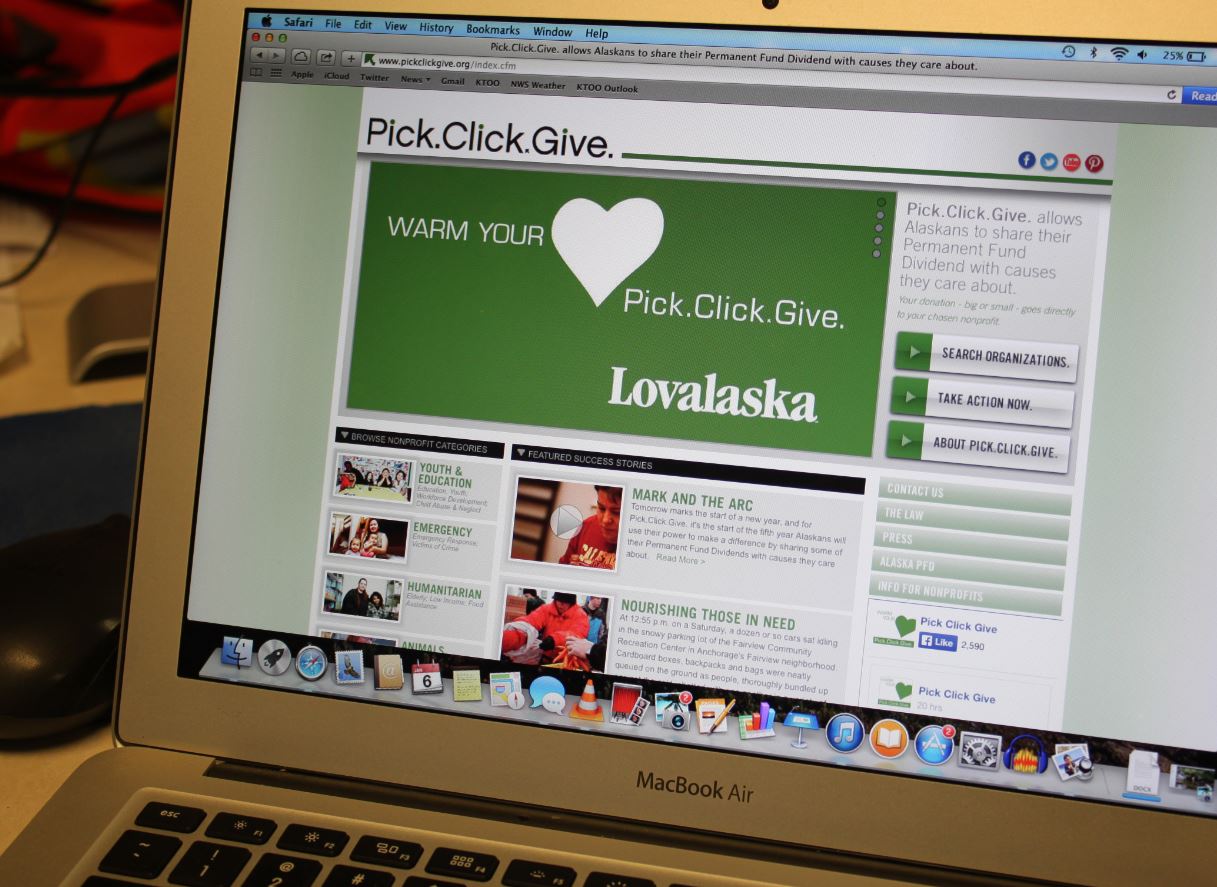
Annual giving in the Pick. Click. Give. program has grown robustly since its 2009 launch, though the total number of donors appears to be tapering off.

This year, program officials have brought back the Double Your Dividend sweepstakes to attract donors, and organizations will be charged a new 7 percent administrative fee.

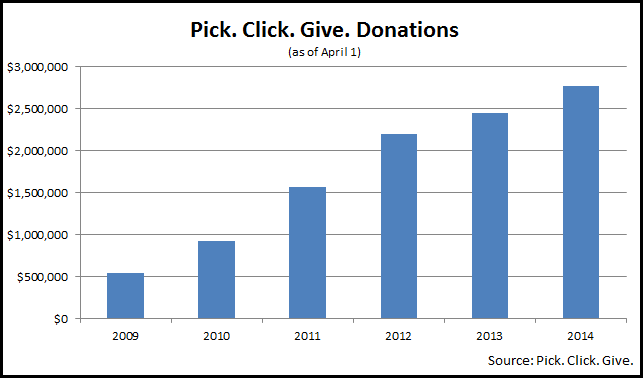
There’s been double-digit percentage growth in the amount given to Alaska nonprofits through Pick. Click. Give. since its launch.

(Graphic by Jeremy Hsieh/KTOO)

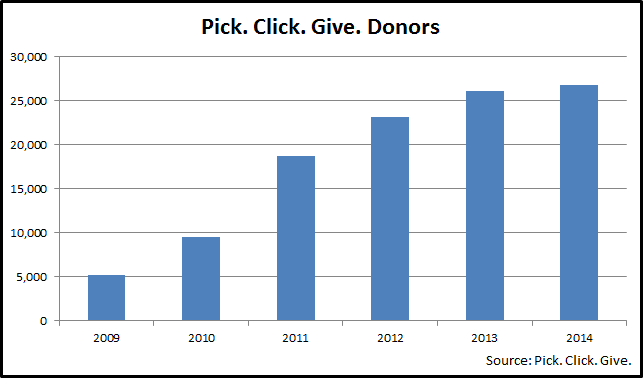
The program makes it easy for Alaskans to give part of their Permanent Fund Dividends to charities. Almost 27,000 people donated about $2.8 million in 2014.

However, the growth in the number of people giving is down.

“So we sometimes wonder if people are thinking back to the dividend that they just received a couple of months earlier,” says Pick. Click. Give. program manager Heather Beaty of the Alaska Community Foundation.

(Graphic by Jeremy Hsieh/KTOO)

The payout in 2013 was about half of last year’s, the third biggest in the history of dividends.

“We have speculated that having a lower PFD amount may have affected the rate of participation,” Beaty says.

Tim Blust is a bookkeeper with Discovery Southeast, a Juneau nonprofit with an outdoor education mission. Last year, he goosed his organization’s books a little with a personal donation through Pick. Click. Give.

In the fall, he got a coy phone message from Beaty.

“My 12-year-old son immediately said, ‘Dad, you must have won.’ And I said, “Won what?”

His son was right. Blust was one of 10 winners of the Double Your Dividend drawing that Pick. Click. Give. donors entered.

The sweepstakes launched last March, the final month of the dividend sign-up period. It was meant to counter low giving caused by technical problems in what’s usually a busy January.

It’s hard to suss out exactly what effect the sweepstakes had.

But, Beaty says, “We did see Pick. Click. Give. participation go up quite a bit while we were promoting the sweepstakes. So we decided to go ahead and implement it again this year hoping that it continues to encourage more Alaskans to make donations through Pick. Click. Give.”

One change this year affecting participating organizations is a new 7 percent administrative fee. The fee is meant to replace temporary grant funding, largely from the Rasmuson Foundation, used to get the program going. Organizations will continue to pay a separate $250 filing fee.

Last year, the legislature unanimously created the new fee while also relaxing some requirements.

The sentiment among several local nonprofit officials was that it’s too bad to lose the revenue, but worth the convenience.

Rasmuson President and CEO Diane Kaplan said in a recent blog post that the new fee is a sign of the program’s sustainability and maturity.

Dividends are expected to grow again in 2015. The value of the dividend is based on a rolling, 5-year average of Permanent Fund investment gains and losses.

Full disclosure: KTOO participates in Pick. Click. Give.

Assembly committee: Scale back senior sales tax exemption

A package of sales tax recommendations that could take a big bite out of the city’s anticipated $7.2 million budget deficit is headed for public hearing.

The Juneau Assembly’s Tax Exemption Review Committee completed its six-month examination of municipal tax breaks Thursday.

The committee recommends:

  • Raising the maximum taxable value of big ticket items from $7,500 to $14,000,
  • Limiting the senior sales tax exemption to Juneau residents,
  • Limiting the senior sales tax exemption to food, fuel and electricity,
  • And limiting the senior sales tax exemption on all other goods to seniors with incomes below 250 percent of the federal poverty level.

The recommendations were made piecemeal. Deputy Mayor Mary Becker chaired the committee and noted the recommendations don’t constrain the Assembly’s policymaking authority.

One proposal the committee did not recommend was raising the age of eligibility for the senior sales tax exemption from 65 to 70 over five years.

“I would certainly not personally agree to that because I think it is a double whammy,” Becker said referring to the combination with the other changes to the senior sales tax exemption. “I think one or the other is fine with me.”

Assemblywoman Kate Troll said she saw it as a double break.

“They get two good benefits. Instead of eliminating the exemption altogether, we’re keeping it on essentials, we’re making it needs based,” Troll said.

Assemblyman Jesse Kiehl argued that people are living longer, healthier and many are choosing to continue working past age 65.

“And so some limited shift to reflect the realities of the world we live in I think is good tax policy, because it keeps, it keeps us in line with the economic realities of our age,” Kiehl said.

 The recommendation, which the Juneau Commission on Aging supported, failed in a 2-2 vote. Assemblyman Jerry Nankervis was the other no vote.

Becker says she expects the Assembly’s Finance Committee to take up the recommendations after the public hearing scheduled for Jan. 8.

Editor’s note: An earlier version of this story referred to a $9.2 million budget deficit. That figure did not reflect $2 million in cuts and new revenue to be carried forward from the current budget year.

Gov. Walker warns of ‘lean times’ at inauguration

Walker oath of office
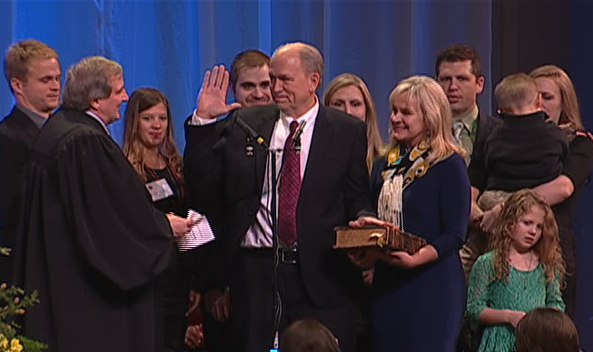
Alaska Supreme Court Justice Daniel Winfree administers the oath of office to Gov. Bill Walker, Dec. 1, 2014. (Video still courtesy Gavel Alaska)

A multicultural celebration that included Alaska Native and Filipino dance groups marked the inauguration of new Alaska Gov. Bill Walker today. About 900 people packed Juneau’s Centennial Hall for the event, where Walker spoke of the need for Alaskans to come together.

In his first speech as governor, Walker recounted his upbringing in Delta Junction and Valdez and how his family survived the 1964 earthquake. He said a good-paying job related to Alaska’s pipeline boom changed his life.

Only about a third of his 14-minute speech focused on policy matters. A key challenge for the new administration will be the budget. The state relies almost entirely on oil and gas for revenue. As prices for those commodities have fallen, so has state income.

“Today, oil was hovering in the $70 range,” Walker said. “We’re heading into some lean times. There is no reason we cannot turn that around. We live in one of the most resource rich states in nation in one of the richest countries in the world.”

Perhaps the biggest applause line came after Walker’s statement about an issue on which he and outgoing Gov. Sean Parnell disagreed.

“I told you that accepting expanded Medicaid was a high priority for me. And we will begin the wheels in motion today to begin accepting expanded Medicaid,” Walker said.

Walker also made this clear promise: “I vow to you that we will have an open and transparent government.”

He cited the recent transition committee process that brought hundreds of diverse Alaskans together as an example. He said it was risky, but “awesome.”

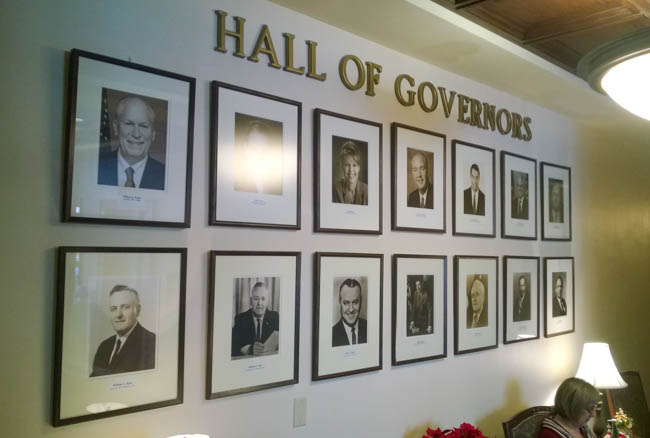
Hall of Governors
Bill Walker’s portrait was added to the Hall of Governors on the third floor of the Capitol building shortly after he was sworn in Dec. 1, 2014. (Photo by Jeremy Hsieh/KTOO)

Shortly after Walker was sworn in, the trappings of the governor’s office in the Capitol building had also transitioned. Walker’s photo was added to the Capitol building’s Hall of Governors, and the receptionist answered the phone, “Good afternoon, Gov. Walker’s office.”

Walker is currently the nation’s only nonpartisan state governor.

Site notifications
Update notification options
Subscribe to notifications