Katie Anastas

Local News Reporter, KTOO

In District 2, incumbent Christine Woll faces challenger David Morris

Juneau Assembly member Christine Woll is running against David Morris for the District 2 seat. (Photo by Katie Anastas/KTOO)

Two Juneau Assembly members are running for reelection this year, each against a single challenger. For the District 2 seat, member Christine Woll faces David Morris.

Woll has served on the Assembly for the last three years. In an interview, she said her highest priority is housing, and she thinks her experience would serve her well in a second term.

“It definitely takes a long time to get up to speed on how the city works, what are the big priorities that we need to be focused on,” she said.

Meanwhile, Morris says he’s running because he sees a need for greater transparency in city government. 

“They have spent a lot of their time behind closed doors and in executive session,” Morris said in an interview.

Woll is an executive transition guide at The Foraker Group, where she helps nonprofits recruit and select their next executives, board members and other leaders. She has a master’s in fisheries from the University of Alaska Fairbanks and a bachelor’s in biology from Bates College in Maine.

While she says the city has already incentivized developers to build higher density housing, she thinks the city could do more to open up its land for development.

“I think our codes and our zoning are really not serving us when it comes to building higher-density housing,” she said. “I know people who want to put a tiny home on their property to rent out, and they can’t right now. We need to clean up our code and our zoning to make sure that we can have a diversity of housing options.”

Morris is a retired swim coach, former Alaska Marine Highway System employee and member of the Family Promise of Juneau’s board of directors. He agrees that Juneau needs more housing. To get there, he said in an interview, he supports areawide candidate Nano Brooks’ idea of raffling off one-acre plots to residents.

“If you built high-end housing here, the people that are in middle housing that are ready to move up would go take those houses,” he said. “And with those vacancies, people that are in low-income housing that are ready to move up would move into those spaces.”

Another of Morris’ top priorities is the landfill. Juneau’s landfill has about 20 years left at its current level of use. Morris thinks using an incinerator again could help.

He said he’s also heard from many voters about property taxes. This year’s mill rate was the lowest it’s been in decades, but because property values also went up, many Juneau residents are paying higher property taxes.

“The thing that hits everybody that I talk to is taxes,” Morris said. “Everybody is really upset about the taxes.”

At a forum co-hosted by KTOO, Woll said she would prioritize basic community needs like building maintenance while also making sure the city has enough revenue to afford them.

“I know people are feeling strapped right now. My monthly house payment went up this year, like most people in Juneau, and that’s not easy,” she said. “The good news is that Juneau’s economy continues to grow, which has allowed us to lower the mill rate, even when personnel and materials go up. Ideally, if other revenue sources grow, we can keep property taxes stable.”

Woll and Morris have different views on the future of Bartlett Regional Hospital, which the city owns. At a forum hosted by the Juneau Chamber of Commerce, candidates discussed turnover among the hospital’s leadership. Woll said supporting the hospital board was important, while Morris said the hospital should be privatized.

But Morris says he’s running to increase transparency in local government. As an example, he says the Assembly’s city manager selection process – through a committee Woll chaired – happened mostly in executive session.

The selection committee reviewed applications and conducted initial interviews in executive session. Finalists met with city leaders during a closed staff meeting, and the Assembly interviewed them in an executive session before picking Engineering and Public Works Director Katie Koester for the role.

Woll has raised more than $6,500, including $1,200 of her own money. Her donors include Sen. Jesse Kiehl, former Assembly member Carole Triem, former Juneau Mayor Bruce Botelho, school board president Deedie Sorensen and Juneau Career Firefighters.

Morris has not reported any campaign fundraising.

Woll and Morris both live in the Mendenhall Valley – a requirement to run for a District 2 seat – but Juneau voters can vote in all races on the ballot. Election Day is Oct. 3.

Correction: A previous version of this story said Christine Woll earned her master’s from the University of Alaska Southeast. She received the degree from University of Alaska Fairbanks.

In District 1, incumbent Alicia Hughes-Skandijs faces attorney Joe Geldhof

Juneau Assembly member Alicia Hughes-Skandijs is running against attorney Joe Geldhof for the District 1 seat. (Photos by Katie Anastas/KTOO)

Juneau Assembly member Alicia Hughes-Skandijs is running for reelection against attorney Joe Geldhof. It’s one of two races on this year’s ballot featuring an incumbent and a single challenger.

Hughes-Skandijs works as a program director for the Alaska Municipal League, a statewide organization of local governments. The Assembly appointed her to fill Sen. Jesse Kiehl’s seat in Jan. 2019, and she served the remaining year of his term. Voters elected her to a full three-year in Oct. 2020.

In an interview, Hughes-Skandijs said housing is her top priority. She’s been glad to see programs like the city’s accessory dwelling unit grants expand.

“We need to continue really aggressive subsidization until we can kind of catch up with the state of the crisis that we’re at,” she said.

When it comes to hazard maps and development restrictions in landslide and avalanche zones, Hughes-Skandijs said it’s important to balance educating residents about risks with ensuring people can still build more housing.

“I think you do have a responsibility to notify people and let people be aware of the fact that they are taking some personal risk by what kind of hazard they’re living near,” she said.

Geldhof is an attorney. He wrote the marine passenger fee initiative that Juneau voters approved in 1999. At a forum hosted by Tlingit and Haida, he spoke about his experience working with the Crow Tribal Court in Montana.

In 2020, Geldhof successfully challenged a state tax credit program for oil and gas companies. That same year, he represented a Juneau man who sought to block the state from sending pandemic relief funding to some small businesses, saying it was unconstitutional to do so without the Legislature’s approval. More recently, Geldhof represented the same Juneau man when he said the state’s management of the Yukon River and Kuskokwim River salmon fisheries was unconstitutional.

In 1995, the Juneau Empire reported that Geldhof, then 44, allegedly struck an 8-year-old girl with a hockey stick and swung it at her 14-year-old brother because he felt they had gotten in the way of his roller hockey game. He did not know the children. 

Geldhof was charged with two felony assault counts, but they were reduced to one charge of misdemeanor assault in the plea bargain.

In 1996, the Juneau Empire reported that Geldhof pleaded no contest to two assault charges – one for the hockey incident and another that was related to disciplining one of his children, according to the Empire. Geldhof was sentenced to 15 days in jail, three years of probation, 200 hours of community service and a $500 fine. He was also ordered to pay for the girl’s hospital costs.

In an interview, Geldhof said he “learned a tremendous amount” and that voters would have to decide whether the events were relevant.

“I deeply regret what I did,” he said. “I went through court-ordered anger management, which I found very useful. It allowed me to put my life together and my family’s life back together, and we’ve had a great deal of success in my personal life and family. At this point, it’s up to the electorate to decide whether my mistakes from 30 years ago are relevant to the contemporary political issues in this election cycle.”

At candidate forums, Geldhof has billed himself as a candidate who will change Juneau’s city government. He’s been endorsed by Save Juneau, a local advocacy group that opposes property tax increases.

“If you want increased taxes, you should keep the people who are in place,” Geldhof said at a forum hosted by the Juneau Chamber of Commerce. “If you want change and relief, you better vote for change.”

Geldhof opposes the $27 million bond proposal to fund a new city hall, saying city leaders should have listened to voters when they rejected a similar ballot measure last year.

“The City and Borough staff and the Assembly have not made a compelling case,” he said in an interview.

Hughes-Skandijs voted to put the bond proposal back on this year’s ballot. She said repairing the existing city hall, which fits fewer than half of city employees, wouldn’t be a good use of public funds.

“It feels like it’s going to be a waste of city money if we remodel rather than building something that’ll serve us for the next bunch of years,” she said.

As of Sept. 5, donors to Hughes-Skandijs include Kiehl, Mayor Beth Weldon, former Mayor Bruce Botelho, Assembly member Michelle Hale and former member Carole Triem. She’s raised more than $4,400 and spent about $900 on yard signs, brochures, stickers and mailing materials. Geldhof has not reported any campaign fundraising or spending.

Hughes-Skandijs and Geldhof both live on Douglas Island and are running for the District 1 seat, but Juneau voters can vote in all races on the ballot. Election Day is Oct. 3.

Why the city is asking Juneau voters to fund a new city hall, again – and why opponents say no

People enter and exit Juneau’s city hall on Friday, Sept. 15, 2023. (Katie Anastas/KTOO)

Fourteen people are running for four Juneau Assembly seats this year. Three are running for two school board seats. But perhaps the most contentious race in Juneau’s Oct. 3 municipal election is between city leaders and skeptics of the need for a new city hall.

The only proposition on the ballot this year asks voters whether or not to fund a new city hall through a $27 million bond. Last year, voters narrowly rejected a $35 million bond proposal for the project. This time around, the city is ramping up messaging about the benefits of a new building.

Supporters of the ballot measure say the city should be spending its money on a building the city owns rather than renting aging facilities and making expensive renovations. Opponents say now isn’t the time to bond for a new city hall — and they say the city should have listened to voters last time.

At a forum co-hosted by KTOO, outgoing City Manager Rorie Watt said building a new city hall was about being “better with the public dollar.”

“We have to do something, and the question is: What’s the best use of our money?” he said. “A new city hall is something we would own together, and we as a community would build equity and own that facility. Continuing to rent means that other people get those profits.”

How much would it cost?

The city’s preferred location for a new city hall is on Whittier Street, next to the Zach Gordon Youth Center and across the street from the state museum.

City leaders say building a new city hall with underground parking would cost $43.3 million, and that it would break even after 32 years. Part of that calculation includes rent the city won’t be paying at other spaces and revenue from the sale of the old city hall building.

The existing city hall isn’t included in property valuation assessments because it’s owned by the city. But similarly sized nearby buildings are worth about $3.5 million, according to Rain Coast Data.

The break-even year depends on the size of the city’s down payment and how much rent for office space is expected to go up each year. A 2022 analysis by Rain Coast Data estimated that a $38.2 million project – the estimate at the time for the Whittier Street project – would break even after 52 years if rent went up 2% per year and 35 years if rent went up 5% per year.

Critics have said that in Alaska’s expensive construction market, it’s hard to guarantee it won’t cost more than $43.3 million to build a new building. The city’s chief architect said in May that when the city used its usual procurement method, some recent bids had been “significantly over the professional estimate” – up to 1.8 times the estimate.

But Watt said the city is proposing a design-build procurement method for a new city hall instead. That means they’d work with a designer and contractor from the beginning to figure out what amenities, building materials and schedule would work at a $43.3 million price.

Chipped paint on the outside of City Hall on Sept. 15, 2023. (Katie Anastas/KTOO)

Would property taxes go up?

Many critics link their opposition to the ballot measure with their frustration over higher property taxes. Both are core issues for several of this year’s Assembly candidates. According to the city, property values increased by 13% this year across the borough.

In June, the city approved a budget with a 10.16 mill rate, the lowest it’s been in decades. Setting it that low required the city to put less money into savings and draw $2 million from reserves for recurring costs. They also put $10 million toward “renovating the current City Hall or building a new City Hall.”

Local advocacy group Save Juneau, which opposes building a new City Hall, wrote on their website that the Assembly put $10 million toward city hall “rather than return those funds to citizens in the form of property tax relief.” Last week, the group endorsed District 1 candidate Joe Geldhof, District 2 candidate David Morris and areawide candidates Nano Brooks and JoAnn Wallace, who all oppose the ballot proposition.

According to the proposition, the mill rate isn’t expected to go up if the bond passes because the city has enough debt capacity. A portion of the mill rate is set aside for debt service. That money goes toward paying off bonds the city has taken on over the years, like the one that paid for the recently completed Centennial Hall renovations.

The city paid off multiple bonds during the last fiscal year. Angie Flick, the city’s finance director, said that will free up space for new debt.

“If the voters approve this item, we could issue a bond and take the place of the debt that’s retiring with new debt,” she said. “We could structure the bond for a new city hall such that it fits within the mill rate, taking into account the debt that we have coming off our books.”

The city would pay back $1.87 million per year, assuming an interest rate of 4.77%.

People walk by Juneau’s City Hall on Friday, Sept. 15, 2023. (Katie Anastas/KTOO)

Where else could city employees work?

Fewer than half of city employees work at city hall. The rest work in four other buildings downtown, in office space the city rents. The city’s lease of two floors in the Municipal Way building ends in June 2028. Another space – the Marine View Building – has frequent plumbing issues.

“We just got notified that they’re going to shut down the water again for a couple of days, so we either have to send everybody home, or get hand sanitizer stations and port-a-potties on the sidewalk,” Watt said at the forum.

Getting out of the Marine View Building could also free up apartments in the building and parking in the garage underneath.

Tracey Ricker, a real estate consultant hired by the Assembly, found that there are no existing commercial properties that could fit all city staff without displacing other tenants. U-Haul now uses the former Walmart building, so that’s no longer an option.

But there is one building that could fit a good portion of city workers: the Michael J. Burns Building – formerly known as the Goldbelt building – which the Alaska Permanent Fund Corporation now owns. There’s 24,000 square feet of office space available for rent there, according to Ricker’s website. Right now, the city rents nearly 34,000 square feet of office space across four buildings.

At the forum, Watt acknowledged renting space in the Michael J. Burns Building could be an option for some of the employees.

“But that would just be delaying the consolidation and delaying the benefits of a centralized workforce,” Watt said. “It would be delaying the benefits of the public being able to go to one place. It would be delaying the benefits of the public eventually saving money by building a new city hall.”

The city would also still have to maintain and renovate the current city hall, which has cracking walls, leaking ceilings and asbestos in the carpet. City leaders say renovating it would be an expensive, disruptive project. 

“City Hall maintenance has been limited, because quite frankly how much good money do you want us to throw at the bad?” asked Assembly member Wade Bryson in an opinion piece in the Juneau Empire. “It is difficult to justify spending $14 million to renovate a building worth $3.5 million that will still only hold a third of the city’s downtown employees.”

Why is it back on the ballot?

Opponents to this year’s ballot measure say city leaders won’t take no for an answer. Juneau resident David Ignell said the $10 million allocation showed the city wasn’t listening.

“You didn’t want this $35 million bond, so we’re not going to take money out of your left pocket, we’re going to take money out of your right pocket,” Ignell said at the KTOO forum.

Watt said he and the Assembly knew some Juneau residents would disagree with their decision to put it back on the ballot.

“But we can’t really stomach the thought of wasting the public’s money,” Watt said.

The city has brought bond proposals back to voters before after they failed. Ballot measures to fund projects like the downtown parking garage, the Treadwell Ice Arena and the Marine Park expansion succeeded after the city changed how they were funded or the scope of the project.

This year, the city is spending $50,000 to advocate for the project. The Alaska Public Offices Commission requires the Assembly to appropriate funds through an ordinance if it wants city staff to share information that could influence the outcome of an election.

In a Juneau Empire opinion piece, former Juneau Mayor Bruce Botelho compared the existing city hall to a family’s old Toyota.

“It’s long since lost its warranty, and the estimate for repairs of the suspension and a transmission rebuild easily exceed the value of the car,” he wrote. “Is it time to look at purchasing a new vehicle? If not now, when?”

Last year, just 246 more people voted against the $35 million bond proposal than for it. In a few weeks, city leaders will find out whether their outreach campaign has changed enough minds.

Juneau Assembly candidates call for collaboration at Tlingit and Haida forum

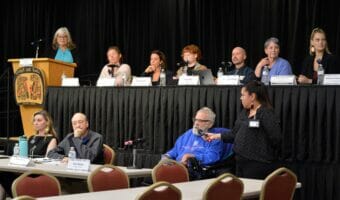
Juneau Assembly candidates attend a forum hosted by the Central Council of the Tlingit and Haida Indian Tribes of Alaska on Friday, Sept. 15, 2023. (Katie Anastas/KTOO)

Juneau Assembly candidates pledged greater collaboration with the Central Council of the Tlingit and Haida Indian Tribes of Alaska at a forum on Friday.

Several candidates pointed to the city’s sale of Pederson Hill property at a discounted rate to the Tlingit Haida Regional Housing Authority as an example.

“In some of the activities you do, there should be cooperative and shared power with the City and Borough, particularly in the areas of delivering housing,” said District 1 candidate Joe Geldhof.

Ten of the 14 Assembly candidates attended the forum in person at Elizabeth Peratrovich Hall, and Geldhof joined on Zoom. Areawide candidates JoAnn Wallace, Emily Mesch and Jeff Jones did not attend.

Areawide candidate Ella Adkison, a Curyung tribal member, noted that Tlingit and Haida is working to address a lot of the same issues as the city. The tribe offers services for elders, child care, Head Start and other education programs.

“I think there’s a lot more room to connect those efforts and work together to maximize these for these shared constituents that we have,” Adkison said.

Areawide candidate Laura Martinson McDonnell said Tlingit and Haida’s job training programs are important for Juneau’s workforce.

“We have a really huge problem with skilled labor shortages,” she said. “If we can provide that kind of training to our own local people here, that’s going to be a huge problem solver for housing and development.”

Areawide candidate Ivan Nance spoke about opportunities for Alaska Native people in Juneau to get involved in city government. He’s a member of the city’s systemic racism review committee, which the Assembly created in 2020.

“We’re looking into how to get more people involved in the committees and the processes that the city has,” Nance said. “How can we reach out and get people from every community involved?”

District 2 incumbent Christine Woll said strengthening the relationship between the two governments is an important part of building trust.

“I think CBJ has done work to improve relations with the Native community here in Juneau, but I think we have a lot of work to do still,” Woll said. “If I’m reelected, my promise is that I’ll have an open door for ideas on how we can be better partners to the tribes, to the corporations, to the other Native organizations and community at large.”

Tlingit and Haida is Alaska’s largest federally recognized tribe. In May, President Richard Chalyee Éesh Peterson announced the tribe would withdraw from the Alaska Federation of Natives, citing the tribe’s ability to manage relationships with the state and federal governments on its own. They’ve received a state-tribal education compacting grant, and have worked to return ownership of traditional lands in the Aak’w Village District.  

Friday’s forum came the day after ballots were mailed to registered voters. Election Day is Oct. 3.

City and Borough of Juneau announces police chief finalists

Then-Police Chief Bryce Johnson discusses crime with Juneau residents at City Hall, Jan. 17, 2017. (Photo by Jeremy Hsieh/KTOO)

The City and Borough of Juneau announced three finalists for the role of police chief on Friday. Members of the public can meet them during town hall events at the end of the month.

Krag Campbell is the only Juneau-based finalist. He’s been a lieutenant with the Juneau Police Department since 2017 and is one the department’s public information officers. He joined the department in 2002, when he moved to Juneau from Ketchikan. He joined the U.S. Army in 1996 but left to work in law enforcement.

Campbell’s town hall meeting will be at 5:30 p.m. on Tuesday, Sept. 26, in the City Hall Assembly Chambers.

Joshua Kingsbury oversees loss prevention at Amazon sites in Albuquerque, N.M. In 2021, he retired as a captain from the Bernalillo County Sheriff’s Office in Albuquerque after working there since 1996. He holds a bachelor’s in political studies with an emphasis on criminal justice from Dordt College in Iowa.

Kingsbury’s town hall meeting will be at 5:30 p.m. on Wednesday, Sept. 27, in Assembly Chambers.

Derek Bos has been police chief for the Eagle Police Department in Eagle, Colorado since December. He was the police chief for the Brush Police Department in Brush, Colorado from 2018 to 2022. He was an officer with the Chaffee County Sheriff’s Office in Chaffee, Colorado from 2006 to 2016. He earned a bachelor’s in criminal justice from Western New Mexico University.

Bos applied to be Petersburg’s police chief in 2018. He was also a candidate for the role in Wrangell in 2019.

Bos’ town hall meeting will be at 5:30 p.m. on Thursday, Sept. 28, in Assembly Chambers.

Ed Mercer retired this summer as Juneau’s police chief after six years on the job. He was Juneau’s first Alaska Native police chief. Deputy Chief David Campbell has served as interim police chief since his retirement.

Site notifications
Update notification options
Subscribe to notifications