Katie Anastas

Local News Reporter, KTOO

Juneau’s cold weather shelter likely will be in a Thane warehouse this winter

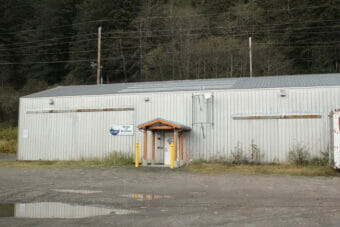
A city-owned warehouse in Thane, part of which is used to process ballots, is the likely location of Juneau’s emergency cold weather shelter this winter. (Katie Anastas/KTOO)

City leaders say Juneau’s emergency cold weather shelter will likely be operated by St. Vincent de Paul at a city-owned warehouse in Thane, about a mile from downtown. 

Resurrection Lutheran Church ran the shelter for the last two years at its church in the Flats neighborhood downtown. But this summer, that congregation voted twice not to run it again. No other providers applied because they didn’t have suitable space.

In a third vote on Sunday, the congregation finally approved the shelter — by one vote. But Deputy City Manager Robert Barr said he’d already been working on an alternative with St. Vincent de Paul.

“Since Resurrection Lutheran has voted this down twice, and it was obviously a super narrow vote this Sunday, I have been working closely with St. Vincent’s on a backup plan,” he said.

Barr said city leaders are moving forward with the Thane plan — a decision that Resurrection Lutheran Pastor Karen Perkins said was “baffling” to her. She said the warehouse’s location would make it harder for people to access services there. 

“I was surprised, frustrated, disappointed and hurt,” she said. “And concerned, because at the end of the day, what matters is how well does it address the problem.”

Perkins said the warehouse is better than an idling city bus, which Barr had floated as a “last-ditch option.” But now that her congregation has voted in favor, Perkins thinks the city should take them up on their offer. She said there’s still enough time to get the church ready, and that it’s a better, more welcoming location than the warehouse.

“Of course, if that’s the way things go, we’ll do whatever we can to help,” Perkins said. “But I hope somebody changes their mind because this is a bad idea.”

Transportation

The warehouse is a mile away from the downtown library. It’s surrounded by industrial buildings and parking lots. Perkins worries that the distance from the downtown core will prevent many patrons from going there, especially if they try to get to the shelter by foot.

“That road, because of the way the road goes, gets a lot of wind. The sidewalks are narrow and are going to be covered with berms once there’s snow,” she said. “Walking there is going to be dangerous.” 

Barr said the location does make transportation more complicated. It’s one of the reasons the city initially ruled out the warehouse. But he said St. Vincent de Paul, the Glory Hall, police and the fire department’s CARES program could help get people to the warehouse.

But Perkins worries that people who usually use the warming shelter – many of whom experience chronic sleep deprivation – may have trouble knowing how to access that transportation. She said that’s especially true if people are experiencing homelessness for the first time.

“I think there’s an illusion that everybody is going to access the services where you’re providing them,” she said.

Barr said the location could address some of the concerns residents had when Resurrection Lutheran ran the shelter during the last two winters. Some congregants and neighbors worried about vandalism and loitering at the church, which is in a neighborhood and near Harborview Elementary School.

“Thane has some advantages to it,” Barr said. “Most notable among them being that it is not in a residential neighborhood, not close to a school.”

But Perkins said people have become familiar with services offered at the church. They also run a food pantry there each week. She said having the warming shelter in a neighborhood can provide consistency for the people who use it. 

“It’s not detrimental to communities, the way a lot of times people assume it is,” she said. “Having it away from communities doesn’t support better outcomes for the patrons.”

Resurrection Lutheran Church, photographed on Oct. 9, 2023. (Katie Anastas/KTOO)

Part of a provider network

Dave Ringle, executive director of Juneau’s St. Vincent de Paul chapter, was still drafting a potential contract on Wednesday morning. But in an interview, he said they plan to keep the shelter open from 9 p.m. to 7 a.m. A city bus would pick people up in the morning and take them to the Glory Hall or other locations.

Ringle said his organization has strong relationships with other homeless service providers in Juneau – relationships that can help connect warming shelter patrons with more stable housing.

“I would expect, if we started to have over 40 to 50 people, we would meet with service providers, look at the numbers, and identify what are the options within our other service providers where some of these people would go,” he said. 

St. Vincent de Paul, the Glory Hall and AWARE have community navigators who help connect people to housing, medical care and other social services.

“I think that’s going to make a big difference,” Ringle said. “The goal would be to have us all work together to keep the shelter numbers down.”

St. Vincent de Paul has affordable apartments, transitional housing and supportive housing throughout the borough. Some of that housing is just for seniors, who make up a growing portion of their clientele, Ringle said.

Staffing and capacity

Ringle said he plans to ask the city for flexibility on weather requirements that prompt the shelter to open. The shelter is required to open when temperatures are expected to dip below 32 degrees, but Ringle said he’d like the option to stay open when it’s slightly warmer, too.

“We will submit a budget to the city as if we need to open every day,” he said. 

Ringle expects that budget to be between $240,000 and $250,000. That would fund at least three staff members. Resurrection Lutheran leaders had said they would ask for about $290,000 to run the shelter, plus a usage fee to cover repairs and maintenance. They planned to have three staff members available and a full-time manager.

Ringle said they also had three staff members when St. Vincent de Paul ran the warming shelter at the armory from 2020 to 2021. The space became unavailable once the Juneau Arts and Humanities Council started using it again.

“If there is an emergency, having three people is the safest way for staff to handle that,” Ringle said. “We received excellent compliments from Juneau police and Capital City Fire and Rescue about that, and we’re going to hope that we can build on those relationships we established when we were running it before.”

Barr said they plan to serve 35 to 50 people a night at the warming shelter. But Ringle said the warehouse has enough space to accommodate more, if needed.

“Another advantage of having a very large space would be it might allow our guests more space and eliminate some of the conflict and confrontations that might come up when you have everyone crowded into a smaller area,” Ringle said.

The warehouse has heating, insulation and electricity. Part of it is used to process ballots, and the rest is used for storage. The city will have to remove items it stores there and add bathrooms, which would be port-a-potties. Barr said he hopes to have that done by the end of October.

The city provides cots for the warming shelter. Ringle said St. Vincent de Paul will provide food at night and in the morning. As the opening date gets closer, Ringle said they’ll likely accept donations of blankets, hats and coats.

The Juneau Assembly still has to approve the use of the warehouse for the shelter. The Assembly’s next meeting is Oct. 23.

Newscast – Tuesday, Oct. 10, 2023

In this newscast:

  • The Presbyterian Church acknowledges the closure of Rev. Walter Soboleff’s church and begins reparations in Juneau
  • Alaska Native students in Anchorage celebrate Indigenous People’s Day with dance performances and Native Youth Olympics events
  • Bethel organizations put on a day of activities for the holiday

Presbyterian leaders apologize, begin reparations for 1962 closure of Juneau church led by Rev. Walter Soboleff

Students from the Tlingit Culture, Language and Literacy program sing and dance at Elizabeth Peratrovich Hall on Oct. 9, 2023. The event, held on Indigenous Peoples’ Day, was part of a series of ceremonies acknowledging the closure of the Memorial Presbyterian Church, which for decades served a primarily Alaska Native congregation in Juneau. (Katie Anastas/KTOO)

Dozens of kids streamed into Elizabeth Peratrovich Hall on Indigenous Peoples Day, singing in Lingít. Most wore red and black regalia dotted with mother of pearl buttons. One wore a fringed Chilkat robe with yellow, black and blue formline designs.

“Because of the advocacy of our ancestors, of our elders, of our leaders and of our people, these things are becoming more common, finally,” said La quen náay Liz Medicine Crow, president and CEO of First Alaskans Institute.

The performance opened the final ceremony in a weekend of events meant to acknowledge the 1962 closure of Memorial Presbyterian Church, which for decades served a primarily Alaska Native congregation in Juneau and became a vital part of Juneau’s Alaska Native community.

Last summer, national, regional and local Presbyterian Church leaders committed to paying nearly $1 million in reparations. This weekend, they began to fulfill that commitment by donating nearly $105,000 to Sealaska Heritage Institute and the Central Council of the Tlingit and Haida Indian Tribes of Alaska.

A thriving church closed

On Sunday, church leaders delivered a long-awaited apology at Ḵunéix̱ Hídi Northern Light United Church, just a few blocks away from where Memorial Presbyterian Church once stood.

Rev. Walter Soboleff was the church’s pastor. Beginning in 1940, he led a mostly Alaska Native congregation, preaching in both Lingít and English. But in 1962, citing a new policy to end segregated churches, the Presbyterian church closed Soboleff’s church and loaned money to a non-Native congregation to build a new one.

Rev. Bronwen Boswell leads the U.S. denomination of the Presbyterian Church. On Sunday, she said the racist closure had followed “decades of Memorial Presbyterian Church’s thriving ministry and Dr. Soboleff’s unmatched record of transformative service.”

“The Presbyterian Church USA apologizes for the act of spiritual abuse committed by the Presbyterian Church’s decision of closure, which was sadly aligned with nationwide racism toward Alaska Natives, Indigenous nations, Native Americans and other people of color,” Boswell said.

Students from the Tlingit Culture, Language and Literacy program sing and dance at Elizabeth Peratrovich Hall on Oct. 9, 2023. The event, held on Indigenous Peoples’ Day, was part of a series of ceremonies acknowledging the closure of the Memorial Presbyterian Church, which for decades served a primarily Alaska Native congregation in Juneau. (Katie Anastas/KTOO)

House of healing

Sunday’s apology came after years of advocacy. In the 1990s, a group of Alaska Native church members started discussing Memorial Presbyterian Church’s closure and possible reparations.  

In 2021, the church’s Native Ministries Committee wrote an overture outlining the actions and monetary contributions that could make up an apology for the closure. 

Some have already happened. For example, the church has been renamed Ḵunéix̱ Hídi Northern Light United Church. Ḵunéix̱ Hídi means “people’s house of healing” in Lingít. They’ve also committed to funding scholarship programs, incorporating Lingít language into church services, and adding Alaska Native art and architecture to the building.

Freda Westman, a member of the Native Ministries Committee, said those efforts will offer the next generation a chance to celebrate their culture within the church.

“What I’m excited about is bringing in younger people and children with the language, with the cultural practices and seeing how those can be woven together,” she said in an interview.

Tlingit and Haida President Chalyee Éesh Richard Peterson accepts a donation from Ḵunéix̱ Hídi Northern Light United Church council member Jim Alter on Oct. 9, 2023. (Katie Anastas/KTOO)

‘This is the beginning’

At Monday’s event, national church leaders gave $100,000 to Sealaska Heritage Institute to support language revitalization efforts. Church council member Jim Alter also presented Tlingit and Haida President Chalyee Éesh Richard Peterson with a check for more than $4,400 for the Tribe’s cultural programs.
Future reparations payments will fund cultural opportunities for Alaska Native youth, support Tlingit and Haida’s reentry programs for people returning from incarceration, and pay for educational materials about the closure at Ḵunéix̱ Hídi Northern Light United Church.

In an interview, Peterson said it’s important to acknowledge the role churches have played in colonization and language loss throughout Alaska.

“This is the United States Presbytery taking accountability for one instance,” he said. “I hope that the churches really do step up and take their role in the healing, as they took their role in the damage.”

Medicine Crow said this weekend’s events offer a framework for “other entities and institutions who were complicit in the efforts to eradicate the Native people of this place.”

“What happens here is going to shape, impact and give more foundation to all the other apologies that are due,” she said. “This is the beginning. We are setting a table together.”

A new sign outside the Juneau Fire Hall on Glacier Avenue commemorates Rev. Walter Soboleff’s leadership of Memorial Presbyterian Church before its closure. (Katie Anastas/KTOO)

This weekend’s events also included the unveiling of a sign at the site of Soboleff’s church, now occupied by the Juneau Fire Hall. It describes the church’s closure and the Presbyterian Church’s commitment to reparations. 

The sign also says Ḵunéix̱ Hídi Northern Light United Church “hopes to create a more fitting memorial at this place” in the future.

In preliminary results, votes against new city hall hold narrow lead

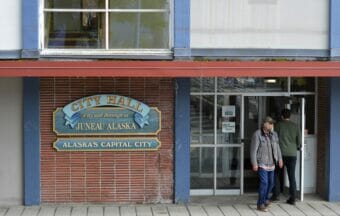
People enter and exit Juneau’s city hall on Friday, Sept. 15, 2023. (Katie Anastas/KTOO)

The outcome of the $27 million bond proposal for a new city hall is unclear after Juneau election officials shared preliminary results early Wednesday morning.

According to the results, 2,582 people had voted no and 2,470 people had voted yes. But there are likely thousands more votes left to count — the first batch of results only includes ballots received before Election Day. 

City leaders say building a new city hall with underground parking would cost $43.3 million. The preferred location is on Whittier Street, next to the Zach Gordon Youth Center.

Last year, voters narrowly rejected a $35 million bond proposal for the project – just 246 more people voted no than yes. This year’s city budget put $10 million more toward the project, which allowed for a smaller bond.

The city also spent $50,000 to advocate for the project. Rorie Watt, who just left the role of city manager, said taxpayer money would be better spent on a new city hall than on maintenance at the current building and rent at four others.

Still, voters like Kara Johnson opposed the bond. At the downtown polling place on Tuesday, Johnson said she agrees that Juneau’s municipal buildings need work, but she was frustrated with the city’s approach.

“They were shot down once, and they basically turned around and said, ‘We’re just going to put it back to the voters,’” Johnson said. “I’d like to see a little more restructuring on their financial planning.”

Others, like Catherine Wilkins, supported the bond.

“I am very much in favor of the new city hall,” Wilkins said. “Even though I don’t think it’s going to pass, I wanted to be sure to register my vote in favor.”

Voter Sylvia Madaras said she was torn.

“I see the benefit of the long-term financial investment of making a building that is not falling apart,” she said. “Also, I understand we don’t have a lot of funds right now. Everybody’s asking for money, and we’ve got a lot of projects that we’re working on.”

Election officials will post updated results as they process the remaining ballots  until the election is certified on Oct. 17.

Incumbent Assembly members hold leads in contested Juneau municipal election

Odin Brunie drops off his ballot at City Hall on Oct. 3, 2023. (Anna Canny/KTOO)

Preliminary results in Juneau’s municipal election show incumbents on the Assembly holding healthy leads and a few of the 10 candidates in the areawide race separating themselves from the pack. 

The race for two Juneau School Board seats does not appear to be close, with David Noon and Britteny Cioni-Haywood each getting nearly twice as many votes as Paige Sipniewski.

But the ballot measure to fund a new city hall was much closer, with votes against the bond measure leading by just 112 votes.

Voters may not know the races’ outcomes for up to two weeks. Tonight’s tally only includes ballots sent in or dropped off before Election Day, and there are likely thousands more left to count. 

Officials had counted 5,198 ballots by Wednesday morning, and 27,767 people are registered to vote in Juneau. Voters cast 9,137 ballots in Juneau’s 2022 municipal election.

Election officials will post updated results a few times until they’re certified on Oct. 17.

‘Democracy only works when people have choices’

At the Mendenhall Valley Public Library on Tuesday morning, election workers set up booths as voters trickled in. Some were there to vote in person. Others swapped completed ballots for “I voted” stickers. 

Last year, five incumbents ran unopposed for reelection to the Juneau Assembly and school board. This time, 14 people ran for four Assembly seats, and three people ran for two school board seats.

Voter Sylvia Madaras said she hadn’t seen this many candidates in a Juneau municipal election before. 

“I thought it was a sign that civic engagement was really high,” Madaras said.

Areawide Assembly candidate Dorene Lorenz waves a campaign sign on Oct. 3, 2023. (Katie Anastas/KTOO)

Bill Oatman stopped by the library to drop off his ballot. He had filled out his ballot on Tuesday morning, and he was happy to see new names.

“I don’t consider politics a career thing,” he said. “So I like to see new people come in.”

Deputy Municipal Clerk Andi Hirsch said having so many candidates is better for an election.

“I love when there’s a contested race, or all races are contested,” she said. “I really think that helps drive conversation and turnout, because democracy only works when people have choices.”

Hirsch said Tuesday morning that turnout seemed to be about the same as last year, which was also the state’s first-ever ranked choice general election

Two school board candidates hold large leads

Three candidates vied for two seats on the Juneau School Board. Preliminary votes showed David Noon and Britteny Cioni-Haywood leading. Noon had 3,216 votes, Cioni-Haywood had 2,993, and Paige Sipniewski trailed with 1,646. 

Each of the top two vote-getters will serve a three-year term.

Incumbent Assembly members lead in Districts 1 and 2

Assembly members Alicia Hughes-Skandijs and Christine Woll ran for reelection against one opponent each. 

As of Wednesday morning, Hughes-Skandijs led challenger Joe Geldhof by 839 votes in the race for District 1 assembly seat. In the District 2 race, Woll led David Morris by 1,391 votes. 

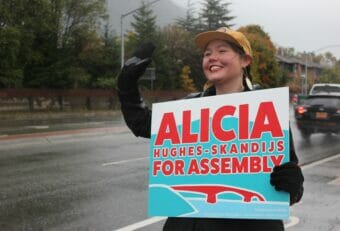
Hughes-Skandijs has been on the Assembly since 2019. On Tuesday morning, she stood by the Juneau-Douglas Bridge holding her campaign sign in one hand and Woll’s in the other. 

She said voters told her the number of candidates pushed them to do their research.

“There’s been a lot more doing the step-by-step homework of, ‘I better go back and watch that forum,’” Hughes-Skandijs said. “My biggest hope today is that turnout is decent.”

Juneau Assembly member Alicia Hughes-Skandijs waves to drivers on Oct. 3, 2023. Hughes-Skandijs is running for the District 1 seat. (Katie Anastas/KTOO)

Woll said this election felt different than her last one for a few reasons. For one, her last election was in 2020, so she couldn’t do the door knocking and in-person events she did this year.

Another difference was how often cruise ship tourism came up in her conversations with voters.

“Everyone wants to talk about cruise ships,” Woll said. “I was amazed at how consistently people across the political spectrum wanted to talk about how to manage tourism better.”

She said new Assembly members should talk to as many city staff and community members as possible about different topics.

“You’re not going to get another opportunity to be like, ‘Hey, I’m new, I don’t really know exactly what’s going on, tell me everything that you think,’” she said. “I had a few of those conversations when I started, and they were so valuable.”

In areawide race, early results winnow down large field

Ten people ran for two areawide Assembly seats. Preliminary results show Paul Kelly and Ella Adkison leading with 1,946 and 1,698 votes, respectively. 

Close behind were Nathaniel “Nano” Brooks (1,489 votes), JoAnn Wallace (1,340 votes) and Laura Martinson McDonnell (1,316 votes).

The five remaining candidates got fewer than 500 votes each.

Areawide Assembly candidate Paul Kelly waves to drivers on Oct. 3, 2023. (Katie Anastas/KTOO)

Kelly turned out to wave signs at the Juneau-Douglas bridge on Tuesday morning, too. He was on the Juneau school board from 2018 to 2021 and ran for the District 1 Assembly seat in 2021. He said this year, voters were eager to talk about city hall, tourism, homelessness and other issues.

“I think there was a lot more engagement,” he said. “There were a lot more people who I had the chance to listen to, and a lot more people who wanted to listen to what I had to say.”

Areawide Assembly candidate Ella Adkison holds a campaign sign on Oct. 3, 2023. (Katie Anastas/KTOO)

On the same street corner, Adkison waved to drivers. She said the many forums held this year helped the candidates build relationships with each other.

“Because there’s two seats, it’s been really great getting to know all the candidates, because if I win, I’m going to serve with one of them,” Adkison said. “In a sense, it makes the race more challenging, but I’m so happy to see the community buying in and being ready to serve.”

Across the street, Martinson McDonnell said she hopes this level of engagement continues after the election. She said voters talked to her about property taxes and the cost of living in Juneau. Others brought up topics like public safety and the graveyards on Douglas.

“I’ve learned so much about things that I had no idea were on people’s minds,” she said. “There’s a few really good things about election season, and one of them is that everybody gets to talk. Community priorities start coming up to the surface in a different way.”

KTOO’s Anna Canny and Yvonne Krumrey contributed reporting.

10 candidates vie for 2 areawide seats on the Juneau Assembly

Paul Kelly, Ella Adkison, Nano Brooks, Laura Martinson McDonnell, Jeff Jones, Dorene Lorenz, Michele Stuart-Morgan, Emily Mesch, Ivan Nance and JoAnn Wallace are running for two areawide seats on the Juneau Assembly. (Katie Anastas/KTOO)

In last year’s municipal election, three Juneau Assembly members ran unopposed for reelection. This year, ten candidates are running for two areawide seats.

The areawide candidate who gets the most votes will serve a three-year term, and the one with the second-most votes will serve the remaining two years of former member Carole Triem’s term

As Election Day approaches, the candidates have been sharing their views on the city hall ballot measure, the economy and transparency in city government.

Split views on new city hall

The areawide candidates are split on whether to build a new city hall. Six are in favor of the ballot measure — which asks voters to fund a new city hall with a $27 million bond — and four oppose it.

Paul Kelly started campaigning early. He had a booth at the Maritime Festival in early May, and he says he’s knocked on more than 1,400 doors this summer. He said concerns about the measure came up early in his conversations with voters.

“So I went and toured the current city hall,” Kelly said. “I have pictures of bags hanging from the roof to contain leaks, carpet that is in disrepair — and it can’t be repaired because there would need to be asbestos remediation, which would have both financial and workflow consequences to the city.”

Kelly is an analyst and programmer for the Alaska Department of Education and Early Development who served on the Juneau school board from 2018 to 2021. 

While he had misgivings about the Assembly’s process — which included putting more money toward the project before this year’s vote — he thinks a new city hall is in taxpayers’ best interest.

Ella Adkison, a staffer for Juneau Sen. Jesse Kiehl, also supports the city hall ballot measure. 

“We have city employees in places that aren’t ideal for them to work and are taking up potential housing spaces for our community,” she said. “We either need to invest a lot of money in a city hall that’s old and really not working for us, or we spend that money on a better city hall that will be there forever and suit Juneauites’ needs.”

Laura Martinson McDonnell, Emily Mesch, Ivan Nance and Michele Stuart-Morgan also support it. 

Other candidates oppose the bond proposal, including JoAnn Wallace, Jeff Jones, Nano Brooks and Dorene Lorenz.

“I feel like no should be no for now,” said Wallace, a realtor who’s concerned about the high cost of living in Juneau. “We’re going to have a lot of commercial space opening up in our town in the next year or two that could also be good options.”

Jones is an account executive for a construction company. He’s also on the executive board of the Plumbers & Pipefitters Union. In an interview, he said the city should prioritize funding other construction projects instead of a new city hall.

“We know what kind of shape the school district and the hospital are in,” he said. “They need to be fixed before we build a new city hall.”

Brooks, an HVAC and plumbing technician and small business owner, agrees that there are other projects the city could focus on instead. If a new city hall does get built, he said in an interview, keeping up with repairs will be important.

“I’m not a fan of any position where the city is losing money, but before any new building goes up, we need to address the processes and systems that got the current facility into $15 million in deferred maintenance,” he said.

Local advocacy group Save Juneau — which opposes the city hall bond and property tax increases — endorsed Wallace and Brooks for the areawide race.

Juneau Assembly candidates Laura Martinson McDonnell and Nano Brooks at a forum hosted by the Central Council of the Tlingit and Haida Indian Tribes of Alaska on Friday, Sept. 15, 2023. (Katie Anastas/KTOO)

Support for education and economy

Martinson McDonnell, a small business owner and president-elect of the Juneau Chamber of Commerce, is focusing on the local economy. In an interview, Martinson McDonnell said she would bring a new perspective to the Assembly.

“I’m a small business owner, and I’ve been born and raised in Juneau. I’ve got a small child here,” she said. “I think it’s important to mix up the perspectives and bring a little bit of a different view on board.”

Kelly and Adkison say child care availability and a strong education system can foster a strong economy by attracting business owners and employees. The Alaska Department of Education and Early Development has challenged some of the city’s financial support of the school district.

“We’ve had some attacks on our ability to fund our education system by the current administration, and it’s really important that we educate our kids,” Adkison said. “People aren’t going to start up new businesses in a place that doesn’t have a good education system.”

Lorenz, a communications consultant, said growing the local workforce could help reduce the burden of tourism on residents.

“We need more excursions, but we can’t have more excursions unless we have people to work to make those excursions go,” she said.

Housing a top concern for some

As city leaders expand subsidies for residents wanting to build accessory dwelling units, consider regulating short-term rentals and search for someone to run the emergency cold weather shelter this winter, housing is a top concern for several candidates.

In interviews and at forums, Brooks has said the city could raffle off one-acre plots to generate revenue and get more land in the hands of residents who might want to build their own homes.

Michele Stuart-Morgan, a medical assistant who started Juneau Stop Heroin Start Talking, said homeowners, landlords and tenants are all dealing with higher costs.

“I own a home and I also own a rental, and I know on both sides of that that our taxes have gone up,” she said in an interview. “I know what it costs to maintain a rental – the utilities and all those things. I also have my two sons who don’t own a home yet, and I see their struggles.”

Emily Mesch, president of Southeast Alaska LGBTQ+ Alliance, said building more housing could help address staff shortages for Juneau employers. She’s worked for the state, the city and the Shéiyi X̱aat Hít Youth Shelter.

“We have, across the board, staffing issues, both within the city and in private industry,” Mesch said. “We need to have more, better-trained people living in Juneau in our workforce.”

Calls for transparency and efficiency

Some candidates say they would work to make the Assembly more transparent and efficient.

“I think a lot of discussion that should be going on in public isn’t,” Lorenz said in an interview. “If you don’t have faith and confidence in the process, you’re not going to have faith and confidence in your government.”

Lorenz is a member of the city’s Historic Resources Advisory Committee and a former member of the Seward City Council. 

In 2018, Alaska Public Media reported that the state stopped funding a nonprofit Lorenz chaired because of “reporting issues and accountability issues.” The nonprofit, Friends of the Jesse Lee Home, had plans to restore the former children’s home where Benny Benson designed the state flag and turn it into a residential charter school. The City of Seward used the remaining $1 million of the nonprofit’s state funding to demolish the building in 2021.

In an interview, Lorenz said Gov. Bill Walker’s administration questioned expenses that had already been approved by officials from prior administrations. She said the group’s federal funding required the school to be up and running as soon as construction was complete, and that many of the expenses state officials questioned had been part of developing the curriculum.

Juneau Assembly candidate Dorene Lorenz at a forum hosted by the Central Council of the Tlingit and Haida Indian Tribes of Alaska on Friday, Sept. 15, 2023. (Katie Anastas/KTOO)

Ivan Nance is a retired member of the U.S. Coast Guard and was mayor of Prairie City, Oregon, from 1998 to 2000. In an interview, he said he wants to make the Assembly “as productive and efficient city government as it can be.” 

Nance is on the city’s Systemic Racism Review Committee. At a forum hosted by Tlingit and Haida, he spoke about opportunities for Alaska Native people to get involved in Juneau’s city government.

In 1996, Nance pleaded no contest to a misdemeanor assault charge. In an interview, he said it was a mistake that happened a long time ago.

Who is contributing to their campaigns?

City leaders, labor unions, business owners and other Juneau residents have donated to several of the areawide candidates. 

Martinson McDonnell has raised more money than any municipal candidate this year. She’s reported raising more than $41,000 and spent more than $33,000. Several local business owners have donated to her, along with Mayor Beth Weldon, Bartlett Regional Hospital Board President Kenny Solomon-Gross, Huna Totem President and CEO Russell Dick and Goldbelt President and CEO McHugh Pierre. 

Pierre has also donated to Save Juneau. Save Juneau has reported raising more than $13,000 and spending more than $8,000 on radio ads, yard signs and mailers.

Kelly has reported raising more than $18,000 and spending more than $17,000. Donors include school board president Deedie Sorensen, Juneau Economic Development Council Executive Director and former school board member Brian Holst, Juneau Rep. Sara Hannan and Sen. Jesse Kiehl, Anchorage Sen. Forrest Dunbar and former Anchorage Rep. Les Gara.

Adkison has raised more than $15,000 and spent nearly $13,000. Her donors include Kiehl, Assembly member Greg Smith, AWARE Executive Director Saralyn Tabachnick and several fellow legislative aides.

Lorenz has raised more than $11,000 and spent more than $9,000. Donors include Acting Commissioner of the Alaska Department of Labor and Workforce Development Cathy Muñoz, Juneau Hydropower CEO Keith Comstock and Irene Gallion, a senior planner for the city.

Wallace has raised more than $5,000. Her donors include Mayor Beth Weldon, local business owners and Maria Uchytil, executive director of the Bartlett Regional Hospital Foundation.

Jones has reported raising $1,000 from the Juneau Central Labor Council and the Plumbers and Pipefitters union.

Unions have also donated to Martinson McDonnell, Kelly and Lorenz.

The Juneau Pro-Choice Coalition reported $100 donations to Adkison, Kelly, Martinson McDonnell, Mesch, Nance and Stuart-Morgan.

Municipal candidates only have to disclose campaign finances through the Alaska Public Offices Commission if they intend to raise or spend more than $5,000. Brooks, Mesch, Nance and Stuart-Morgan have not reported any campaign fundraising or spending. 

Election Day is Oct. 3.

Site notifications
Update notification options
Subscribe to notifications