Katie Anastas

Local News Reporter, KTOO
Teal Street Center gathers many of Juneau’s social services under one roof

Juneau residents can now access a range of social services in one building.

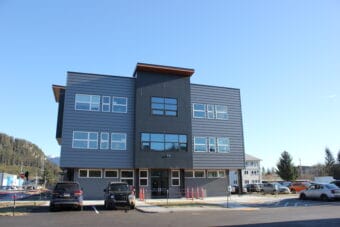
The Teal Street Center, located in the Mendenhall Valley near the airport, has been in the works for years. Construction began in 2021, and tenants moved in this spring. 

At a presentation hosted by the Juneau Chamber of Commerce on Thursday, United Human Services Executive Director Joan O’Keefe said the goal is to make services more accessible to the people who need them.

“Nonprofits that are in the building now were scattered all over town,” she said. “It was a barrier for folks who needed multiple services.”

United Human Services owns the building. They rent office space to Southeast Alaska Independent Living, Alaska Legal Services, AWARE, Disability Law Center of Alaska, Juneau Suicide Prevention Coalition and the National Alliance on Mental Illness.

O’Keefe said having all of them in one building is helping providers refer clients to each other more efficiently. If Southeast Alaska Independent Living staff want to refer someone to Alaska Legal Services, O’Keefe said, it’s as easy as walking down to the second floor.

It’s also helping providers financially. Rent is below market rate for the nonprofit tenants. The tenants share common spaces like reception areas, conference rooms and bathrooms. They also share costs for things like janitorial services and snow removal.

“They can worry about providing services and fulfilling their mission versus having higher overhead,” O’Keefe said.

The Teal Street Center sits between the Glory Hall, an emergency shelter and soup kitchen, and Smith Hall, a subsidized apartment building for seniors. St. Vincent de Paul has housing units on the other side of Smith Hall. SEARHC’s mobile clinic van stops by several times a week to provide medical and behavioral health services.

Dave Ringle, executive director of Juneau’s St. Vincent de Paul chapter, said the center is benefiting organizations outside the building, too. He said St. Vincent de Paul’s clients often need support from groups like the Disability Law Center.

“It’s a lot easier to walk across the street than it is to drive across town, and it saves our agency quite a bit,” Ringle said.

Funding for the $10.3 million project came from a mix of federal funding, city funding, grants and private donations. Sara Chapell manages fundraising for the center, and she said they have about $100,000 left to raise. That will pay for finishing touches like landscaping and signage.

“We’re thankfully approaching the finish line,” Chapell said.

Chapell said the center plans to have a grand opening in spring. In the meantime, offices are open and ready to help meet clients’ needs. 

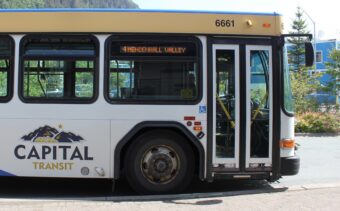
And as of this week, clients can take a city bus there. Capital Transit resumed service to the Teal Street Center on Monday.


Juneau Assembly approves 9% increase to docks and harbors fees

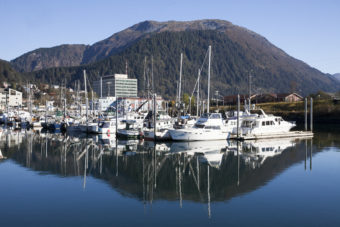
Boats lined up in Harris Harbor on a sunny, clear day Wednesday, Oct. 12, 2016 in downtown Juneau, Alaska. (Photo by Rashah McChesney/Alaska’s Energy Desk)
Boats lined up in Harris Harbor on a sunny, clear day Wednesday, Oct. 12, 2016 in downtown Juneau, Alaska. (Rashah McChesney/Alaska’s Energy Desk)

The Juneau Assembly has approved a 9% increase to all docks and harbors fees, starting in January.

Carl Uchytil, Juneau’s port director, told the Assembly on Monday that the increase will allow the Docks and Harbors Board to maintain facilities and put more money into savings.

“We have about a quarter billion dollars in infrastructure, and we only have about $3.7 million in savings, in our fund balance,” Uchytil said.

Uchytil said savings are important in grant applications, which often ask applicants to commit some of their own funding. For example, he said, the board has applied to add a drive-down float at Aurora Harbor with help from federal funding, which would require $500,000 in match money.

Docks, which serve cruise ships, and harbors, which serve fishing and recreational boats, have separate finances and personnel. For the most part, both docks and harbors have brought in more revenue than they’ve spent during the last several years. The only exception was during the pandemic, when COVID led to a loss in revenue for the docks.

Four members of the public spoke against the proposal, saying harbor users shouldn’t bear the burden of revenue loss from the cruise industry. 

“I do support raising the docks fees paid by tourism and foreign cruise ship lines. They take too much from Juneau, and they need to start giving back more,” said Shane Kraus, a live-aboard. “I am here to speak out against raising the harbors rates that affect local boaters and locally owned businesses.”

Assembly member Alicia Hughes-Skandijs said she was unsure how to vote.

“It’s the harbor fee increases that I’m struggling with,” she said. “If they’re firmly in the black, to do a 9% increase for the purpose of building up capital funds, there’s part of me that would rather them come to the Assembly when they need capital funds.”

But member Michelle Hale said that would mean spending more taxpayer money on infrastructure used by a small number of Juneau residents.

“Everybody that doesn’t have a boat or doesn’t happen to live in the harbor is then paying that money for harbor improvements,” she said. 

Assembly member Wade Bryson, the Assembly’s liaison to the Docks and Harbors Board, said “there is no easy way” to increase revenue right now.

“I don’t think we’ve talked about raising a single price tag in any city function that hasn’t been met with opposition,” Bryson said.

In 2021, the Docks and Harbors Board considered doubling monthly fees for live-aboards but never sent it to the Assembly for approval. After hiring a consultant to conduct a rate study, the board agreed on a 9% increase on all fees for all customers. 

“The board thought that that was the fairest way to proceed,” Uchytil told the Assembly.

The increase will apply to launch fees, resident surcharges, grid usage fees, port maintenance fees and others. Nearly all of them will go up by 9% in January. Monthly moorage fees, which vary depending on the size of a boat, will go up 3% each year for the next three years.

The rate increase passed in a 5-4 vote. Members Bryson, Alicia Hughes-Skandijs, Michelle Hale, ‘Wáahlaal Gíidaak and Mayor Beth Weldon voted yes, and members Greg Smith, Christine Woll, Paul Kelly and Ella Adkison voted no.

Mourning the death of Black Moon Koven, Juneau’s witchiest brunch spot

Aims Villanueva-Alf at her restaurant, Black Moon Koven, in Juneau. (Yvonne Krumrey/KTOO)

Three years ago, Aims Villanueva-Alf was out for a run in downtown Juneau when she saw a small restaurant space for rent on Seward Street. 

Its walls were painted what Villanueva-Alf called “bumblebee yellow,” but she could already envision what would eventually become Black Moon Koven: a dark but cozy nook adorned with taxidermy and skulls, with coffins and three-eyed cats painted on black walls.

“When somebody is walking past the window, they don’t know what’s going to happen. They don’t know if you’re going to get a curse, they don’t know if you’re going to get some hexing,” she said. “I wanted them to be curious enough to risk it — and then maybe get a banh mi.”

Black Moon Koven opened in April 2021, offering sweet and savory waffles for breakfast and sandwiches and noodles for lunch. On the northern end of the block between Second and Third Streets, it was just outside of the tourist-centric core of downtown. Locals stopped by year-round.

Last week, it closed. Starting next month, Villanueva-Alf will train to become a death and grief doula.

“When I think about grief in general, it’s not even those who have passed,” she said. It can also include “grieving a friendship or closing a restaurant.”

Before Black Moon, Villanueva-Alf spent five years running GonZo, a restaurant in Auke Bay. It was a “loud and all-over and adventurous” place that took up all of her time, Villanueva-Alf said.

The outside of Black Moon Koven. (Lyndsey Brollini/KTOO)

She closed GonZo in 2020 after she was assaulted there

“I’d never had a trauma like that happen,” she said. “I had lots of friends who’ve had restaurants and had people that have violated them, but not in this way, and so it felt very lonely.”

Villanueva-Alf went into what she called a “cocooning phase.” She signed a lease for the new space downtown. She invited friends to paint ghosts and coffins on the walls. She collected taxidermy. She said she was inspired by the Latin phrase “memento mori,” which means “remember you must die.”

“How many times have we had to shed certain skins, and how many times have we had to build on these skins that we can’t shed because we’re too scared?” she said

The first thing she cooked in her new kitchen was bone broth, honing her recipe to make the flavors even deeper. Black Moon Koven offered bone broth seasoned with ginger, garlic, scallions and cilantro meant to be sipped. It was also the base of their noodle bowls.

Much of the menu was vegan or vegetarian. Villanueva-Alf had been disappointed by much of the vegetarian and vegan food she’d tried in the Pacific Northwest. A tour of restaurant kitchens in Ojai, California, showed her it could be done differently.

Store managers Sam Martinez (left) and Clark Bolaños (right) with Aims Villanueva-Alf (center) outside Black Moon Koven. (Photo courtesy of Aims Villanueva-Alf)

“You can eat nutritious food without having to be like, ‘Where’s the flavor?’” she said.

Customers could also sign up for food subscriptions to fit their dietary preferences and pick up their orders at Black Moon. Villanueva-Alf said she’s continuing the food subscription program after the closure.

Like any restaurant in downtown Juneau, inflation drove up the price of everything from eggs to takeout containers. Villanueva-Alf juggled orders from local suppliers like Juneau Greens and shipments arriving on Alaska Airlines. Parking downtown was a challenge for customers and staff alike.

But unlike GonZo, Black Moon Koven wasn’t all-consuming for Villanueva-Alf. She started studying yoga, sound healing and spiritual psychology around the time she opened Black Moon. A question from one of her instructors led her to her next move: becoming a death doula.

“It was, ‘If you could be something for yourself when you were a child, what would you be? What would you need? And can you bring that out right now?’” she said. “And I was thinking about how badly I would have wanted somebody to explain grief to me.”

At age 9, Villanueva-Alf experienced the unexpected death of a loved one. The shock of the loss was followed by confusion about how to process it. 

Now, she wants to help people at the end of their lives – and their loved ones – experience death and grief in a healthy way. Like birth doulas, death doulas do that by providing emotional and spiritual, rather than medical, support. 

“I want to give people life recipes on how to suffer well,” she said.

For now, she’s grieving the closure of Black Moon Koven. She’d spent the last few days gifting decorations to friends and her staff of seven. Pretty soon, it would be time to paint the black walls white.

Unlike GonZo, Black Moon is closing on Villanueva-Alf’s own terms, out of excitement for the future rather than ties to the past.

With new hires on board, Capital Transit restores service to suspended Juneau bus routes

A Capital Transit bus bound for the Mendenhall Valley parks at the downtown transit center. (Katie Anastas/KTOO)

Juneau residents can once again take a Capital Transit bus to the airport, University of Alaska Southeast and social service providers on Teal Street on weekdays.

Capital Transit suspended the routes in Dec. 2022 because of a driver shortage. Now, both routes are running on weekdays and at peak hours only, pausing service in the late morning and early afternoon.

Capital Transit Superintendent Rich Ross said driver recruitment picked up over the summer, when the city switched to an online application system. Last winter, they were short eight or nine drivers. Since then, they’ve hired five drivers. They also hired another maintenance worker.

“We have a fleet of 18 buses, and I’d say on average this summer, probably five of them were broken down at a time,” Ross said.

Hiring the maintenance staffer brought that down to two or three, Ross said. Capital Transit is still looking to hire a mechanic and a service technician.

The city resumed service on routes 5 and 6 on Monday. Route 5, the University Connector, runs from the Valley Transit Center to Auke Bay and UAS. Route 6, the Riverside/Airport Connector, has stops at the airport, Nugget Mall and Teal Street.

Additionally, routes 1 and 4 will start earlier in the morning. Route 1 serves downtown and Douglas, and route 4 serves the Mendenhall Valley. 

“Every time we add in earlier service, we get more people riding than we had initially expected, so it seems like there was some unmet demand there,” said Matthew Carpenter, Capital Transit’s lead operator.

The earlier service on route 4 will allow people to get to Bartlett Regional Hospital before 7 a.m.  The first route 4 bus will leave the Valley Transit Center at 6 a.m. and get to the hospital by 6:45 a.m., according to the new schedule.

“We had gotten feedback that there were people trying to get to the hospital early in the morning before 7 a.m. for some shifts that start there early in the morning,” Ross said.

Updated schedules are on Capital Transit’s website.

Free flu shots available at Juneau public health clinic on Saturday

Elaine Hickey, a public health nurse, asks a man screening questions during Juneau’s COVID-19 vaccine clinic at Centennial Hall on Friday, Jan. 15, 2021, in Juneau, Alaska. (Photo by Rashah McChesney/KTOO)

Juneau residents can get free flu shots at a clinic on Saturday.

The clinic will be held at the Juneau Public Health Center from 10 a.m. to 2 p.m. Anyone aged 9 and older can get the flu vaccine at the clinic. Juneau residents can make appointments online. Walk-ins will not be accepted.

Doctors recommend getting the flu shot by the end of October. Last year’s flu season started earlier than usual, and rates were especially high in Southeast Alaska.
Flu shots are recommended for anyone 6 months and older, but health officials say they’re especially important for older adults, young children and people with chronic health conditions. 

It’s safe – and recommended – to get a flu shot during pregnancy.

The latest COVID-19 vaccine is also available at pharmacies and other healthcare providers. Like the flu shot, the COVID vaccine gets updated as the virus changes over time. The Center for Disease Control and Prevention recommends the newest vaccine for anyone who hasn’t gotten a COVID shot in the past two months.

The City and Borough of Juneau tracks how much of the virus is in the wastewater. Data from both the Juneau-Douglas treatment plant and the Mendenhall Valley plant show that amount is relatively low right now. 

But Chad Gubala, the city’s utilities production and treatment manager, said that could change in the winter months.

“The numbers for both Mendenhall and JD right now are pretty similar to what they were this time last year in October, and then as we got into the holiday season and colder weather, the incidence of COVID increased quite a bit,” he said.

RSV vaccines are also available. This is the first year infants can get the RSV vaccine, which greatly reduces the risk of hospitalization. There’s also an RSV vaccine now recommended during pregnancy. Last year, Bartlett Regional Hospital saw both children and adults hospitalized with RSV.

Public health officials originally announced the clinic would be at Dzantik’i Heeni Middle School. Reservations that were made for the middle school will be honored at the new location.

Bartlett Regional Hospital appoints new chief financial officer

Bartlett Regional Hospital, photographed on Aug. 2, 2023. (Katie Anastas/KTOO)

A former chief financial officer for Bartlett Regional Hospital will return to the role next month.

The hospital announced Thursday that Joe Wanner, who previously worked as Bartlett’s CFO and controller, will start Nov. 15. 

Incoming CFO Joe Wanner. (Photo courtesy of Bartlett Regional Hospital.)

“I am excited to return to Juneau and Bartlett,” Wanner said in a statement. “There are so many remarkable people that make this organization great. I look forward to working with the team to help ensure exceptional care to the residents and visitors of Southeast Alaska.”

Most recently, Wanner has been the CFO and chief operating officer at Wallowa County Health Care District in Enterprise, Oregon. That organization includes a 25-bed hospital, four clinics and a senior living center.

Wanner has moved back and forth between Juneau and Oregon jobs since 2011, when he became Bartlett’s controller. He then served as Wallowa’s CFO from 2013 to 2017, went back to Bartlett for a year as CFO, then returned to the Oregon job.

Wanner replaces Sam Muse, who resigned in August after a year on the job for personal reasons. Former hospital CEO David Keith also retired this summer. 

Their announcements came immediately after board member and doctor Lindy Jones said staffing and management problems were leading to inadequate care of behavioral health patients.

In August, the hospital’s board appointed Nathan Rumsey as acting CEO. Rumsey had been the hospital’s executive director of business development and strategy. 

Then, in late September, the board selected Ian Worden as the interim CEO. Bartlett spokesperson Erin Hardin said Worden is set to start as CEO on Oct. 30.

Site notifications
Update notification options
Subscribe to notifications