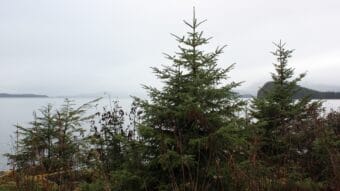
Evergreen trees on North Douglas on Nov. 7, 2023. Juneau households can harvest Christmas trees in designated areas from Thanksgiving to Dec. 31. (Katie Anastas/KTOO)
Juneau residents can now cut down Christmas trees in designated areas as early as Thanksgiving.
“We’re part of Christmas creep,” Assembly member Alicia Hughes-Skandijs joked at a Lands, Housing and Economic Development Committee meeting on Monday.
The city lets each household remove one live evergreen tree per year from certain areas of municipal land. But in previous years, people had to wait until Dec. 1.
“There’s a handful of families that include it as part of their Thanksgiving tradition, so we made that update,” said Dan Bleidorn, the city’s lands and resources manager.
Trees must be harvested at least 50 feet away from hiking trails in areas designated on the city’s wood-cutting map. Those areas are near Fritz Cove and False Outer Point on North Douglas and near Bridget Cove and Sunshine Cove, between mile markers 33 and 38 on Glacier Highway.
Juneau households can begin harvesting evergreen trees in designated areas starting on Thanksgiving through Dec. 31. One of the areas is on North Douglas near Fish Creek. (Katie Anastas/KTOO)
According to the policy, Christmas trees must be cut at ground level. Residents can also harvest trees for firewood in the same designated areas. Unlike Christmas trees, those trees need to be dead or down.
The last day to harvest a Christmas tree in the city’s wood cutting areas is Dec. 31.
The U.S. Forest Service also allows each Juneau household to harvest one tree per year – at any time of year – from some Tongass National Forest land without a permit. Trees can’t be taken from developed Forest Service sites, which includes Auke Village, Lena Beach and all of the Mendenhall Glacier Recreation Area.
According to the Forest Service, trees should be no larger than seven inches in diameter at the stump. They ask that trees be cut within 12 inches of the ground, and as close to the ground as possible.
For both municipal and Forest Service land, trees shouldn’t be taken from muskeg areas because it can take a long time for them to grow back.
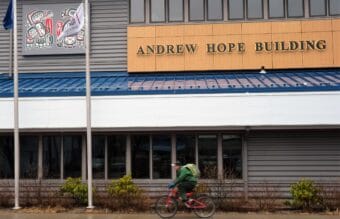
The Andrew Hope Building in downtown Juneau is the headquarters of the Central Council of Tlingit and Haida Indian Tribes of Alaska. (Photo by Ed Schoenfeld/CoastAlaska)
Alaska’s largest federally recognized tribe is opening a new office in Lynnwood, Washington.
More than 8,200 tribal citizens live in the Washington area, according to the Central Council of the Tlingit and Haida Indian Tribes of Alaska. President Chalyee Éesh Richard Peterson said it’s the tribe’s latest step in establishing a presence in all of its communities.
“I’ve always said we’re going to meet our citizens where they’re at, so it’s kind of that promise kept,” he said.
The office’s 20 staff will provide tribal court services, enrollment, case management in child welfare cases and other services. The new office also has a large classroom where Tlingit and Haida’s education staff can host language, arts and cultural programs.
Lynnwood is just north of Seattle, and the regional transit system plans to open a light rail station there next year. Peterson said having a centralized space will help build community among tribal citizens who live in Washington.
“In an area like Seattle, you could go about your daily life and never look across and see somebody who looks like you, who has your background,” he said. “You’re going to be able to go in and feel like you’re home.”
Tlingit and Haida recognizes 21 communities in and outside of Alaska as community council chapters. Delegates from those chapters make up the governing body during annual Tribal Assembly meetings.
Last month, the tribe announced new relief programs for its citizens in Anchorage and Washington using American Rescue Plan Act funds.
The tribe has been pursuing other revenue sources, too. They bought the Alaska Seafood Company in June and the Driftwood Lodge in March.
“We’re working for our own economic sovereignty,” Peterson said. “We’ve started enterprises so that we can build our own unrestricted revenue and serve our people how we want – not dictated by anybody else – which I think is true sovereignty.”
Tlingit and Haida staff based in Washington had already worked for the tribe remotely. Peterson said the pandemic showed remote work was possible, both in and outside of Juneau.
“It’s really opened up the hiring pool for us,” he said. “For the first time ever, we’re hiring tribal citizens and creating opportunities for people who live outside of the service area.”
In February 2022, Anchorage became the site of the tribe’s first office outside of Southeast Alaska. A second Anchorage office opened earlier this year. Peterson said he’s seen the difference having a presence there can make.
“Just driving in downtown Anchorage, and you see a Tlingit and Haida sign, your head kind of spins around. We’ve had people walk in right off the street and they’re saying, ‘Hey, I’m Tlingit. Hey, I’m Haida. What’s this?’” he said. “I’ve had people literally tear up, they’re so excited about having those connections and opportunities.”
Peterson said the Washington office is a success worth celebrating.
“I just think this is a really important time in our history for Tlingit and Haida,” he said. “We’re kind of changing what people think of as the rules or how we do things.”
Staff moved into the new Lynnwood office this week, and the tribe is planning a grand opening on Nov. 8.
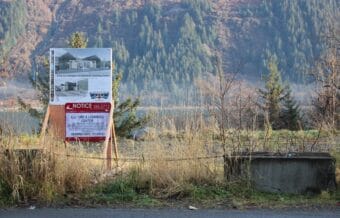
The Douglas Indian Association is requesting a conditional use permit for up to 4,000 square feet for the building and up to 1,000 square feet of covered outdoor space. The lot is about 13,500 square feet. (Katie Anastas/KTOO)
The Douglas Indian Association hopes to build a new learning center in South Douglas. The Juneau Planning Commission will consider permitting the project later this month.
According to information submitted by NorthWind Architects, the proposed facility is a single story building with a basement. It would include a classroom and a teaching kitchen. The Douglas Indian Association owns the proposed building site at the end of St. Ann’s Avenue near the Treadwell Mine Trail.
Kamal Lindoff, the Douglas Indian Association’s property management and transportation director, said classes would focus on Lingít language learning and food sovereignty.
“It’s going to be on a small scale – probably no more than 20 students,” he said.
The location is also culturally significant, he said. It overlooks Sandy Beach, the site of the former Douglas Indian Village, and Mayflower Island, a traditional subsistence site.
“It’s a pretty historical and important site for the Douglas Indian Association,” Lindhoff said.
The lot is about 13,500 square feet. Its zoning allows for an educational facility with a conditional use permit. The Douglas Indian Association is requesting a permit for up to 4,000 square feet for the building and up to 1,000 square feet of covered outdoor space. The planning commission will review the request on Nov. 14.
A drawing by NorthWind Architects shows a possible design with a small parking lot in front of the building. (Drawing by NorthWind Architects submitted to Juneau’s planning commission)
One major question is how to provide parking for the new facility. Because of the proposed size of the building, the architects are likely required to put in at least six parking spaces.
One option is to put angled parking spots along the front of the lot. Drivers would back out of those spots directly onto St. Ann’s Avenue. That design would allow for nine spaces.
“The DIA would consider posting some of these spaces as shared for public use, thereby expanding public access capacity at the trailhead at no cost to the City,” the architects wrote.
Another option is to put a small parking lot on site. “Due to challenges in site development and subsequent cost,” the architects wrote, the Douglas Indian Association is requesting a waiver to reduce the required parking from six spots to five.
Lindoff said he’s heard concerns about increased traffic or difficulty parking in the area. But he emphasized that the building wouldn’t be big enough to host large events.
“I can understand people’s concern, but I don’t think we’re going to be pushing that limit to where it’s going to be a problem,” he said.
The site where the Douglas Indian Association hopes to build the learning center is near an entrance to the Treadwell Mine Trail. The city has a small parking lot there. (Katie Anastas/KTOO)
If the planning commission approves the conditional use permit for the overall project, their next step is to approve or reject the angled parking spot proposal. If they reject it, they’d consider the five-spot parking waiver instead. If both parking plans are denied, the planning process ends unless the Douglas Indian Association appeals.
Lindoff said he expects construction would take two to three years.
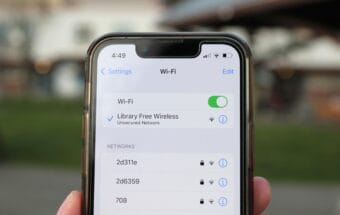
The Juneau Public Library provides free wi-fi in Marine Park during the tourist season. (Photo by Katie Anastas/KTOO)
On the busiest summer days in downtown Juneau, it’s easy to notice the crowded sidewalks, packed city buses and longer waits at restaurants. In recent years, residents and visitors alike have struggled with another sign of the season: slower cell service.
“On a low ship day, it works just fine,” said Chris Murray, the City and Borough of Juneau’s IT director. “But when you have more people, it’s congested and nobody’s happy.”
Tourism Manager Alexandra Pierce said complaints have increased since the 2022 tourist season, which saw more than 1 million cruise ship passengers in Juneau for the first time in three years.
“Since the industry returned last year, we’ve had a fairly large volume of questions and complaints about whether or not the cruise ships are contributing to this issue,” she said. “And they absolutely are.”
Now, in an effort to free up space on cell service networks, city officials are considering expanding public Wi-Fi service in the busiest parts of downtown during the tourist season.
“The cellular networks only have a certain amount of capacity,” Murray said. “If we can slice off a chunk of passengers onto public Wi-Fi, that frees up space on the cell networks.”
Wi-Fi reduces physical and virtual congestion
City leaders have used public Wi-Fi to reduce physical congestion at the Juneau Public Library.
Before the library added Wi-Fi to Marine Park in 2018, tourists and crew members would often go to the downtown branch to use the internet. City officials reported more than 100 people used the Wi-Fi there on any given summer day, taking up the armchairs and spots at the desks.
“It was creating some congestion issues for them,” Pierce said.
Yellow signs in the library and near the elevator advertise the free Wi-Fi in Marine Park, which is available from 7 a.m. to 9 p.m. during the tourist season. While Wi-Fi connections in the library last up to one hour, those in Marine Park last up to 24 hours.
“I think it’s taken the pressure off the library to some extent,” Pierce said. “Especially when the weather is nice.”
Along with reducing physical crowding in the library, the Marine Park Wi-Fi helps reduce congestion in Juneau’s cell phone networks. When visitors use that Wi-Fi, they’re freeing up space in networks run by cell service providers like AT&T and GCI. Those networks can slow down when there’s a big influx of visitors.
“If you’re in Marine Park and you’re on Wi-Fi, then you’re using the city’s Wi-Fi and you’re kind of not part of the problem,” Pierce said. “All your iMessages and WhatsApp and your Instagram story about Juneau is all happening over Wi-Fi, as opposed to over the 4G or 5G network.”
Expanding the city’s seasonal Wi-Fi would give more visitors a chance to get off the 4G and 5G networks and free up capacity for locals trying to use their phones.
A sign on the bulletin board near the elevator to the library advertises wi-fi in Marine Park. (Katie Anastas/KTOO)
What it takes to expand
The city’s IT department is gauging internet providers’ interest in installing and managing Wi-Fi in a three-square-mile area downtown. The city has put out a request for information, which gives providers a chance to ask questions about the potential project and helps city leaders get a sense of costs and technical requirements.
According to the request, the new Wi-Fi would only run during the daytime from April to September, and work on the project likely wouldn’t start until at least July 2024. Providers can respond to the city’s request until Nov. 8.
Murray said that the three-mile stretch would start at the whale statue and go south along the waterfront.
“We would have to connect various access points all the way from the whale statue south, which means bouncing it off light poles and putting in a lot of infrastructure,” he said.
The millimeter wave wireless backhaul on top of the Marine Park pavilion connects a wireless hotspot to the internet. (Katie Anastas/KTOO)
Murray said the request for information will help determine whether that’s even feasible, given factors like the heights of buildings and distances between light poles.
Murray said many of the light poles along that stretch are owned by Alaska Electric Light & Power. Nearby buildings are owned by the state, the city and private owners. A provider would have to work with all of them to make the new Wi-Fi happen.
“We’re really looking for a vendor that has experience working with multiple entities in a tight location,” he said.
If city leaders decide to pursue the project, Murray said the next step is to identify a funding source. After that, the city could issue a request for proposals and contract with a provider.
That source could be marine passenger fees. The Juneau Assembly and Cruise Lines International Association Alaska would have to approve spending those fees on the project.
Marine passenger fees pay for the Wi-Fi in Marine Park, which is provided by local company SnowCloud Services. The city spent $7,800 to set it up, and it costs about $1,900 per season to run it.
Internet providers have set up temporary Wi-Fi hot spots before. In May 2020, Alaska Communications set up public Wi-Fi hot spots at school parking lots in Anchorage and Fairbanks to help students access the internet when schools went remote.
Other communities provide public Wi-Fi year-round. In Seattle, the city offers free public Wi-Fi at public libraries and several community centers. And throughout Hawaii, state-designated hot spots offer an hour of free Wi-Fi service per device each day.
If Juneau’s project moves forward, it could be the latest way the city adapts to record-breaking visitor numbers during tourism season.
Close
Update notification options
Subscribe to notifications
Subscribe
Get notifications about news related to the topics you care about. You can unsubscribe anytime.