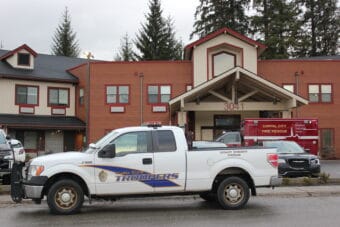
Staff at Riverview Senior Living located Nathan Bishop inside the building’s attic on Monday, Nov. 27, 2023. (Photo by Katie Anastas/KTOO)
A Juneau man who was reported missing Saturday from Riverview Senior Living was found alive in the building’s attic on Monday.
Alaska State Trooper Luke Lemieux said Riverview staff found 58-year-old Nathan Wilder Bishop, who has Parkinson’s disease and dementia, in the attic around noon. Staff had gone to the attic to address a mechanical issue.
“I’m very happy,” Lemieux said Monday.
Lemieux said there wasn’t security footage to show how Bishop got to the attic, or whether he left the building at any point. Bishop is a resident at the facility.
“He would have had to climb up a ladder and then open up a latch, or there’s two entrances from the roof,” Lemieux said. “We’re just happy that someone found him.”
Lemieux said Bishop appeared uninjured when staff found him.
Bishop was reported missing on Saturday. He’d last been seen at 5 p.m. that day.
Authorities issued a Silver Alert for Bishop on Saturday. Lemieux said first responders started the search around 7 p.m. that night with the help of SEADOGS, a local team of search dogs. On Sunday, Juneau Mountain Rescue and 77 community volunteers searched the Mendenhall Valley, including the Nugget Mall area, Fritz Cove Road and University of Alaska Southeast campus.
On Monday, SEADOGS and Juneau Mountain Rescue focused on the Kaxdigoowu Héen Dei Brotherhood Bridge Trail until Bishop was located.
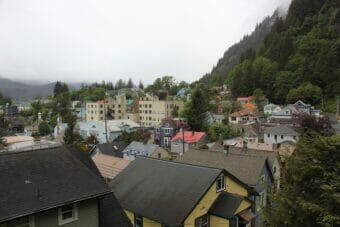
Homes in downtown Juneau on June 6, 2023. (Katie Anastas/KTOO)
Juneau’s population is aging, and unless more young people start moving to Alaska’s capital city, there may not be enough people to fill jobs and take care of its seniors.
That’s one of the takeaways from this year’s economic indicator report from the Juneau Economic Development Council.
“For the first time in our history here in Juneau, the over-60 crowd outnumbers the under-20 crowd,” JEDC Executive Director Brian Holst said at a presentation to the Juneau Chamber of Commerce last week.
Juneau’s birth rate isn’t high enough to maintain its population size without more people moving here. But Robin Thomas, an attendee at the presentation, said now isn’t a good time for people to have kids in Juneau.
“If you’re looking at considering having a child, you have to look at the cost of daycare, medical expenses and housing,” she said in an interview. “There’s a lot working against people.”
If that trend continues, it could mean even fewer people having children, lower enrollment in the Juneau School District, a smaller summer workforce and an increased demand for senior services and health care.
“This is going to have a big impact on how we think about what we should do as a community,” Holst said.
Where did the new housing go?
Housing continues to be a major barrier for people looking to move to Juneau. Business owners in the region have said the lack of housing is the biggest challenge to hiring and retaining workers.
That’s despite Juneau adding around 1,500 units over the last decade.
“Our population increased by, basically, zero,” Holst said. “So where did all the housing go?”
“We also know that tourism companies, to call them out a little bit, have had to purchase a residence for their workers,” he said.
Juneau’s aging population is also affecting housing availability, as more seniors choose to stay in their homes. Holst said nearly 800 units are occupied by people over 65 years old who live alone.
The number of Juneau home sales continues to decline after reaching a peak for the decade in 2021. That year, nearly 550 homes were sold. Just over 100 sold in the first half of this year.
Efforts to increase housing availability are in the works.
But for now, the market is extremely tight. Homes that do go up for sale aren’t on the market for long. In 2019, the average number of days that homes were on the market was 18 days. In 2020, it dropped to 8, then to 5 for the following two years.
“As houses come on the market, despite high interest rates, they are going really, really, really, really, really quickly,” Holst said.
Juneau Economic Development Council Executive Director Brian Holst speaks at a Juneau Chamber of Commerce luncheon on Thursday, Nov. 16, 2023. (Katie Anastas/KTOO)
High cost of living
So far this year, median prices have been $515,000 for single family homes. Renters in Juneau pay an average of $1,420 per month, and Juneau has a lower vacancy rate than the rest of the state.
“The vacancy rate and the price of an apartment are pretty tightly correlated,” Holst said. “If you don’t have a lot of competition, there’s not a lot of reason to lower your rent.”
And the prices of things like groceries and health care may also keep people from moving to Juneau. Juneau’s cost of living is higher than both Anchorage and Fairbanks.
Mining jobs pay the highest average monthly wages in Juneau, but Holst said many of those workers commute between Juneau and other places in the state or country.
“The wages are great. It would be great to have them. It would be great for our economy,” he said. “But they choose not to live in Juneau. Is cost of living part of that answer? I think it might be.”
Holst said Juneau has a lot of good jobs to offer, but potential employees won’t make the move if they can’t afford to live here.
“We have a lower population, lower workforce, increasing seniors who require services, and yet we have an economy that is actually really solid,” Holst said. “We have mining jobs, we have fishing jobs, we have tourism jobs, but we don’t have the workers.”
An employee shovels snow to clear the entrance to Squirez bar on November 20, 2023. While other restaurants closed for the storm, Squirez had a few visitors. (Tasha Elizarde/KTOO)
A blizzard brought high winds to downtown Juneau and several inches of snow to the Mendenhall Valley on Monday.
National Weather Service meteorologist Andrew Park said the Mendenhall Valley got 3 to 6 inches of snow and light wind. Meanwhile, downtown faced 60 to 70-mile-per-hour gusts.
“If you stayed in the Valley the whole day, you might have thought it was a beautiful winter wonderland day with not a whole lot going on,” he said. “As soon as you headed downtown, the story changed.”
Heavy winds damaged and ultimately sank a boat in Harris Harbor. Harbormaster Matthew Creswell said they’re working with the owner and U.S. Coast Guard on recovery efforts and pollution mitigation.
“There doesn’t seem to be a big pollution threat from the vessel, but the potential is always there,” he said.
Electricians were in Douglas Harbor on Tuesday to restore power, which went out early Monday evening. As of 1 p.m. on Tuesday, they were still working on it.
Creswell said harbor staff are working to remove snow from the Auke Bay and Statter Harbors.
A tractor clears snow in the Mendenhall Valley on Nov. 20, 2023. (Tasha Elizarde/KTOO)
Capital Transit buses will run on modified snow routes through Tuesday. There is no bus service on Franklin St. and Fourth St. downtown or on Cordova St. in Douglas.
More snow accumulated out the road. Park said residents from Lena to Tee Harbor reported 8 to 12 inches of snow. Snowfall in other Southeast communities also hit the double digits. Park said Gustavus residents reported 8 to 15 inches, and Hoonah and Angoon got at least 16 inches of snow.
The National Weather Service expects snow to continue falling in Skagway, Haines and Klukwan until late Tuesday afternoon.
As of Tuesday afternoon, the forecast calls for rain through the rest of the week in Juneau. Wind gusts could get up to 35 miles per hour Tuesday afternoon, 30 miles per hour tonight and 20 miles per hour after midnight.
Snow isn’t in Juneau’s forecast again until Saturday morning.
Harris Harbor on Nov. 21, 2023. High winds damaged one of the boats in the harbor, and it sank. (Katie Anastas/KTOO)
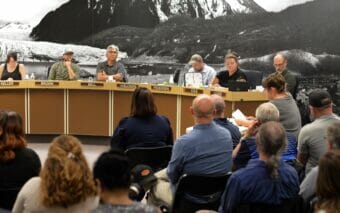
Juneau residents attend a planning commission meeting on Aug. 8, 2023. (Katie Anastas/KTOO)
Several seats will soon be open on three of Juneau’s city boards and one of its advisory committees. Juneau residents have two weeks left to apply.
There are three seats up for grabs on the planning commission, three on the Bartlett Regional Hospital board, four on the Board of Equalization and one on the Systemic Racism Review Committee.
“We want to encourage people from all walks of life to apply for serving on one of our boards and commissions,” City Clerk Beth McEwen said. “We can only appoint those people who apply. We hope it’s as diverse an application pool as our community is.”
Planning commission
The planning commission is a nine-person group that reviews public and private development plans to make sure they comply with city code and zoning requirements. They meet every second and fourth Tuesday of the month at 7 p.m.
The commission has two subcommittees: the Title 49 subcommittee, which reviews and revises land use code, and a governance committee, which sets rules for the commission’s meetings.
Commissioners get a stipend of $225 per month.
All three open seats have two-year terms that start in January. The city originally set an application deadline of Nov. 29, but it’s been extended through Dec. 4.
City code says ideal board members would have experience in fields like health care, finance, strategic planning or law. Up to two members can be physicians suggested by hospital staff, but otherwise, board members and their immediate family members can’t work at the hospital.
The three open seats have two-year terms that start in January. The application deadline has also been extended through Dec. 4.
Board of Equalization
The Board of Equalization hears property assessment appeals, usually between May and July. It’s a nine-member board, and they sit on panels of three when hearing appeals.
“We haven’t had a full nine members sitting on that board for quite a number of years,” McEwen said. “So the five people who have been sitting on the board for the last few years have been having to serve in those three person panels a little bit more frequently.”
Board of Equalization members get a $100 stipend per appeal hearing.
The board has four seats open. Applicants can apply by Dec. 6. The Assembly will review applications and recommend appointments on Dec. 11.
Systemic Racism Review Committee
The Systemic Racism Review Committee, created in 2020, considers whether city legislation perpetuates systemic racism. If it does, the committee makes recommendations to the Assembly on how to remedy it.
“Generally, the Assembly holds a meeting on a Monday night, and then the very next day, the Systemic Racism Review Committee is reviewing the legislation that was introduced,” McEwen said.