Katie Anastas

Local News Reporter, KTOO
State says Juneau School District can keep last year’s additional city funding

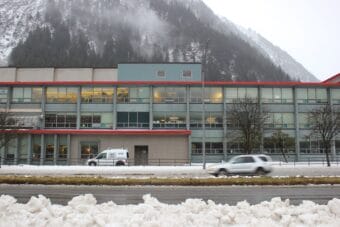
Juneau-Douglas Yadaa.at Kalé High School on Nov. 21, 2023. (Katie Anastas/KTOO)

The Juneau School District can keep $2.3 million in supplemental funding it got from the city this year, but a potential amendment to state code could restrict local funding in the future. That’s according to a letter sent Friday from the Alaska Department of Education and Early Development.

The state sets a limit on how much money a local government can give to its school district. The idea is to make sure districts are funded as fairly across the state as possible. It also helps the state pass the disparity test, a federal rule that saves Alaska millions of dollars in education spending.

The City and Borough of Juneau has funded the district up to the local limit for decades. In the last fiscal year, that maximum — or cap — was about $28.5 million. 

It also routinely funds “outside the cap.” This spring, the Juneau Assembly gave the district $2.3 million to resolve deficits related to transportation, child care and other non-instructional programs. 

In June, the state said the additional funding wasn’t allowed because it went beyond the limit. But the district argued that the cap only applies to instructional costs, and the $2.3 million paid for non-instructional expenses. That money went into separate funds from the operating fund, which pays for things like teacher salaries.

Will Muldoon, who chairs the school board’s finance committee, said this hasn’t been an issue before.

“The state had stated that we had violated, perhaps the spirit if not the letter, of local contributions,” he said. “That caught us by surprise a little bit. These are things Juneau has consistently done.” 

In her latest letter to the district, DEED School Finance Manager Lori Weed wrote that a city or borough’s local contribution isn’t limited to the district’s operating fund. DEED wants to make that clear in an amendment to state administrative code, she said.

“Of course, any proposed regulation project must go through the required procedures under state law, including a mandatory time period for public comment, and it would ultimately be up to the State Board of Education and Early Development to consider public comment and vote on whether they would adopt any regulation change,” she wrote.

Weed said DEED would request any amendment take effect for the fiscal year 2026 budget cycle. In the meantime, the Juneau School District can keep the $2.3 million from the city.

“DEED will honor JSD’s interpretation of ‘local contribution’ as only including appropriations to or funds reported in a school district’s operating fund, until a new regulation takes effect, if ever,” Weed wrote.

Muldoon said he doesn’t expect the school board to change how it requests city support for non-instructional costs next year.

“I don’t think it would be prudent for us to make large scale changes of behaviors on unknown proposed code that will most likely not be in effect during that time,” he said. “That being said, we probably only have a year to really figure out what that means.”

The district is already facing a nearly $3 million deficit in its operating fund, between unexpected expenses at the end of the last fiscal year and lower enrollment. Muldoon said the district is also expecting a $2.9 million reduction in revenue next year, as COVID relief funding and one-time state education funding run out. 

Salaries and insurance are also expected to cost more next year. Muldoon thinks the total budget shortfall is around $7 million. That’s about 10% of this fiscal year’s budget.

“We have very few levers as a district and as a board that we can work with,” he said. “We do have some vacancies right now that are saving us a little bit, but that’s also a strain. We budget positions because we need them.”

Muldoon said the pupil-to-teacher ratio is the main lever the district can pull. While it doesn’t translate exactly to class size, increasing the ratio usually does lead to more students in each classroom.

A permanent increase in state funding would help districts across the state avoid reducing staff, cutting programs or increasing their pupil-to-teacher ratios. The Alaska Senate passed a bill to increase per-student funding for education last session, and the session ended with the bill in the House Finance Committee.

Gov. Mike Dunleavy is set to share his proposed budget by the end of next week. His budget last year included just a $30 increase to the base student allocation.

City leaders are considering whether – and how – to limit cruise ship visitors in Juneau

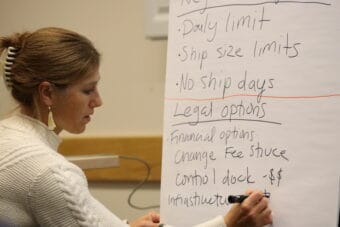
Juneau City Manager Katie Koester writes a list of ways the city could limit cruise ship tourism at a Juneau Assembly retreat on Saturday, Dec. 2, 2023. (Clarise Larson/KTOO)

A record number of cruise ship passengers visited Juneau this year. Now, city leaders are considering whether — and how — to set a future limit.

At a Juneau Assembly retreat on Saturday, Juneau Tourism Manager Alexandra Pierce said this season’s busiest days made the strongest impression on locals.

“When people are concerned about their experience as it relates to the visitor industry, they’re concerned about the daily impacts – what they see day in, day out,” she said.

Pierce shared initial results from a resident survey the city conducts each year. This time, 56% said the city isn’t doing enough to manage tourism — up from 45% last year. And when asked about future cruise passenger volume, half said it should be lower.

Pierce said there are three kinds of limits she thinks the cruise industry might agree to.

One is a daily passenger limit. Pierce said the industry doesn’t “love any sort of limits, but they’re comfortable with that discussion.” 

The city and the cruise industry have already agreed to a maximum of five large ships in Juneau per day starting next year, but the overall volume of passengers will remain about the same.

Assembly member Alicia Hughes-Skandijs said she liked the daily passenger limit idea, but that she’d also support negotiating a seasonal limit. 

“I do think the overall number in a season matters,” she said. “Our slow days are less slow than they used to be.”

Another option Pierce said the industry might agree to is a limit on ship size. The Spanish city of Palma de Mallorca has both: just three cruise ships can visit each day, and only one of those can have 5,000 passengers or more.

“We don’t have the infrastructure in Alaska to get those massive ships like you see in the Caribbean and Mediterranean, but that’s something that we could consider,” Pierce said.

A third option is to schedule ship-free days. Pierce said the industry seems to like that option the least because of how it might affect trip itineraries.

Assembly member Christine Woll said she’d want to consult local business owners.

“I want to hear from the local tourism industry which of these works for them,” she said. “If we have no-ship days, does everybody close? Do people want to come downtown?”

Pierce said that plan A would be negotiating an agreement with the cruise industry. Regulation from the city government is plan B.

Other communities have tried regulating the industry and wound up in court. Local business owners in Bar Harbor, Maine, sued the town after its citizens voted to approve a 1,000-passenger daily limit. 

City officials in Sitka denied a citizen’s petition to put a visitor cap on the ballot. In a letter explaining his recommendation to deny it, Municipal Attorney Brian Hanson wrote that it was “an impermissible appropriation under the Alaska constitution and contains enforcement provisions that are confusing, misleading, and incomplete.” The city denied it for a second time last week.

“Are there regulatory options that could exist? I think the answer is yes,” Juneau Municipal Attorney Robert Palmer said. “But the question is what type of option are we looking at, and what combination of options are we looking at, and how much risk are we willing to take if we have to fight it?”

In 2021, Juneau resident Karla Hart proposed a ballot initiative to set a ship size limit, no-ship days and no-ship hours. It didn’t get enough signatures to go to voters.

This story has been updated with information about why the City of Sitka denied the ballot proposition.

Juneau residents have 1 month to submit proposals for using cruise ship passenger fees

Cruise ships docked in Juneau on Aug. 28, 2023. (Katie Anastas/KTOO)

Juneau residents can submit proposals for how the city should spend marine passenger fees next year.

The city has collected a $5 fee per cruise ship passenger since 2000. Those fees, which usually total around $20 million, help fund projects that both serve visitors and lessen tourism’s impact on locals.

“If there are things that can benefit everybody, residents and visitors, and we can use the visitor industry funding stream to do it, then that’s a great thing for the community,” said Tourism Manager Alexandra Pierce.

City departments, business owners and the public can submit proposals for projects until Jan. 3. Pierce said proposals should include a description of the project and a cost estimate. They can be sent by mail to the city manager’s office or by email to Pierce.

Projects funded with marine passenger fees generally need to be in the downtown waterfront area, Pierce said. Other areas of town are eligible, but they need to be popular with visitors. For example, marine passenger fees are paying for improvements to Homestead Park on Douglas.

“We always like good ideas from residents,” Pierce said. “If we can make it work somehow, we try to do it.”

Last year, Capital Transit proposed adding signs at the Downtown Transit Center with information about getting to the Mendenhall Glacier. Other funded projects included Marine Park construction and restroom maintenance at the docks.

Pierce said she plans to recommend funding a circulator bus to spread visitors out throughout downtown, expanding public wi-fi and extending the seawalk from the Franklin Street Dock to the AJ Dock.

“The seawalk is a great community asset, so I’m excited for the opportunity to fund that,” she said.

Once Pierce receives proposals, a draft list of recommended projects will be open for public comment. The Assembly Finance Committee will review the proposed projects, public comments and the city manager’s recommended list. Then, the Assembly will consider which projects to fund during the spring budget cycle.

Lack of snow delays opening for Juneau’s Eaglecrest Ski Area

Snow dusts trees on a mountain in Juneau on Nov. 30, 2023. This week’s forecast doesn’t call for enough snow to open Eaglecrest Ski Area. (Katie Anastas/KTOO)

Juneau skiers will have to wait at least one more week to ski Eaglecrest. The city-owned ski area’s opening date has been tentatively pushed back to Dec. 9.

Eaglecrest had planned to open on Saturday. But at a Juneau Chamber of Commerce luncheon on Thursday, Manager Dave Scanlan said there isn’t enough snow in this week’s forecast. 

“Unfortunately, Mother Nature has been playing her way with us this past week,” he said. “We’re pushing off our opening day for one more weekend, hopefully.”

Scanlan said Eaglecrest’s high-efficiency snowmaking machines can be up and running as soon as temperatures drop to 28 degrees. And they have seven more of them this year, bringing the total to 22.

Scanlan says that investment has helped bolster sales. Last year saw record purchases of season passes, and nearly as many have already been sold this year.

“People now can trust and have faith that we’re going to be able to deliver a good product,” Scanlan said.

But Scanlan said that as winter temperatures rise and the cruise season extends, the ski area is also looking at new ways to attract visitors.

Scanlan told luncheon attendees that warming winters are one of the reasons the gondola, which the city bought last year, will be such an important addition to Eaglecrest. 

“It’s all about the sustainability of Eaglecrest, both from a climate sustainability and a financial sustainability standpoint,” he said. “As we have warm winter weather, the gondola is going to give us a lot of ability to not be so reliant on all our revenue coming in in the winter season.”

In an interview, he said the snow-making equipment runs best at 25 degrees or below. 

In the summer, Scanlan said, the gondola could help people get to hiking and mountain biking trails from a stop partway up the mountain. In winter, they could snowshoe or Nordic ski. And he said longer cruise seasons could even give some tourists a chance to ski.

“I think as we’re having boats arrive earlier in the spring, there’s going to be some great learn-to-ski packages being sold as some tour opportunities,” Scanlan said.

Scanlan said he thinks Eaglecrest could comfortably handle about 500 summer visitors per day. A traffic analysis is still underway. He said the goal is to open the gondola during the 2025-2026 ski season.

Legislators and staff will be allowed to keep pets in new downtown apartments

Work is still ongoing at the Assembly Building, a former office building that will house legislators and staff next year. (Katie Anastas/KTOO)

Alaska legislators and staff will have a new housing option during this year’s session in Juneau: a former office building that’s been converted into apartments.

It’s just steps away from the Capitol. The rates are about average for Juneau – from $1,100 for a small studio to $1,600 for a large one-bedroom. And the apartments will come with a perk that’s hard to find here: they’ll allow cats and dogs.

But earlier this month, when a House-Senate committee discussed a list of policies for the apartments, not everyone was keen on having furry friends in the building. 

Sen. Donny Olson, a Democrat who represents the Kotzebue, Nome and lower Yukon River regions, worried about odors and allergens.

“You go into a place that has pets, you have that smell that’s there, you have the dander that’s there,” he said.

Rep. Craig Johnson, R-Anchorage, worried about damage.

“I once was a landlord and I’m no longer a landlord because of pets,” Johnson said. “They can be very destructive.”

He asked the committee to consider removing the policy.

“I would certainly like an opportunity to vote, as much as I’ll be accused of being a dog and cat hater, that we not jeopardize our investment with pets,” he said.

Sen. Jesse Kiehl, D-Juneau, led the group of legislators who drafted the apartment policies. He said they talked extensively about whether to allow pets.

“These folks are all going to be either legislators or legislative staff,” he said. “We will have a relationship with them. They will have an interest in keeping the place in good shape.”

Johnson said he was still concerned about the noise, damage and allergies that pets might cause.

“We do have a relationship with the humans that live in those apartments, and it’s not them I’m concerned about,” he said. “We do not have a relationship with the pets that live in the apartment.”

But Johnson’s motion to ax the pet policy failed. That means legislators and staff – along with their pets – will be allowed at the new apartments next year.

Olson said he wanted it on the record that he does have a dog. He’s just “very strict” about where it’s allowed to be.

Site notifications
Update notification options
Subscribe to notifications