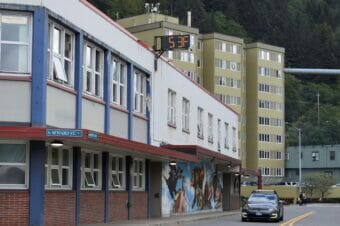
Fewer than half of city employees work at city hall. The rest are in four other buildings downtown, including the Marine View Building. (Katie Anastas/KTOO)
Juneau voters elected Paul Kelly and Ella Adkison as the newest members of the Juneau Assembly. They re-elected Alicia Hughes-Skandijs and Christine Woll.
They also rejected a $27 million bond proposal to fund a new city hall – something all four winning candidates had favored.
Kelly thinks their victories and the city hall bond’s defeat show this wasn’t a one-issue election.
“I had a lot of conversations with people at the door – people who said they would consider voting for me but were against the new city hall,” he said. “I always had the caveat that if I get elected and the city hall passes, I’m going to make sure we do things differently.”
Voters rejected a $35 million bond proposal for a new city hall in 2022. The Assembly voted unanimously to put it back on the ballot, this time with a smaller bond, in July.
Hughes-Skandijs was on the Assembly during that vote, and said she’s still reflecting on the process. Like Kelly, she spoke to voters who supported her but opposed the bond. Some thought the city needed to explore other rental spaces, and some didn’t believe their property taxes wouldn’t go up.
But others seemed to vote against it on principle, she said.
“If you talk one on one with someone, they agreed, ‘That’s a pretty good plan, your facts are good, you’ve convinced me. But I’m still going to vote no because I’m mad that you’d put it back on the ballot the next year,’” she said. “What I see from that is that people didn’t feel heard, and they didn’t feel respected.”
Hughes-Skandijs said one Assembly meeting kept coming up in conversation – the meeting where the Assembly voted to put the bond proposal on the ballot.
Assembly members can object to a motion in order to comment on it, even if they plan on voting yes. It’s a chance for them to explain their thinking and to acknowledge points made by members of the public who might have been opposed.
The vote happened nearly two and half hours into the three-hour Assembly meeting. No Assembly members objected.
“I think the reason no one did that is we had a packed agenda,” Hughes-Skandijs said. “I wish someone had said something. I still would have voted, at that time, yes. But I wish I had done a better job communicating with the public why we were doing it.”
Hughes-Skandijs said between skepticism about the Assembly’s process with the city hall bond and several candidates’ calls for more transparency in city government, she’s thinking about how they can make the Assembly’s decision-making easier for the public to understand.
“Clearly we’re failing at making the process easier for people to follow,” she said. “We’re doing the work in public, it’s in committee meetings. But if people are only watching the Assembly meetings, it feels like, ‘Where are those decisions being made?’”
Hughes-Skandijs said that for now, she’s ready to step back from the city hall issue. Then-City Manager Rorie Watt pointed out that ballot propositions have gone before voters multiple times before, but Hughes-Skandijs doesn’t think the city hall bond will – or should – go on next year’s ballot.
“I think someday it should be,” she said. “I think we take a break from city hall and focus on other much-needed issues.”
Paul Kelly and Ella Adkison wave to drivers on Election Day. (Katie Anastas/KTOO)
Final results in Juneau’s municipal election show areawide candidates Paul Kelly and Ella Adkison will be joining the Assembly while Alicia Hughes-Skandijs and Christine Woll held onto their seats. David Noon and Britteny Cioni-Haywood will be the newest members of the Juneau School Board.
Turnout was up this year. Nearly 34% of registered Juneau voters voted in this election, compared to 32.87% last year.
Kelly and Adkison win areawide seats
Two areawide seats were up for grabs this year. Paul Kelly held a strong lead in the 10-person race from election day, but Ella Adkison’s lead over Nano Brooks narrowed with each update. As of Friday, Adkison had just 116 more votes than Brooks.
But Adkison held her lead through the final count, receiving a total of 114 more votes than Brooks.
Kelly wound up with about 20% of the votes cast in the areawide race. He said he plans to continue the outreach he did to voters during the election.
“It’s still not quite a majority, or anything close to a majority of Juneau voters, so I think that’s really going to shape my first term in office,” he said. “It’s going to need to be a lot about constituent outreach.”
Assembly members Alicia Hughes-Skandijs and Christine Woll won the District 1 and 2 races, respectively. Hughes-Skandijs received 1,462 more votes than Joe Geldhof, and Woll received 2,475 more votes than David Morris.
“One of the most fulfilling things I’ve gotten to do is represent the people of Juneau in this capacity,” Hughes-Skandijs said. “It’s a good feeling to still have folks want you there.”
She and Woll will each serve another three-year term.
Juneau School Board candidates Britteny Cioni-Haywood and David Noon at the 2023 Juneau League of Women Voters Candidate Forum on Sept. 13, 2023. (Photo by Adelyn Baxter/KTOO)
Noon and Cioni-Haywood elected to school board
David Noon and Britteny Cioni-Haywood held strong leads for the two available school board seats from the first vote count. In the end, Noon got 5,739 votes and Cioni-Haywood got 5,377.
The third school board candidate, Paige Sipniewski, was the only candidate to embrace culture war issues like restricting the rights of transgender students and banning certain books from school libraries. She got 3,061 votes.
Noon, a history professor at the University of Alaska Southeast, said he’s heard from teachers and other staff about declining morale amid flat-funding from the state and new mandates from the Alaska Reads Act.
“That’s one of the things in the district I’m most concerned about – the possibility that we’re going to lose some really good teachers who’ve been here for a really long time, or we’re going to fail to retain some quality educators and staffers who are new to the district,” he said.
Cioni-Haywood said she’s looking forward to bringing her experience with budgeting to the school board. She previously directed the state’s Division of Economic Development.
“I feel like there are no easy decisions left,” she said. “I think one of the most important things when you’re facing those types of decisions is to be very transparent and to be very clear as to what the consequences are going to be.”
Cioni-Haywood is the chair of Juneau Community Charter School’s board. She said she plans to step down as chair but remain a board member.
Noon and Cioni-Haywood will replace Brian Holst and Martin Stepetin on the school board. Holst has been on the board since 2014, and Stepetin was elected in 2020.
City hall bond rejected
Last year, 246 more people voted no than yes on a $35 million city hall bond proposal. This year that margin grew to 633 votes even though city leaders reduced the size of the bond and mounted a $50,000 campaign to advocate for the project.
“There’s probably many different reasons why people voted no, and now it’s our job to listen to the public and figure out how to move forward in a thoughtful way,” said City Manager Katie Koester.
Koester said the $16 million the Assembly has allocated to City Hall could be spent on repairs and renovations at the current building. She said city staff would discuss any potential renovations or leases at other office space with the Assembly.
“It’s important that the space is convenient and accessible,” Koester said. “What that might look like in the future is a very open-ended question right now.”
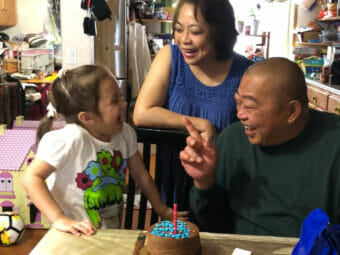
Janaea Dahl helps her lolo, or grandfather, Rodini Roldan blow out the candles on his cake while her grandmother Vicky Roldan watches on Father’s Day in 2020. (Screenshot courtesy of Kaye Roldan)
“Filipinos, by nature, are very adaptable people,” Phillipine Honorary Consul for Alaska Rebecca Carrillo says in episode two of Mga Kuwento. “Our … collective goal, mostly, is to work and provide for our families. Those were the driving forces that propel us to pursue this proverbial American dream.”
That force still drives many Filipino workers in Juneau, including families like the Roldans.
Rodini Roldan says the desire to support his family drove him to work hard. His wife worked night shifts as a nurse when their kids were little.
He worked hard, too, for 20 years in the Alaska Marine Highway system. His family motivated him as he worked his way up.
Phillipine Honorary Consul for Alaska Rebecca Carrillo in her office in Juneau. (Photo by Adelyn Baxter/KTOO)
“Started on the bottom, entry level, like cleaning the toilet, dishwashing pots and pans, and then tried to move up to the deck department,” he says.
Rodini eventually became captain of the MV Matanuska, a ferry in the Alaska Marine Highway System.
His cousin Rex Roldan had a similar progressions, retiring as a chief steward in 2014. Throughout his time in the ferry system, he was surrounded by people who also felt like family.
But as we learn in the second episode of Mga Kuwento, that wasn’t the case when Filipino workers first came to work in canneries, mines and aboard vessels of all kinds.
As reporter Katie Anastas explains, a variety of forces have made labor one of the top reasons why Filipinos come to Alaska. And, the desire to provide for themselves and their loved ones has driven Filipino migrants to make a lasting impact on so many of Juneau’s industries today.

Rodini Rodan before his retirement from the Alaska Marine Highway System. (Courtesy state of Alaska)
First Forty Feet designers presented four possible development plans for Telephone Hill on Wednesday, Oct. 11, 2023. (Katie Anastas/KTOO)
Designers unveiled four possible development options for Telephone Hill at a community meeting on Wednesday.
About 50 people attended to review potential plans, and many of them called for the city to consider a “no build” option instead of adding new units.
There are currently seven houses and one five-unit apartment building on Telephone Hill, and the city estimates that 17 people live there. All of the designs presented Wednesday add new housing to the area, and just one involves preserving the existing homes.
The city contracted First Forty Feet, an Oregon-based design company, to come up with a development plan for Telephone Hill after the state transferred ownership of the property to the city in March. Then-City Manager Rorie Watt said the city would likely put more housing on the property.
Telephone Hill residents, many of whom have rented homes there for decades, have objected to any plan that involves displacing them and forcing them to find new housing in an expensive, limited market. But city leaders say Telephone Hill is an ideal place to expand that market.
“Everything is possible,” First Forty Feet designer Jason Graf told attendees on Wednesday. “The four concepts we’re showing you today are not concepts that say, ‘No change.’ So there is some anticipated change on the hill.”
Wednesday’s meeting was the second community engagement event meant to gather input from residents on the potential designs. First Forty Feet aims to have a master plan ready for the city manager, city staff and Juneau Assembly in December.
First Forty Feet architect James Brackenhoff speaks to meeting attendees on Oct. 11, 2023. (Katie Anastas/KTOO)
The design options
All four designs shared on Wednesday add more housing to Telephone Hill, but the types of housing vary. One design has just townhomes, one just has apartments and the other two have a mix of both.
Graf said the parking structure next to the downtown transit center could either have additional parking levels or two floors of office space added to it.
Option A is the lowest density option. It would include about 30 single-family townhomes. Small groups of them would be attached to each other, and they could be one, two or three stories tall.
Option A is the only option that puts office space on top of the parking structure.
“We felt we could do that because there’s lower density on the site – you don’t need as much parking on the site itself,” First Forty Feet architect James Brackenhoff told attendees.
First Forty Feet’s Option A would include single-family townhomes and office space on top of the parking structure. (Katie Anastas/KTOO)
Option B has about 60 units, with a mix of attached townhomes and three-story apartments without elevators. Option B would add parking to the parking garage.
Option B from First Forty Feet has about 60 units, with a mix of attached townhomes and three-story apartments. (Katie Anastas/KTOO)
Option C features mid-rise apartment buildings, which would have elevators. Brackenhoff said there could be 100 to 200 units, with parking levels added to the parking garage. Those apartment buildings could have space on the first floor for restaurants or other commercial spaces.
Option C also has a hotel, which Brackenhoff said may work with other types of housing, too. The design features a plaza in the center of the hotel and apartments.
First Forty Feet’s Option C features a hotel and mid-rise apartment buildings, which could add 100 to 200 housing units, according to designers. (Katie Anastas/KTOO)
Option D would put walk-up apartment buildings in spaces between some of the existing houses. Brackenhoff said the design adds 40 units to Telephone Hill. He called it an “acupunctural approach” that would mix the old with the new.
“We wanted to make sure we provided an option that took on board what we’ve been hearing from some of the folks in the community about preserving some of the homes,” Brackenhoff said at the meeting.
Option D from First Forty Feet would put walk-up apartment buildings among some of the existing houses. (Katie Anastas/KTOO)
Brackenhoff said they still need to determine whether or not it’s feasible to preserve the homes.
“What we have to do is go through the survey process to make sure these homes are actually structurally sound, that there’s not a significant burden that the city would need to carry to renovate these homes,” Brackenhoff told attendees.
Downtown resident Joshua Adams told the designers and attendees that he was skeptical the city would consider keeping the homes, even if the community favored that option.
“We all know that the city is going to look at this and say none of these buildings can be feasibly restored. Anybody who knows anything about historic restoration knows it’s at least three times as expensive to restore something properly than it is to tear it down and build it new,” he said. “Does that mean we shouldn’t preserve our history?”
Some attendees suggested the city sell the homes in their current condition. But Graf said those kinds of decisions are up to city leaders, not the designers.
“What we’re trying to look at is, if we preserve those, can we add additional housing, and what is that development like?” he said.
Community response
Most of the Juneau residents who spoke at the meeting said the city should preserve the houses and not add additional housing.
Tony Tengs, who lived on Telephone Hill for nearly three decades before moving out this spring, looked through the designs before the meeting started. He pointed to Option D, which has orange apartment buildings amid gray houses.
“The only one that has the buildings in place, they look like ghost buildings on the drawing,” he said. “Even in the one where they’re still shown, they look like ghosts.”
Skip Gray, who has advocated for the city to restore the existing houses, said he’s frustrated that questionnaires haven’t given him the opportunity to vote for a “no build” option.
“There just aren’t any answers on these surveys that I want to push the button on,” he said in an interview.
But Betsy Brenneman, a former Telephone Hill resident, told attendees that the planning commission and Assembly were the right people to contact about a “no build” option.
“You’re shooting the messenger a lot tonight,” she told attendees. “The city asked for this plan.”
Brenneman was a member of the Blueprint Downtown Steering Committee, which drafted a revitalization plan for downtown Juneau that lists adding housing as the top priority.
“If we don’t get more people living downtown, you are going to have more closed storefronts in the winter, you are not going to have any businesses downtown,” she said. “We have to get more people downtown.”
Brenneman said she favors keeping the existing homes, but she’s open to adding more units around them.
“I will be laying down in front of the bulldozers if anybody tries to take down the historic homes,” she said. “However, I do think there are ways on Telephone Hill to add a little more housing.”
A ramp leads up to the houses on Telephone Hill from the Capital Transit center. (Katie Anastas/KTOO)
Incentivizing affordability
Some attendees wanted assurance that the new houses or apartments would be affordable.
Graf said the city will have the opportunity to require a certain amount of affordable housing in its contracts with developers.
“Because it’s under the CBJ, they create the carrots to incentivize affordability as an option as well as market rate,” Graf told meeting attendees. “There will be an opportunity for affordability if that’s valued, which I think it is.”
Chris Zahas, a consultant with Leland Consulting Group, agreed. He’s tasked with identifying developers who can make the master plan happen. He said in an interview that the city could offer subsidies to developers, which could come with conditions.
“The city is in a position to kind of put strings attached to it to get what the community wants out of it,” he said.
Zahas said developers’ proposals usually go before the Assembly for approval.
“So there’s going to be multiple points along the way where the public and the Assembly get to have a conversation about it,” he said.