
Katie Anastas

Local News Reporter, KTOO
Juneau will keep planning for icebreaker, despite removal from federal spending bill

The icebreaker USCGC Healy transits Gastineau Channel during a 2014 visit to Juneau. (Photo by Matt Miller/KTOO)

Funding to buy a privately owned icebreaker was removed from the $1.7 trillion spending bill signed by President Joe Biden on Friday morning. The decision delays plans to possibly dock an icebreaker in Juneau.

The U.S. Senate passed the National Defense Authorization Act earlier this month, which gave the government permission to spend $150 million on an icebreaker called the Aiviq. The removal of that funding from the separate spending bill means the purchase won’t happen, at least for now.

But Juneau City Manager Rorie Watt said the federal decision won’t stop the city from planning for one in the future, whether it’s the Aiviq or a new one built by the U.S. Coast Guard.

“I think we still need to plan for an icebreaker, but clearly it’s not happening as soon as people thought,” he said.

Watt recently proposed that the Juneau Assembly spend $300,000 on planning the location of a new cruise ship dock. He said accommodating an icebreaker should still be a factor.

“In the planning for a cruise ship dock, you have to think about all the other uses,” he said. “I don’t think that fundamentally changes.”

A new icebreaker could bring 190 Coast Guard personnel and their families to Juneau, according to Sen. Dan Sullivan, who voted against the spending bill. In a statement, he said removing the icebreaker funding undermines Arctic security.

“This decision could further set back our nation’s ability to provide persistent presence in the Arctic for years,” Sullivan said in the statement. “This is a major disappointment for our state and country.”

On a call with reporters Friday, Sen. Lisa Murkowski called it a frustrating but temporary setback.

“I think we will have yet another opportunity in this next appropriations bill going forward, and I’m certainly going to be pushing to advance that,” she said. “The concern though, quite honestly, is if there are others who may be interested in purchasing [the Aiviq.]”

The Aiviq would have been a temporary solution as the Coast Guard works to buy new icebreakers, according to a congressional report. The Coast Guard expects them to be ready in 2026 or 2027.

Emergency shelters will be open in Juneau this holiday weekend

Warming shelter shuttle
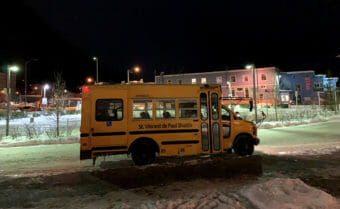
A shuttle for St. Vincent de Paul’s warming shelter waits in downtown on Jan. 10, 2020. (Photo by Rashah McChesney/KTOO)

With the National Weather Service expecting heavy snow in Juneau starting Friday afternoon, most shelters will be open during their regular hours throughout the holiday weekend and next week.

The warming shelter at Resurrection Lutheran Church will be open every night through at least Sunday, Jan. 1. The shelter opens nightly at 10:30 p.m., but staff sometimes open by 9 p.m. during extreme weather.

The Glory Hall will remain open during the day throughout the holidays. Check-in for overnight stays at their emergency shelter near the airport is at 9:30 p.m. They offer three meals and a snack each day. Interim executive director Chloe Papier said Congregation Sukkat Shalom will make dinner on Christmas Eve, and Glory Hall staff will cook Christmas dinner.

The Shéiyi X̱aat Hít Youth Shelter and AWARE’s emergency shelter will remain open 24/7 throughout the holidays.
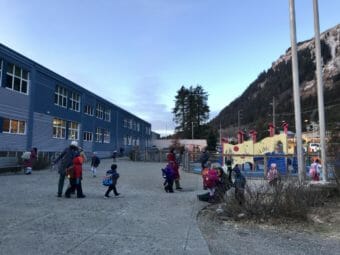
The Zach Gordon Youth Center will be closed Saturday through Monday this weekend and next weekend. Juneau’s public libraries will be closed on Sunday, Monday, and Jan. 1 and 2.

Birth rate data shows kindergarten enrollment likely to remain low in Juneau

Parents greet their children in front of Harborview Elementary School in Juneau at the end of the school day on Dec. 21, 2022. (Photo by Jennifer Pemberton/KTOO)

The Juneau School District has more than a hundred fewer kindergarteners than expected this year, and birth rate data shows the trend is likely to continue.

The district projected 390 kindergarteners would start this fall. Instead, just 282 did. Cassee Olin, the district’s administrative services director, said district leaders thought enrollment would be closer to pre-pandemic levels this year.

“We figured maybe we’d have more coming in just because the pandemic was lessening,” Olin said. “Things were going back to normal in classrooms. We’re not wearing masks, we’re not doing those kinds of things, so [we thought] families would feel more safe to be back in classrooms and bring their kids back to school.”

Data published by the state this month shows the total number of kindergarten-age students in Juneau – and all of Alaska – will likely continue to go down. Olin said the Juneau School District may have to consider closing or consolidating schools if the trend continues.

“It definitely impacts future planning, and how we want to tailor our education to the needs of the community,” she said. “In the next three or four years, there’s going to be a lot of decisions that need to be made.”

The fertility rate in Alaska has been declining for several years, said state demographer David Howell.

“Around 2010, we were at 2.3 children per woman,” he said. “Now we’ve fallen in Alaska to 1.9 children per woman, which is obviously not enough to replace the existing population. And Juneau has had a lower fertility rate than the state as a whole for a long time.”

Howell said there are many possible reasons behind the decline. In Juneau and other Southeast communities especially, a lack of affordable childcare may cause young couples to decide against having children. Youth outmigration might contribute to a lower total number of births. And the millennials who are still here are getting older.

“Once you get into your mid-30s and on, you see less and less births,” he said. “(Millennials) are really starting to hit those ages where we’ll start to see less births from them.”

The Juneau School District isn’t the only one dealing with lower than expected enrollment. In Anchorage, school administrators have cited birth rate data when discussing possible school closures and other budget cuts.

Howell said it’s too early to tell whether this overall decline is starting to level off in Alaska.

“But as far as the school-age kindergarten population goes, it’s going to go down going forward, just sheerly because of the number of births we’ve had over the last five years,” he said.

Olin hopes declining enrollment in Juneau, Fairbanks, Anchorage and other districts will show the state legislature the importance of increasing public education funding.

The base student allocation, the amount of money per student school districts receive from the state, hasn’t increased substantially in years. Meanwhile, inflation has driven costs up.

“If we don’t have adequate funding, our numbers in enrollment will continue to decline,” Olin said, “because families are going to leave the state of Alaska to find education that is getting funded at the level they need.”

She said enrollment projections for the 2023 to 2024 school year are underway.

City asks Juneau residents for input on Marine Park renovations

Juneau’s Marine Park on Dec. 20, 2022, seen from across Marine Way. Among other changes, the city is considering putting back the crosswalk that was here until 2019. (Photo By Paige Sparks/KTOO)

Juneau’s parks and recreation department is planning renovations for Marine Park, and residents are invited to submit ideas.

An online survey is open through Jan. 10. It asks park-goers and nearby business owners how they use the space, and what they’d like to see there in the future.
Michele Elfers, deputy director of the parks department, said it’s the first step of a public outreach process recently funded by the Juneau Assembly.

“The park is aging, and it gets a lot of different use and more use than it did 20, 30 years ago,” she said. “We’re looking at how we can make it better connected to the seawalk and into downtown.”

Marine Park was first developed in the late 1970s. Since then, it’s become a community gathering place, a first stop for many cruise ship passengers and one of the only waterfront spaces in Juneau accessible by public transportation.

The survey asks residents about their interest in several new amenities, including a large covered gathering space, roller skating areas and BBQ grills.

It also asks if residents would like a crosswalk at South Seward Street. Elfers said the old crosswalk was removed in 2019 because of visibility issues, but city officials are considering adding it back.

“That was keyed in as a really important connection from the waterfront into downtown, and a cultural and historic connection as well,” she said. “Canoes used to come into the waterfront there and then march up during Celebration.”

The department will host a series of public meetings from February to July to gather more input from the community. The online survey closes at 5 p.m. on Tuesday, Jan. 10.

Juneau Assembly funds four affordable and mixed-income housing projects

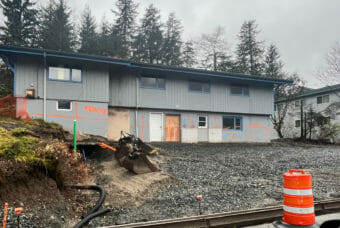
AWARE’s new affordable housing units will be on Cordova Street in West Juneau. The site previously housed the Tlingit & Haida Head Start program. (Photo courtesy of Mandy O’Neal Cole)

Four organizations will receive funding for new housing projects through Juneau’s affordable housing fund. The Juneau Assembly approved $2 million in grants and loans from the fund this week.
AWARE, a nonprofit that supports victims of domestic and sexual violence, will receive a $200,000 grant to develop seven affordable studio apartments in West Juneau. Executive Director Mandy O’Neal Cole said she’s looking forward to offering housing there.

“I think it’s a really good message to survivors, to people who are making the low end of the area median income,” she said. “You get to live in cool neighborhoods, and you get to have the same kind of beautiful view and access to transportation that other people have.”

Cole said the units will help give survivors more privacy and independence than shelters or transitional housing can typically offer. She said the goal is to complete construction by summer.

This is AWARE’s second round of grant funding from the affordable housing fund. It’s also the second round for St. Vincent de Paul. The nonprofit will receive $100,000 for maintenance at its Teal Street Shelter in the Mendenhall Valley.

Tlingit Haida Regional Housing Authority is working to build 10 affordable two to four bedroom homes in North Douglas over the next three years. They’ll get a $500,000 grant through the housing fund.

The fourth recipient will receive a loan instead of a grant. Utah-based company Rooftop Properties LLC will borrow $1.2 million to build 24 units. It’s part of a planned 444-unit project near Glacier Gardens, between Lemon Creek and the Mendenhall Valley. 

According to the funding proposal, 19 units will be market rate, at $1,925 per month for a one-bedroom unit and $2,275 per month for a two-bedroom. Rent for the other five units will be about $100 less.

Joseph Meyers is the city’s housing and land use specialist. He said it’s important for the city to try to meet all housing needs, and in Juneau, that includes market-rate options.

“It takes all kinds of housing to make a community,” he said.

The Juneau Planning Commission approved the first 96 units of Rooftop’s project this week.

Correction: This story has been updated. A previous version said AWARE’s project will be located in Douglas. The project will be in West Juneau on Douglas Island.

Juneau School District extends contract with food vendor

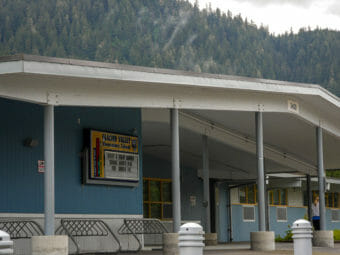
Sít’ Eetí Shaanáx–Glacier Valley School on June 14, 2022. (Photo by Paige Sparks/KTOO)

The Juneau School District has extended its contract with NANA Management Services, the food vendor whose worker mistakenly delivered floor sealant to a food warehouse this summer.

Staff served the floor sealant to students, thinking it was shelf-stable milk. The school board will vote in January whether to pursue a third-party investigation into the district’s communication about the incident.

At a school board meeting Tuesday night, the board approved a six-month contract with NANA starting Jan. 1. Cassee Olin, the district’s administrative services director, told the board it was the only food vendor to submit a proposal.

The contract includes a 12.5% increase in meal rates, which will be absorbed by the district to avoid passing on that cost to students this school year. Olin said the decision to make breakfast “grab and go” when the new contract begins – offering microwaveable or cold meals rather than hot meals – helped avoid an even higher increase.

Site notifications
Update notification options
Subscribe to notifications