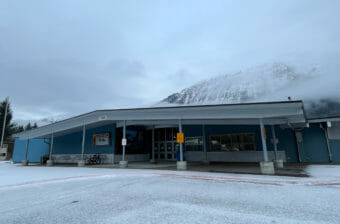
Sít’ Eetí Shaanáx Glacier Valley School on Jan. 11, 2023. (Photo by Katie Anastas/KTOO)
The Juneau School Board will no longer pursue an investigation into the district’s communication about last year’s floor sealant incident.
Last summer, staff mistakenly served students floor sealant instead of milk. At the time, some parents said calls from the school came too late. The school board was considering spending $11,500 on a third-party investigation into the district’s communication about the incident, but at a school board meeting Tuesday night, they decided against it.
Board member Martin Stepetin said previous investigations into the incident itself had been sufficient.
“We have learned a great deal about what we can do to protect ourselves from this happening again, and that’s the most important thing,” he said.
Member Emil Mackey argued that the investigation was still worth pursuing if it could restore families’ trust. He said that while the district’s food vendor, NANA Management Services, made the mistake of delivering the floor sealant to a food warehouse, the district was responsible for communicating with families.
“There may be only a few people out there that still really are concerned about it, but what if there is something to learn that we’re going to miss because we didn’t do this?” he asked.
But Superintendent Bridget Weiss said, judging in part by students’ continued attendance at the RALLY summer school program, trust had been restored.
“We had families in RALLY the very next day, every day for the remainder of the summer,” she said. “That is because this was one incident, not a large series of incidents where there had been challenges and problems.”
Several groups investigated the incident, including the Juneau Police Department, the state Department of Environmental Conservation and NANA. NANA created new shipping and receiving protocols following the investigation.
From left to right: Rep. Sara Hannan, Sen. Jesse Kiehl and Rep. Andi Story pose for photographers outside the Capitol in Juneau on Jan. 16, 2019. (Photo by Skip Gray/KTOO)
Juneau’s legislators are outlining their priorities for this year’s legislative session. They say they hope to find new sources of state revenue, reduce outmigration and improve the Alaska Marine Highway system.
Rep. Sara Hannan, who represents downtown Juneau and Douglas, will continue her efforts to tax vaping products.
“Seventeen years ago was the last time we tweaked our tobacco tax,” she said. “Because electronic cigarettes didn’t really exist 17 years ago, they’re not mentioned in it. So providers of that product have argued, ‘You can’t tax us because we’re not named in the tax statute’.”
Gov. Mike Dunleavy vetoed a tax on vaping products last year, saying he was against any tax increase on Alaskans. Hannan said she’s hopeful this year as the state searches for new sources of revenue.
She’d also like to see increased Alaska Marine Highway service. She said it’s a vital resource for Southeast communities year-round, especially for people traveling to Juneau for medical care.
All three legislators pre-filed bills this week. Rep. Andi Story, whose district now includes the Mendenhall Valley, Haines, Skagway and Gustavus, introduced a bill that would update certain aspects of the Alaska Performance Scholarship. It gives high school students money to attend an in-state postsecondary program. She said the goal is to encourage young people to stay in Alaska.
“This would notify students in their junior year that they qualify for the award if they continue to take the classes they say they’re going to,” she said. “Right now, they don’t know until the end of their senior year, and many kids choose earlier.”
Story said she’s optimistic the state will increase the base student allocation, the amount of money per student that school districts receive from the state.
A bill pre-filed by Sen. Jesse Kiehl would give public service workers the option to pay into a pension. Kiehl said it would help reduce worker turnover.
“Most people who work in public service do it because they love it,” he said. “We shouldn’t make it an irrational choice economically for them to stick around.”
The Juneau delegation will host a town hall meeting Wednesday night at Dzantik’i Heeni Middle School Commons from 5:30 to 6:30 p.m.
Correction: A previous version of this story had the wrong location for the town hall. It will be Dzantik’i Heeni Middle School Commons.
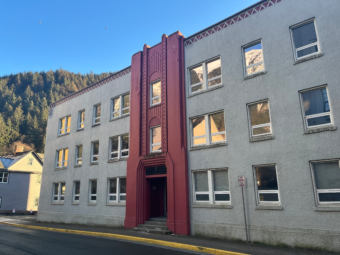
The Assembly Building, located steps away from the Capitol, is set to become legislative apartments as early as next year. (Photo by Katie Anastas/KTOO)
Members of the Alaska Legislature will soon have more housing options in Juneau.
Last month, a House-Senate committee approved spending $6.6 million to convert the Assembly Building, a state-owned office building just steps away from the Capitol, into 33 apartments as early as next year.
Lawmakers and staff say it could help address common challenges they face when it comes to housing during the legislative session.
The downtown location could reduce the need to bring cars to Juneau. That’d be a perk for legislators like Anchorage Sen. Bill Wielechowski, who stopped bringing a car with him to Juneau after an icy, windy stop in Whittier to drop his car off at the ferry a few years ago.
“It was like a comedy scene,” he said. “I fell down and I couldn’t get back up. I was crawling, trying to get back to my car, because it was sheet ice and 80 mile an hour winds. And then my glasses flew off into the ocean. It was crazy.”
It would also bring the amount of session housing closer to pre-pandemic levels. The Legislative Affairs Agency keeps a list of rooms, apartments and houses for rent submitted by landlords. Executive Director Jessica Geary said the list got significantly smaller during COVID; there were nearly 100 fewer listings last year than there were in 2019.
The cost to rent an Assembly Building apartment has yet to be determined, according to Juneau Rep. Sara Hannan, the chair of the committee that approved the spending.
“The goal is not to undercut the market, and the goal isn’t really to become a profitable landlord,” she said. “We’re not going into the landlord business to make money, but I think there will be an expectation that it pays for itself and doesn’t undercut any market that’s out there.”
According to state data, the average rent for an apartment in Juneau is around $1,300. On top of their salaries, legislators who don’t live in Juneau receive $307 per day during the session to cover housing, food and other expenses.
Hannan said they also haven’t determined what will happen with the units when the Legislature isn’t in session. But she said the goal is to have the units available for legislators and staff during special sessions, which can happen throughout the tourist season.
Market rate apartments have become harder to find. In the last few years, Geary said, more and more listings submitted to the agency have also been posted on AirBnB.
“We’ve had some people try to list using their short term AirBnB rental rates, so a few hundred dollars a night,” she said. “We’ve turned down those listings, because we want it to still be affordable.”
Earlier tourism seasons have also brought challenges. Many leases meant for legislators and staff end in late April or early May. If the session goes longer than 90 days, it can put those renters in a tough spot.
“Ships are coming earlier and earlier,” Geary said. “We’re usually good on housing until May 1, and then it starts getting a little bit difficult.”
Mike Mason has been a legislative staffer since 2015. He said flexible lease dates could be a major benefit of the Assembly Building apartments.
“I can tell you horror stories,” he said. “I had housing for when we had five special sessions in a year. I did not have to lose my housing, but almost everybody else did. I’m stashing people’s clothes in my house because people are just couch-surfing.”
Mason is working for Anchorage Sen. Löki Tobin this year. Tobin said the housing crunch in April and May can have an impact on legislators’ ability to get work done.
“That 90-day period of time actually results in some work having to be shifted, because many staffers are moving out of the place they had secured into new accommodations,” she said. “You really see an impact to the speed and efficiency of some of the bills moving forward because of that unfortunate blip.”
Whether it’s getting a bill passed on time, or simply being able to walk to work, Tobin said the Assembly Building apartments will be a welcome addition.
In the meantime, Geary said, Juneau residents are offering their support in a tough market.
“The housing market here, just like other places, is pretty tight,” she said. “But the Juneau community continues to graciously open their homes for legislators and legislative staff who come here and do the work for the people of Alaska. I think that really speaks volumes.”
The Legislative Affairs Agency still has rentals listed for the upcoming session, which starts Jan. 17. Legislators and staff in need of help finding housing, as well as Juneau homeowners with rentals available, can contact the agency’s office.
Douglas Bridge in Juneau in December 2018. (Photo by David Purdy/KTOO)
The omnibus spending bill passed by Congress late last year provides more than $16 million in funding for Juneau-based projects.
The funding items include ongoing analysis of a second bridge to Douglas and a new youth services center.
The city is getting $2.5 million to design and build a commercial-scale composting facility. City Manager Rorie Watt said that will help extend the life of the local landfill, which has about 20 years left at its current usage level.
“It’s in our interest that it not fill up any faster than necessary,” he said. “Once the landfill is full, people will have to pay more money, in all likelihood, to ship their garbage south.”
It could also reduce wastewater treatment costs by helping keep compostable material out of garbage disposals. Watt said the location of the facility is yet to be determined, but the gravel pit near Costco and Home Depot is an option. Juneau Composts, a privately-owned service, leases land from the city nearby.
The city will also get $7 million toward building a second bridge between Douglas Island and Juneau. Watt said a second bridge could help improve access to land on Douglas where new housing could be built. It could also speed up police and firefighter responses to incidents on Douglas and improve Juneau residents’ access to the Eaglecrest ski area.
“It’s been a community goal for decades and decades,” he said.
The federal funding will help the city continue its environmental and site selection process. Watt estimates that the project would likely cost more than $100 million and take several years of planning and community meetings.
The University of Alaska Southeast will receive $750,000 to create a commercial driver’s license training program. On a call with reporters after the bill’s passage, Sen. Lisa Murkowski said there’s a longstanding need for a program unique to Southeast Alaska, where communities might lack some of the road features required to get the license.
“If you don’t have on and off ramps in a place like Ketchikan or Utqiagvik, how do you get your CDL?” Murkowski said.
The bill also puts $5 million toward a new building meant to house several local nonprofits that serve families and children, including a child care center.
JAMHI, which provides behavioral and mental health services in Juneau, will get $870,000 to renovate and expand its youth services center.
A masked city bus driver makes his way through downtown on Thursday, July 29, 2021 in Juneau. (Photo by Rashah McChesney/KTOO)
The Juneau Assembly is considering offering sign-on bonuses and enhancing retirement benefits to attract and retain more city workers.
This winter, a driver shortage led to the temporary cancellation of some city bus routes. But the problem goes deeper — more than a quarter of city employees have been on the job for less than a year, as more experienced employees age out of the workforce and younger workers stay for shorter periods of time.
City Manager Rorie Watt said some positions requiring technical skills have been especially hard to fill.
“Heavy equipment operators are hard to find right now,” he said. “People with commercial drivers licenses, bus drivers, IT workers, programmers.”
Watt outlined three proposals at an Assembly finance committee meeting Wednesday night. The first is to offer sign-on bonuses of up to $40,000 for certain positions. To get that bonus, an employee would have to commit to working at least two to four years, depending on the job.
City leaders also suggested the city contribute to dependent care flexible spending accounts. That’s a pre-tax account that employees can use to pay for childcare.
“During the COVID-19 pandemic working parents and caregivers left the workforce in high numbers and have yet to return to full-time employment,” Watt wrote in a memo to the committee. “In fact, according to the Bureau of Labor Statistics, there are still two million fewer women in the workforce than pre-pandemic rates.”
The third proposal, from Finance Director Jeff Rogers, would match retirement contributions made by workers hired since July 2006. Under Alaska state law, those employees – who make up Tier IV of the Public Employee Retirement System – get individual retirement accounts rather than paying into a pension, and they can take their accounts to new jobs after five years.
Watt said contributing to their accounts could motivate city employees to stay for several years.
“We’re trying to replicate that hook that defined benefits employees have,” he said. “They start to think about job changes and they think, ‘If I stay longer, I’m incentivized.’”
Assembly Member Michelle Hale said it could be a local solution to a statewide problem.
“It has felt, at the city level, like we’ve been in a trap of a former legislature’s making,” she said, referring to the 2005 decision to establish Tier IV.
The finance committee agreed to move the proposals forward. City leaders will incorporate them into the proposed budget and present them to the full assembly.
Alaska Airlines Flight 64 arrives at Juneau International Airport on Dec. 15, 2020. (Photo by Jeremy Hsieh/KTOO)
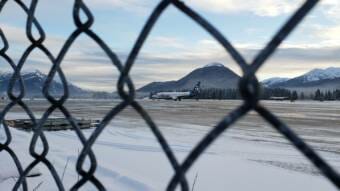
Juneau’s airport parking lots are packed as residents struggle to leave Seattle.
Airport Manager Patty Wahto said both long-term and short-term parking lots, which fit about 250 cars total, are at capacity. She said Juneau residents should avoid parking at the airport for the next day or two.
“It’s just over the top right now,” she said. “We’re seeing cars parked in spots where they really shouldn’t be parked, and it’s blocking people in.”
As of Tuesday afternoon, some long-term parking was still available at Mike’s Airport Express, across the street from the airport.
Alaska Airlines is still canceling flights to and from Juneau. Winter weather throughout the country has left planes and their crews stranded, the airline wrote in a press release Tuesday.
Wahto said it’s not local weather conditions causing delays. It’s cancellations in Seattle and Anchorage.
“When it hits down in Seattle, it can have a ripple down effect because planes are stranded elsewhere,” she said.
Juneau resident Geralyn Davis has experienced those ripple effects herself. She was set to fly to Anchorage at 7:30 a.m. Tuesday for a medical appointment. But when she checked her phone at midnight, the flight had been canceled.
Eventually, Alaska Airlines booked Davis for Thursday morning, but now she has to reschedule her doctor’s appointment and transportation from the airport.
“I’ve been flying up there for over four years now to have this done, and I’ve never had a cancellation,” she said. “It’s just a lot of pieces that it upsets when it gets canceled.”
Davis said she’d recommend Juneau residents reconsider their travel plans this week.
“I just wouldn’t fly if I didn’t have to right now,” she said.
Close
Update notification options
Subscribe to notifications
Subscribe
Get notifications about news related to the topics you care about. You can unsubscribe anytime.