Katie Anastas

Local News Reporter, KTOO
Alaska tribal entities to receive federal land transfers for health care facilities

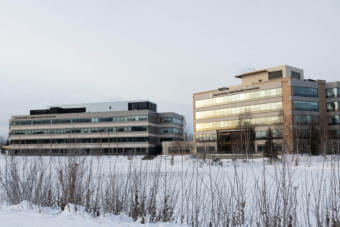
The Alaska Native Tribal Health Consortium in Anchorage, Alaska on Dec. 30, 2021. (Lyndsey Brollini/KTOO)

The Tanana Tribal Council and two Alaska Native health consortiums will receive land transfers from the federal government. 

President Biden signed a bill in December that gives Indian Health Service (IHS) land to the Southeast Alaska Regional Health Consortium (SEARHC) in Sitka, the Tanana Tribal Council in Tanana and the Alaska Native Tribal Health Consortium (ANTHC) in Anchorage.

SEARHC marketing director Lyndsey Schaefer said the transfer gives them the two remaining federally-owned properties within the Sitka health campus. It’s been a lingering step in the consortium’s hospital expansion plan.

“The land transfer allows SEARHC to self-determine the best uses of the properties, and once construction is complete, it will enable the properties to be repurposed to complement the new Mt. Edgecumbe Medical Center,” Schaefer wrote in an email.

In Tanana, the transfer gives a former IHS hospital site to the Tanana Tribal Council. In 2016, Council Secretary Dorothy Jordan said the transfer would help the tribe apply for grants to fund substance abuse and suicide prevention efforts.

In Anchorage, ANTHC already has a warehouse on the land they’ll receive from IHS. They use that warehouse to prepare for construction projects throughout Alaska, including water treatment improvements. 

Jim Roberts, ANTHC’s interim Vice President of Intergovernmental Affairs, said owning the land will make it easier to build a new, larger warehouse.

“Every time we have to do improvements, we’re subject to rigorous federal oversight,” Roberts said. “If the land is transferred to us, we loosen up some of those requirements and we have more flexibility. It allows us to construct the actual building in a way that meets our needs.”

It can also give health consortiums – and the state – more financial flexibility. In 2014, ANTHC received a land transfer that allowed them to build patient housing. Patients had previously been reimbursed for hotel stays through Medicaid.

“Once we internalized that to ANTHC, we were able to work with the state to help them save state general fund dollars,” Roberts said.

Rep. Don Young first introduced a bill authorizing the transfers in January 2021. The act signed last month was named after him.

“I think this is a legacy that can be attributed to him,” Roberts said.

Juneau Assembly outlines state and federal funding priorities

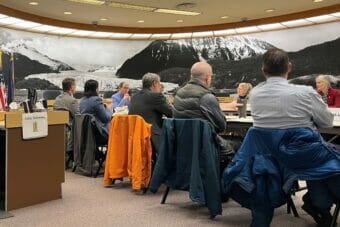
Members of the Juneau Assembly meet with the Juneau delegation to discuss legislative priorities at a work session on Jan. 26, 2023. (Katie Anastas/KTOO)

The Juneau Assembly is asking state and federal legislators for help funding a range of local projects this year.

Assembly members discussed a draft list of legislative priorities at a committee meeting last Thursday. That list will go to the full assembly Monday and then on to state and federal representatives.

Housing development in Pederson Hill tops the proposed list this year. The Tlingit Haida Regional Housing Authority and a private developer have applied to build housing in the area.

Several projects have carried over from last year, including a multiuse path in Lemon Creek, a new City Hall and a second crossing between Juneau and Douglas Island. Some projects on the proposed list have already received some federal funding, including the second crossing and a new municipal composting facility.
Bartlett Regional Hospital recently requested $4 million in state funding for its new Aurora Behavioral Health Center.

“It makes a lot of sense to request state funding to support this facility, because we support not just Juneau but Southeast Alaska and other communities up north,” assembly member Michelle Hale said.

Mayor Beth Weldon and some assembly members questioned why the hospital board didn’t make its request in October, when city officials asked for input. But city manager Rorie Watt said it’s still worth supporting.

“I think they understand that they should have participated earlier,” he said. “I think that doesn’t diminish the fact that they have a good project and a need.”

The committee added the project to the bottom of the list, bringing the total number of items to 23. Other new priorities this year include HVAC and security upgrades in the Juneau School District.

Gov. Dunleavy announces PFD education raffle winners

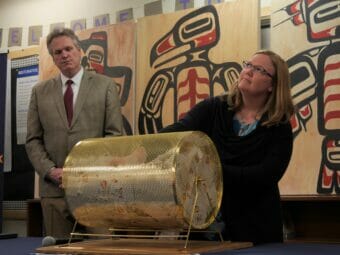
Gov. Mike Dunleavy watches as Department of Education and Early Development commissioner Heidi Teshner draws an education raffle winner’s name at Harborview Elementary School in Juneau on Jan. 25, 2023. (Katie Anastas/KTOO)

Gov. Mike Dunleavy announced the winners of the fourth annual education raffle on Wednesday from Harborview Elementary School in Juneau.

Alaskans enter the raffle by donating part of their permanent fund dividend. Half of the donated money goes directly to schools in the form of grants. A quarter goes into an education endowment fund.
This year, 8,740 people entered the raffle, giving $437,000 to public education and $218,500 to the endowment fund.

The four winners were Hannah Palmeter, John Erickson, Charles Greene and Suzanne Taylor. Their prizes range from $7,045.81 to $56,366.49.

Juneau joins communities across the country to count people experiencing homelessness

new Glory Hall bedroom
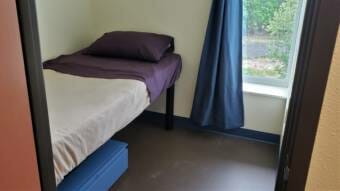
The Glory Hall emergency shelter has 42 individual bedrooms like this one, pictured on July 20, 2021. (Jeremy Hsieh/KTOO)

In an effort to measure the number of people experiencing homelessness in communities across the country, this year’s point-in-time count will take place on Tuesday, Jan. 31. 

Dave Ringle is the executive director of St. Vincent de Paul Juneau. On Juneau Afternoon, he said the count helps homeless service providers take stock of community needs and apply for funding.

“Getting an annual count helps us see the patterns and modify our services,” he said.

Juneau’s homeless service providers will be at two locations for this year’s count. Volunteers will be at the Marine Park pavilion from 7:00 to 10:00 a.m. giving out toiletries, socks and other essentials. The Glory Hall will be open all day and offer a catered lunch. 

At both locations, people will be asked to fill out a form to help with the count. They’ll get a $10 IGA gift card if they do.

The forms will also be available at St. Vincent de Paul’s Teal Street shelter, the Family Promise day center, the warming shelter at Resurrection Lutheran Church and the SEARHC Front Street Clinic.

The point-in-time count measures both sheltered and unsheltered homelessness. Ringle says it can also be a chance for people to access services for the first time.
“We have the visible homeless — those are the people that are obvious, and they’re served at our shelters. But we also have the invisible homeless,” he said, referring to people who might be living in their cars or have other forms of short-term shelter.

Last year, volunteers in Juneau reported 229 people experiencing homelessness. Nearly half of them were in emergency shelters, 78 had temporary housing and 39 were unsheltered.

Luke Vroman is the deputy director of the Glory Hall. He said, based on the number of people the Glory Hall serves, the point-in-time counts tend to be low, but they’re important “because they lead to funding, eventually,” he said.

Vroman said he hopes that conducting the count at locations throughout Juneau will yield a more accurate count.

With songs and speeches, Alaskans rally in Juneau for more education funding

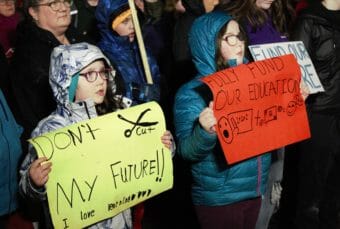
Students, parents and teachers hold signs calling for increased education funding outside the Alaska State Capitol on Jan. 23, 2023. (Katie Anastas/KTOO)

Educators, students and parents gathered on the steps of the Alaska State Capitol Monday night to call for more education funding.

Tom Klaameyer is president of NEA-Alaska, a statewide union of public school employees. He said state funding is at the root of stalled negotiations with teachers’ unions across the state.

“Districts want to hire the best and the brightest for their students,” he told the crowd. “They want to provide solid healthcare benefits, and they don’t want to cut programs and shutter schools. But they’re stuck between a rock and the BSA.”

The BSA — or base student allocation — is the amount of money per student school districts receive from the state. It hasn’t increased substantially since 2017. Last year, the state approved a $30 increase that goes into effect in July. But many school leaders say it’s not enough to keep up with rising inflation.

The Juneau teachers’ union declared an impasse in its negotiations with the district last month. Superintendent Bridget Weiss said the $30 increase isn’t enough to give teachers the contract they deserve.

Juneau School District superintendent Bridget Weiss speaks at a rally for education funding on Jan. 23, 2023. (Katie Anastas/KTOO)

“If we committed the $243,000 we would get from that $30 BSA solely to teacher salaries and nothing else, that would mean a 0.25% increase each year over each of the next three years,” she said. “It is inadequate.”

Gov. Mike Dunleavy has proposed keeping the BSA at $5,960 next year. The Alaska Association of School Boards is calling for an increase of at least $860.
“We are meeting increased needs with fewer resources every single day,” Weiss said. “When does the legislature get held accountable for putting us in this impossible situation by not fully funding one of the very most vital aspects of our Alaskan communities?”

Some rally-goers held signs calling for a $1,086 BSA increase.

But that’s not the only challenge legislators are considering this session. Juneau Sen. Jesse Kiehl has introduced a bill to give teachers the option to pay into a pension, which he said would help with teacher retention.

“That’s a lot of money,” Kiehl said, referring to a $1,086 increase. “That’s about $220 million. Are our kids worth it? You bet they are. I’ve got your first $15 or $20 million, because pensions cost less than the system we have today for retirement.”

Students like Dzantik’i Heeni eighth grader Inde Eckerson are experiencing the statewide teacher shortage firsthand. He said large class sizes are tough on teachers and distracting to students.

“I think our classes are way too crowded. We have too many people,” he said. “I mean, it’s fun, but it gets a little too crazy and then you can’t really learn.”

Several freshman legislators joined rally organizers on the steps of the capitol. Juneau Rep. Sara Hannan highlighted three legislators who left teaching jobs to come to Juneau: Rep. Maxine Dibert of Fairbanks, Rep. Rebecca Himschoot of Sitka and Sen. Jesse Bjorkman of Nikiski.

“We have dozens of new colleagues working with us who campaigned on this issue,” Hannan said.

The rally ended with a song led by Dzantik’i Heeni music teacher Mike Bucy.

“Education built the nation,” he sang. “Increase the base student allocation. Pass this legislative test, and give our kids the best.”

Bucy said he’s hopeful the 33rd Legislature will substantially increase school funding this year, and that reading and math scores will rise along with it.


Educators, students and parents rallied outside the Alaska State Capitol on Jan. 23, 2023, to call for an increase to the base student allocation. (Katie Anastas/KTOO)

Alaska’s teachers, parents and school leaders to rally for state education funding

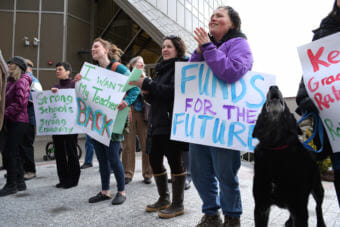
A dog joins in the chorus in support of greater funding for public schools at a rally on the Capitol steps in 2014. Almost 10 years later, educators are taking up the same cause at a rally planned for Jan. 23, 2023. (Photo by Skip Gray/KTOO)

Teachers, school administrators and parents plan to meet outside the capitol building in Juneau Monday night to call for more education funding.

Alaska funds school districts through a formula called the base student allocation, or BSA. It determines the amount of money per student a district gets from the state. 

The BSA hasn’t increased substantially since 2017. On Juneau Afternoon last week, Dzantik’i Heeni Middle School science teacher Cheyenne Cuellar said the BSA hasn’t kept up with urban Alaska’s consumer price index, which has increased by 15.4% over the last five years. 

“Since 2017, it’s only increased 0.5%,” she said. “Districts across the state are really feeling the impacts of this.”

The BSA increased by $30 last year. This year, the Alaska Association of School Boards is calling for an increase of at least $860. Gov. Mike Dunleavy’s proposed budget did not include an increase to the BSA, though he acknowledged “inflationary issues that need to be addressed.”

Dzantik’i Heeni music teacher Mike Bucy said flat-funding education impacts negotiations with teachers’ unions. The Juneau Education Association declared an impasse in its negotiations with the school district last month. Teachers and staff in Fairbanks have also declared an impasse.

“In the classroom, you can just feel that there’s not the resources – more and more students with fewer and fewer resources – year after year,” Bucy said. “That all goes back to the formula funding.”

State funding also affects district’s abilities to hire other workers, like bus drivers or paraprofessionals who work with special needs students. This fall, a shortage of bus drivers left Anchorage School District bus routes without service for weeks at a time.

Bucy said budget cuts hurt students, especially when class sizes have to go up.

“I know one of the sixth grade teachers this year started with 43 kids in his class,” he said. “These are 11-year-olds. 43 of them — many of them with special needs. How on Earth is he going to help a student that’s struggling with something in that class? It’s impossible.”

The Alaska Association of School Boards has also called for a defined benefit retirement plan for teachers. Juneau Sen. Jesse Kiehl has introduced a bill to give public workers, including teachers, the option to pay into a pension.

Monday’s rally will be at 6 p.m. at the steps of the capitol building.

Site notifications
Update notification options
Subscribe to notifications