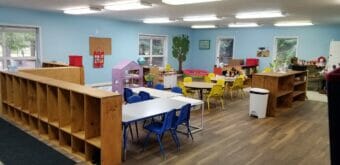
The Aurora Lights Childcare Center opened at Juneau’s Aldersgate United Methodist Church in 2018. (Photo courtesy of Barbara Mitchell)
Barbara Mitchell opened the Aurora Lights Childcare Center at Aldersgate United Methodist Church in 2018. The church, in Juneau’s Mendenhall Valley, offered an ideal space and discounted rent. Church families donated thousands of dollars to get it up and running.
“(Child care) centers seemed to be coming and going a lot for many different reasons,” Mitchell said. “We thought maybe it would be more steady if the church actually took it and ran with it.”
But Aurora Lights lasted less than five years. Its permanent closure — and the temporary closure of Gold Creek Child Development Center — have made Juneau’s long-standing child care shortage even worse.
A fifth of Alaska’s licensed child care providers have closed since the start of the pandemic, according to the state Department of Labor. Now, child care workers, advocates and state legislators are calling for a collaborative approach to rebuilding the workforce.
Aurora Lights closes amid labor shortage
The pandemic forced Aurora Lights and other child care centers to close for months. Once they reopened, they were competing for a shrinking pool of workers. Like other centers in Juneau, Aurora Lights raised its hourly wages to try to retain employees. It also increased the cost of tuition.
“It was our written policy to go up 3% every year,” Mitchell said. “But after a point, I just don’t see the parents paying more and more and more. Somewhere that has to quit.”
Hiring at Aurora Lights had been a challenge even before the pandemic. Background checks took two weeks to process, and by then, most applicants had found other jobs. Staffing ratios required by the state made it especially challenging to meet parents’ needs.
Finally, in October, Aurora Lights told families they’d be shutting down the coming March, when its administrator was set to leave. A drop in enrollment and loss of staff after the announcement forced them to close even sooner.
Kristi McGuire is the pastor at Aldersgate United Methodist Church. She said the shutdown was the culmination of ongoing hiring challenges.
“When you’re paying $35 an hour and you’re still not able to staff, something else needsto be addressed,” McGuire said.
Giving providers a seat at the table
McGuire said she’d like to see child care providers work together to identify problems and come up with solutions. A bill in the Alaska State Legislature could help make that happen.
Anchorage Democratic Rep. Zack Fields introduced a bill that would give child care providers the ability to collectively bargain with the state’s health department. Fields said the idea is to give providers a voice when the state makes decisions about funding and regulations.
“The state Department of Health administers ongoing streams of federal funding and regulates the child care sector,” he said. “I think the department should be very sensitive to input from the sector so that whatever they’re contemplating in terms of revised training or safety requirements, they should listen to sector input up front.”
Training requirements make it harder to hire employees at all levels. Administrators must earn a certain amount of college credit in early childhood development. Administrators and caregivers are required to do 24 hours of training each year. Usually, that training is unpaid and can’t be completed on the job.
Fields said a collective bargaining system would increase provider input about those kinds of requirements before they’re put into place.
“Historically, we’ve kind of pushed training without any way of rewarding people or keeping people,” he said. “There haven’t been sufficient financial incentives for people to get training and stay in the sector.”
Fields said more and more state leaders are recognizing the economic impact of child care shortages.
“When we’re a place where people can afford a house, the education system is at least decent, and child care is available, people will move here rather than moving to places where those things are less affordable or less available,” he said. “That is a very sound economic development strategy.”
The bill would also establish a child care provider fund, which would give financial support to providers through grants. A version of the bill passed the House last year but got stuck in the Senate Labor and Commerce Committee.
The next hearing on the bill is set for Friday, Feb. 10.
A local model
Juneau’s city government took a similar approach to its local child care shortage in 2018, when the Assembly appointed a child care committee made up of providers, school district leaders and Assembly members.
Blue Shibler, executive director of the Southeast Alaska Association for the Education of Young Children, was on that committee. She spoke to the House Labor and Commerce committee in support of Fields’ bill.
“You can’t pay a worthy wage and also make it affordable for parents,” she said in an interview. “That brought about the realization that had been talked about across the nation for decades: that there needs to be a public subsidy of child care.”
The committee recommended the city create a loan fund for child care startups. That program still exists through the Juneau Economic Development Council.
“I think, prior to these two centers closing, those operating subsidies cushioned Juneau a little bit from the effects of the pandemic,” Shibler said.
As the industry deals with the labor shortage, Shibler said it needs help from the state. Otherwise, workers will keep opting for jobs that pay better, provide benefits, are less stressful and have fewer unpaid training requirements than caregiving.
“To make child care jobs attractive again, and make people want to come to them and be able to afford to do them, we need a sizable investment,” Shibler said. “And it’s possibly one that a municipal government can’t afford on its own.”
As legislators decide whether to take on that investment, many Juneau parents are stuck on waitlists, hoping to claim spots at the handful of centers left.
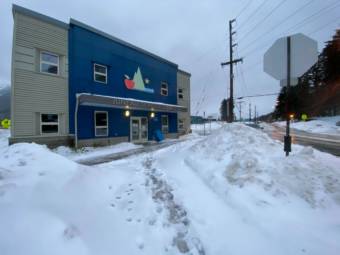
Piles of snow sit in front of the empty Juneau School District offices on Glacier Avenue in Juneau on Monday, Jan. 10, 2022. (Photo by Bridget Dowd/ KTOO)
Juneau School District leaders are gearing up for major budget decisions over the next two years as enrollment declines and major funding sources expire.

At a public budget forum Thursday, Administrative Services Director Cassee Olin said the district is facing a $4.7 million deficit next fiscal year.
The $30 increase to the base student allocation increases state funding to the district by $243,000, according to Superintendent Bridget Weiss. But it’s not enough to keep the district out of a deficit as costs go up and enrollment goes down.
The district still hasn’t felt the full financial impact of an 11% enrollment drop from 2020. That’s because of the state’s hold harmless provision, which helps districts who’ve lost students by gradually reducing the amount of state funding they receive over the course of three years instead of immediately.
That provision gave the district an extra $2.1 million in state funding this year, according to Olin. Next year, that money goes away.
Elementary, middle and high school principals shared their budget priorities with district leaders at Thursday’s forum. They included avoiding increases to class sizes and retaining reading specialists and counselors.
The district will be in a similar position next year, when one-time COVID relief from the federal Elementary and Secondary School Emergency Relief (ESSER) Fund runs out. Weiss said the district has an estimated $1.6 million in ESSER funds to spend next school year.
“So there’s another consideration as we look down the road to FY25 and how we’re going to manage that stair step away from ESSER, like we’re having to manage this year the stair step away from hold harmless,” she said.
District and city leaders began discussing longer term financial plans for the district at a meeting Friday. Enrollment projections show the district will likely have 1,100 fewer students in 2032 than it does now.
“It’s unsettling, and it’s not the demographic trend that any of us wish, but I think the data supports it,” City Manager Rorie Watt said.
“Changes in the projections are really only going to come from us believing that people are moving into Juneau and moving into the region and our population’s going to grow, and I don’t think anybody’s really predicting that to any significant degree,” Watt said.
Weiss said a proposed $1,000 increase to the base student allocation offered “a glimmer of hope” for future years.
In the meantime, the Juneau school board must come up with a balanced budget by March. It will go before the Juneau Assembly for final approval in May.
Educators, students and parents rallied outside the Alaska State Capitol on Jan. 23, 2023 to call for an increase to the base student allocation. (Photo by Katie Anastas/KTOO)
Teachers, school administrators and elected officials spoke in favor of increased education funding at a Senate Education Committee meeting Wednesday.
The committee has introduced Senate Bill 52 to raise the base student allocation, or BSA — that’s the amount of money per student that school districts get from the state — by $1,000.
Teachers from around the state spoke in favor of a funding increase, saying it would help reduce turnover.
“The morale of the young teachers, a lot of them that are single wage earners just getting started, are so low,” said Fairbanks teacher Thomas Kennedy. “They’re the lowest that I’ve seen in all my years of teaching.”
“Underfunded schools are a major factor driving away young, skilled and professional families,” he said. “Families who would love to contribute to the growth of our state’s economy, but are not willing to sacrifice their children in a subpar education system.”
Some speakers opposed a funding increase, saying changes to curriculum or expanded access to private schools would be better ways to improve student outcomes. More than half of Alaska students tested below grade level in reading and math last year.
But Danielle Specht, a teacher from Kodiak, said inadequate funding hurts student performance by leading to high turnover rates among teachers and support staff, including those who help with reading instruction.
“If we want to improve student outcomes, we need to not have staff turnover like we do,” she said.
School districts across the state have received more than $500 million in COVID relief funds from the federal government, starting with the CARES Act in March 2020.
Anchorage School Board member Kelly Lessens said, ideally, that money would fund the extra math and reading support many students needed after online learning. Instead, she said, the Anchorage School District has used some of it to close budget gaps and avoid increasing class sizes.
Jessica Paris, a parent and former teacher in Juneau, said keeping class sizes low should be a priority. She said when extra funding allowed her class to drop from 30 to 25 students, her relationship with the students improved.
“Each got more talking time, more performance time, more comfort with their peers, more chance to shine,” she said. “I also knew them better, so I was able to pick up when I had a freshman who was initiating marijuana use and another who was abusing alcohol.”
That was 20 years ago. Now, she says her own kids’ classes are much larger.
“My children have had 30 students in their elementary class, 43 in their middle school English class, 40 students in their high school history and English classes, 50 in their PE,” Paris said.
Last year’s Alaska Reads Act included a $30 increase starting in fiscal year 2024. But many district leaders say it’s not enough to keep up with rising costs.
A $1,000 increase — the highest one-year increase ever — would make the BSA $6,960 and, according to legislative finance division Director Alexei Painter, add $257 million in state education funding. But even that might not keep pace with inflation. Painter said that matching the buying power of the 2017 BSA would require an increase of $1,195.
The committee will hear additional public comment about the proposed increase to the BSA on Wednesday, Feb. 8.
A view from the Goldbelt Tram of a Princess Cruises ship docked in Juneau on Aug. 31, 2021. (Photo by Jennifer Pemberton/KTOO)
The Juneau Assembly approved a list of tourism industry policy objectives Tuesday night. They outline the city’s goals for negotiating with cruise ship companies and developing local tourism infrastructure.
The city hopes to curb issues like crowding and air pollution in the downtown area. Its objectives are to limit cruise ships to five per day in the downtown port, complete construction of the Seawalk, increase the city’s input in ship scheduling, electrify cruise ship docks and develop goals for emissions and congestion mitigation.
Some Juneau residents, like Steve Krall, told the Assembly that a five-ship limit wasn’t enough.
“We’ve got too many people in too small an area,” he said. “Downtown hasn’t gotten any bigger, the sidewalks aren’t bigger, the roads aren’t bigger. We’re at the point where capacity really is the issue.”
Assembly member Maria Gladziszewski said they received several emails asking for a three or four-ship limit. She said the city would likely face legal opposition if it tried to enforce such a cap.
“We would be in litigation immediately,” she said. “It would take years and would cost a lot of money.”
“Some people will say it’s not a big enough step. I would say at least it’s a step,” she said. “We’re going to be the first Assembly that has actually tried to tackle some of these issues, so give us some time to ease into it.”
The Assembly appointed a Visitor Industry Task Force in October 2019. In March 2020, the task force presented 45 recommendations. Those recommendations inspired the five policy objectives approved Tuesday night.
Also on Tuesday, the Assembly voted against appropriating $300,000 for cruise ship dock planning at the downtown subport. Norwegian Cruise Line donated the land to the Huna Totem Corporation, which hopes to build a visitor center and cruise ship dock there by 2025.
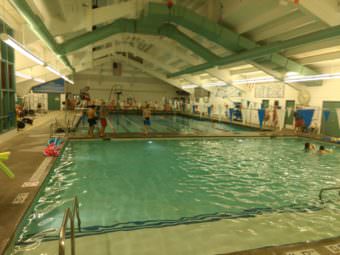
The Augustus Brown Pool in downtown Juneau on May 3, 2017. (Photo by Jacob Resneck/KTOO)
Swim lessons are in high demand as Juneau faces a shortage of lifeguards and instructors.
The city’s parks and recreation department opened registration for a parent and toddler class on Friday. The 10 spots were claimed within minutes, according to the city’s aquatics manager, Terra Patterson.
She said a shortage of lifeguards has led to a shortage of swim instructors.
“It’s really hard to offer swim lessons when a lot of your instructors are also lifeguards,” she said. “If you don’t have lifeguards to stand on the pool deck, you can’t put people in the water to teach.”
That shortage, along with pool closures during the height of the pandemic, impacted kids of all ages. The city offered a limited number of classes last year, but not enough to serve all the kids who needed them.
“In addition to all these young children who need to get into lessons to learn how to swim, we have all these kids that for two plus years haven’t been able to get into swim lessons,” Patterson said. “It’s a compounded problem.”
The city’s pool supervisors are now trained to teach new lifeguards, which has helped reduce the shortage. But more broadly, Patterson said, the pools are facing the same labor shortage as other city employers.
Patterson said getting young kids comfortable in the water is vital, especially in Southeast Alaska.
“If they are scared of the water, they don’t want to put their face in the water and they don’t feel comfortable in the water, they can’t relax enough to learn how to float,” she said. “Floating is the first stage of learning how to swim.”
The parks department will offer a second parent and toddler class at the Dimond Park Aquatic Center next month. Registration for that class will open on Feb. 16.
Class registration for kids three and up will also open Feb. 16. Those classes will be at the Augustus Brown Swimming Pool.
The Augustus Brown pool will close for renovations from April through at least December. Those staff will move to the Dimond Park Aquatic Center, allowing the city to offer year-round lessons after school and during the summer.
Close
Update notification options
Subscribe to notifications
Subscribe
Get notifications about news related to the topics you care about. You can unsubscribe anytime.