Katie Anastas

Local News Reporter, KTOO
Outgoing Juneau superintendent will help University of Alaska recruit teachers

Juneau School District superintendent Bridget Weiss speaks at a rally for education funding on Jan. 23, 2023. (Katie Anastas/KTOO)

The University of Alaska is tapping outgoing Juneau School District Superintendent Bridget Weiss to help build the state’s teacher workforce.

Weiss has been named the first-ever liaison for the Alaska College of Education Consortium. According to the university, Weiss will help the education program partner with school districts, state government and other stakeholders.

Weiss said she’s looking forward to strengthening the connection between Alaska’s K-12 and university systems. She chairs the Alaska Superintendents Association, and she said her relationships with local school leaders will be key to this position.

“I feel like my experience really lined up so nicely with this opportunity,” she said. “I’ve been in K-12 for a very long time, and this seemed to be the right way to use all the experiences that I’ve built over those 39 years in a constructive way, from a different angle.”

One of her goals is to increase the number of students dual enrolled in high school and college courses, especially for those pursuing teaching degrees.

“When high school students earn college credit in our system, that’s a big head start for them,” she said. “It’s more likely that they’ll become full-time students in our state university system. And when we produce teachers in our state system, they’re very likely to stay in the state.”

At a presentation to the state Senate Education Committee this week, university leaders showed a map displaying percentages of school district staff who graduated from the state’s university. The lowest percentages were in Northern and Western Alaska, where districts have increasingly relied on teachers from the Philippines

“We have capacity in our education programs,” UA President Pat Pitney said. “We need more students.”

The university already has several strategies to recruit teachers within the state, including a mentor program to support early career teachers and a teacher placement program to help school districts fill vacancies. It also supports Educators Rising, a nationwide program meant to help high schoolers pursue teaching careers.

“But we’ve got some things that are bigger than what the university alone can do,” Pitney said, referring to public school teacher salaries and retirement systems.

Weiss said she’s looking forward to advocating for changes to state policy as part of her new position.

“If we don’t have the foundational core of a defined benefit retirement and adequate funding, it’s going to be much harder to entice kids into this field,” she said.

Weiss announced her departure from the superintendent position in October. She’ll stay in Juneau for her new job, which starts July 1.

Juneau tour company hopes to offer e-bike tours on Douglas Pioneer Road

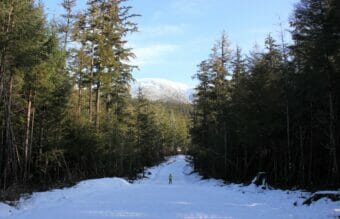
In winter, the Juneau Nordic Ski Club grooms the West Douglas Pioneer Road. A handful of skiers were there on Monday, Feb. 20, 2023. (Photo by Katie Anastas/KTOO)

Guided e-bike tours could come to Juneau for the first time this summer.

iRide Alaska has applied for a permit from the city to use the West Douglas Pioneer Road for e-bike tours. According to the permit application, the company would offer three tours per day, six days a week from May 1 to Oct. 30.

Reuben Willis, one of the co-owners of iRide Alaska, spoke at a Juneau Assembly Lands, Housing and Economic Development Committee meeting on Friday. He told city leaders the e-bike tours would help the company offer more activities to tourists and generate sales tax for the city.

“We think this could be a win-win,” Willis said.

Tours would cost $149.95 per person, he said, and a small portion could go to the city. iRide Alaska pays a $3 user fee per person to the city when they take tourists to the Rainforest Trail. Willis said they could have a similar policy for the West Douglas Pioneer Road.

That extra funding would be welcome, said Juneau Lands and Resources Manager Dan Bleidorn. At the meeting, he said upkeep for the city-owned road costs $10,000 to $20,000 per year.

In the summer, Bleidorn said, the gravel road is used for hiking, biking and firewood harvesting. The Nordic Ski Club grooms the trail in the winter. The city has also allowed the Alaska Department of Fish and Game to study bats there and the U.S. Geological Survey to monitor nearby streams.

“This actually isn’t a trail, it isn’t a road, it’s more like driveway access to city property,” Bleidorn said.

Whether it’s a trail or a road could make or break iRide Alaska’s plans for e-bike tours. Christopher Mertl, chair of the city’s Parks and Recreation Advisory Committee, said e-bikes aren’t allowed on Juneau trails because they’re considered motorized.

“The Parks Service, the Forest Service, everybody is trying to figure out where this gray mode of transportation fits,” Mertl said. “I just want to offer a little bit of caution before we jump into this with both feet into the pool here, that it may have repercussions beyond just this one proposal before us.”

The lands committee forwarded the permit application to the full Assembly. The Assembly’s next meeting is on Monday, Feb. 27.

Newscast – Friday, Feb. 17, 2023

In this newscast:

  • Alaska is slated to get $285 million from the federal government to modernize its ferry fleet
  • Juneau city leaders propose spending marine passenger fees on a range of city services and projects
  • A longtime state employee has been chosen to lead the Alaska Division of Elections
  • The Alaska Native Sisterhood in Juneau celebrates Elizabeth Peratrovich Day

You can weigh in on how Juneau spends marine passenger fees this year

The Seawalk reaches from Marine Park to the Franklin Street dock. (Photo by Heather Bryant/KTOO)

City leaders expect 1.6 million passengers to visit Juneau this summer. It would be a nearly 50% increase from last year’s estimated 1.1 million.

Each of those visitors generates money for the city through fees charged to cruise ships: a $5 marine passenger fee, $3 port development fee and $5 state commercial passenger vessel fee. If the 1.6 million passenger expectation becomes reality, they would generate $21.5 million in revenue.

“We’re gearing up for a really, really big season this year,” said Juneau Tourism Manager Alexandra Pierce.

Pierce has proposed putting that money toward a range of city services and projects. They include $10 million for the Seawalk, $2 million for Marine Park improvements and $1 million for the proposed Capital Civic Center.

A 2019 settlement agreement with the Cruise Lines International Association Alaska limits the city’s use of marine passenger fees. Some projects require approval by the tourism industry. This year’s list  includes proposed improvements to Homestead Park, the viewpoint on Douglas Island directly across from downtown Juneau. Pierce said that project could involve rebuilding the staircase down to the water.

“We’re pretty encumbered on how we can spend the funds, but we also want to make sure that we’re spending them in a way that not only supports the visitor industry but also creates lasting assets for the community, which is why something like the Seawalk is a major priority,” Pierce said.

Some of the allocations came from project proposals submitted by city departments and the public in December. For example, Capital Transit proposed adding information screens at the transit center to help tourists use city buses more easily. The proposed list includes $75,000 for more signs at the transit center and at Peratrovich Plaza by the cruise ship docks.

“An interesting thing that’s happened in the last year is an uptick in the number of tourists using the city bus and taking it to where it drops off on Dredge Lake [Road], which is still about a mile from the glacier,” Pierce said. “We’ve realized we need to improve signage and wayfinding for that new increased use.”

The list also includes $50,000 to study seasonal worker housing. Other proposed allocations would support police, emergency medical services and street cleaning.

Juneau residents can send their comments to Pierce until March 17 by mail to the city manager’s office or by email to alexandra.pierce@juneau.gov.

Those comments will be submitted along with the proposed list to the Juneau Assembly’s finance committee. The Assembly will consider the final list during its budget cycle this spring.

Juneau preschoolers ask legislators to ‘have a heart’ for kids this session

Juneau preschoolers prepare to hand out Valentine’s Day cards to legislators on Feb. 13, 2023. (Photo by Katie Anastas/KTOO)

Preschoolers, parents and advocates delivered Valentine’s Day cards to Alaska state legislators Monday, asking them to “have a heart” for kids as they make budget decisions this session.

Nikki Love, community engagement coordinator for the Association for the Education of Young Children, pulled a red wagon full of cards through the front doors of the Capitol.

“We have an over 20 year tradition of bringing valentines to our state lawmakers,” she said. “We make personal visits to as many as we can in their offices, and then greet them on their way into the committee room and ask them to please prioritize children when they’re making policy.”

Juneau preschoolers walked the halls of the Capitol building on Feb. 13, 2023, to hand out Valentine’s Day cards to legislators. (Katie Anastas/KTOO)

Love says it feels especially urgent this year, as school districts across the state call for more education funding, and childcare workers in Juneau push for higher wages.

“We have to make these jobs worthwhile to people,” she said.

The cards featured photos of the kids at school, with construction paper hearts and handwritten signatures. The group walked into legislators’ offices to drop them off. 
For five-and-a-half-year-old Aven McKenry, the cards were also a chance to practice cursive.

“I love cursive,” she said. “It’s pretty fun because I get to write in different shapes of the letters.”

Her mom, Sadie McKenry, hadn’t been to the Capitol since high school. She said even if these kids are too young to understand the importance of school funding, visiting the Capitol is valuable.

“I think it’s really important that kids understand how the government works so they can better use their voice,” she said.

Soldotna Rep. Justin Ruffridge reads a Valentine’s Day card before walking onto the House floor on Monday, Feb. 13, 2023. (Katie Anastas/KTOO)

Gov. Mike Dunleavy wasn’t available, but the group dropped the biggest card in the wagon off at his office. It included a collage of photos of the students and was signed by each one of them. Inside was a request to increase the state’s funding per student by at least $1,000.

Fairbanks Sen. Scott Kawasaki said the kids made a strong impression.

“Just seeing their bright eyes at 10 in the morning is a real treat,” he said. “We’re going to be talking about early education, funding K-12, all the way to the university, and it’s a big deal that they’re here today.”

Monday’s schedule included committee meetings on childcare and the public education workforce.

The kids handed out the rest of their cards as legislators walked onto the House floor. Parent Liam Thier said he hoped the visit put a face to the policy decisions lawmakers are considering this year. 

“You get to see who it’s benefiting,” he said. “It’s a reminder that this is the future.”

A school bus full of preschoolers, their parents, caregivers and advocates pulled up to the Capitol building on Monday to hand out Valentine’s Day cards to state legislators on Feb. 13, 2023. (Katie Anastas/KTOO)

Another Juneau elementary school is likely to be designated for Title I status

Mendenhall River community school
Juneau’s Mendenhall River Community School (Photo by Heather Bryant/KTOO)

Students at Juneau’s Mendenhall River Community School likely will have more reading support next year, when it’s expected to be designated as a Title I school.

Title I status is based on the percentage of students who receive free or reduced lunch. The district expects 35% of students at Mendenhall River Community School to participate in the meal program next year — up nearly 10% from 2019. The school’s change in status means it would get a share of the federal funding the state allocates to the district for Title I schools. 

Ted Wilson, director of teaching and learning support for the district, said all Title I schools in the district get reading interventionists. They meet with small groups of students who need extra help and advise teachers on reading instruction.

The school’s principal and other leaders will consult with staff and parents over the next few months to decide how to spend the rest of the money.

“They will also have some supply and operational money that they can use for additional resources that they might use for interventions for math or reading,” Wilson said at a school board meeting Tuesday night.

The federal government paid for universal free meals regardless of income for two years because of the pandemic. But a lack of awareness about that program’s end left many school districts with fewer applications this school year than they had before the pandemic.

In a report to the board, Wilson said the number of students in Juneau schools receiving free and reduced lunch has been rising back toward 2019 levels. Sitʼ Eeti Shaanáx̱ Glacier Valley and Kax̲dig̲oowu Héen Elementary School still have 10% fewer students getting free and reduced lunch than they did in 2019.

The Juneau School District had three Title I schools a decade ago. The addition of Mendenhall River Community School would bring the total to five.

Site notifications
Update notification options
Subscribe to notifications