KCAW - Sitka

KCAW is our partner station in Sitka. KTOO collaborates with partners across the state to cover important news and to share stories with our audiences.

AK: The Sitka Sentinel remains a family affair

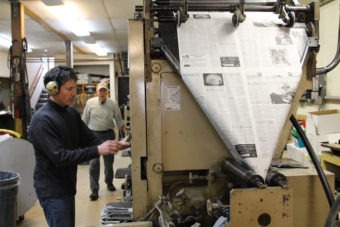
James Poulson and his father Thad operate the printing press
James Poulson and his father Thad operate the printing press, which is the same piece equipment used by the family to print the paper in 1969. James was four years old then and has since become the staff photographer. (Photo by Emily Kwong/KCAW)

The Sitka Sentinel celebrated its 75th anniversary last year without much fanfare. As many newspapers in big cities have folded or turned into online only operations, the Sentinel steadily churns out five issues a week.

The paper is owned and edited by Thad and Sandy Poulson, reporters who arrived in 1969 and are determined to keep the press running.

“Come on back, there’s something kind of interesting,” Thad Poulson said, winding his way through the print shop.

On our right is a giant orange machine – a printing press that was state of the art when Poulson arrived in 1969 – and continues to churn out every issue of the paper to this day. But that’s not what Poulson is excited about. He motions to the back room, his fingers covered with ink.

Sandy Poulson
Sandy Poulson is the city editor. She and Thad met while working at newspapers in Oklahoma City, where her first job was to write obituaries. She continues to write them with the care for the Sentinel, saying, “Some newspapers charge for obituaries. I can see that in a big city, but in small towns, it’s news. We try to do a good job.” (Photo by Emily Kwong/KCAW)

“Things are kind of inky back here, so be careful not to touch things,” Thad said.

Before us is their brand new CTP machine, which stands for computer-to-plate. The plate works like a rubber stamp—getting covered with ink and smooshed by the press onto large banks of paper. But instead of rubber, it’s a giant square of aluminum.

“So it’s going to emerge fully developed within three minutes,” Thad said, feeding the plate into the machine. “There it goes!”

Lasers will etch the words and images of the front page onto the plate’s surface. There’s a story about a Coast Guard rescue and Medicaid reform. The lead photo is of a little boy getting his head shaved for St. Baldrick’s, a cancer fundraising event. Transferring his face onto the front page would have been a three step process before, involving cutting and pasting and a lot of manual labor. With the CTP machine, that imaging process is entirely digital.

“This thing takes an hour at least an hour of the production process,” Thad said.

The Sentinel’s first editor was Harold Veatch in 1939. Alaska wasn’t yet a state. Franklin Delano Roosevelt was president. And the reason the paper’s still around – surviving the digital revolution and the folding of papers around the country – is through the steady devotion of one newspaper couple, Thad and Sandy Poulson. They have been working at the paper since 1969.

“It’s all we know how to do. We talk about that sometimes. What if we weren’t here? What if we had something? Well, what else can we do?” Thad said. “This is the path we’ve charted for ourselves, so here we are.”

Thad Poulson scrupulously inspects issues of the paper that arrive hot off the press
Thad Poulson scrupulously inspects issues of the paper that arrive hot off the press. Their process has been expedited by a new CTP imaging machine, which the paper bought on their 75th anniversary. (Photo by Emily Kwong/KCAW)

And the Sentinel really is a family production. Thad and Sandy co-edit. They met while working at papers in Oklahoma City. He’s 79 and she’s 75. Their son James Poulson takes all the pictures. There are two general assignment reporters and a handful of additional staff members. In addition to copy editing all the content, Thad runs the press in the basement, just as he did when he was 36.

As issues arrive hot off the press, he flicks them to check for ink spots and clear jams.

As for Thad’s wife Sandy?

“She’s the quarterback of the team,” Thad said. “She decides what’s going to be on the front page and chooses the write stories and writes the headlines.”

Nowadays, Sandy culls national stories from the Associated Press with a few clicks of the mouse. But in the beginning, she was tethered to news of the world through a single wire service that typed at 60 words a minute.

“DEDDEDEDDDEDE – except five times louder,” James Poulson said. He was four years old when his parents took over the paper, called growing up in a 1970s newsroom “tumultuous.”

“When there’s an important breaking story, a bell would go off and I just remember when I was a kid, the bell would go off quite a bit because it was during Watergate,” James said. “Lots of breaking news.”

James Poulson makes sure the ink is evenly distributed on the press.
James Poulson makes sure the ink is evenly distributed on the press. The son of two newspaper owners, Poulson grew up to the sounds of teletype machine delivering news from around the world. (Photo by Emily Kwong/KCAW)

James says his parents have tried their best to keep up with technology over the years.

“Dad is kind of an early adopter,” James said. “He was sending out e-mails back when it was like sending out Morse code.”

But that doesn’t mean that it’s been easy to adapt. The CTP machine cost $50,000, which is why it took the Sentinel so long to incorporate it. But the paper is profitable. That’s partly because the operation is mostly a family affair.

“I wouldn’t recommend it for a business model and I’ll tell you why,” Thad said. “What if we want to move on? Do something else? Transfer ownership? The salaries we’ve been paying ourselves on the books won’t cover half of what you have to pay the people who will do it in real life.”

Thad and Sandy met working for city papers in Oklahoma, but had to change their approach to reporting in Sitka. This is especially true with the obituaries, which Sandy takes particular pains to write. She invites the family to weigh in in their own words.

“With age I realize more and more the importance of having some sort of legacy or having your life on record somewhere,” Sandy said.

The Sitka Sentinel is a daily paper that serves a community of 9,000, which owner Thad Poulson considers “extraordinary.” “Sitka has the advantage of its isolation. It’s a good newspaper town.” (Photo by Emily Kwong/KCAW)

It’s the kind of personal touch that only newspaper in a town of 9,000 can bring.

“We are a daily paper in a weekly sized town. It works very well for us, but it’s the exception rather than the rule.”

Within 20 minutes, the print is done. And 2,500 issues are stacked and ready for distribution. Thad looks over me a triumphant grin.

“Another day, another dollar!” he said.

Thad Poulson says circulation is double what it was in the 1970s and that as long as Sitkans still want a daily paper, he intends for the Sentinel to be around.

PSP: tribal partnership seeks modern solution to an ancient problem

Esther Kennedy of the Resource Protection Department collects water samples every week from Starrigavan.
Esther Kennedy of the Resource Protection Department collects water samples every week from Starrigavan. Along with six other tribes in Southeast, the group is working to create an early warning system to protect shellfish diggers from PSP. (Photo by Emily Kwong/KCAW)

Of all the traditional seafoods in Southeast Alaska, none are more shrouded in myth — and genuine risk — than clams and mussels. Paralytic shellfish poisoning (PSP) killed two people in Southeast in 2010 and dozens more have fallen ill over the recorded history of the state.

For subsistence harvesters, there has been no way to measure the risk of clam digging — until now. In part 1 of a two-part series, KCAW reports on a partnership among Southeast tribes to create a regional water monitoring program.

In Southeast, between Chicagof and Baranof Islands, there’s a waterway called Peril Strait. The name doesn’t come from winds ripping through the channel, but from a shocking event that happened in 1799.

“A Russian ship came in and the villagers had gone out and collected a bunch of clams from an area now called Poison Cove,” explained Jeff Feldpausch, the Resource Protection Director for Sitka Tribe of Alaska.

The incident he’s describing is the earliest documented case of PSP in the state. After eating the shellfish, 100 Aleut crew members of fur trader Alexander Baranof – died. Feldpausch added, “They only made it a few miles to the area that’s now called Dead Man’s Reach.”

Eat the wrong clam and you can die on the beach. That’s the grim pathology for PSP, which one state publication in 1982 called “Alaska Roulette.” In order to protect subsistence harvesters, the Sitka Tribe decided to invest in the latest science and to look really closely at what the clams themselves are eating.

aralytic shellfish poisoning is transmitted through bivalves, especially butter clams, mussels, and cockles. But it all begins in the water, in the naturally produced toxins of certain kinds of plankton. (Photo by Emily Kwong/KCAW)

I met Esther Kennedy of STA’s Resource Protection Department near the Starrigavan dock. She took note of the day’s conditions. “So it’s 10AM, it’s sunny, it’s calm.” Every Tuesday, Kennedy starts her morning by collecting water samples. From far away, it looks like she’s flying an underwater kite, dragging a net sedately through the water as microscopic creatures called phytoplankton get trapped inside.

“Most plankton is just beautiful and it looks like little Christmas ornaments and I have no problem with that,” said Kennedy. “But it’s a little bit unnerving to be looking at that and be like, ‘How many of those have I swum through in the past?’”

Alexandrium is a genus of dinoflagellates that leads to Paralytic Shellfish Poisoning. This cell was identified by a team of researchers at NOAA’s biotoxin testing lab in Seattle. (Photo courtesy of NOAA).

The vast majority of phytoplankton are totally harmless. But a few of them, particularly of the genus Alexandrium (they look like an acorn under the microscope) produce a chemical called Saxitoxin. Saxitoxin is 1000x more potent than cyanide, so potent it’s listed as a chemical weapon by the US military. Saxitoxin is what’s responsible for PSP.

The timer beeps. Three minutes are up and Kennedy pulls up net and bottle – now filled with water. She’ll take these drops of water back to a lab, and using a microscope, count what kinds of phytoplankton, toxic or not, are in the water that week.

So, how do these tiny creatures poison us? It works like this: when toxic-bearing phytoplankton accumulate in the water, it’s known as a harmful algal bloom, or a HAB. Some HABs are visible, even red, earning the nickname “red tide,” but many are not. As shellfish feed, the bloom’s toxins get trapped inside and have the potential to poison whoever eats the shellfish, whether a sea lion in Kodiak or a subsistence user in Klawock.

SEATT partners are monitoring for other kinds of toxic phytoplankton, such as Dinophysis. “It kind of looks like a pitcher filled with punch with Sangria,” said Kennedy. “We’re worried about that because it produced diuretic shellfish poisoning, which is very unpleasant but not high priority.” (Photo courtesy of Esther Kennedy)

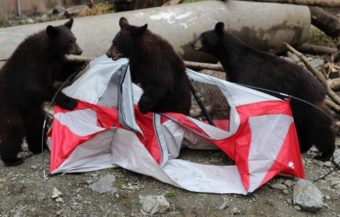
“Here we are living with hundreds of bears wandering that will wander through the streets, but everyone is worried about the clams,” said Chris Whitehead, STA’s Natural Resource Specialist.

Chris Whitehead joined STA’s Resource Protection Department in the fall of 2013. In his former home of Washington State, there’s a hotline you can call to know which beaches are safe for shellfish digging.

WA HOTLINE: You have reached the Washington State Department of Health Shellfish Safety Hotline…

No such system exists in Alaska, so Whitehead wanted to create a local solution. He pitched the idea for a HAB monitoring program to several tribes. The response was instant.

“This is kind of the first step or kind of the poster child for collaboration on environmental issues,” said Jeff Feldpausch. Six other tribes have signed on for the project. Together, they form Southeast Alaska Tribal Toxins group, or SEATT, with membership from Sitka, Juneau, Yakutat, Petersburg, Klawock, Craig, and Kasaan.

Matt Anderstrom does the water testing for the Yakutat Tlingit Tribe at the Yakutat Lagoon. Two weeks ago, the lab saw its first sighting of Alexandrium – that’s the one that makes Saxitoxin. It was spotted by his younger daughter, Nellie.

“I’ve got flashcards and identification keys,” said Anderstrom. “[My daughter] was asking what the bad ones look like and as soon as she seen it, she lit up and was like, ‘That’s it, right there!”

Identification keys from NOAA’s Phytoplankton Monitoring Network in Charleston, SC.
Identification keys from NOAA’s Phytoplankton Monitoring Network in Charleston, SC. Representatives came to Alaska to provide training to SEATT’s field workers. (Photo by Emily Kwong/KCAW)

Using the data field workers like Anderstrom and Kennedy are gathering, each tribe hopes to eventually create an early warning system for toxic bloom events in their area. In Sitka, Feldpausch imagines it will be a stoplight published in the daily paper.

“A green should be good to go, a yellow is proceed with caution, and a red, we have found saxitoxins out there,” said Feldpausch.

Right now, the Sitka Tribe is only testing the waters at Starrigavan. Feldpausch recognized that may not be enough for some harvesters.

“Eventually we may be able to grow and do other areas,” he said, “But I imagine there’s probably 50-60 beaches around here that people get their shellfish from. There’s no way to cover all those areas.”

Each tribe has focused their first year of fieldwork on one site and for Sitka, the choice of Starrigavan is strategic. In 2013, two locals suffered mild PSP cases in the middle of October.

White explained, “It used to be wintertime was somewhat safe, you didn’t have to worry about it. But because of climate change and warming conditions, the bloom may last all the way through October, November.”

So the old rule of thumb, that safe harvesting months had an “R” in them, basically September through April, is no longer true. In 2012, Alaska Magazine got in trouble with the state for saying otherwise. With PSP a threat any time of year, Whitehead says it’s more important than ever for communities to reclaim their beaches and know exactly what lurks in the water.

For more on PSP safety and prevention, check out the Alaska Department of Environmental Conservation’s fact sheet.

Closing after 65 years, Brenner women look to the future

Once a dress shop in Nome, “Vi’s Apparel” moved to Sitka in 1949 and Bonnie Brenner convinced her parents to purchase it at the age of 19. Brenner’s closed its doors last month after 65 years. (Emily Kwong/KCAW photo)

The doors of one of the oldest family-owned stores in Sitka closed last month. Brenner’s Fine Clothing & Gifts has been a staple on Lincoln Street for the past 65 years, and after nearly 50 years of management, owner Bonnie Brenner decided to retire.

KCAW sat down with Bonnie and her assistant manager, Stephanie Brenner, during the store’s last few weeks, to talk about what’s ahead, both as business partners and as a mother-daughter duo.

Walking into Brenner’s awakens all the senses. A little bell rings when you open the door. Painted rain boots and cozy sweaters adorn the wall. The front tables display soap satchels and fine scented pillar candles. Brenner’s is the place you go when you want a little something special for your friend, or for yourself.

“This is a destination store,” said owner and manager Bonnie Brenner. “I know a lot of people that, if they come to Sitka, they’re coming to Brenner’s.”

Brenner’s Fine Clothing & Gifts officially closed its doors to shoppers on March 30th. The store relocated to Sitka from Nome in 1949, where it was known as “Vi’s Apparel.” Bonnie Brenner began working there after school, and loved the store so much, she negotiated the sale with the owners – Duke and Vi Mitrovich – in 1962 or 1963, at the tender age of 19.

“[Duke and Vi] were getting ready to retire and I just said, ‘What are you going to do with it?’ I wanted to buy it,” said Bonnie Brenner. “I didn’t have any money! And my mom worked for a doctor. She’d never done retail.”

(L to R): Stephanie and Bonnie Brenner said one of their big secrets to keeping merchandise interesting was buying items at gift shows around the country. Both women love to travel. (Emily Kwong/KCAW photo)

But the family bought it and renamed it Brenner’s, moving the store three times into gradually larger spaces. For Bonnie, the teenager entrepreneur, the appeal was not only the clothes, but the opportunity to hand pick items at markets outside of Sitka.

“I found out that when I went to college that you could go to market and travel. And that’s the part that I liked,” said Bonnie Brenner. “I found out that I could leave this island and hop on a plane. Otherwise, I would have never left.”

Stephanie Brenner, Bonnie’s daughter, started working at the store when she was just ten, dusting racks, cutting tissues, and fashioning bows on an old fashioned machine. She remembers watching her mother and grandmother work

“They just were always women that worked,” said Stephanie Brenner. “It always seemed kind of glamorous to me because I can remember when my mom and grandma would travel to New York City and I thought, ‘Oh, they’re going to New York City!’ They’d always bring back something really – not extravagant – but something unusual you wouldn’t have in Sitka, Alaska.”

With time, Stephanie became assistant manager and got bit by the same travel bug. Pretty soon, Bonnie and Stephanie were making yearly trips to markets and gift shows around the country – to Atlanta, Dallas, Los Angeles and many times to Seattle. The pair have come back with plenty of stories. Some they couldn’t tell on the radio, and others…

SB: We met Richard Simmons and that was absolutely hysterical. He was hilarious.
KCAW: Wait, how does one even meet Richard Simmons?
SB: He was at the Atlanta Gift Mart. I even think my mom had her picture taken with him.

Brenner’s hosted several sales the last month of operation, to sell the remaining merchandise. Many customers came by to pick up items and say their goodbyes to the store. (Emily Kwong/KCAW photo)

Stephanie said that these little trips, which they sometimes called “research and development,” were a valuable way to keep the merchandise fresh. As the decades passed, the racks at Brenner’s would follow the ebb and flow of women’s fashion. Stephanie reminisced on the era of tuxedo blouses and some trends that have made a comeback.

One current trend Stephanie Brenner remembered from the past was, “Racks and racks of floral leggings and they would sell, as well as stirrup pants. You know, fashion evolves, but it’s sometimes reminiscent of maybe the 70s or the 80s.”

Though fashions have recycled, Bonnie said that the meteoric rise of online shopping has changed the buying habits of customers.

“People need to know with the internet buying that the tax dollars leaves Sitka,” said Bonnie Brenner.

The Brenner women spoke of other economic changes that have affected the challenged the store, including the cost of utilities and the decreased number of cruise ships. Bonnie has been shrinking her inventory for the past two years, in preparation to retire and this year, the timing was good.

“I’ve done this for 50 years,” said Bonnie Brenner. “I will miss being downtown with my customers. I’m just overwhelmed with the comments I have received on how much they have loved our store. I have put my whole heart into it. It’s also a time – I’m excited. There’s going to be new changes in the store and it’s still going to be a wonderful store.”

Particularly exciting is Brenner’s Fine Clothing & Gifts in Hoonah, which Stephanie and her husband will operate this May through September. Stephanie said if she’s learned anything from her mom over the years, it’s to not be afraid of change.

“One thing that my mom has always said is that you’re never too old to stop learning,” said Stephanie. “I think that makes you better business people by being open to new ideas and trying new things. But I learned that from my mom.”

Among those new beginnings? The chance for Bonnie to return to her first love…

SB: And my mom is going to live the high life. (Laughs)
BB: Travel!

And the first destination? Somewhere in Europe or the fall leaves in New England.

Silver Basin, a home decor and cooking store, will move into the Brenner’s location in Sitka sometime next month.

PSP: With new lab, STA takes a gamble on shellfish testing

Jeff Feldpausch and Chris Whitehead stand in the soon-to-be biotoxin testing lab at STA’s Resource Protection Department, intended to test shellfish for commercial entities. (Photo by Emily Kwong/KCAW)

Despite the risk of paralytic shellfish poisoning — or PSP — Southeast Alaska has a robust dive fishery that includes geoduck clams. The entire industry hinges on weekly testing results from the Department of Environmental Conservation laboratory in Anchorage.

This scenario could change in the not-too-distant future. In part 1 of our 2-part series, KCAW’s Emily Kwong reported on efforts by Sitka Tribe of Alaska to monitor the waters of Southeast for PSP. In part 2 today, she tracks their plans to launch a commercial testing lab.

If you’ve ever seen Willy Wonka and the Chocolate Factory, you may remember that scene with the golden eggs.

Willy Wonka: These are the geese that lay the golden eggs.

Veruca Salt: Are they chocolate eggs?

Willy Wonka: Golden chocolate eggs.

The green haired Oompa Loompas weigh the eggs on a scale to decide if they’re good or bad.

Wonka: If it’s a good egg, it’s shined up and shipped out over the world. But if it’s a bad egg, down the chute.

The same could be said for geoducks. These giant bivalves, with lolling necks like space worms, have a high market value, where they’re called xiàngbábàng (象拔蚌) or elephant trunk clams in China. Because these clams run the risk of carrying PSP toxins, divers cannot harvest an area before a few of it’s clams have been sent to the DEC and cleared for consumption.

“If you’re lucky you get the sample on a plane that day and it gets up to the lab in Anchorage,” said Larry Trani, a diver and member of the Southeast Alaska Regional Dive Fisheries Association, or SARDFA. Harvest has to happen within a week, which means that by the time divers get a test result, they tend to do all their actual harvest in just one day. And that’s not a lot of time.

“Time is off the essence on this,” said Trani, “As far as making all the connections from Southeast Alaska to Hong Kong, or wherever they’re going.”

Divers like Trani go down to the bottom of the ocean floor, breathing surface supplied air through a diving hookah, and walk the bottom, blasting the sand with a water gun and prying gooey ducks from their beds. It’s dangerous work, which Trani believes could benefit from the kind of lab Sitka Tribe wants to open.

“I can see that that would save time on the sampling and give us more days in which to conduct our diving,” said Trani. “I think it’s an excellent idea.”

That’s the appeal of a lab in Southeast, one Sitka Tribe hopes will persuade divers like Trani, shellfish growers, and harvesters to relocate some of their testing work to Sitka.

“It was two offices so we removed a wall and made this one large space…”

The man with the plan is shellfish biologist Chris Whitehead, who pitched the idea for a biotoxin lab to Sitka Tribe two years ago.

“I got really busy at writing grants and somehow they all got funded, said Whitehead. “Now it’s a matter of doing the work.”

That includes over half a million dollars from the Administration for Native Americans’ (ANA) Environmental Regulatory Enhancement Program to build the lab from scratch.

Jessica Gill is the tribe’s fish biologist and said, “When we get our first order, it’s going to be like Christmas!”

The most eagerly anticipated order is for the receptor binding assay, or RBA machine. The machine isn’t authorized to test gooey ducks for PSP yet, just mussels and soft shell clams, but Chris Whitehead believes that will change soon. And the exciting thing about the machine is that it eliminates the traditional testing method, practiced by labs throughout the country.

Whitehead explained, “They run whats called a mouse bioassay. So they inject this slurry of shellfish into a mouse…”

And time how long it takes for the mouse to die. Based on that number, the lab can calculate the relative toxicity of the gooey duck for humans. With the RBA method, no mice need be harmed.

Jessica Gill, for her part, is relieved. She said, “I don’t think I could take the lab manager job thinking, ‘Oh, we’re going to kill a bunch of rats today.’”

AmeriCorps volunteer Esther Kennedy is helping STA launch an early warning system for beaches in Southeast, so harvesters can know when it’s safe to dig and when to steer clear. (Photo by Emily Kwong/KCAW)

With staff to be trained and testing to launch, STA has secured 1.3 million dollars in grant money for the PSP project for the next three years. That includes $210,000 from the Environmental Protection Agency’s Indian General Assistance Program (IGAP) for fiscal year 2015, with plans to continue through 2017, $48,000 from the Bureau of Indian Affairs (BIA), $527,000 from ANA to the build the new lab, and an additional $150,000 to support SEATT to conduct cellular toxin analysis, as detailed in Part 1 of our series.

Jeff Feldpausch, the Resource Protection Director, recognizes it’s a luxury that won’t last.

“We couldn’t keep this lab open on grants forever,” Feldpausch said. “It was going to have to be something that could stand on it’s own.”

And that means attracting commercial business. The goal is for the lab to become a source of unrestricted funds for the tribe.

But among SARDFA and other potential customers KCAW spoke with, the big question on their minds was this: Would the state of Alaska by okay with handing PSP testing over to a commercial entity?

Elaine Busse Floyd, the Environmental Health Director of the DEC, said, “Well I think that if they achieved FDA certification, that would be a terrific benefit to the Southeast Alaska community.”

Busse Floyd said that while it would nice to have a lab servicing Southeast, it’s never been done before and for good reason. The state does PSP testing for free.

“So it’s possible that the big influx of customers that you might think you were going to get because of being closer, you might not get because you’d be charging and we wouldn’t be,” Bussy Floyd said.

But the state may not always be there. Funding for PSP testing is safe this fiscal year, but that may change with future budget cuts.

The lab in Sitka would also have to earn certification from an alphabet soup of agencies, such as the FDA and the International Shellfish Sanitation Commission. Easier said than done, but STA’s Chris Whitehead has determination in spades.

“For a long time, there’s probably been a need to do something like this,” said Whitehead.
“I don’t know if I lucked out and just came in the right time to start it, but doors are opening for us to do this.”

Whithead hopes to win FDA certification by 2017 and to first test shellfish collected through subsistence, through the Southeast Alaska Tribal Toxins Group, or SEATT. It’s an ambitious plan trying to address a basic problem.

“It all started out I just wanted to go dig clams and I had no one to call to see if it was safe or not.’

And Whitehead hopes this little-lab-that-could can answer that call.

DOT considers cutting Sitka Airport hours

An Alaska Airlines jet touches down in Sitka. Both runway approaches are over ocean. (<a href="https://www.flickr.com/photos/patgroves/1343624431/in/photolist-7zFG3A-7zBW5t-4GXmQU-33Jr6B-33JqJt-71m6eF-787ZQd">Flickr photo/Pat Groves</a>)
An Alaska Airlines jet touches down in Sitka. Both runway approaches are over ocean. (Flickr photo/Pat Groves)

The state Department of Transportation has told city officials that budget cuts may mean shorter hours for Sitka’s Rocky Gutierrez Airport.

The Sitka Airport is currently staffed 24 hours a day. DOT is considering cutting one staff member, and perhaps reducing operating hours to 18 or 20 hours a day.

Spokesman Jeremy Woodrow said DOT would still have staff on-call, in case a flights need to land after hours. He said that hopefully, under the proposal, airline passengers wouldn’t notice any change in service.

“Even if this draft plan were to go forward, it won’t affect commercial operations,” Woodrow said. “So your Alaska Airlines flights will still be able to land, as well as the Delta flights that are coming, will still be able to land as scheduled. Even unscheduled ones, say if there’s fog in Juneau and they need to land in Sitka, we’ll still be able to accommodate those flights as well.”

Woodrow said the cuts wouldn’t affect medevac flights, which don’t require staff on-hand to operate out of the airport.

For now, the cut is only a proposal. DOT won’t make any final decisions until the state operating budget passes the legislature and is signed by the governor. At that point, the department will know the scale of cuts it must absorb.

While the Sitka Airport terminal building is owned by the city, the airport itself — including the land beneath the terminal, the parking lot, and the runway — are all owned by the State of Alaska. That means the state is responsible for everything from snow removal to runway operations.

DOT currently has a staff of eleven at the airport. Eliminating one full-time position would save about $110,000 a year, Woodrow said.

“Instead of having a staff person that would have to be at the airport during those hours, even if there isn’t anything going on, that person would just be on-call,” Woodrow said. “[They] would get a phone call at home, and would be paid for the hours that they’re working.”

But an 18-hour day would cut things close. Sitka’s earliest Alaska Airlines flight leaves at 6 a.m. and its last flight lands around 11 p.m. That’s about 17 hours a day of active use, even without weather disruption.

When Governor Bill Walker addressed the Sitka Chamber of Commerce last week (Friday 4-3-15), City Administrator Mark Gorman told him that the proposed cut “is of great concern.”

“That connection to our transportation, given the pressures on the Marine Highway, would be very devastating if we lost that flight,” Gorman said. “So anything that can be done to ensure that our airport accommodates our Alaska Airlines connections would be very important to this community.”

Meanwhile, public works director Michael Harmon told KCAW that the city is hoping to develop the airport into a hub for non-passenger planes. Sitka has better year-round flying weather than Juneau — it’s almost always possible to get in and out — and the city is hoping to attract companies like FedEx or UPS.

Harmon said the city is hoping that whatever DOT decides, it doesn’t limit the airport’s ability to attract that kind of business.

First two VPSOs graduate from firearm training

Governor Bill Walker (left) and VPSO Michael Gagliano after the governor signed his first bill, establishing Law Enforcement Officer Day. (Rachel Waldholz/KCAW)

Two Village Public Safety Officers graduated from firearm training on Friday (4-3-15), becoming the first officers in the 40-year history of the program to be armed.

First Sergeant James Hoelscher of Hooper Bay and Corporal Michael Gagliano of Noatak were certified in a ceremony in Sitka attended by Governor Bill Walker and Lieutenant Governor Byron Mallott.

Mallott told the pair that they will be examples, closely watched by communities across the state.

“Those of you who carry firearms, you know why you carry firearms,” Mallott said. “You are there to keep us safe. You also know that there may be the need to go in harm’s way. And for that, as Lt. Gov, as a lifelong resident of this state, as a grandfather, as a parent, as one who grew up in a village, I thank you so much.”

VPSOs Michael Gagliano (second from left) and James Hoelscher (second from right) pose for pictures with their families, Gov. Bill Walker and Lt. Gov. Byron Mallott. (Rachel Waldholz/KCAW)

Also on hand was Representative Bryce Edgmon of Dillingham. Edgmon wrote the legislation to arm village officers after VPSO Thomas Madole, of Manokotak, was shot and killed in in 2013.

Corporal Gagliano, standing with his one-year-old son in his arms, said after the ceremony that Madole’s death was one reason he’d gone through with the training. The two trained together when they were first hired.

“Tom was in my class here back in 2012, actually from the same state I’m from, so we were pretty close,” Gagliano said. “After he died, there was definitely some changes that needed to be made…and hopefully he didn’t die in vain.”

Of twenty-one officers who initially expressed interest in the program, three passed the physical test, background check and psychological screening necessary to participate in firearm training at the Public Safety Training Academy in Sitka, and two completed the course and graduated.

After the graduation ceremony, Governor Bill Walker signed his first bill in office. House Bill 43, written by Anchorage Representative Bob Lynn, declares January 9 Alaska Law Enforcement Officers’ Day.

Site notifications
Update notification options
Subscribe to notifications