KCAW is our partner station in Sitka. KTOO collaborates with partners across the state to cover important news and to share stories with our audiences.

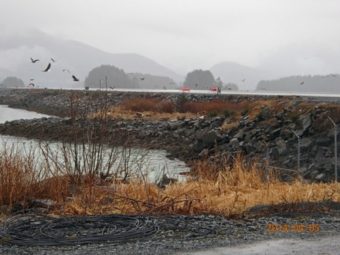
If fish debris gathers near the runway, the feeding eagles pose a safety hazard. “A bird that size, especially an ingestion into an engine, could be catastrophic for human lives,” said Tresham. (Photo courtesy of Dave Tresham)
As fishing season moves into full swing, so does the workload of the staff who haze birds off of Sitka’s runway.
Dave Tresham, a wildlife specialist with the U.S. Department of Agriculture, spends his entire day scaring birds from the Rocky Gutierrez Airport. He says the improper disposal of fish waste in the waters around Sitka’s harbors creates a safety hazard. The biggest problem — and the biggest scavenger — is the bald eagle.
“A bird that size, especially an ingestion into an engine, could be catastrophic for human lives,” Tresham says. “Sitka is well known for not having an alternate runway to go to. There’s really no way for an aircraft to turn if they had a severe eagle or gull ingestion. ”
It is against city regulations to dispose of fish in harbor system waters, or to clean fish at any place other a designated fish cleaning station. Tresham says that disposal practices have improved in the past five years, but reminds Sitkans to practice good etiquette on the water to ensure safe travels in the sky.
At 12, Jasmine Molina has found a way to help newly arriving Filipino students transition to middle school. “She is a self-initiated ambassador,” says her teacher, Janelle Farvour. (Emily Kwong/KCAW photo)
Imagine you arrive in a world where it rains all year round, and daylight swings from 17 hours in summertime to a paltry six in winter. And you’re only seven years old. That’s the situation Jasmine Molina found herself when she first got to Sitka, over 5,000 miles from her native city of Manila in the Philippines.
Sitka’s Filipino population has grown substantially in the past five years, but there remains no formal system to help new students transition to school. That is, until Jasmine came to town.
“Hello – ang pangalan ko ay Jasmine Molina.”
There’s something about Jasmine that makes you want to talk to her.
“It’s a pretty big school compared to the Philippines,” she said, walking down the hallway.
Maybe it’s her big brown eyes or her silky black hair, which she quickly tucks behind her ear while dialing her locker combination.
But it’s probably her smile, which turns her face into a huge pair of parentheses.
“I just like want to go up to them and be like, “Hey, do you want to be my friend?” And they’ll be like, “Yeah.” And I’ll be like, “Cool,”’ Jasmine said. “Everyone says I’m weird. But weird is awesome. I think weird is awesome.”
Oh, and she’s got killer self-confidence. Again, not your typical middle schooler.
Janelle Farvor was Jasmine’s language arts teacher last year.
“She’s funny, sensitive and she’s generous,” Janelle said.
Janelle remembers the very first time she saw Jasmine. At the grocery store, with a bunch of other Filipino kids, talking.
“I thought, ‘What is this little girl doing?’ She’s talking so fast, and I just kinda observed a little bit and then I saw her pointing out things and showing things, and I thought, ‘Oh my gosh, this little girl is explaining how this store works,’” Janelle said.
Janelle saw her again a few years later. She’d grown a bit taller, but was doing the same thing.
Filipinos make up 9 percent of the Sitka School District, yet there is no Tagalog-speaking staff member or formal support group to help new students. In her own way, Jasmine has taken up that cause. (Emily Kwong/KCAW photo)
“I thought, I wonder if she’s an ambassador,” Janelle said. “These kids all look very new. They’re just wide-eyed and mouth agape, wondering what this is about, what this can is of. And there was Jasmine, explaining it all.”
And last year, when Janelle met her 6th grade class, Jasmine was in it – all grown-up. Jasmine’s dad is a fisherman and came to Sitka five years ago. Jasmine and her mom followed, a month later.
“I was really shy,” Jasmine said. “I didn’t really know anything about Sitka until my cousin showed me around the next day. There was a lot of tall people.”
And not only that, but it was several degrees colder than in Manila, where Jasmine grew up.
“I only had one jacket and it was really cold and there was a lot of snow on the ground,” Jasmine said.
As she got used to the cold, one thing that made a big difference to Jasmine was meeting other kids her age.
“On the first day I went to second grade they’re like, ‘Hey what’s your name?’ I’m like my name is Jasmine. I came from the Philippines.’ They’re like, ‘Cool.’ I wanted to do the same thing and make people comfortable where they are,” she said.
And it’s something Jasmine has been doing ever since: from greeting new families and showing their kids the ropes, to how to open a locker and getting around the building. It’s more than middle school survival tactics; Jasmine is helping her classmates succeed in a Western school.
“And for her to do it on her own volition, and to just see a need and to step up to fill a need, I think that says a lot about her character,” Janelle said.
At Blatchley Middle School, there are 29 Filipino students and in the whole district, 121, making up 9% of the Sitka student body. At the bottom, the school district doesn’t have a designated Tagalog speaker or support group to help students orient themselves. But for now, Jasmine fills that gap.
“I’ve had her – even I’ve brought her down to help me scold,” Janelle said. “They need to not be so chatty or whatever, I have her talk to them in Tagalog to hear a lecture in the mother tongue. There’s nothing like it.”
Now, it’s hard to imagine Jasmine yelling at anyone. And if you asked her if she’s an ambassador or a leader, she’d probably say no. She’s just being a friend. Antonete Partido remembers meeting Jasmine in dance class.
“When I first got here, she talked to me instead of just ignoring me,” she said.
The two girls chatted in both English and Tagalog. Antonete lives with her grandmother, who adopted her. She hasn’t seen her parents for five years and describes her family as broken apart.
“I don’t really get to call them because I have school. My grandma has work. So we don’t really have time to call them,” Antonete said. “I don’t think other people know that my parents aren’t here because I don’t show my feelings to them.”
But Jasmine knows. And when we finish the interview, Jasmine takes Antonete aside and says, “You’re my one.” She says it again, “Don’t forget. You’re my one.” And with that, Jasmine turns on her heels and heads out the door to go to her next class.
Garry White came to Sitka in 2008 and has ridden the wave of the bulk water venture. But new developments in infrastructure and capital are giving him hope that bulk water shipments to California will happen this year. (Photo by Emily Kwong/KCAW)
In Sitka, raising the hydroelectric dam at Blue Lake has created not only a source of renewable energy, but an even larger reserve of fresh water. The bulk water presents a business opportunity.
In April, California Governor Jerry Brown gave a speech in the Sierra Nevada Mountains. The formidable snowpack, which melts to provide ⅓ of California’s water supply, was nowhere to be seen. The earth was brown and bare.
“People should realize we’re in a new era,” Brown said. “The idea of your nice little green grass getting lots of water every day – that’s going to be a thing of the past.”
The governor went on to impose the first mandatory water restrictions in California history, cutting urban use by 25%.
With a contract deadline looming that could terminate its exclusive rights, Alaska Bulk Water hopes to deliver on long awaited promises to ship tankers of water and to make California its first customer.
The contract has been extended four times (in 2008, 2009, 2011, and 2012) and to keep it, Alaska Bulk Water spent $1.5 million and must ship 50 million gallons by December 8th. Still, no water has been moved. Garry White, the Executive Director of the Sitka Economic Development Association says recent developments give him hope that water will finally leave the island this summer.
“When I see our current partners putting real money down to go out and put in a mooring buoy system and hire engineers to design it and going out and getting their Army Corps permit, doing all the right things and continuing to invest in the venture, then it’s no longer a 30,000 view of it,” White said. “It’s starting to get down to the details.”
In addition to storage on the California side, it’s unclear what kinds of ships will be used. If those ships aren’t flagged as American, their passage from Sitka to California violates the Jones Act, which prohibits the transport of goods by foreign vessels. White is looking to Alaska Bulk Water and several engineering firms to tackle these and other issues.
Black bear cubs Smokey, Bandit, and Tuliaan were orphaned in Juneau and Seward in 2013. They make short work of a tent baited with grapes and graham crackers. (Photo by Robert Woolsey/KCAW)
About a hundred fifth-graders turned out in Sitka recently to watch a trio of captive brown bears destroy a small tent that had been “baited” with fried chicken.
While the demonstration was a very graphic way to convey an important message about safety, it was also a step toward not doing this kind of project in the future. The directors of Sitka’s Fortress of the Bear hope to one day rehabilitate orphaned animals with as little human contact as possible, and then release them into the wild.
Tennie Bentz is an education specialist with the Alaska Department of Fish & Game. She does this messy camp exercise in schools in Juneau and Sitka — but in Sitka she gets to use real bears.
“In the past we set up a campsite behind Keet (Gooshi Heen Elementary School). We show the kids the tent,” Bentz says We make a messy campsite. We go back into the classroom and that’s it. And so this way we’re actually able to show what would happen if they left a messy campsite.”
During the demonstration, other ADF&G staff have set up video cameras to capture the exercise. They’ll give the tape to Sitka High School students to prepare a bear safety TV commercial.
After the fifth graders have piled back into buses and gone back to school, they set up another tent in a smaller area set aside for three black bear cubs, Smokey, Bandit, and Tuliaan, who were orphaned in Juneau and Seward in 2013. Then they sit back, and watch.
The black bears, which weigh from 150 to 250 pounds, take a little more time as they devour the dog kibble and grapes inside the tent. They’re playful. They pull apart the tent poles, and chew on the bungee cords. They wrestle a bit. But eventually the tent is shredded, and they stretch out among the ribbons like tired puppies.
Les Kinnear used to be a hunting guide and is now executive director of the Fortress of the Bear. He hunted bears, among other things, in the Alaska Range, and says one of his fellow guides, especially, was notorious for leaving a messy camp.
“So it was kind of a toss-up, whether a bear had been there or not. The only way you could really tell was if the skillet was clean. You knew it was a bear.”
This kind of education outreach was in the plan when he and his wife Evy took on the project of converting former mill structures into a 60,000 square foot bear habitat eight years ago.
“It’s all part of the ongoing process,” Kinnear says. “We hope someday to expand and create an area where we can bring the next generation of orphan cubs to raise remotely, until they’re big enough, fast enough, strong enough, smart enough to take care of themselves. And start a pilot project here in Alaska putting them back in the wild where they belong.”
That won’t happen for these animals, unfortunately. The Fortress of the Bear sent triplet brown bear cubs to the Bronx Zoo in 2009, after their mother was accidently killed by police in Sitka. Another orphan black bear cub went to a wildlife sanctuary in Texas in 2010. But these bears will live out their lives here — maybe up to 30 years, according to state biologist Phil Mooney, who orchestrated today’s demonstration. He believes these bears remind us of our role in creating orphaned and captive bears.
“If they were really as violent as some people believe, we’d have a lot more people taking beds at the community hospital,” Mooney says.
In the meantime, the Fortress bears will do this job over and over again for students. And sooner or later, Mooney says, they’ll figure out that a tent just means fried chicken.
The family of a Sitka woman missing for nearly three years is asking the state to issue a death certificate.
33-year old Lael Grant was last seen in a local grocery store in the early morning of October 15, 2012. Despite an intensive search she has never been found.
The fate of Lael Marie Grant remains an open wound for her family, and a dark question mark over the community of Sitka.
Grant’s sister, Erika Burkhouse, filed a presumptive death petition in Sitka Court on April 20 on behalf of the family: Grant’s mother Bonnie Grant, and Lael’s two boys, who are now 14 and 12 years old.
“When something like this happens it’s really hard to mourn, I guess. They need closure too. They need some sort of closure.”
Lael Grant lost her own father shortly before her disappearance. His funeral was on October 13, 2012. The following day, October 14, was her last contact with her family. On October 15, she was seen in a local grocery store for the last time.
Five days later, her car was located 8 miles outside of Sitka, parked on the Nelson Logging Road.
Burkhouse says filing for presumptive death does not mean the search is over.
“We are still searching for answers. We have not lost hope when it comes to finding out what happened. This is purely procedure: It doesn’t mean the investigation is closed. The investigation is still open and we’re still hoping for answers.”
According the petition Burkhouse filed, Grant did not possess valid identification at the time of her disappearance that would have allowed her to leave Sitka by plane or by ferry. She also had never been apart from her family for more than a few days. An extensive ground and air search turned up no clues.
Judge Leonard Devaney will empanel a jury in Sitka District Court on June 25 to hear evidence in support of the petition and to examine witnesses. The proceeding is expected to last a full day.
In the meantime, a Facebook page called Help Find Lael Grant remains active, with nearly 1,400 followers who continue to share their thoughts on the case.
Burkhouse says this outpouring has been important for everyone close to Grant.
“The community in general has shown so much support. It’s unbelievable. It’s awesome.”
Posters with Grant’s picture and a request for information about her disappearance continue to be displayed in many businesses throughout Sitka.
Mt. Edgecumbe students perform during Elizabeth Peratrovich Day in February. (Photo courtesy KCAW)
With education a hot button issue in the ongoing budget debate, one school in Sitka is definitely safe this fiscal year. The state-run Mt. Edgecumbe High School will continue to receive $4.6 million from the Department of Education and Early Development. That money goes directly towards boarding over 400 students from around the state.
Dionne Brady is a social studies teacher and a Mt. Edgecumbe alumna, class of 1991. She was surprised in February when Mt. Edgecumbe came up as the House Finance Subcommittee discussed education cuts.
The conversation, led by Rep. Lynn Gattis (R-Wasilla), was about how much the school cost the state. As Brady put it, the underlying question for many teachers and students was “whether or not Mt. Edgecumbe is even needed anymore, at all.”
Brady said her first reaction was denial.
“Even as a government teacher who should have been more aware of the possibility that state revenue, that’s so dependent on oil, would decrease, that this school might not exist forever, never occurred to me,” Brady says. “I’ll confess that my second — because it’s like a second home to me — my second reaction was anger.
Brady took to the Friends of Mt. Edgecumbe Facebook page, which has almost 1000 followers. A network of alumni around the state began making phone calls, writing letters to legislators and uploading photos of themselves with Braves sweatshirts and hats. Their colors are maroon and gold. Brady says it was a springboard point for lessons in her class, to “kind of show students how the government works and how the budget process works.”
“Underclassmen who definitely knew they wanted to continue their education at Mt. Edgecumbe were very worried at that time,” Brady says. “I think this just sort of validated what we’ve been telling them. That it’s not an inalienable right for Mt. Edgecumbe to exist. In fact, we live in a fishbowl with people always trying to see whether Mt. Edgecumbe is doing the job it’s kept open in order to do.”
According to the administration, what the school is trying to do is provide an educational alternative for students around the state, some in rural places with fewer opportunities.
Ayla Reynolds is a new student from Savoonga, an island in the Bering Sea.
“It’s a big world out there. There’s a lotof stuff to do than stay at home on an island,” Reynolds says. “It’s the same old routine every day on an island. I couldn’t envision how it was going to be [at Mt. Edgecumbe] because it’s a new adventure.”
Superintendent Bill Hutton says he’s relieved the funding will continue, but with one major hitch: it may not be enough this year to cover the rising cost of operating the boarding school. Contracts for dorms and food service, as well as personnel costs are up.
“And with flat funding, flat sounds like it’s perfect, but really we have incremental increases in expenditures,” Hutton says. “We have to cut in order to be prepared for those.”
Another major concern for Hutton is how much money the school receives from the legislature for each student. The legislature proposed a cut of 1.1% to the foundation funding; that translates into $46,000 less for Mt. Edgecumbe. If that figure survives the special session, it will leave the school, and likely many others, with a deficit.
“As of right now, we’re about $220,000 short for next year,” Hutton says. The school’s annual budget is $10 million, with 45% coming from the legislature, 45% from the EED and 10% from grants.
To prepare, Hutton is planning to purchases a minimum amount of school supplies, reduce travel for student activities, reduce dual-credit programs with the University of Alaska Southeast and keep two and a half open teaching positions empty. Still, much is up in the air.
Hutton’s experience speaks to the odd situation many superintendents find themselves in as they await the final budget — to plan for a financial future with a foggy crystal ball.
Close
Update notification options
Subscribe to notifications
Subscribe
Get notifications about news related to the topics you care about. You can unsubscribe anytime.