KCAW - Sitka

KCAW is our partner station in Sitka. KTOO collaborates with partners across the state to cover important news and to share stories with our audiences.

Cirque dancing class lassos Sitkans into the show

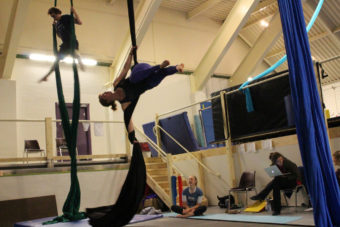
Nearly 100 Sitkans are learning to fly on aerial silks. Sitka Cirque performed before a sold out crowd in May. (Mike Hicks/KCAW photo)
Nearly 100 Sitkans are learning to fly on aerial silks. Sitka Cirque performed before a sold out crowd in May. (Photo by Mike Hicks/KCAW photo)

The circus is coming to Sitka, but the performers aren’t from out of town. They are ordinary citizens, who in the past two years, have learned to climb, swing, and soar. Led by an aerialist with roots in Alaska, Sitka Cirque is dreaming up a new kind of circus that provides as much thrill to the participants as it does to the audience.

“Okay, are you ready? On your marks, get set,” says Frannie Donohoe as she watches as her students climb—not to the top of a dunk tank or a trapeze…

“Look at the silk dance,” she says.

Up a flowing piece of fabric rigged to the ceiling and falling dramatically to the floor like a stage curtain. It’s called a silk. Donohoe has rigged four of them in what used to be the town swimming pool. Part of the drama of silks is the height and within seconds, her students are 20 feet in the air.

“Part of the thing when I was starting out, I would say, “Oh I’m teaching silks,” and people go, “What? What is that?” Well now, I say, “I’m teaching aerial silks,” and they all go, “Oh! You’re the one doing that thing with everyone up in the air. I heard about that.”

Today, Donohoe is leading an evening class for her advanced students.

Aerial silks was invented by Cirque du Soleil in the mid-90s. Performers wrap, drop, swing, and spiral their bodies on the silk to music. All kinds of music.

“And let’s find a way back down to the ground.”

Donohoe grew up dancing in Sitka, without any dreams of running away with the circus. She started learning ballet at the age of 10. She was the Snow Queen in Sitka’s first local performance of the Nutcracker. But when she moved to London in 2008 to light up professional stages, the circus found her.

“Every agency that I came up against, they said ‘Oh, you’re a dancer. Great. But can you do it up in the air?’ So after enough of those people saying, ‘Can you do it in the air?’ I went, ‘Okay, yes. Why not?’”

From L to R: Zeke Blackwell and Chantal Cough-Schulze improvise to music. (Photo by Emily Kwong/KCAW photo)

Donohoe picked it up quickly. She returned to Sitka in 2014 and opened a grassroots circus program with aerial silks at its core. In the past year, 95 students enrolled in her classes, some with prior training in dance or climbing, but whose last pull-up was on the monkey bars in kindergarten. And these are exactly the kinds of people Donohoe wants to teach.

“The ones that say I can’t are the ones that I am most wanting to succeed because for me what is important isn’t how well someone can execute a skill, it’s how far they progress from where they started.”

And sometimes, that means being painfully honest about your body’s limitations. Taylor White is an aquarium manager. She’s constantly moving buckets of rocks and shifting aquariums around. She joined Cirque to improve her upper body strength and those first two weeks were brutal.

“You can’t even hold onto the silk long enough to do the things that you want to do because you can’t hold yourself on the silk long enough and you wake up with these lobster claw hands,” she laughs, “and you have to stretch them back.”

White broke her pinky once during a drop, which is when you wrap the silk around you and free fall so that the silk catches you before you hit the ground. That drop, which used to be her nemesis, is now her favorite. She performed it at the Southeast Alaska State Fair in Haines last month.

“It’s a total trust thing and trusting that the silks are wrapped correctly and that your body can handle that drop,” she says.

And according to Zeke Blackwell, when you finally get it, it’s pure exhilaration.

“There’s nothing like it. All of the lights in your body go off at once.”

Some students come to circus with prior training in dance, yoga, or climbing. But many are new to the aerial arts. (Photo by Emily Kwong/KCAW photo)

Blackwell was obsessed with the circus growing up.

“I wanted to be one of the 40 clowns that come out of the small car and hit each other on the nose and fall around and eat pie,” he remembers.

Blackwell explains that modern circus is trying to showcase something a little less slapstick and a little more human:

“You still get tricks and the amazing marvel, but it’s all channeled through people and through the human form.”

Donohoe just signed a lease for a new space for the circus program and plans to add more classes this fall: juggling and acrodance. She’s not aiming for perfection. Rather, she wants to create a space where students don’t have to worry about wowing audiences, and can simply learn to be in awe of themselves.

“How many adults are allowed the time to play? To not be limited by what you think is possible but to allow yourself to discover what can be possible,” Donohoe says.

And sometimes, that means getting off the ground.

After years of teaching, a shy Western screech owl retires in Sitka

Peanut is a 13-year-old Western Screech Owl currently living at the Alaska Raptor Center. (Photo by Vanessa Walker/KCAW)
Peanut is a 13-year-old Western screech owl currently living at the Alaska Raptor Center. (Photo by Vanessa Walker/KCAW)

There’s a new bird at the Alaska Raptor Center in Sitka, and she’s a little shy. After a long career in education, she doesn’t have a lot of patience for the classroom. She’s now settling into a comfortable retirement.

On a cold and rainy day, the yellow-eyed, grey Western screech owl peers out of her small owl house in a cage at the raptor center. Her name is Peanut, and her right wing sticks out just a little further than her left. She’s injured and unable to fly. She used to live in California and at some point moved to Alaska.

“We know she’s about 13 years old, which is really old for a screech owl. They usually live to be about 8 or 9,” says says says Jen Cedarleaf, an avian rehabilitation coordinator at the center.

Peanut arrived at the center in July, after the bird educational facility she lived at in Ketchikan shut down. Before that she belonged to a California falconer. Cedarleaf says the raptor center tried using Peanut as an education bird at first but it didn’t work out, so the center decided to let her rest.

“She’s really enjoying, I think, not being an education bird,” Cedarleaf says. “She really seems to like her little habitat. She gets around in there and doesn’t have to deal with people all day long.”

Peanut has already laid 4 or 5 eggs, more than she probably ever has, says Cedarleaf. The little owl is now living a somewhat quiet life.

“Peanut is a little beast,” Cedarleaf says. “A lot of times she’ll try to run away from you, but sometimes she’ll come after you. It’s kind of funny because she’s so tiny; she can’t really hurt us that much, but she thinks she can.”

Peanut is one of three screech owls currently at the Alaska Raptor Center, and one of about 20 permanent residents that include bald eagles, red tailed hawks, great horned owls and ravens. There are also more than 20 birds being rehabilitated, mostly bald eagles.

The center took in a bird nearly every day in June, making it a particularly busy month.

Peanut is a 13-year-old Western Screech Owl currently living at the Alaska Raptor Center. (Photo by Vanessa Walker/KCAW)
Peanut is a 13-year-old Western screech owl currently living at the Alaska Raptor Center. (Photo by Vanessa Walker/KCAW)

They don’t know how Peanut injured her wing, but Cedarleaf says common human-related owl injuries are caused by cars.

“It’s very possible she was hit by a car. Owls get hit by cars more often than you would think, because they use the headlights to help find their prey, and they’ll swoop in front of a car without realizing it, and then they get it,” she says.

Despite Peanut’s reclusive nature, Cedarleaf says visitors stand to learn a lot from her.

“She’s a very good bird for teaching us about longevity and just about the different kinds of birds that are out there in the environment that you don’t always see all the time.”

It’s not every day you see a Western screech owl. However, if you’re lucky, Peanut may look your way the next time if you’re ever at the Alaska Raptor Center.


National Parks to care for state historic sites in Sitka

Castle Hill, in downtown Sitka, is the best place to take in the full measure of the community’s “cultural landscape.” (Photo courtesy of Alaska Division of Parks)

The federal government is stepping in to care for two of Alaska’s most important historic sites, after the legislature cut funding to state parks in Sitka.

The National Park Service calls Castle Hill and Old Sitka “cultural treasures,” and has agreed to take care of the parks at least through the fall.

A third state-owned site, the popular Halibut Point Recreation Area, ultimately may be managed the city.

Sitka National Historical Park superintendent Mary Miller says it’s “ironic” that the park has scaled up storytelling around the Russian colonial presence in Sitka this year, since it’s now going to be taking care of a larger piece of the former colony.

But that’s not the only irony in this agreement. The deal is good only through this fall — October 18. That’s the day in 1867 that Russia formally ceded Alaska to the United States in a flag raising ceremony on Castle Hill, one of two sites in Sitka that the state has decided it can’t afford to operate anymore.

“Those are recognized as significant cultural and historic treasures, really, whose stories overlap with Sitka National Historical Park.”

The other site, known as Old Sitka, is less celebrated than Castle Hill, but its role in the larger story of Alaska is far greater: The destruction of a Russian outpost there by the Sitka Tlingit in 1802 prompted a retaliatory strike by Alexander Baranov two years later, and he would subsequently move the headquarters of the Russian-American Company — and the capital of Russian America — to Sitka.

Modern Sitka is built right on the footprint of the Russian colonial capital, which was built over the historic Tlingit community, with Castle Hill right at its center.

Fitting this story together needs a better vantage point than can be found inside a museum.

“What you start to see, by combining say the Russian Bishop’s House, St. Michael’s, the Blockhouse, Castle Hill, Building 29, the Russian Cemetery — you start to realize the cultural landscape that was here.”

Starting back on July 1, Miller and the National Park crew decided to step in as stewards of to provide stewardship over the cultural landscape. Sitka National Historical Park itself is a major feature of the downtown waterfront. Miller says her staff was positive about folding Castle Hill and Old Sitka into their responsibilities.

“When we talked to the maintenance crew about this — and we’ve got a bigger crew than usual because of extra projects at Sitka National Historical Park — they were actually pretty excited about it. They recognized that taking care of these sites is actually a source of pride, just like it is for taking care of the assets of the regular park.”

The National Park Service is not taking over management of Castle Hill and Old Sitka per se — Miller says it’s more about maintenance. The NPS will remove trash, mow grass, blow leaves, clean trails, and brush out vegetation.

And The National Park Service is not going to be providing these services at the Old Sitka boat launch, or at Halibut Point Recreation Area. Halibut Point, the boat launch, Ft. Rousseau, and the Magoun Islands and Big Bear/Baby Bear state marine parks all went into so-called passive management when the state started its new budget year on July 1.

With the exception of Halibut Point, all of these sites are accessible only by boat, and scarcely require maintenance of any kind. Halibut Point, however, is probably the most popular picnic beach in Sitka. Municipal administrator Mark Gorman told the assembly recently that passive management would likely lead to “public safety issues.”

“It’s very clear to me that with the sudden closure of the state presence in the park that the issue is going to roll up to the city very rapidly — in fact it did on Friday, with people coming and saying, I have a wedding planned there at the end of this week, I can’t get in, who do I talk to?”

Gorman said that city hall was putting together a plan to care for Halibut Point, for the assembly’s review at its next meeting.

Meanwhile the state Division of Parks is continuing to solicit proposals for the permanent care of Sitka’s parks, which were de-funded this spring along with sites in Homer and Valdez.

Despite the excellent overlap with the national park mission in Sitka, superintendent Mary Miller sees her intervention as a stop-gap measure.

“We’re happy to step in, recognizing that the state is in need right now. And I’d like to think that if the tables were turned and that the federal government, for whatever reason, was short of resources, that we could look to the state and that they would step up and help us likewise.”

Miller says the National Park Service will assess how well maintenance is going at Sitka’s state parks this fall, before she seeks additional funding for the program.

KCAW’s Emily Kwong contributed to this story.

No second king opening for Southeast trollers

A forest of trolling poles in Sitka’s ANB harbor, July 2015. (Photo by Rachel Waldholz/KCAW)

After just eight days in early July, the summer king salmon season for Southeast trollers is over.
The Alaska Department of Fish & Game announced Friday that there will be no second king opening in August. It will be only the third summer in fifteen years without an August opening.

The announcement ends a season that has been the subject of unusual controversy between Alaska its neighbors to the south, all of whom fish under the U.S.-Canada Pacific Salmon Treaty. Alaska argued that the preseason forecast vastly underestimated the amount of kings returning this year and asked for the right to catch more fish. But the state gave in under pressure from Washington, Oregon, and the federal government and agreed to abide by the lower estimate.

In the end, however, the fleet caught more fish — and faster — than would be expected under that lower number.

Given the preseason forecast, managers would have expected the fleet to catch about 7,000 to 9,000 kings per day, said Fish & Game biologist Pattie Skannes. But the fleet actually caught about 20,000 fish per day in July, for a total of more than 150,000 Chinook.

That maxes out this year’s harvest limit.

“It’s higher than what we anticipated,” Skannes said. “We went into the opening expecting that abundance would be down from last year, certainly…And obviously once people got out and fished, they found the abundance was actually quite good. So, the total harvest is a surprise. It’s higher than what we expected.”

But Dale Kelley, of the Alaska Trollers Association, said this result is actually precisely what the state and trollers predicted.

“I’m not at all surprised that we took that many fish in eight days,” Kelley said. “We’ve been saying and saying and saying again that there’s a massive abundance of fish out there, and that the quota was inappropriately low.”

The Department usually tries to reserve about 30-percent of the catch for August. Kelley said the lack of a second opening will affect fishermen and processors who usually deliver to fresh markets in August — or anyone who missed out in July.

“Heaven forbid you’re somebody that had a mechanical breakdown or a family emergency during the first opening because there’s not any other opportunity for kings until October,” Kelley said. “And kings are big money for us.”

Many trollers are now targeting coho or chum salmon, which bring in significantly less per pound.
Altogether, Fish & Game estimates that about 730 boats fished the July king opening, down from more than 800 boats last year. The price this year is relatively low. At less than $3 per pound, it’s almost a dollar below the five-year average. That may be because there is still inventory left over from last year’s monster summer run.

All numbers so far are preliminary. Fish & Game is still receiving fish tickets, and won’t have final numbers for about another week.

Amid financial problems, Sitka dissolves board of city-owned hospital

Sitka Community Hospital. (Photo from KCAW)

The Sitka Assembly voted Tuesday to dissolve the board of the city-owned Sitka Community Hospital.

The vote came in the aftermath of the hospital’s financial crisis this winter, when the city had to extend an emergency $1 million loan to keep Sitka Community afloat.

Deputy Mayor Matt Hunter said that looking back over the past decade and a half the city has faced similar issues nearly every other year.

“The city has been startled by crises … seven times here,” Hunter said. “In September 2001, the city gave a million-dollar short-term loan — in September 2002, an additional $300,000. In April 2004, another $250,000 line of credit … in 2006 and 2007, interest and loans were written off…In 2009, a $500,000 line of   credit. And then in December 2014, (which) was increased to $1.5 million with an additional million.”

Meanwhile, this spring, the assembly voted to double the tobacco tax to provide the hospital with an additional cash infusion.

Hunter argued that Sitka Community needs closer city oversight and a board that’s better qualified to handle its complex finances. A new proposal would reduce the board from seven voting members to five, and require that at least one member have professional financial experience. It would also include a member of city staff appointed by the city administrator, Mark Gorman, to give the city more say in hospital decisions.

But Ann Wilkinson, who took over as board president this spring, said the current board has been blindsided.

“We had heard that the Assembly was concerned about the board’s ability to handle the finances of the hospital, and we were told we would probably all be asked to quit,” Wilkinson said. “But that didn’t happen – for months that didn’t happen. And then suddenly Mr. Gorman tells me, ‘Well, we’re going to restructure the board and you’re all going to be out.’ They hadn’t told us this, or asked us any questions. They just decided – and I don’t know who decided that.”

The proposal passed 6-1 on first reading, with Steven Eisenbeisz  voting no. It will have to pass at least once more to go into effect.

After 8 days, Southeast king opening to close

Southeast commercial trollers will soon take a break from the king salmon harvest, but the final target this year remains anyone’s guess.

The Alaska Department of Fish and Game announced Tuesday (July 7) that the first king opening of the summer will close at midnight on Wednesday (July 8), after eight days of fishing.

Sitka’s ANB Harbor, home to many local trollers. (Greta Mart/Photo by KCAW)

That opening has been longer than many trollers expected. This year’s king salmon quota was the subject of a months-long dispute between Alaska and its neighbors to the south, including Canada, Washington and Oregon. Alaska challenged the pre-season forecast, which called for relatively low numbers of Chinook in Southeast. In the end, however, the state agreed to fish under the lower estimate, to remain in compliance with the U.S.-Canada Pacific Salmon Treaty.

Still, Fish and Game hasn’t released a final number for this year’s king salmon quota, so it’s impossible to know how many kings the fleet is targeting. Even fishermen are in the dark.

Exact numbers on how many kings have been taken so far won’t be available for a few weeks, while the Department tabulates fish tickets. But Fish and Game expects a second king opening for trollers in August.


Site notifications
Update notification options
Subscribe to notifications