KCAW - Sitka

KCAW is our partner station in Sitka. KTOO collaborates with partners across the state to cover important news and to share stories with our audiences.

Sitka High struggles to maintain after-school activities with dwindling budget

Sitka High senior Josh Risko moves the ball downfield during a May 2011 game against Thunder Mountain. The recent addition of sports like soccer has put pressure on the activities budget. (KCAW file photo by Berett Wilber)

The activities budget for Sitka High School may have reached a tipping point and it could force the end of some programs.

The Sitka School Board heard a report from activities director LieuDell Goldsberry earlier this month. Between the recent addition of several new activities and a reduction in district spending, most programs have seen a cut of at least 40-percent over two years.

“Each sport is going to have to fundraise year round,” says LieuDell Goldsberry, who is in his first year as activities director at Sitka High. His budget was cut by $35,000 to about $132,000.

“If we continue to stay at our current level, with the district giving us $132,000 and $10,000 for uniforms, my thought was: We’re going to have to cut at least three activities if we want to fund our activities at $10,000,” Goldsberry says.

That $10,000 figure is significant. Only two years ago, each of Sitka High’s activities was receiving exactly $10,000 from the district. Last year, the high school added two new activities, girls’ and boys’ soccer. The district cut its allocation to $8,500 per activity, but the overall activity budget still rose, to over $177,000.

This year that budget has been slashed, and every activity is getting only $6,000.

Goldsberry says participants, families, and the community are taking up the slack — well beyond the season for any given activity.

Participation fees are also up. Goldsberry said the fees at best create a burden on families, and at worst, aggravate economic disparities that are not supposed to exist in public schools.

He presented data showing typical per-student participation fees running up to $350. A four-activity student may pay around $1,200. Goldsberry says students are sitting out — for the wrong reasons.

“A high school kid is more ashamed to go tell the coach that, I don’t have the money,” Goldsberry says. “It’s embarrassing.”

Goldsberry urged the board — at the very least — to reverse the downward slide in the activities budget, and restore funding to last year’s levels.

“It’s not a fix, believe me. It’s not a fix to our problem. Our problem is how can we sustain our current activities with the money that the district has given us? That’s the problem that you as board members need to solve. You have to go to the city. You have to ask those questions.”

Last year board member Tim Fulton tried to pull together a public committee to discuss activities funding. Two former activities directors — Mike Vieira and Lyle Sparrowgrove — both attended.

Board member Tim Fulton was interested in attacking the problem again. “We’ve done a couple of things that have created the perfect storm here. Now that the waves are bigger, there might be more people willing to work with us.”

The school board budget process will begin in the early spring next year.


Sitka Community Hospital facing unexpected financial woes

Sitka Community Hospital. (Photo courtesy Sitka Community Hospital Foundation)

The city-owned Sitka Community Hospital is in worse financial shape than anyone thought — including its new CEO.

The Sitka Assembly was briefed on the hospital’s finances during a closed-door session Tuesday. The hospital’s chief financial officer has resigned. Very little information has been released to the public so far.

After the closed meeting, Mayor Mim McConnell offered the body’s only public comment on the situation.

“The assembly met to receive a report on the fiscal situation at Sitka Community Hospital,” she read from a prepared statement. “There has been a perfect storm of financial events that have led to a difficult situation. We have an excellent team in place, committed to exploring all possible solutions, which include both short- and long-term plans. The assembly will be updated on a regular basis over the coming weeks.”

While Sitka Community Hospital is mostly autonomous, its board answers to the Assembly and its budget is a line item in the city’s budget.

Speaking with reporters after the meeting, hospital CEO Jeff Comer said he hopes to release more information soon. Comer was hired in September.

“I’ve been, as you all know, on the job for about three months now, and I’ve been looking into our financial situation,” he said. “We’ve got multiple issues that I’ve uncovered, and I’m still evaluating. So as soon as I have a better feel for those, and the depth of them, and the impact, then I’ll have more information to release.”

Comer said the hospital will be able to make payroll and that he’s still evaluating whether to ask the Assembly for money. Comer said the hospital’s dire financial situation was not discussed during his interview and it’s come as a surprise to him.

Comer has recently outlined ambitious plans for the hospital, including major recruitment, regional collaborations, investment in telemedicine, and satellite clinics. He said his ultimate goal is to make Sitka Community Hospital the dominant health care provider in Southeast Alaska. That vision still stands, he said.

When asked if learning about the hospital’s finances has made him regret taking the position, Comer said, “not at all.”

Sitka hospital aims to become regional health care hub

Sitka’s new hospital CEO is thinking big — really big. In remarks to the Sitka Chamber of Commerce last week, Jeff Comer said he’s developing a strategy to expand Sitka Community Hospital into a regional health care provider.

Listening to Jeff Comer makes you think of the old palindrome “A man, a plan, a canal, Panama!”

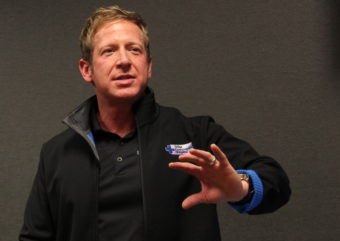
Jeff Comer says of the Affordable Care Act: “Whether you agree with it or not, it will help our hospital.” (Photo by Rachel Waldholz/KCAW)

Sitka Community Hospital’s CEO has been on the job since September. He recently described his vision to the Sitka Chamber of Commerce at the end of November.

He’s a man with a plan, and a hospital.

“We want to be the dominant health care provider in Southeast Alaska, and I’ve just mapped out a plan for how I think we can get to that. It’s going to take a few years. It’s not going to happen immediately, but we are starting to move in that direction. We have recruitment in place, we have the walk-in clinic across the street that we’ll put into place. We’ve got telemedicine coming on line in a May-June timeline. So we’re heading in that direction.”

Comer comes from Phoenix, Arizona. He’s managed 12 major hospitals over his career — and he’s the child of a professional hospital administrator. He told the chamber of commerce that Sitka represented a particular challenge. Although he considers the hospital to be “a gem,” he also believes it’s one of a dying breed.

“It is getting very difficult to survive as a standalone hospital. Very few standalone hospitals are standalone anymore. They’re part of bigger systems. That’s not what our board wants; that’s not what our city wants; it’s not what I want for this hospital. I want this hospital to stay standalone. We do not want to merge it or expand it.”

But that doesn’t mean that he doesn’t want to expand the hospital’s capacity. He calls it “external expansion.” It includes recruiting more providers, setting up a walk-in urgent-care clinic in Sitka, and opening clinics staffed by physicians’ assistants, nurse practitioners, and physical therapists — in places like the local pharmacy, or even the Hames Center.

Comer appeared on KCAW’s Morning Interview the day after his chamber presentation and elaborated on this idea.

“Part of the model, where I see us going in the future, is focused more on the mid-level providers. They can provide 90 percent of the health care that people need, and we can do it in a community-oriented setting. So to add to that, we’re looking at several clinics downtown — one facility we’re looking at right across the street from the Westmark, where we’ll have a physician assistant located. People on lunch, morning breaks, can go right down and see that person, get that primary care, get their lab work done, and then get back to work without waiting a couple of hours to see a doctor.”

Besides adding face-to-face providers, Comer says Sitka’s hospital is expanding its virtual care. He says telemedicine will be online by early summer.

“We will have full specialty coverage for our ER physicians, so if they need a consult with cardiology or endocrinology, it will be a live feed, where that patient will actually see that physician in Providence in Anchorage, and that physician will be looking at the patient, reviewing all the vitals, all of the clinical information, and working with our local providers to provide the best possible care.”

Telemedicine is key component of Comer’s regional strategy. Sitka, he says, needs a dermatologist, but can’t afford to keep one. But Sitka, Petersburg, Wrangell, and Juneau — for example — could easily keep a dermatologist busy, and thanks to telemedicine, that specialist could live anywhere in the region. The same is true of other specialties — even surgical specialties like orthopedics — where significant follow-up care is needed.

Comer’s vision is definitely a new direction for Sitka’s local hospital. It was only a few years ago that Sitkans contemplated the idea of absorbing the 12-bed facility into the neighboring Mt. Edgecumbe Hospital, which is run by the Southeast Alaska Regional Health Consortium.

He was asked about this by a member of the chamber audience: Can Sitka continue to support two hospitals?

“In the long term I don’t think we really can. It is very expensive to duplicate OB-GYN services. It’s very expensive to have two operating rooms. SEARHC taking all patients now has had an impact on us. So long-term, I don’t think we can — where we are today. That’s why I’m putting all this together to expand outside of Sitka.”

Comer said that “on the department level” Sitka Community Hospital and SEARHC remain close allies, but at the strategic level — not so much. Although he didn’t rule out partnership in the future, Comer told the chamber, “I am not interested — and the board is not interested — in a joint venture right now.”

Rachel Waldholz and Melissa Marconi Wentzel contributed to this story.

Sitka Blue Lake project is complete

Representatives from McMillen LLC, Barnard Construction, and the city cut the ribbon, including (l to r) Andrew Pharis, Dean Orbison, Mim McConnell, Mark Gorman, and Jessica Stockel (Emily Kwong/KCAW photo).
Representatives from McMillen LLC, Barnard Construction, and the city cut the ribbon, including (l to r) Andrew Pharis, Dean Orbison, Mim McConnell, Mark Gorman, and Jessica Stockel (Photo by Emily Kwong/KCAW photo).

Although there are a lot of loose ends to tie up, the Blue Lake Expansion Project came to a formal close in Sitka Wednesday with a ribbon cutting ceremony at the new powerhouse.

“Now that this plant is expanded and it’s bigger and the dam is higher, we can make more electricity from the Blue Lake plant than Green Lake,” said Dean Orbison, the city’s Generation Engineer.

With this expanded capacity, about 165,000 MW-h per year between the two lakes, Orbison hopes citizens will wean themselves off of oil and switch to electric heat.

Southeast communities speak out on B.C. mines

Oxidized rock colors a valley where one of Seabridge Gold’s KSM project’s open pit mines will be dug. in British Columbia. (Photo by Ed Schoenfeld/ CoastAlaska News)

A growing number of municipalities in Southeast are expressing concern about the mining boom in British Columbia.

More than half a dozen mines have been proposed in B.C., and several sit in the headwaters of rivers flowing into Southeast Alaska, including the Taku, Stikine, and Unuk Rivers.

Critics are concerned the mines could affect water quality and salmon habitat.

SitkaWrangellPetersburgTenakee Springs and Port Alexander have all either passed resolutions or written to Alaska’s congressional delegation, asking the U.S. government to intervene.

The Southeast Conference of Mayors has a similar resolution in the works. And in Ketchikan, the assembly has directed the borough manager to draft a resolution for it to consider.

Sitka Mayor Mim McConnell says the mines may seem far away, but their impacts could be felt close to home.

“We’ve worked hard to keep our reputation strong for having healthy salmon,” McConnell said. “And we don’t want to lose that. It’s a huge industry in our state…that would be crazy to do something to impact that.”

The Sitka Assembly passed its resolution on October 14. It asks the federal government to take their concerns to the International Joint Commission, which handles issues under the U.S-Canada Boundary Waters Treaty.

The resolution asks the U.S. government to use “any and all powers under the Boundary Waters Treaty to ensure that Alaska resources are not harmed by upstream development in B.C.” and asks that local communities be represented in any discussions.

State Representative Jonathan Kreiss-Tomkins says the goal isn’t to stop development, but to make sure that projects are fully vetted.

“So it’s not an ultimatum,” Kreiss-Tomkins said. “It’s just saying, ‘We need to do our homework,’ or, rather, ‘Canada, please, do your homework, for all of our sakes.’”

A dam failure at the Mount Polley mine in eastern B.C. in August gave the issue more urgency. That breach released more than 2 billion gallons of water and mine tailings into the headwaters of the Fraser River.

In his letter to Alaska’s congressional delegation, Wrangell Mayor Dave Jack wrote that the Mount Polley spill has “shaken confidence in the Canadian Government’s oversight of mining operations.”

The resolutions join similar statements passed by many tribal governments and organizations, including the Alaska Federation of Natives, National Congress of American Indians and the Tlingit and Haida Central Council.


Sitka bears enjoy a taste of British tradition

Brown bear “Lucky” devours a kibble-filled pumpkin on Guy Fawkes Day. (FOB photo/Debi Terry)

Guy Fawkes Day doesn’t mean much to anyone unless you happen to be British — or in one special case in Sitka — a brown bear.

Every year on November 5th, Brits recall the day in 1605 when Fawkes rolled barrels of gunpowder into the basement of Westminster, and nearly blew up both houses of parliament and the king before he was caught.

The day is traditionally celebrated by lighting a bonfire and burning the notorious traitor in effigy. Chris Turner, at Sitka’s Fortress of the Bear, had a different approach. He spoke with KCAW’s Rich McClear.

McClear – Is it traditional to feed an effigy of Guy Fawkes’ head to the bears?
Turner – Absolutely not. It’s not something we often do in England. We don’t have a huge amount of bears to partake in the tradition. But it’s fun. We’re putting a bit of an Alaskan spin on it.

Turner is a volunteer at the Fortress. He hails from Exeter, England.

Besides inviting the community to feed leftover Halloween pumpkins to its several grizzly bears, the Fortress lit the traditional bonfire and placed another pumpkin — carved in the likeness of Guy Fawkes — on top.

The symbolism may have been lost on the several dozen Yankees who turned out for the event, as one onlooker observed.

“I smell pumpkin roasting. It’s a really good smell — the best smell!”

And likely to be the animals’ only opportunity to enjoy it — like their wild counterparts, most of the Fortress bears will head to bed before pumpkin pie season and the traditional American holiday of Thanksgiving.

Site notifications
Update notification options
Subscribe to notifications