KCAW - Sitka

KCAW is our partner station in Sitka. KTOO collaborates with partners across the state to cover important news and to share stories with our audiences.
Yuck! Despite odor (and color) Sitka’s temporary water is safe

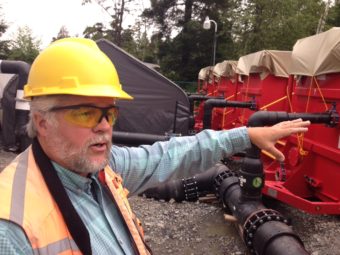
Sitka environmental superintendent Mark Buggins looks over the temporary filtration plant at the Indian River. Buggins says Sitka’s water smells like chlorine “because there’s more chlorine in it.”(KCAW photo/Robert Woolsey)

Sitka’s tap water smells bad at times, and it turns yellow at others — but it’s safe to drink. And it’s also temporary. In about 40 days, the community should be back on its primary water source at Blue Lake.

That water system has been shut down during work installing the new penstock at the Blue Lake Hydro plant. Sitka’s environmental superintendent, in the meantime, has been assuring residents that they are not imagining things. Sitka’s water is bad — but safe.

Sitka has been drawing its water from the Indian River since August 13. A $4-million rental plant has been installed at the end of the Indian River Road, and despite the price tag, the product is sometimes hard to swallow.

“There is more chlorine in it. The way we’re situated with the Indian River treatment plant and the water quality of Indian River requires more chlorine to meet the safe drinking water standards.”

Read a report prepared for the Sitka Assembly on water quality at the temporary Indian River plant.

That’s Mark Buggins, Sitka’s environmental superintendent. When Buggins talks about Blue Lake — Sitka’s regular water source — being pristine, he’s being technical. There’s almost nothing in Blue Lake for chlorine to react with, so Sitka’s dose historically has been very small.

The temporary plant on the Indian River is a different matter. At the moment the stream is full of dying salmon for one thing, and also bacteria. But the plant is doing its job.

“We test our water all the time. Based on the size of our community, we have to do at least ten total coliform samples — that’s an indicator test of anything that might make you sick — and we do that at various locations throughout the community on a schedule. And we do at least ten samples a month.”

Buggins says the amount of chlorine in the water is less than the maximum allowed by the Environmental Protection Agency, and his department monitors flow rates constantly so as to not go overboard.

Still, there are times when the tap smells so strongly of chlorine that people wonder if Buggins himself can drink it.

“That’s a question that I get in the grocery store or something frequently. Am I drinking the water or buying bottled water. I’m not doing anything different. I make my coffee with it in the morning. Taking my vitamin pills with it.”

The Indian River is also a highly variable water source: Some days a clear, quiet stream, other days — especially after high rainfall — a raging, muddy torrent. Buggins says that at times like these, the filtering technology is nothing short of remarkable.

“That dirt is all taken out by the microfilters. They just plug along. It doesn’t matter what dirt level or turbidity we feed them, it’s always coming out consistent and about 10 times more clear than Blue Lake water normally is.”

But color can’t be filtered out. The naturally-occurring tannic acids in the muskegs along the Indian River Valley floor are washed into the river during high rainfall. It looks like chamomile tea. Old-timers in Sitka remember that yellow water happens in the spring and fall. Well, not that old-time: The Indian River was last used as Sitka’s permanent source in 1984.

On the upside, other than filtration and chlorine, Indian River receives no other treatment. Nothing.

“No other chemicals. Just sodium hypochlorite — or bleach, essentially — which we’re using as our chlorine source there at Indian River. Normally, when Blue Lake is operating, it’s very soft and we have to add soda ash to it to raise the alkalinity and the pH, and we also add fluoride at Blue Lake. We’re not adding soda ash or fluoride while we’re on Indian River.”

The contract with Barnard, the firm building the Blue Lake Hydro project, calls for an outage of 63 days as the new penstock is installed. The target date for reconnecting Sitka’s water supply falls on October 18. Alaska Day is already the community’s biggest holiday. Going back to great water will be one more thing to celebrate.

KCAW’s Chris Todd contributed to this story.

King salmon trolling ends on slow note

Trollers in Sitka’s ANB Harbor. The annual troll closure starts at midnight on Saturday. (Photo byRachel Waldholz/KCAW))
Poor weather extended a planned three-day king opener into five days. (Photo byRachel Waldholz/KCAW)

After an unprecedented two extensions, the summer king salmon season for trollers in Southeast is over.

The Alaska Department of Fish & Game closed the fishery at 11:59 p.m. Monday, August 18 — two days later than planned.

Pattie Skannes is troll management biologist for the region.

“Yeah. We don’t usually work on Saturday and Sunday. But this was one of those openings that required a little bit of attention every day. We set it for three days thinking, This is going to be easy. But it turned out to be anything but easy.”

The target for the three-day opener was 36,000 kings. But on day one, it looked like trollers were bringing in about 12 fish per day. During the first opener of the season — the first week of July — trollers were landing about 50 kings per day. An August storm blew in and kept many of the region’s 700 trollers off the ocean. So the department extended the opening 24 hours to Sunday night. And then another 24 hours until Monday night.

As the weather improved, Skannes says, so did the fishing.

“There were some boats that came in with 0-10 kings, and some that came in with a few hundred. So it’s a wide range, but the average is still fairly low — 19-20 per boat per day. So I think that we’re going to come out just about right.”

Skannes relies on fishermen to keep her informed of their success during the fishery. During a three-day opener, the Department can’t collect fish tickets from processors quickly enough to make timely decisions about how things are going. So a number of boat call in their catch rates directly to Skannes, and she estimates the total harvest based largely on this voluntary survey.

It’s a strategy to avoid undershooting the harvest, and having a third opener later in the summer.

“There have been years in the past where there was a third opener to kind of mop up what’s left. We don’t let you do that anymore. It’s very unpopular. So I expect this will be our last opening for the year.”

In the first summer opener in July, trollers landed almost 200,000 kings. They were paid an average of $3.14 per pound. Since then, the catch rate for coho salmon has skyrocketed, with trollers sometimes bringing in hundreds of coho with their kings. The average price for coho has been around $1.49 per pound.

Although this wraps up the summer season for kings, trollers will still be on the ocean fishing for coho and chum salmon for the next few weeks. And come October, trollers will once again be able to target kings when the winter fishery gets underway.

Democrat Forrest Dunbar hopes to challenge Young

Democrat Forrest Dunbar campaigned in Sitka on August 7, 2014. (Photo by Rachel Waldholz/KCAW)

Anchorage Democrat Forrest Dunbar is hoping to challenge Don Young for Alaska’s lone seat in the U.S. House of Representatives.

Dunbar faces Homer Democrat Frank J. Vondersaar in Tuesday’s primary — and if he makes it through that race, the twenty-nine-year-old first-time candidate will likely face the longest-serving Republican in the U.S. House.

Dunbar visited Sitka last week (8-7-14), and talked about campaigning as an underdog, his vision for the state, and the virtues of 80’s rock.

So, how do you challenge a 21-term Congressional incumbent with a 20-to-1 advantage in cash-on-hand?

Well, this is one approach…

Dunbar video: I just want to earn your vote tonight…I don’t want to lose your vote tonight…

That’s a campaign video from Anchorage Democrat Forrest Dunbar. The candidate lip-syncs his way through a parody of the 1986 song “Your love,” with the lyrics re-written to fit the campaign trail.

Dunbar video: Alaska I’d do anything for you!

 KCAW: Who wrote the lyrics?

Dunbar: Mostly me [laughs]

Dunbar says the idea of singing for votes was all his.

Dunbar: I’ve realized that I used to like eighties rock sort of ironically, but now I just love eighties rock. I’m not sure what happened exactly…

KCAW: You might lose some votes on that one.

Dunbar: Well, you know, I get it, I used to be a hater with eighties rock, but I’ve come around, and there’s sort of a deep genius to it…

He’s hoping there’s a deep genius to his campaign approach as well — using social media and grassroots organizing to take on 41-year-incumbent Don Young and overcome a major fundraising disadvantage:  At the end of July, Dunbar had about $27,000 in cash on hand, compared to Young’s $566,000.

The videos may be silly, but in person it’s clear that Dunbar is dead serious.

It’s undeniable that right now we have a uniquely terrible and dysfunctional congress. And things aren’t going to change until we change the people there and change the attitudes there. Now, in Alaska’s case in particular, we have an ineffective representative.

Dunbar argues that Young has lost influence in Congress after years of ethics investigations. Young was formally rebuked by the House Ethics Committee this summer for misusing campaign funds and taking inappropriate gifts.

Dunbar: The real problem there is the impact it has on Alaska’s credibility and Alaska’s influence in D.C.  And I think that’s what a lot of Alaskans are looking for – they’re asking, ‘Are you going to put yourself before the state?’ Or are you going to be that public servant we need, that’s not going to be concerned with personal enrichment, and is going to fight for transparency, and is going to fight to represent us? And is not going to squander the clout that Alaska built? And that’s ultimately what he did. And again, there was a time when he was very effective, and he had a lot of influence in D.C. That time ended in 2008. It’s never going to come back. He is what he is at this point, and we need a new representative who’s on a positive trajectory.

Dunbar has an impressive resume: he grew up in Eagle and Cordova, and interned for then-Senator Frank Murkowski at age 17;  worked for House Democrat Madeleine Bordallo while an undergrad at American University;  spent two years in the Peace Corps in Kazakhstan; and received degrees from Harvard’s Kennedy School of Government and Yale Law School. Since last August, he’s served as a judge advocate general in the Alaska Army National Guard.

It’s the resume of someone who looks like they’ve been running for Congress since they were in High School. Dunbar says that push comes from his family history.

Dunbar: My grandmother was a Holocaust survivor. Her dad perished in the camp and she came across as a refugee. And I think when you have that kind of background in your family – and my family, especially that side of the family, is very funny and into humor and that kind of a thing. But at the same time, there’s sort of a seriousness there. My grandmother, when I was doing something that she considered kind of frivolous, she would tell me. She would say, ‘Why are you wasting your time with this?’ And I think that’s a big motivator for me, and kind of kept me on the – maybe not the straight and narrow, exactly [laughs] but certainly pointed toward public service.  

On his website, Dunbar lists five top issues: veter ans’ care, campaign finance reform, resource development, education costs — and gay rights. Dunbar says that last issue hits close to home.

Dunbar: Well, on a personal level, my sister is gay, and she’s married, and she lives in the lower 48. And I’d like to live in a state where my sister’s marriage – this is her home state, too, she was born in Fairbanks – I’d like to live in a state that recognized her marriage.

Dunbar says another key issue is developing Alaska’s natural resources but also diversifying the economy, with an eye on the future, when the state will have to depend less on oil.

Dunbar: That means moving into high tech, it means continuing to develop and protect our fishing industry, it means a lot of things. That’s one of our biggest priorities. And I do think that’s the seminal, the central challenge for our generation, is figuring out where the jobs of the future are going to come from.

Dunbar will be on the primary ballot on Tuesday, August 19, running against Frank J. Vondersaar of Homer for the Democratic nomination for U.S. Representative.

Court orders a second look at controversial fish observer program

Observer sampling fish. (Photo by NOAA Fisheries)

A U.S. District Court judge has ruled that a newly-implemented fisheries observer program in the Gulf of Alaska may have become unreliable, and is sending federal managers back to the drawing board to fix it.

The decision by Judge H. Russel Holland is being hailed as a victory by Southeast Alaska’s longline fleet, who have chafed under the new system, which requires them to carry human observers on their relatively small vessels.

But federal fisheries managers see it as a win as well.

The observer program is not going away. Instead, the court’s action may compel the National Oceanic and Atmospheric Administration — or NOAA — to find a way to remodel it, which is what the small-boat fleet has wanted since the North Pacific Fisheries Management Council adopted the new plan in 2010.

Joel Hanson is the conservation director for The Boat Company, the non-profit regional cruise company-cum-environmental organization that brought the lawsuit.

“We don’t hesitate to speak our peace with federal agencies when we see them doing something awry.”

In this case, something awry meant redistributing observer coverage on Alaska’s trawlers — who drag huge nets along to ocean floor scooping up pollock — in order to create an observer program for the halibut fleet, generally smaller boats who use a type of gear called longlines, which catch fish on hooks.

Hanson says NOAA — acting under the direction of the North Pacific Fisheries Management Council — just got it wrong. The fish observer program is intended to keep track of bycatch, or the number and kinds of fish being caught unintentionally. Restructuring the program was supposed to improve coverage of the fisheries, but Hanson believes its gotten worse.

“So this was an opportunity for us to look at what the outcome of the restructuring program was, where it should be, and how to make it more like what we think the public expected, and what we certainly expected. ”

And Judge H. Russel Holland agreed in part. In his 50-page ruling, Judge Holland says coverage under the new system risks dropping below a reliable threshold.

The government doesn’t necessarily dispute that finding.

“The analysis that the judge has asked us to do is actually very helpful.”

Martin Loefflad directs Fisheries Monitoring for NOAA’s Alaska Fisheries Science Center in Seattle. Judge Holland’s decision requires the agency to prepare another environmental analysis, to ensure that enough observers are on enough boats to gather reliable data on bycatch.

“And we’re certainly game to do that, because we too share the concern of the data quality issue.”

Read NOAA’s 2013 Observer Program Annual Report.

Unfortunately for fishermen, better coverage may mean an increase in costs. The fleet pays 1.25 percent of its gross sales to fund the observer program. The Magnuson-Stevens Act caps those fees at 2 percent, but there are still millions of dollars in play.

Loefflad says the decision validates the government’s efforts to expand observer coverage in the 25 years since it began.

“The court’s judgement on us is really quite a success story because it preserved many of the strides that we were able to get through with the restructured observer program, working through the North Pacific Fisheries Management Council. So many of those things that didn’t occur in the past are present today.”

Foremost among those new things is coverage of the halibut longline fleet, which did not have to carry observers until last season. An organization calling itself The Fixed Gear Alliance intervened in the lawsuit on behalf of The Boat Company. Linda Behnken is the director of the Alaska Longline Fisherman’s Association — or ALFA — which is member of the Alliance.

“The main improvement we hope to see in the program is an increase in observer coverage on vessels where bycatch is an issue. So salmon bycatch is all in the trawl fishery. Halibut bycatch is primarily in the trawl fishery. To see better coverage.”

The Fixed Gear Alliance also wanted to see electronic monitoring (EM) addressed in NOAA’s new Environmental Analysis, but Judge Holland did not allow that argument to move forward. Still, the use of cameras to count fish instead of humans — especially in cramped quarters on boats under 60 feet in length — has its advocates. Really important advocates. Like Sen. Lisa Murkowski, recently speaking to the Sitka Chamber of Commerce.

“We can be smarter in our technologies to allow for electronic monitoring that is accurate and reliable, and doesn’t get in the way of the operations. It’s been fascinating to me how much foot-dragging we have had from the agencies, Oh you know, we just don’t know, somebody might tamper with this, you can’t do that — Good heavens! Work with us.”

Linda Behnken at ALFA hopes that NOAA does just that when it reopens the environmental analysis — even though the judge didn’t spell it out. ALFA has been working for several years on an electronic monitoring pilot project. NOAA is piloting a program of its own with nine boats this season.

NOAA’s Loefflad says it’s a start.

“I think there is a future for electronic monitoring in Alaska. We’re doing the research right now, and we’ve been partnering to move that research forward.”

Still, electronic monitoring would have to be adopted by the North Pacific Management Fisheries Council — a process that is by no means fast. None of this is particularly fast. The Boat Company’s attorney, Paul Olson, filed this suit in 2012 with Earthjustice. Although the observer program isn’t going away, Olson considers the ruling a win anyway, since the government is going to have to take another hard look.

“Basically what the court said is that your NEPA analysis failed to consider whether you would acquire statistically reliable data at significantly reduced coverage rates, especially for the trawl fleet.”

NEPA stands for National Environmental Policy Act. In this case, a new NEPA analysis means — not necessarily starting from scratch — but a new document, and a new opportunity for the public, the small-boat halibut fleet, and US Senators to comment on the process.

Four-day troll closure starts this weekend

Trollers in Sitka’s ANB Harbor. The annual troll closure starts at midnight on Saturday. (Photo byRachel Waldholz/KCAW))

Southeast Alaska’s commercial troll fishing fleet will have to stand down for a few days, starting this weekend.

The Alaska Department of Fish and Game announced Aug. 5 that the Southeast troll fishery for all salmon will close for four days, starting at midnight on Saturday, Aug. 9. It will reopen at 12:01 a.m. on Thursday, Aug. 14.

The fishery typically shuts down for several days in August to allow coho salmon to escape back into their home streams to spawn.

Fish & Game also announced that trollers will get a second king salmon opener next week. Trolling for kings will re-open on Aug. 14. The opening will last just three days, and close at midnight on August 16.

Fish & Game estimates there are about 36,000 kings left to catch before the fleet reaches this year’s target harvest. Trollers caught nearly 200,000 fish during the first summer king opening, which ran from July 1 through July 7.

Trollers may still target chum salmon in certain areas throughout the troll closure, including in much of Sitka Sound. Trolling for all species will also remain open in select terminal harvest areas, including Deep Inlet near Sitka, so that fishermen can target salmon returning to hatcheries.

*Editor’s Note: This story previously incorrectly stated the length of next week’s king salmon opener for Southeast commercial trollers. The king opening will last three days, not two. It will run from 12:01 a.m. August 14 through 11:59 p.m. August 16. The story has been updated to correct the error. We regret the mistake.

30-year-old buried TNT riddle in Sitka solved

The eastern end of Lance Drive. (Photo by Greta Mart/KCAW)

The Lance Drive bomb mystery has been solved.

Explosives found last week at the end of Lance Drive in Sitka turned out to be no longer dangerous — in fact, bomb experts believe that they had already detonated underground years ago.

The Sitka fire department called in a military bomb squad from Ft. Richardson to assist with the case.

Last Thursday, a Lance Drive homeowner called in officials after discovering strange wires sticking out of the ground where he was building a rock wall. Authorities briefly evacuated neighboring residents and closed Sawmill Creek Road to traffic.

By Saturday, the investigating team cleared the area and cut down an 80-foot spruce tree adjacent to the wires. Unearthing what turned out to be a 30-year-old fuse, the team followed the fuse wire down eight feet to find a hollowed-out cavern, assistant fire chief Al Stevens said on Monday.

Buried dynamite had exploded years ago, creating the cavern, but the TNT was so tightly packed in the surrounding sand, it had not caused an explosion above ground. And the fuse, or detonation cord, had never burned.

Officials suspect the cache of dynamite was left over from an abandoned roadworks project designed to connect Lance Drive to Sawmill Creek Road. The project was halted after city staff determined it was too dangerous to create an intersection on that particular blind curve of Sawmill Creek Road.

Stevens said in all of his years on the job, he had never come across anything like the underground explosion site. He added that it was likely the felled spruce tree would have eventually toppled on adjacent homes as it was standing atop a hollow mound.

Site notifications
Update notification options
Subscribe to notifications