KCAW - Sitka

KCAW is our partner station in Sitka. KTOO collaborates with partners across the state to cover important news and to share stories with our audiences.

Mass die offs of Sitka sea stars reported

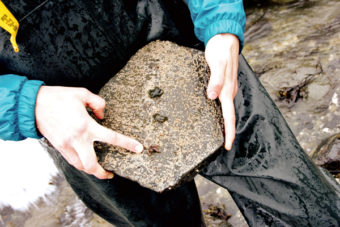
Taylor White pulls up a rock on Sage Beach to see three leptasterias, which are small, 6 legged sea stars that are common at this site. She points to the one with three legs and lesions, symptoms of sea star wasting disease. (Photo by Anne Brice/KCAW)

A trip to the coast usually means you’re going to see sea stars, but a mysterious disease is killing them along the West Coast. There had been a few reports of sick sea stars in Alaska, but recently in Sitka, the first mass die offs in the state were detected. Scientists in Sitka are tracking the progress.

Patty Dick lives on a boat in Thompson Harbor in Sitka. In the morning, when it’s low tide and she has an extra moment, she goes out and checks on the sea stars living in the area.

“I just sit there in awe of the beauty of that animal,” she said. “Everybody loves sea stars.”

Dick teaches 6th grade biology at Blatchley Middle School. She often takes her students on field trips to learn about marine animals, and they usually find dozens of sea stars.

But one morning last month, Dick noticed something was wrong with the sea stars. “I just looked over and I just stopped. There were these big, huge, white spots all over them and they were just wasting away. My heart just sank.”

She’d heard about this happening, but she hadn’t seen it with her own eyes. “I’m trying to find one star fish that is not affected,” she said, “and they were all dead. They were all dead.”

They had sea star wasting disease. All along the West Coast, sea stars have been dying of this disease. The first case was discovered in the summer of 2013 on the Olympic Peninsula and scientists still don’t know what’s causing it.

Taylor White is the aquarium manager at the Sitka Sound Science Center. For the past year, she’s been working with a team that is monitoring sea stars and other marine life in Sitka and along the West Coast.

“You really do look a lot harder at sea stars now that sea star wasting disease is occurring. I feel like a lot of people are paying a lot more attention now.”

“It’s a lot of just crouching down and going from the top left corner and going through the entire plot, moving this rockweed around, and counting as any starfish as you see,” White said.

She takes me for a walk along the beach to see for myself. She pulls up a rock and is looking at some six-legged sea stars called leptasterias. We’re looking at sea stars on Sage Beach, next to the science center.

The Sitka Sound Science Center is part of a project called MARINe, which stands for Multi-Agency Rocky Intertidal Network. MARINe is made up of agencies that use the same marine monitoring methods. They’ve set up about 120 sites along the coast in the U.S., from Southern California to Alaska. There are three sites in Sitka – the only long-term MARINe sites in Alaska. White helps monitor the Sitka sites as part of her job at the science center.

“You really do look a lot harder at sea stars now that sea star wasting disease is occurring,” she said. “I feel like a lot of people are paying a lot more attention now.”

Once sea star wasting hits an area, it can quickly spread through the population. Research divers from the University of Alaska, Sitka, have surveyed different areas in Sitka Sound and have seen evidence of wasting in most locations. At Sage Beach, divers found that in the past few weeks, sunflower stars have disappeared, leaving behind white ‘ghost piles’ of tissue.

While there have been minor wasting events in the past, this event is by far the longest and most widespread.

White says she’s seeing the same thing happen in the touch tanks at the Sitka Sound Science Center. “A lot of those guys have been in there for a very long time. It was hard to see it suddenly hit.”

They use an open system, so sea stars live in water straight from the ocean. She describes what she saw when the disease hit. “They just started crawling away from their bodies,” she said. “They contort themselves. Then they just started to decay since there are so many bacteria in the water. They just kind of break down after that point.”

When sea stars are sick, they can lose a leg and then regrow a healthy one. But with the wasting disease, they just keep losing legs, sometimes until only a central disk is left. The aquarium has had 35 sea stars die within three weeks, and now, only two remain in the touch tanks.

Scientists know there will be substantial impacts from these mass deaths, but they aren’t sure what yet.

Marnie Chapman, a biology professor at the University of Alaska, Sitka, has been working with White in the longterm monitoring project. She says sea stars play a big role in the ecosystem.

“They are major predators in the intertidal,” she said. “They’re definitely the lions and tigers of the intertidal environment.”

And they’re diverse. There are about 1900 species of sea stars in the world, and at least 18 in Sitka alone. “Sea stars are as unique and as individual than those predators that we’re more familiar with,” said Chapman.

There are several groups trying to figure out what’s causing this mass die off. It could be a bacterium, a virus, or environmental change, like lower pH levels in the ocean or warmer water. Most scientists think it’s a combination of things.

“They just started crawling away from their bodies. They contort themselves. Then they just started to decay since there are so many bacteria in the water. They just kind of break down after that point.”

When scientists do figure it out, there’s not much that can be done. If it’s a pathogen, there won’t be a sea star vaccine. If it’s warmer water, that’s irreversible.

Chapman worries about the future of the species. She recalls a day when she was out counting dying sea stars and a boy was looking at healthy ones nearby. “This young kiddo was saying, ‘mom, look at all the sea stars,’ and there were a lot of really healthy, unaffected on the side they were looking on,” she said, “and I thought, ‘boy, I hope that still happens. I hope that still happens next summer.’”

But there is some hope. At some of the MARINe sites along the coast, they’re seeing some juvenile sea stars. So, they could make a comeback. In time, we’ll know better.

And there is something that everyone can do to help track the disease. If you see sick or healthy sea stars, report it to seastarwasting.org. Reports from the public help scientists better understand the disease and could help solve this mystery.

Sitka couple’s 10-year marriage recognized

Heidi, at left, and Karla Horner Raffaele met in Sitka in 1993. They work in town as a school administrator and school director, respectively, for the Southeast Enrichment Resource School (KCAW photo/Emily Kwong).

On Sunday, a federal judge overturned Alaska’s 16-year ban on same-sex marriage. He ordered the state to recognize legal marriages made in other states and to issue new licenses immediately. By Monday morning, applications appeared in court houses across Alaska. They were gender neutral, with boxes labeled “Party A and Party B,” instead of “Bride and Groom.”

By 11:30am, there was no line at the courthouse. Just the ding of an elevator door. Heidi Horner Raffaele and Karla Horner Raffaele had come to apply for a marriage license.

“I’m 52 and I just never thought I would have this opportunity,” said Raffaele. “So perhaps that’s why I’m a little nervous. What it does is it helps bring about 1,100 rights that are given to straight couples – to typical couples and that now gives those rights to us.”

Heidi and Karla met in 1993 through a mutual friend. But, the first time Heidi technically saw Karla, was in passing.

“[Karla] was the manager at McDonald’s and working on her teaching certificate and I was a teacher,” said Heidi. “And I drove through the drive through and saw this cute little red head and I just thought, ‘My goodness isn’t she cute.’ And so I drove around again.’”

Karla, however, is fuzzy on these details.

Karla: Yeah, I still can’t remember. Thinking back over it.

Heidi: Yes, she did not notice me in the least. But it’s been kismet ever since. You know, 19 years.

In those 19 years, the couple adopted 12 children and actively pursued opportunities to wed. The first came in 2004, when city officials in San Francisco began issuing marriage licenses.

“Karla and I had the opportunity to fly down,” said Heidi. “Our friends in Sitka and our family in Sitka jumped in right away and said, ‘Hey we’ll watch all the kids. You and Karla go down to San Francisco.’  So we did and we got married.”

But a few weeks later, they got a letter from the California Supreme Court. It declared their marriage null and void. They married again four years later, in San Francisco in 2008, this time for keeps, but the marriage still wasn’t recognized in the state of Alaska.

When Heidi and Karla went to the courthouse Monday, they expected to have to apply for a third time. But they learned from court clerk Leslie LaPean that that wouldn’t be necessary.

LaPean: You just present the certificate that you got from California.

Heidi: Great.

LaPean: And that’s it.

Heidi: Actually, I think that’s terrific. What do you think, Karla?

Karla: Saves me $60.

Heidi: (Laughing) Yes it does, by golly…that means I don’t have to buy a bigger ring. And thank you for doing that.

LaPean: Oh, you’re welcome.

Though somewhat anticlimactic, Heidi and Karla expressed gratitude to finally be considered a married couple in the town they call home.

“It was very kind and very personable and very supportive and they were excited for us and I think that’s what I would wish for every couple applying for their first license,” said Heidi. “And for couples married elsewhere, I would wish for them the joy and excitement of knowing they are equal. That we are equal.”

In a press release, Governor Sean Parnell said that the state will appeal the same sex ruling in order to “defend and uphold the law and the Alaska Constitution.” But for now, there is a permanent injunction on the enforcement of marriage laws in place. As of Monday afternoon, 11 same sex couples in Fairbanks, Juneau, and Anchorage had applied for licenses to marry.

Liveaboard firefighter stops spreading Sitka harbor blaze

Crescent Harbor, where a boat fire was extinguished by a liveaboard firefighter on Friday, Oct. 3. (Photo by KCAW News)
Sitka’s Crescent Harbor, where a boat fire was extinguished by a liveaboard firefighter on Friday, Oct. 3. (KCAW News photo)

Quick thinking by an off-duty Sitka firefighter may have prevented a boat fire from becoming a major disaster in a local harbor last week.

Deputy fire chief Al Stevens says Michelle Snowden, an engineer with the department, had just moved onto a liveaboard in Crescent Harbor when she heard the department-wide tone-out — or emergency paging signal — that a boat was burning on another finger.

He says Snowden ran down the dock, assessed the situation, and acted.

“And having the firefighter ability she has, she was able to lay out the hoses out and get the hoses out before the engine even arrived.”

The 24-foot sport fishing boat was fully involved when Snowden arrived, and a neighboring vessel had also sustained damage. Stevens says Snowden’s being in the right place at the right time, plus her quick thinking, prevented the situation from growing much worse.

“It certainly had all the recipes for being a disaster because winds were pretty steady at 20-25 knots with gusts to about 30. It was one of those windy nights, and did do damage to the boat next door, but it was limited right there to the two vessels.”

Stevens suspects faulty wiring in the battery compartment may have arced and started the blaze, but he hasn’t ruled out some of the other electrical equipment on board. The fire burned a through-hull fitting, causing the boat to start sinking, but Stevens says Harbormaster Stan Eliason was able to keep the boat afloat with portable pumps.

Stevens says his department mobilized to fight fire, but — to everyone’s good fortune — went home a little disappointed.

“Everybody showed up but there was no fire to put out. Michelle had it all out.”

The Harbor Department assisted the vessel’s owner in hauling it out on Saturday morning. The boat appears to be a total loss.

Landslide destroys Starrigavan restoration projects

The main area of the slide encompasses an area of roughly 100 acres. (USFS photo)

High rainfall this month is being blamed for a major landslide near Sitka. The U.S. Forest Service reports that a 100-acre slide came down in the Starrigavan Valley, about ten miles from town. Although there was no structural damage in the event, hundreds of thousands of dollars of watershed restoration projects in the valley have been wiped out. The slide, and water damage to an ATV trail in the valley and other hiking trails elsewhere in Sitka — all add up to a tough month for the agency.

The scale of the Starrigavan slide has unfolded slowly. A Fish & Game biologist was in the area — apparently the morning after the slide — on Friday, September 19, and noticed that Starrigavan Creek had been diverted onto the old logging road that is now being used as an all-terrain vehicle trail.

Marty Becker is the watershed program coordinator for the Sitka Ranger District. He and other staff went to check on the problem Monday morning.

“It wasn’t until we actually climbed through the front of the slide that we saw the magnitude of it.”

Read the USFS Preliminary report on the Starrigavan Landslide here.

There was not one slide, but three. Two smaller slides across the both the north and south forks of Starrigavan Creek…

“And then one main slide that came down off the north-facing slope. Came down and ran about a third of a mile down the main channel, and ended up at the log stringer bridge, which hung up the main slide.”

Becker estimates the area of main slide to be in the neighborhood of 100 acres, starting in the old growth timber high on the valley slope and running down through the second growth to the valley floor.

Becker says the Sitka district hasn’t seen a cluster of slides like this since the mid-1990s, in Nakwasina Sound and the Katlian area, which he says are more dynamic systems. The Starrigavan slide, Becker says, is “pretty extraordinary.”

“Boy those freaky events keep us on our toes…”

The log stringer bridge in the Starrigavan Valley is a lost cause. At the other end of town, USFS recreation manager Mike Mullin is on the Herring Cove Trail, next to a footbridge that his crew is working hard to save.

“These guys will get a gap opened up under it and get a lot of that material flushed through, and we might end up jacking the bridge by a couple of feet. I’m hoping once we uncover the rocks and debris that there’s not some big chunks out of it. So I’m hoping it can be saved.”

This is the second time this year that the trail has sustained major water damage. All the repairs from last January’s flooding have been washed out, two minor slides have cut the trail, and this footbridge over the stream — while it hasn’t moved — is more or less sitting on dry land. Heavy rains over two consecutive weekends in September pushed rocks under the bridge and turned it into a dam.

It doesn’t look like it will survive another high rainfall event. Mullin says the Forest Service is basically between a rock and a hard place.

“The couple of events we’ve had this summer have been a little out of the ordinary for sure, but yeah, we’re not even in the rainy season, and we lose our seasonal crew in a couple of weeks. And obviously Forest Service budgets for maintaining trails are on the decline. So we’ve got a lot of things working against us.”

Mullin says the agency will likely have to consider realigning the trail away from the alluvial fan at the base of Bear Mountain Falls, into a less dynamic area.

Both the Herring Cove trail and the Starrigavan Valley were probably affected by what Marty Becker calls a “micro-burst.” Meteorological data for Sitka doesn’t indicate rainfall amounts too extraordinary for this time of year, but the rain came hard and fast. What was officially recorded as three-and-a-half inches of rain at the Sitka airport on the day the Herring Cove Trail was damaged, Becker says filled rain gauges in some parts of town to nearly seven inches.

In the Starrigavan Valley, the mitigation strategy is uncertain. Three of the Forest Service’s coho-rearing ponds were lost in the slide; a fourth was almost completely filled with sediment. Two fish culverts have been blown out, and a half-mile of stream, several forest test plots, and 300 meters of the ATV trail are just gone.
The Forest Service has invested several hundred thousand dollars in restoration work in this valley. Becker is not sure to what extent the agency will attempt to undo some of the damage.

“Yeah, that’s the big question. We’re going to be sitting down the next couple of days assessing what we know right now. Getting some aerial reconnaissance to see if there are more slides that we haven’t seen, and then getting out there in the next week or so after we let things stabilize — it’s pretty dangerous, things still shifting around — to get a full inventory of what’s been damaged, where the main problem areas are, and then to see what we can actually do.”

The last slide of this magnitude around Sitka happened at Redoubt Lake in May of 2013, and two people staying at the Forest Service cabin there managed to escapemoments before the mountainside came down. Becker says both slides are comparable in size, but he says the resource damage here is greater, because the Redoubt slide was stopped by the lake, and in Starrigavan it just “ran right down the valley.”

Groups hope MSA update won’t move fish conservation ‘backwards’

Magnuson-Stevens created 8 separate regional councils to manage fisheries in federal waters. According ALFA’s Linda Behnken, not all regions have placed as much emphasis on resource protection as the North Pacific. (NOAA Fisheries image)

A number of regional fishing associations are joining forces to strengthen the Magnuson-Stevens Act.

The Sitka-based Alaska Longline Fishermen’s Association announced last week (9-9-14) that it’s reached an agreement with the Alaska Marine Conservation Council and several east-coast industry groups to form the Fishing Community Coalition.

The new organization wants to ensure that Congress makes protecting fish stocks a priority as it prepares to reauthorize the nation’s most important law governing the harvest of seafood in federal waters.

Draft language containing proposed changes to Magnuson-Stevens has been working its way through the US House of Representatives, but the political lines became clearer when Florida’s Republican Sen. Marco Rubio introduced his version of the bill on September 16.

Read the full text of Sen. Rubio’s Florida Fisheries Improvement Act.

The top priority for Rubio is giving the regional management councils more flexibility in setting timelines for rebuilding depleted fish stocks.

This is exactly what Linda Behnken, the director of the Alaska Longline Fishermen’s Association, was hoping not to hear.

“There’s quite a pushback right now against the rebuilding timelines and the catch limits. You start rebuilding stocks, it means you have to catch less fish, generally, and that’s a painful process for fishermen.”

Behnken says she wasn’t expecting a Senate bill so soon, but Rubio’s paralells some language she’s seen in the House. Fishing Community Coalition is worried about a reauthorization that merely “reaffirms the status quo” or worse “moves backward.” The Mangnuson-Stevens Act was first passed in 1976, and wasn’t considered very effective for its first two decades. But substantial amendments in 1996 and 2006 reinforced the law’s commitment to sustainability.

Behnken would like to stay the course.

“To protect the gains that we’ve made in the last two reauthorizations, for the resource. And also to look for ways to support policy that keeps a healthy resource and provides access for people who live in traditional fishing communities, to those resources.”

Behnken served three terms on the North Pacific Fisheries Management Council, one of eight regional councils established under Magnuson-Stevens. While there were always politics and tension over the allocation of fish, one thing remained unchanged.

“In this region, in the North Pacific, the council never sets any catch limits for stocks above what the scientists recommend to be optimal levels — the maximum levels that can be taken without undermining the health of the stock. That’s not the case in other parts of the country.”

“We definitely have some out here, with our Georges Bank and our Gulf of Maine cod stocks, that are a mess,” says Tom Dempsey,the Policy Director of the Cape Cod Commercial Fishermen’s Alliance.

“And they’re collapsing right in front of us. We need improve how we manage those stocks, to give ourselves a chance at rebuilding to a point where we can have a sustainable fishery.”

Dempsey says fisheries for scallop and lobster are doing well in his region. But, groundfish, the flagship of the historic New England fisheries, are on the verge of becoming commercially-extinct. As recently as 30 years ago there were 60 boats fishing for cod throughout the summer out of Chatham, Massachusetts, where Dempsey lives. Today there are two part-time boats.

Dempsey also holds a seat on the New England Fisheries Management Council. He says there’s a tendency to distrust science in his area, and unlike Alaska, no annual stock assessment. Management decisions are sometimes being made on biological information that is several years old.

“That is a huge frustration of ours. It’s one of the central things we want to get done in this reauthorization process. And unfortunately there’s been opposition out here to the levels of catch accountability that you need to manage stocks. I say it all the time: When you’re managing fish, there are only two questions. How many fish are in the water, and how many fish are you taking out?”

Sen. Rubio’s bill includes provisions to increase funding for stock assessments and data collection, but the track record of success of Magnuson-Stevens outside of Alaska is not stellar.

Matthew Felling, spokesperson for Alaska Sen. Lisa Murkowski, says his boss holds some sway over her Florida colleague.

“She is someone that he relies on for guidance and for knowledge. Sen. Begich, of course, has a role because he works closely with Sen. Rubio on the Oceans Subcommittee. But as all three of them are members of the Oceans Caucus, Sen. Murkowski has been able to inform Rubio’s understanding of our waters, our fishing industry, and of our success story that we have in Alaska.”

Felling says that with the Senate likely to go into recess until mid-November, there’s no way any reauthorization will happen in this Congress. He thinks the extra time will produce a more thoughtful bill.

“Just last month at an event in the Kenai, Sen. Murkowski said that the most important priority to MSA authorization was to not just rush it and get it over with, but to do it right, dot the i’s, cross the t’s, and make sure that all possible stakeholders have their voices heard.”

Those stakeholders — according to Sen. Rubio’s office — include some of the producers, processors, and retailers trying to make the most of limited stocks. And although giving the councils “flexibility” to depart from strict conservation guidelines may become the most politically-charged idea in the reauthorization process, ALFA’s Linda Behnken says it doesn’t have to be. She says flexibility — as in the use of new data-collection tools, like cameras rather than on board observers — can actually be a good thing.

“That kind of flexibility doesn’t compromise the resource, but it’s real important to small boats and fishing communities.”

In addition to the Alaska Longline Fishermen’s Association and the Cape Cod Commercial Fishermen’s Alliance, the Fishing Community Coalition includes the Alaska Marine Conservation Council, the Maine Coast Fishermen’s Association, and the Gulf of Mexico Reef Fish Shareholder’s Alliance.

Youth climate change lawsuit dismissed

Nelson Kanuk, seated, and Katherine Dolma, standing, were two of the six young plaintiffs who sued the State of Alaska, demanding it take action on climate change. The pair are pictured here in Barrow, following a Supreme Court LIVE hearing at Barrow High School. (Photo by Jeff Seifert/ KBRW)

The Alaska Supreme Court last week dismissed a case brought by six young Alaskans, demanding the state take action on climate change. The suit was one of several filed nationwide, and the first to take its argument to a state supreme court. In dismissing the case, the Court said that climate policy isn’t an issue the judiciary can decide – it must go through the political process.

But, for the young plaintiffs and the nonprofit supporting them, the ruling included some silver linings.

Nelson Kanuk was 16 when he sued the state of Alaska along with five other minors, ranging from infants to teenagers. The six young Alaskans argued that the state has an obligation to do more to halt climate change.

Each of the children named in the suit cited direct impacts from climate change, but Kanuk’s were maybe the most immediate. The river in front of his family’s home in the Western Alaska village of Kipnuk was carving away the melting permafrost beneath their land.

This is Kanuk speaking with KCAW’s Ed Ronco in early 2013, after a year in which his family lost eight feet of their yard to the river:

Kanuk: … as the summer progressed, we lost another five feet…

Ronco: How much is left before it gets to your house?

Kanuk: Last fall, before I left, there was about 40 feet, or so, but when springtime comes, there’s definitely going to be a couple more feet that will be lost.

Now, Kanuk is 20, and a sophomore at the University of Alaska, Fairbanks. And his family’s house? It’s uninhabitable. In the last year, his family moved first to Bethel, and then to Kenai, driven both by the loss of their home and the escalating cost of food and fuel in Kipnuk.

Kanuk says it’s been a huge change, especially for a family that’s used to getting much of its food from the land.

“We aren’t able to just hop on a boat and go out and catch our dinner that night,” he says. “You know, our subsistence lifestyle changed. Now we’re forced to go to Fred Meyer or Walmart. It’s a big change.”

It was to draw attention to the situation of families like his that Kanuk first joined the suit against the State of Alaska in 2011. The plaintiffs are backed by Our Children’s Trust, an Oregon-based nonprofit that has worked with kids in several states and at the federal level to bring similar lawsuits. The Alaska case is the first to reach a state Supreme Court on its merits.

And this month, the justices dismissed the suit. But Julia Olson, Executive Director of Our Children’s Trust, says the court “left the door open” on several key issues.

“The exciting part about the Supreme Court’s decision, is that they said the youth had made a good case,” Olson says. “They noted that the climate science is compelling, it demonstrates real significant impacts to the people of Alaska, and that the plaintiffs had direct injuries…So it did all sorts of really important things. The one thing it didn’t reach was, well, what role does the court have to play?”

Assistant Attorney General Seth Beausang argued the case for the State of Alaska. He saw the ruling in more limited terms.

“The appeal was about where the plaintiffs’ concerns about global warming should be heard,” Beausang said. “Whether it should be heard in court or in the political arena. And the court held that the claims were not the kind of claims that can be resolved in court.”

Claims such as: the state should reduce emissions by at least six-percent a year. That kind of specific policy, the court ruled, should be left to the political process.

But the plaintiffs also asked the court to rule on whether the atmosphere is part of the “public trust.” This is a concept embedded in the Alaska Constitution.  Things like water, wildlife, and fish, are all publicly owned, with the state holding them in “trust” for the benefit of all Alaskans.

Beausang says the plaintiffs suggested a whole new take on the idea of the public trust.

“It was trying to argue that under the doctrine, the state has an affirmative duty to protect public trust resources from harm,” Beausang said. “That is a novel spin on the public trust doctrine.”

The court tip-toed right up to the edge of declaring the atmosphere an asset of the public trust, writing, “the plaintiffs do make a good case.” But, in the end, the court said that a ruling wouldn’t give the state clear direction on what to do next, and wouldn’t give the plaintiffs immediate relief. So while it could issue a ruling, it wouldn’t — not in this particular case.

Olson says the plaintiffs will ask the court to reconsider that decision — specifically, she thinks the court can do something right now, on greenhouse gas emissions.

“Even if it’s the court directing the other branches of government to do the work to set a safe level or a safe standard,” Olson said. “It doesn’t have to be the court that does it, but somebody needs to do it, because no entity within government is doing that right now, and that’s a tragedy.”

As for Kanuk, he says he’ll keep working to bring attention to the issue of climate change in Alaska. For his part, he doesn’t have any choice but to adapt.

“To me, it’s kind of like, [laughs] jumping into a fast-flowing river,” Kanuk said. “You don’t know what’s going to happen, and it’s tough, but you have to adapt to the new way of life that we’re forced to live now.”

Site notifications
Update notification options
Subscribe to notifications