KCAW is our partner station in Sitka. KTOO collaborates with partners across the state to cover important news and to share stories with our audiences.

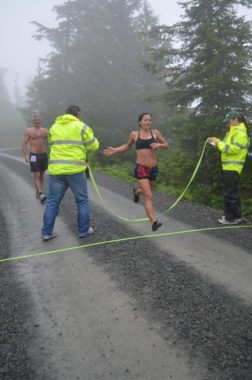
Women’s champion Tasha Folsom crosses the finish line on Harbor Mt. (Photo courtesy Sitka Alpine Adventure)
On a day that seemed almost guaranteed to produce no record times, two Sitka women on Saturday crushed the course record in the 21st Alpine Adventure Run.
Tasha Folsom took first place in the women’s event, with a time of 1:18:10 — a full two minutes faster than the record set last year by New York runner Emily deLaBruyere.
Runners encountered steady rain and winds of about 20 miles per hour on the Gavan Ridge.
Folsom says she’s used to wet conditions.
“I’ve trained in that crappy weather multiple times this season. So I didn’t have to adjust much of anything to get through the course on a wet day.”
Folsom also competed in Alaska’s other classic mountain event, Seward’s Mt. Marathon race, on the 4th of July. That event features a 3,000-foot climb straight up the mountain, and then a wild descent nearly straight down. She finished 13th overall for women in her first time out.
Folsom is not quite sure how Mt. Marathon played in to her success in the Alpine. She believes the Alpine requires more endurance for the long ridge run, while Mt. Marathon requires a lot of strength.
She was surprised to claim the Alpine course record.
“You know, I just wasn’t feeling it the entire race. They told me my time and I just didn’t believe it. I thought, Nah, people are playing a joke on me.”
In second place for women, Sitkan Emily Routon also came in under the previous record pace, finishing in 1:19:58.
Despite the weather, men also posted fast times: Four-time champion Sam Scotchmer of Sitka finished :44 seconds off his record-setting pace last year, finishing in 1:04:47. Anchorage challenger Matias Saari crossed the line about 90 seconds later, with a time of 1:06:10.
The Alpine Adventure Run originated 21 years ago as an Eagle Scout project by Josh Horan. 15 runners participated in that first event. Horan’s mother, Christine, has remained race director ever since. The race is now capped at 75 participants, and usually fills within two hours when registration opens in April.
While Halibut Point Road repaving remains stalled, crews are beginning the $2-million project on Harbor Drive. (Photo by Robert Woolsey/KCAW)
The state has spent nearly $70 million on transportation projects in Sitka over the last five years, and there’s more on the way.
Al Clough is the southeast regional director for the state Department of Transportation. He spoke to the Sitka Chamber of Commerce on Wednesday.
Clough tallied up projects going back to the roundabout: The airport runway extension at $24-million, runway paving at $12 million, Sawmill Creek Road also $12 million, Halibut Point Road — including two new bridges — $20 million, and Harbor Drive from the roundabout to the runway — which is just getting started — at $2 million.
And coming up next, a $12 million gravel road extension from Starrigavan to Katlian Bay.
“The concept there is to construct a single-lane road at low-volume standards, with inter-visible turnouts, to provide recreational access, also access to the rock source that’s in upper Katlian Bay. And potentially be the start of a public roadway network headed in that direction.”
The Katlian Bay road will link the Sitka road system to land owned by Shee Atika, Inc., Sitka’s urban Native Corporation. It will consist of six miles of new construction, and two miles of rehabilitated Forest Service road — open in summer only.
There’s $400,000 in state transportation bonds available to design the project this year. Clough says he’s retained an engineering firm specializing in mountain roads for the project.
“I try to explain Southeast Alaska road building to people who aren’t familiar with the terrain here. The best explanation I can come up with is that it’s like building roads in the mountains, except we don’t have a pass. Our roads are predominantly built along shorelines for the obvious reasons, but we have all the challenges of building through the mountains, it’s just that we don’t have to go up in the high country.”
The Katlian Bay road, plus $900,000 for completion of Sitka’s Cross Trail, are already on the books for the coming year — in a document called the STIP, or Statewide Transportation Improvement Plan.
STIP is a list of realities; another department document, called the Long-Range Transportation Plan, is more about dreams.
Clough discussed Sitka’ most durable transportation vision: a road across the island to either Rodman Bay or Baranof Warm Springs.
“When you start comparing the costs of a completed hard link to a 40 mph standard to Rodman, then you look at what it would cost to punch a tunnel through the mountain — you know, it’s a plan. It’s worth talking about. And we’re looking for feedback.”
A member of the Chamber audience pressed Clough about whether the state should incentivize local hire, given the amount of work happening in Sitka. Clough responded that contractors for marine projects tended to be from out of town, and contractors for road projects tended to be local. He said he had no authority to enforce local hire. Rather, his job was to “get the best value for Alaskans possible.”
A July sunset from the Sea Walk “spur” on Crescent Harbor. The city’s insurer requires a guardrail to be built here. Photo courtesy KCAW/Shaleece Haas)
If the dream of bulk water sales in Sitka ever becomes a reality, the city will be ready.
The Sitka assembly last night revised the way revenues from water sales will be handled, in order to avoid flooding any single department with money.
The water ordinance, a guard rail along the sea walk, and floathouses were the highlights of an unusually speedy assembly meeting.
Sitka hasn’t sold any bulk water from Blue Lake yet, but the price it charges for the exclusive rights to buy that water is getting pretty steep. Since 2006, when it signed a 20-year agreement with True Alaska Bottling, Sitka has received two payments of $100,000, one payment of $150,000, and most recently, a payment of $1 million.
Until that $1 million rolled in, the allocation of water revenues was straightforward: half for the general fund, and a quarter each for the water and electric funds.
The new language deposits all the money from water sales and contracts into a single account — which would then reimburse expenses of any fund which incurred costs related to producing those sales.
Administrator Mark Gorman said it was a precaution against the day when — and if — the real money ever came in.
“If we hit paydirt on water sales, this ordinance will be reviewed again. It just to set in place a template that we can move forward on. But if we start pumping $90 million of water a year, we’ll probably be looking at these ordinances again.”
But assembly member Phyllis Hackett wasn’t so sure. In past assembly meetings, whenever the discussion turned to the prospect of water sales, a discussion of the challenges in “managing success” usually followed.
“All of the sudden when there’s lots of money coming into departments, it gets really difficult to change.”
The city’s chief administrative officer, Jay Sweeney, assured assembly members that — should substantial amounts of money start to flow from water sales — the new structure created a “protection mechanism” to keep potentially millions of dollars being diverted into the water or electric funds. He suggested that it would be easier to reimburse those departments for their expenses, than it would be to extract money that had already been allocated.
The assembly adopted the new scheme 4-0, with Hackett, deputy mayor Matt Hunter, Aaron Swanson, and Ben Miyasato voting in favor.
Mayor Mim McConnell, and members Pete Esquiro and Mike Reif were absent.
Sitka’s leaner-than-usual assembly addressed other matters involving real — rather than potential — money.
They spent $57,000 to have CBC Construction install a guardrail on the yellow cedar boardwalk along the top of the Crescent Harbor breakwater, with $40,000 of that funding coming from the cruise passenger head tax.
It’s officially known as the Sea Walk “spur,” and Sitka’s insurance company objects to the absence of a guardrail, even though one is not required by law.
Deputy Mayor Matt Hunter was ready to bite the bullet.
“Well I was one of the members who definitely wished we didn’t have to do this. The insurance company makes it clear that it’s a strong recommendation. And I appreciate staff coming up with a design that saves quite a bit of money.”
The guardrail will have a yellow cedar top rail, like other portions of the sea walk that has rails, and a single stainless steel cable at mid-height. Other designs came close to $200,000 in cost.
The only alternative to not having a guardrail would be to add gravel fill along either side of the boardwalk, and top it with soil and plantings of some kind, to soften a potential fall. That option was also ruled out.
In addition to the guardrail, Sitka’s insurer, Alaska National, will require a “Pedestrians Only” sign at the head of the walk.
In addition to the guard rail, the assembly spent $165,000 to replace the floatation under fingers 5 and 6 of Eliason Harbor. These are the two outermost fingers where most transients tie up. The fingers have settled somewhat. The sole-source contract was awarded on an emergency basis to WS Construction, the only local business which provides this kind of work.
Having shipshape harbors will be important when houses move in. The assembly last night adopted two ordinances creating a regulatory structure for floathouses in Sitka’s harbors. But they can’t be any old thing that floats: the new regs actually require that the floathouses’ architecture complement the harbors. That means, among other things, pitched gable roofs, and lap or shingle siding.
Assembly member Phyllis Hackett thought some of this language was too restrictive, and she proposed an amendment:
The architecture of the structure must have the intent of enhancing the aesthetics of the harbor environment, while being in compliance with the building safety code. In keeping with this intent, architectural deviations from this intent from Section 13.15.03.0b must be approved by an ad-hoc committee appointed by the administrator.
The ad-hoc architectural committee will be populated by one member each from the Port and Harbors Commission, the Planning Commission, a public works staff member, one planning department member, and one member at large. Hackett’s amendment does not require that any architects sit on the committee.
The amendment and ordinance both passed unanimously. The administration hopes that the introduction of floathouses will help ease the affordable housing crunch in Sitka.
And while it’s not a house, it floats. Sitka administrator Mark Gorman said the city had just taken delivery of a 32-foot long fish waste scow, paid for by grant funding. He invited everyone to stop by the harbor sometime and take a look at the new boat.
The young male brown bear shot by Wildlife Troopers on June 11, 2014 had been collared just a few weeks earlier. Here it recovers after being tranquilized and collared in Starrigavan Bay. (ADF&G photo/Phil Mooney)
Wildlife troopers in Sitka shot and killed a bear Tuesday afternoon, after it tried to reach through a kitchen window.
Sitka police received a call around 2:45 p.m. that a bear was trying to break into a home on the 5300 block of Halibut Point Road. Alaska Department of Fish & Game biologist Phil Mooney said the bear had managed to reach in through the window screen of a trailer home.
This trailer was the end trailer, and at the very end of the trailer was a window that essentially is her kitchen area. And it was reported to me that she was baking a pizza and had pulled it out of the oven, set it on the counter there, and the bear reached up and pulled the corner of the screen up, tore the screen, and then reached through the window … The window, probably the base of it was seven feet off the ground. And the bear, had it been given some time and not had somebody there yelling at it, it may have tried to come through the window. He’s certainly strong enough to do it.
The bear took off, but it was wearing a radio collar, and Mooney and Wildlife Troopers were able to track it. Trooper Tim Hall shot the bear around 4:30 p.m., Mooney said.
The bear was collared just last month, four days after an incident in which a woman found a bear eating her dog in the same neighborhood. Mooney said there’s no way of knowing if it’s the same bear that ate the dog. There have been three bears active in the area recently.
This kind of behavior isn’t typical for Sitka, he said.
It is fairly unusual here. We don’t get it in the degree that some other places do. We have had over the years some bears that come up on porches, especially if there’s a dog inside the house. We have had a bear in recent history come up on a porch early in the year when there was a barbecue grill, when they went out and caught an early salmon and grilled it and left the barbecue out, and the bear came around and licked the grill. But typically what we see are mostly bears related to garbage. They knock over a can and grab a bag and run.
Mooney said the bear was a four-year-old male, about 381 pounds. “One of those teenagers,” he said. “That’s probably why he was hanging in the Starrigavan area, because if he moves much out of that area, he’s at risk from other, bigger bears.”
This was the first bear killed by Wildlife Troopers or Fish & Game this year. A Sitka resident shot and killed a bear near Granite Creek road in April. That shooting was ruled a valid defense of life and property.
Joe Robidou (r.) listens to jury instructions with his attorney, Julie Willoughby, in court last week. (Photo by Robert Woolsey/KCAW)
Joe Robidou has been found not guilty on all counts.
A Sitka jury of seven women and five men delivered its verdict in favor of the former school administrator at about 6 p.m. Monday evening
The one-time Blatchley Middle School principal sobbed quietly as Magistrate Leonard Devaney — tagging in for David George on the Superior Court bench — read each verdict form in order.
“State of Alaska v. Joseph Robidou, verdict form number 1. Count 1, Sexual Assault in the 2nd Degree, K.L. in May 2012, we the jury find find the defendant Joseph Robidou not guilty.”
And so it went for four additional counts of Sexual Assault, three counts of Indecent Exposure, and one count of Assault in the 4th Degree. The state had pressed charges on behalf of three separate witnesses, all current or former teachers at Blatchley Middle School.
Robidou had been facing five-to-ten years prison time, had he been convicted. Magistrate Devaney informed that with the not guilty verdicts, he was free to go.
Both Robidou’s attorney, Julie Willoughby, and assistant district attorney Jean Seaton, who prosecuted the case, declined comment. Several jurors also declined to speak about the case at this time.
After a week-long trial and twelve hours of deliberation over two days, as she put on her raincoat to head out into a rainy Sitka evening, one juror simply looked at reporters and said, “Not today.”
Nora and Dick Dauenhauer wrote Russians in Tlingit America. The book is used to train Sitka’s park rangers. (KCAW photo/by Emily Forman)
Two of greatest living scholars on Sitka’s Russian and Tlingit past were in Sitka last week to train National Park rangers on the historic battles that took place here. Park rangers give programs, of course, but sometimes they’ll interact with visitors for only a few minutes at a time. So the challenge is: How do you teach visitors about the culture in a way that will have impact – when the most commonly-asked question is “Where’s the bathroom?”
I’m on a bus tour. All the passengers are trained historical interpreters. And the tour guides are the leading scholars on the topic. They literally wrote the book.
Dick: One of the earliest recordings of the history is from Sally Hopkins. And her daughter asked Nora if she would transcribe and translate this…
Nora and Dick Dauenhauer are the author’s of Russians in Tlingit America – the definitive work on the battles of 1802 and 1804.
The bus stops in old Sitka. It’s just a patch of grass near the ferry terminal. But in 1802 it was where Tlingit warriors attacked the Russian fort.
Latanich: This is Dick and Nora is right there in the blue sweater.
Dick: Hello
Park ranger: I like your book!
Dick: Thank you.
Park ranger: I make all of my staff read it.
Dick: It’s a good one I’m glad it’s in there because my memory isn’t what it used to be so at least it’s all in there now.
The Dauenhauers are in town to advise Sitka park rangers how to reinterpret the history for transient cruise ship passengers who know nothing about it.
Nora is Tlingit and a native speaker of the language.
Nora: The way we got into this was I was teaching Tlingit in Juneau high school and I got this letter from a professor.
Dick was the professor, he admired her work. The rest is history.
Dick: We’ve been partners in scholarship for over 40 years and we had our 40th anniversary in November…
Somewhere along the line they got married.
Dick: Still doing business but slower than we used to be.
While their relationship was always solid. The making of Russians in Tlingit American was an on again off again kind of affair.
Dick: The first issue that came up to us in doing this book was who owns history.
Nora was asked to translate Tlingit oral histories recounting the battles. But then Native elders didn’t want to rehash the past, which put the book on hold. When the elders died the new generation wanted to know the history. Then the Soviet Union crumbled – freeing up access to Russian archives. It took decades of cultural and political change before they could complete the book.
Dick: So, these are difficult issues. I think it’s important to kind of be up front that this is living history that this is not just something that happened 200 years ago. People are very aware of that here.
Sitka park rangers take tips from the the Dauenhauers on how to engage tourists. (KCAW photo/by Emily Forman)
Sitkans might be very aware of the history, but tourists from… Idaho? The challenge is getting visitors to care. I asked second season tour guide Janet Drake about her approach.
Forman: So much research, and so many different sources, a combination of written and oral history, and then you have to try and synthesize this for a group of tourists that…
Drake: know nothing about this place and..
Forman: How do you do that?
Drake: I know, that’s the challenge – finding those pieces that hit home for people. Forman: What’s the most common question you get?
Drake: Where’s the bathroom? Hahaha! Just kidding… But actually that’s kind of serious.
Chief of Interpretation Becky Latanich is always thinking about how to make the history relatable.
Latanich: I think visitors have a hard time relating to this story. They come here and they don’t know anything about it and they think Sitka and they think totem poles. The battle is a little difficult for people because it’s not well know. It’s not Gettysburg. So do you have any suggestions for our staff about what themes you’ve encountered that people might be able to relate to?
Dick: Whoever controlled Sitka controlled the whole Northwest fur trade… If you got a flare for the dramatic you can reinterpret for the tourists… Imagine Katlian coming down, the Russians on the beach, and all of a sudden the Russians are behind them and here’s Katlian with his hammer because it’s easier to bash heads in than it is to pull a dagger out.
While engaging tourists is one thing, retelling the story in a way that’s respectful of the families that have a personal connection to the history is another. Some parts of this history are so sensitive that the Dauenhauers were actually asked to omit some of the detail. And they did because that’s the respectful thing to do.
Dick: And that’s of course the challenge of ethnohistory you are dealing with the families, family memories, and family traditions.
The idea that family history is complicated? Most people, even out of town visitors, can relate to that.
Close
Update notification options
Subscribe to notifications
Subscribe
Get notifications about news related to the topics you care about. You can unsubscribe anytime.