KCAW - Sitka

KCAW is our partner station in Sitka. KTOO collaborates with partners across the state to cover important news and to share stories with our audiences.

Herring Update: Third opening lasts one hour, ten minutes

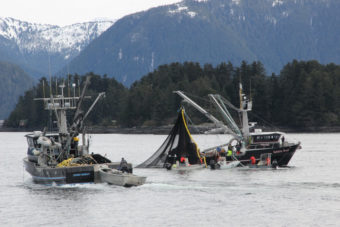
The seiner Infinite Grace pursing up during the third opening in the Sitka Sound sac roe herring fishery, on Wednesday, March 26, 2014 (Photo by Rachel Waldholz/KCAW)

The Sitka Sound sac roe herring fishery had its third opening Wednesday, concentrated in the waters just south of downtown.

The opening lasted one hour and ten minutes, starting at 2:30 p.m. and closing at 3:40 p.m. As of 4:30 p.m. Wednesday, the Department of Fish & Game had not yet issued an estimate of how much was caught.

The action took place close enough to shore that Sitkans could stroll to the water’s edge from downtown businesses to watch the fleet make sets. People lined the Sea Walk and stood under the O’Connell Bridge with binoculars and cameras, as spotter planes circled overhead. The location of Wednesday’s fishery was different from the prior two openings, which both took place north of town, in Starrigavan and Katlian Bays.

The Alaska Department of Fish & Game released this map, showing where fishing is allowed in Wednesday’s herring opening. (Map courtesy of ADF&G)

Fish & Game biologist Dave Gordon had set a goal of about 3,000 tons for this third opening. That was a smaller amount than the Department had initially hoped for. Gordon had said earlier in the week that he hoped to catch the remaining tonnage left in this year’s harvest limit in one opening. But as it became clear that the amount left would exceed 6,500 tons — and exceed processing capacity — Gordon decided to aim for two openings.

During his 11 a.m. update on Wednesday, he said that a large volume of herring had also moved into waters near town that are out-of-bounds to the commercial fishery to protect subsistence use. Instead, the fishery targeted smaller schools of herring scattered throughout the waters south of town, Gordon said.

Despite the smaller volumes, Gordon said this morning, “I feel compelled to provide this opportunity,” given the quality of fish seen in test samples.

ADF&G also revised their counts from the previous two openings, on Sunday and last Thursday. Fish & Game now estimates the fleet caught a total of about 9,800 tons of herring in those first two openings, out of a total harvest limit of over 16,000 tons.

Gordon said that an aerial survey this morning found a few hundred yards of herring spawn on Middle Island; no other spawn was seen. In the sac roe fishery, the eggs are taken intact from the females. It’s critical to the success of the commercial harvest to land the fish prior to spawning.

Once the spawn begins, the focus in Sitka will switch to subsistence harvesting of roe on hemlock branches.

Seiners land 4K tons in herring season opener

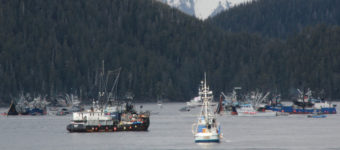
Seiners in Starrigavan Bay during the first opening of Sitka’s 2014 sac roe herring fishery. (Photo by Rachel Waldholz/KCAW)

The Sitka herring fishery had its first opening yesterday afternoon.

The Alaska Department of Fish & Game declared the Sitka Sound sac roe herring fishery open at 1:45 p.m. The fishing area covered much of Starrigavan and Katlian bays, north of Sitka.

The Alaska Department of Fish & Game released this map, showing the boundaries of Thurday’s herring season opener. Fishing was restricted to Starrigavan and Katlian bays, north of Sitka. (Map courtesy ADF&G)

The opening lasted two hours and thirty-five minutes, closing at 4:20 p.m. The Department estimated that the fleet caught at least 4,000 tons of herring, and announced that there will be no fishing Friday (3-21-14), to allow processors to work through the catch.

If sold at last year’s price, today’s catch would be worth about $2.4-million to fishermen at the docks. This year’s price, however, remains unclear.

The total harvest level for this year is over 16,000 tons. Speaking with KCAW earlier this week, Fish & Game biologist Dave Gordon estimated that it would take about four separate openings to reach the limit.

Officials gave the fleet two hours’ notice of the opening at 11:45 a.m. (Thu 3-20-14), after samples of fish tested in the morning found well over 10-percent mature roe, or eggs, in the herring.  10-percent mature roe is the Department’s threshold for a fishery. The most recent two samples came back with 12.5-percent and 13.1-percent mature roe, which is high even for the high-quality Sitka fishery.

The opening kicked off with a voice countdown from Gordon, on board the state’s research vessel, the Kestrel:

Ten, nine, eight, seven, six, five, four, three, two, one, OPEN! The Sitka Sound sac roe fishery is now open. The Sitka Sound sac roe fishery is now open. This is the Department of Fish & Game standing by, Channel 10.

Sitkans lined Halibut Point Road near the ferry terminal to watch the fishery. From left: George Eliason, Dillon Bets, Alainah Nelson, Misty Smith, Sandee Holst. (Photo by Rachel Waldholz/KCAW)

There are forty-eight permit-holders in the lucrative seine fishery. On Thursday afternoon, most of those boats were concentrated in Starrigavan Bay, within sight of Sitka’s road system. People lined Halibut Point Road near Sitka’s ferry terminal, watching through binoculars and cameras as the fishery unfolded in front of them and spotter planes circled overhead.

Among the spectators were two women who identified themselves as Karen and Leanne.

Leanne: You’ve got your pilots flying, and you’ve got spotters actually looking down talking to boats, so you’ve got several people in the planes. And they just have to be very, very careful. They get special permission to work in this kind of airspace.  Normally you’re not supposed to fly that close to each other.”

Karen: It’s very exciting of  course when they do the count down and you see all the boats jockeying for position. And seeing what they catch — it’s actually amazing to see how many herring are in a net.

The Department of Fish & Game plans aerial and vessel surveys throughout the day on Friday (3-21-14), and will be issuing informational updates over the radio at 11 a.m. and 4 p.m. Those can be heard on VHF marine radio, on Channel 10.

Emily Forman contributed to this report.

Sitka herring fishery could open as soon as Thursday

Seiners wait at the newly reopened ANB harbor for the 2014 Sitka Sound sac roe herring fishery to open. (KCAW photo/Rachel Waldholz)

It’s herring time.

The multi-million dollar Sitka Sound sac roe herring fishery could open as early as the end of this week. The Alaska Department of Fish & Game announced Monday evening that as of 8 a.m. Thursday, the fishery will be placed on two-hour notice. That means seiners could have their nets in the water as soon as Thursday morning, if the department’s test samples find a high enough percentage of mature roe, or eggs, in the fish by then.

The Sitka herring fishery packs a major economic punch in a short time span. The roe is sold to markets in Asia, and the fishery, which only lasts about a week, is worth an average of nearly $6 million to fishermen at the docks.

Seiners will target more than 16,000 tons of herring in Sitka Sound this year. That’s considerably more than last year’s limit — but it’s a target, not a guarantee. For the last two years, the herring spawn has happened so fast that the fleet wasn’t able to catch the full limit.

To harvest the roe, the herring must be caught before they spawn, in the window of time between when the female fish develop mature eggs and when they actually move to shore to lay those eggs. Determining that window is the difficult job of Fish and Game biologist Dave Gordon.  He said the Department decided to put the fishery on notice this week so that they’ll be ready in case things start to move fast.

“We have very large fish. The sample we saw yesterday was really as big as they get in Sitka Sound, 200-gram-plus fish. And from what we’ve seen from those larger fish, when they get ready to spawn, they go. And they do it in a hurry, so we want to be prepared for that.”

Once it opens, the fishery will progress in stages. There’s only enough processing capacity in Sitka to handle about four- to five-thousand tons of herring at once. With 48 seiners participating in the fishery, that typically means the opening only lasts a few hours, Gordon said.

“You’re really putting them on the fish,” he said. “The fish are there, and you’ve got 48 boats that have fairly huge capacity to get fish, and it doesn’t take long to get the kind of tonnage that we’d be looking for. Four- or five-thousand tons can be caught in 15 minutes depending on the situation.”

After an opening, the fishery must close for about two days to allow the processors to work through the catch. With a harvest level of about 16,000 tons, Gordon said, he’s anticipating about four separate openings.

The department’s research vessel, the Kestrel, will be in Sitka starting Wednesday. Fish & Game will also be conducting daily aerial surveys.

The department will hold an organizational meeting for fishermen and processors at 1 p.m. Wednesday, March 19, at the Westmark Hotel in downtown Sitka.

For self-employed Alaskans, Affordable Care Act makes a difference

New figures from the Obama administration show more than 6,500 Alaskans have enrolled in insurance plans on healthcare.gov. The deadline to sign up is March 31st. And that has prompted many Alaskans to bite the bullet and figure out what the Affordable Care Act means for them. For some commercial fishermen and others who are self-employed, what they’ve found has been a pleasant surprise.

Back in 2012, when the Supreme Court upheld most of President Obama’s signature healthcare law, Wendy Alderson hoped the ruling would mean good things for her family.

“I know what I would hope that it would do for us, and I hope that it would basically just bring down the cost of our health insurance,” Alderson said, in an interview with KCAW in June 2012, right after the Supreme Court decision cleared the way for the Affordable Care Act to go into effect.

Alderson and her husband are commercial fishermen. They own their own boat, a combination freezer troller and longliner. And for the past decade, they have bought a very basic health insurance plan. They paid over $12,000 a year to cover themselves and their daughter. The plan had a deductible of about $2,500 per individual – meaning that’s how much they’d have to pay before the insurance kicked in.

“You know sometimes I felt like I couldn’t afford to go to the doctor because I had to pay my health insurance bills,” Alderson said.

The insurance only covered major events, like hospitalization — not preventive care or routine doctor’s appointments. In her 2012 interview, Alderson said that could be frustrating.

“It’s wondering whether you should go to the doctor or not,” she said. “It’s knowing that it’s $200 to walk into a doctor’s office, and you may or may not have a prescription that’s going to be $45 to $50.”

“You know, it’s kind of scary having a sick kid, and thinking, OK, are you sick enough to go to the doctor? Is your earache going to be gone in the morning?”

So now that the Affordable Care Act is actually going into effect, we checked in with Alderson to see if it was living up to her expectations.

And at first, Alderson actually didn’t think the act would do much for her family. In fact, she wouldn’t even have looked for a new plan, but her current insurance costs suddenly increased, from about $1100 a month to $1400 a month. All told, her family would be paying $15,000 a year just for catastrophic insurance.

“I decided I better get on the stick and look at what was available,” Alderson said.

So she logged into healthcare.gov, the new online health insurance exchange. And…

“I was astounded,” she said.

Her new plan will cost about half as much as her old one.

“Honestly, [it was] a too-good-to-be-true thing for me,” Alderson said. “It was like, wow, really?”

The new plan is actually quite similar to her old plan, but instead of paying $1400 per month, she’ll pay just $680. In total, it will cost $7,000 this year, instead of $15,000.

That’s because Alderson’s family qualifies for a tax credit. Families that make up to four times the federal poverty level can qualify for tax credits and subsidies that cover part of the cost of health insurance bought on the exchange. In Alaska, a family of three making up to about $98,000 can be eligible.

Alderson said the change is a big deal for her family.

“This is really going to help. This last time, if we had just gone ahead and stepped it up and paid this increase, we would have been paying more for our health insurance than we would for our mortgage.”

Still, Alderson said the new system isn’t ideal. She had hoped that the act would reduce the cost of health insurance by introducing new efficiency and accountability into the world of healthcare.

“That is not the case,” she said. “The case is, the plan still costs the same, it’s [just] the government subsidizing those of us who qualify. I do understand that now, and that’s a little bit of a bummer. But I also feel that paying $700 a month for a catastrophic plan, is still a good chunk of money. I don’t feel like I’m getting anything for free. So, I’m pretty pleased.”

Sitka resident Dan Evans is also self-employed, as a photographer and home inspector. Evans hasn’t had health insurance for most of the past five or six years. For the past three years, he tried to enroll in insurance, but says he was denied because of preexisting conditions. He finally got a plan this past December. He paid $400 a month for a catastrophic plan with a $10,000 deductible.

“Really the only time you’d ever use it is if you really got hurt or sick real bad,” Evans said. “And it took me a long time to even get that.”

The issue of health insurance weighed so heavily on his mind, that he was considering giving up his photography business.

“I’ve been self-employed for 25, 30 years now. And I actually started looking for jobs that could give me insurance, even though I don’t want them. But I just feel…I see a lot of my friends and other people when they’re getting up there. Things happen. And I just kept thinking that something might happen to me and I could have everything taken away.”

Like Alderson, Evans at first thought that the Affordable Care Act wouldn’t change anything for him. He tried navigating the health exchange website himself, and got discouraged. Then his wife heard about a program at the SouthEast Alaska Regional Health Consortium, or SEARHC, in Sitka. SEARHC outreach manager Andrea Thomas has been helping people navigate the website. She worked with Evans to find a plan that will cost him just $189 a month. The deductible is $1500 dollars.

RW: Were you surprised?

DE: Way surprised. I actually said to Andrea, I said Andrea you’ve got to stand up right now, I have to give you a hug, because this is unbelievable. [[laughs]] She knew I was really happy.

Evans said the new plan is literally life-changing.

“I was checking with the city, I was checking with the state [for jobs],” he said. “And I really don’t want to do that. The only reason I was doing it is to get medical coverage! But now, I don’t have to. I can keep doing what I’m doing, and not worry anymore.”

As for Wendy Alderson, when asked what her family will do with the money they’re no longer spending on health insurance, she said: ”Pay bills! Nothing glamorous, sadly.”

“It’ll be nice to just know that I don’t have to struggle to come up with money to, you know, pay bills.”

Cost overruns add up to a bigger bill for Sitka’s Blue Lake

An enormous concrete pump truck pours footings at the new Blue Lake powerhouse. The rig can place 500 yards a day. (Blue Lake Expansion Project photo)

Sitka’s Blue Lake dam expansion project will cost about $3.6-million more than expected.

The total project — not including new backup diesel generators — was originally estimated to cost about $142-million. It is now up to about $145-million, Utility Director Chris Brewton told the Sitka assembly Tuesday night.

Brewton later told KCAW that this is the only major cost overrun the project has seen so far.

Most of the overrun will pay for construction of a temporary water filtration plant at Indian River. Sitka will rely on water from Indian River for about two to four months, starting in late August, when work on the dam will shut off access to Blue Lake, the city’s regular water source.

The city had originally budgeted $2-million for the temporary filtration system at Indian River — but, Brewton said, they always knew that number was a rough guess. As the project engineers completed the final design over the last several months, he said, it became clear that the final cost would be much higher. The city now estimates the total cost for the filtration system will be $4.7-million, or $2.7-million higher than expected.

The other unexpected cost is for debris removal. When the dam expansion is complete, Blue Lake will inundate over 360 acres of currently dry land, Brewton said, drowning trees, shrubs and undergrowth that will eventually die and bob up to the surface. That debris then has to be removed.

The city originally budgeted about $1.5-million dollars for the task, but both contractors who bid on the project estimated that it would take longer than the city thought. The total cost is now estimated to be $2.3-million, or about $800,000 more than originally expected.

The assembly approved a contract with Sitka-based ASRC McGraw Constructors LLC,  to handle the debris removal.

The assembly voted to approve the increased project cost. Assembly member Mike Reif said he felt fortunate that the cost overrun was so small, given the overall size of the project.

Chris Brewton said he felt city staff were keeping a particularly close eye on expenses:

“We’ve got a big hairy guard dog on the project,” Brewton said.

The assembly authorized the administration to apply for a low-interest loan from the Alaska Department of Environmental Conservation to cover the additional expense.

Previous Coverage:Sitka’s hydro project well underway

Stedman spends most for legislative travel

Sitka Sen. Bert Stedman presides over the Energy Council’s 2013 State and Provincial Trends in Energy and the Environment Conference June 21st in the North Dakota Capitol. Energy Council trips made up about 40 percent of Stedman’s 2013 travel expenses. (Courtesy Stedman's office)
Sitka Sen. Bert Stedman presides over the Energy Council’s 2013 State and Provincial Trends in Energy and the Environment Conference June 21st in the North Dakota Capitol. Energy Council trips made up about 40 percent of Stedman’s 2013 travel expenses. (Courtesy Stedman’s office)

State officials recently released documents showing how much each legislator spent on travel last year. The totals range from a little more than $1,000 to almost $50,000.

Two of the most expensive travelers are from Southeast.

Sen. Bert Stedman spent more on legislative travel last year than any other lawmaker.

The Sitka Republican spent more than $47,000 for airfare, lodging, car rentals, meals, per diem and other costs. That’s about a third more than the previous year.

“I’ve never been No. 1 before. I don’t know if that’s good or bad,” he says.

About 40 percent of Stedman’s charges covered meetings and trainings for the Energy Council, which he chaired for most of the year.

The organization includes lawmakers from energy-producing states and provinces, as well as Venezuela. Members meet quarterly, and Stedman attended additional events.

“So it is important that we get outside and educate ourselves on how the industry works and how to structure policies to keep them competitive in a global environment,” he says.

Read Stedman’s 2013 travel report.

In all, 20 of Alaska’s 60 lawmakers attended at least one Energy Council meeting.

A lot of Stedman’s other reimbursed travel covered trips to most of the 27 communities in his district. It runs from Metlakatla to Haines.

“So you should see rural legislators really stick out, not for out of state travel, but in-state, just because we’ve got to get around,” he says.

Some other lawmakers with big districts also racked up large travel bills. But most high-spenders were in leadership posts.

The state paid almost a million dollars last year for all 60 legislators’ travel. That’s up about 50 percent from 2012.

Rep. Peggy Wilson and lawmakers from other states pose Oct. 30 at the U.S. Department of Transportation during a Conference of State Governments Transportation Policy Academy. (CSG photo)

Another Southeast Representative, Peggy Wilson, was eighth on the travel-expense list.

The Wrangell Republican spent more than $35,000 during 2013.

“Now that we have a 90-day session, we actually have more committee meetings outside of the session. And for me to go to a meeting in Anchorage, it takes three days for sure, depending on what time of day the meetings are,” she says.

Wilson serves as majority whip, a House leadership position. She’s in her fourth year in that post. She says that sent her to in-state organizational meetings and other events.

Wilson also traveled to meetings and academies put on by the National Conference of State Legislatures, the Council of State Governments and the Pacific Northwest Economic Region.

That’s where close to half her total travel costs went.

Does she ever turn down invitations to attend?

“Oh my, yes,” she says. “I could be gone all the time. But you just can’t go to every one. So you try to pick and chose which ones you think are going to be the most meaningful.”

Read Wilson’s travel report.

Wilson’s 2013 total showed a five-fold increase from the previous year.

Southeast’s other three sitting lawmakers were in the bottom third of the travel-spending list.

Juneau Republican Rep. Cathy Munoz was 42nd out of 60 with about $7,000 in spending. Sitka Democratic Rep. Jonathan Kreiss-Tomkins was 52nd at $4,500. And Juneau Democratic Sen. Dennis Egan was 55th, with only $3,300 spent on travel.

Former House Minority Caucus Leader Beth Kerttula came in 35th, with about $11,000 spent. The Juneau Democrat resigned her post last month to take a job at California’s Stanford University.

Site notifications
Update notification options
Subscribe to notifications