KCAW - Sitka

KCAW is our partner station in Sitka. KTOO collaborates with partners across the state to cover important news and to share stories with our audiences.
Report finds weaknesses, solutions in Sitka’s food system

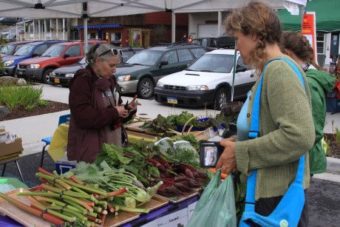
Lisa Sadleir-Hart distributes excess produce from her garden at Sitka’s Farmers Market. (SLFN photo)

The reliability of the food supply is not something most communities devote much thought to. Agriculture, transportation, and grocery stores all work pretty well — even in relatively isolated parts of Alaska like Sitka. And depending on where you live, there can be abundant wild foods.

But a recent report called “The Sitka Community Food Assessment” reveals that our food system is vulnerable — especially to the unpredictable costs of fuel.

Lisa Sadleir-Hart coordinated the assessment. She stopped by KCAW recently to talk with Robert Woolsey about what Sitka — and communities like it — can do to become more food-secure.

The idea for taking a look at Sitka’s food supply took root, so to speak, at the Community Health Summit in the fall of 2012. At that time, food security was still kind of abstract.

That changed on the night of January 4, when Sitka was rocked by a magnitude 7.2 earthquake. We had 45-minutes to get to high ground, leaving behind all of our grocery stores, and most all of our food, at sea level.

“And it became very real, on a community level, when we actually had that event.”

But even before the threat of a tsunami focused Sitka’s attention on food security, people were feeling the pinch of the high cost of groceries, aggravated by the economic recession beginning in 2008.

“Many of us working in the food arena for a long time also realized that because we were seeing rising food prices, we had a lot of concerns about what that meant for household food security. So we’ve got two layers: Overall community food security — can we provide for ourselves and feed ourselves as a community? And secondarily, Can households do the same?”

With the goal of finding answers to those questions, Sadlier-Hart and her work group adopted the US Department of Agriculture’s Food Security Assessment Toolkit and went to work. They surveyed over 400 Sitkans, conducted focus groups, met with community leaders, and explored alternative sources of information like the Cooperative Extension Agency at the University of Alaska.

A year after the earthquake, food security was no longer abstract. Sadlier-Hart has hard data. Her report brings home several key points.

Read the 2014 Sitka Food Assessment Indicators Report.

“I think a big one that’s a real plus, is how generous our community is. And how reliant we are on customary and traditional foods — what people often call subsistence foods. We eat a lot of deer in this town. We eat a lot of fish and seafood, and we also forage and harvest. And a lot of that gets shared from one household to another. Sometimes related households, sometimes they’re friends. That really jumped off the page at me.”

Sadlier-Hart says that the use of food stamps has increased by 40-percent in Sitka since the mid-2000s. Grocery prices began a sharp climb in 2008, harnessed to the cost of fuel. The assessment shows clearly who is bearing the brunt of this perfect storm of economic insecurity.

“When we talked to elders in a focus group, some of them go without. They don’t eat. And others get real creative. Some single-parent families, they’ll show up at church potlucks to try to get a meal for them and their kids. Some real interesting strategies. That sort of stuff also popped out at me.”

The food assessment is a huge source of information about economic conditions in Sitka. It’s also a tool for making policy. Sadleir-Hart says a first step is to begin to make more public land available for gardening.

Sadleir-Hart We know that for many households, 95-percent of their food is imported. Most of the food we eat in the state is imported — 95-percent of it from somewhere else. As recent as the 1950s, that was only 50-percent. I think we can get to 50-percent over the next couple of decades. This is a long-term venture. It took us a long time, with cheap oil and transportation to kind of get us into this really — I don’t know if you would call it lazy — but we’ve not had to work very hard at accessing our food.
KCAW — 50-percent is a lot of potatoes.
Sadleir-Hart — It’s a lot of potatoes, it’s a lot of seaweed, it’s a lot of deer, it’s a lot of lingcod. It’s a lot of gardens. You can grow a lot of food. I grow a lot of food out of my garden. A lot of which I don’t eat, which I donate to the Farmers’ Market. So if I can do it, I think other people can do it.

Sadleir-Hart also believes it’s important to maintain eligibility for food stamps, as much for the economic impact of the program as for its contribution to nutrition. She says it pumps about over $1-million annually into the economy.

She also says Sitka’s rural subsistence designation — and the access it allows to customary and traditional foods — is more than a lifestyle choice. Hunting, fishing, and gathering are a major economic component of food security.

“Deer meat alone was almost $1.5-million in a year. So if we were going to try to replace deer meat out with some other equivalent protein source, most households couldn’t afford to buy it, quite frankly.”

Pro-lifers oppose Planned Parenthood in Sitka’s middle school

Wyman TOP logoA pro-life group remains concerned over Planned Parenthood’s involvement in health instruction at Blatchley Middle School last fall, even though the curriculum is no longer being taught.

The Sitka/Southeast Alaska Coalition for Life Tuesday night presented the school board with a letter signed by 150 residents, expressing shock over the participation of Planned Parenthood, and recommending the postponement of instruction in human sexuality until a consensus can be reached on how best to teach it.

Ed Gray was spokesman for the group. The topic was not on the agenda. The School Board took comments under persons to be heard.

“We were shocked to learn that Planned Parenthood was teaching a sex education class in the Sitka School District. Planned Parenthood is the largest abortion provider in the United States, and promotes a form of sex education which, among other things, considers the abortion pill and surgical abortion to be forms of birth control. As you’re aware, abortion destroys a human life.”

Yvonne Corduan had not signed the group letter, but submitted one of her own. She also objected to the involvement of Planned Parenthood, and favored an approach to sex education based on moral values.

“My generation, of which many of you are a part of also, is at fault for much of the social chaos we are experiencing today. Our generation decided that the moral values and expectations of our parents were a bit old-fashioned and stilted, so we tossed them out and entered the generation of free love, be true to yourself, do your own thing. What we did not realize is that freedom is not the liberty to do what we want.”

There was also testimony from two members of the public, Jeanine Brooks and Davy Lubin, in strong support of comprehensive health education. And testimony from one student, Michael Boos, who asked for more youth participation in developing policy on the subject.

The anti-Planned Parenthood sentiment was also evident at a Blatchley PAC meeting on the subject in February. Yet then — as now — Planned Parenthood did not develop or implement the Blatchley health curriculum.

Pacific High co-principal Sarah Ferrency is a board member of Planned Parenthood Northwest.

“That organization has been vilified in ways that are not accurate. I work tirelessly every day on behalf of our young people, and I work more with people who are facing these issues in a very head-on way than many people do. And I have strong experience to support the education that we are providing. I also see a lot of common ground. I don’t know how many of you are familiar with what’s being taught. I would encourage you to go talk with Mr. White and ask to see it. Because it’s doing what you’re asking it to do: All of these programs are abstinence-based.”

I spoke with Blatchley principal Ben White following the board meeting. He confirmed that the two programs, FLASH in the 6th grade and Wyman TOP in the 7th grade were taught in the fall. FLASH stands for Family Life and Sexual Health. The program was created by the King County Health Department in Seattle, and is used widely across Alaska. TOP stands for Teen Outreach Program. Wyman is a St. Louis-based non-profit whose program has been endorsed by the US Department of Health. I found detailed information about both in a three-minute search on the internet.

Both FLASH and TOP require a trained instructor. In Sitka, the only qualified instructor was Emily Reilly, who was also director of the local Planned Parenthood office.

Kristen Homer is a registered nurse and Blatchley parent who offered some short-term health instruction in the last school year. She told the board that TOP was more comprehensive.

“If you look at the curriculum in the TOPS program, what it went over was values clarification, relationships, communication, assertiveness, goal-setting, decision-making, and human development and sexuality. We all know that sex doesn’t happen in a vacuum. The more tools that individuals have to make good decisions, to communicate, to keep themselves out of bad decisions — the more likely they are to keep from getting pregnant.”

FLASH and TOP were discontinued at Blatchley when Emily Reilly became unavailable to teach them, and principal Ben White could find no qualified replacement. Instead, he sent his two physical education teachers to Anchorage for a 2-day training in a program called Fourth R. The “R” stands for Relationships. The program was developed in Canada and has been adopted by the Alaska Department of Education.

White says Blatchley 8th-graders have been receiving Fourth R instruction every Thursday since January from either his PE instructors or Elena Gustafson, a staff member at the SAFV shelter.

In persons-to-be-heard, the school board can not act on, or reply to, comments made by the public. Some members instead responded during their reports.

Tonia Rioux said she respected the views of the parents who spoke on both sides of the issue, but she stood behind the programs. Twenty-three years ago, Rioux herself was in middle school in Sitka.

“In my two years at Blatchley I saw no less than four girls get pregnant. The majority of them were from people who were over 21. That’s a problem. Those girls needed to know healthy relationships. They needed something more than someone popping in for a week teaching about sex education. And to me, what was exciting about the program was that was what it was offering. More than just how to prevent STD’s, or Here’s how to prevent getting pregnant. It was Here’s how to have healthy relationships, Here’re tools for healthy communication.”

Board member Cass Pook echoed some of Rioux’s remarks, but said that people all held different core beliefs. She felt that as a member of the faith community it was possible to move forward and find something that everyone could agree on.

Superintendent Steve Bradshaw, however, did not want to build up expectations around full agreement. He had recently had a 90-minute meeting with the Sitka Coalition for Life.

“I’m hoping that we can do what everybody’s asking for and get together and find a solution that will meet the needs of the community. I hesitate to use the word ‘consensus,’ because I’m not sure that in today’s society that we’re going to be able to get there.”

Bradshaw said that honest conversation about what was best for kids was what “education is all about.” The board offered to schedule more time in the future to discuss the issue further.

Sitka shops for teachers at Seattle fair

Blatchley Middle School Principal Ben White staffs the Sitka booth at the Seattle teaching fair. (KCAW photo/Ed Ronco)

The Sitka School District went looking for teachers over the weekend. Three administrators from Sitka traveled to the Seattle area to attend job fairs full of applicants hoping to teach in Alaska. Casey Demmert is principal of Keet Gooshi Heen Elementary School. He says there are 14 positions open in Sitka schools, including four at Keet, which serves grades 2 through 5.

“We’re at a point now in Sitka where we are really starting to have turnover with some of our more seasoned veteran teachers. Being able to bring in young teachers who can still get some mentoring and learn from some of those older teachers is important, too.”

Demmert, along with Blatchley Principal Ben White, and special education Director Mandy Evans, attended two different job fairs. The first was a large event in Tacoma open to districts across the Northwest, and the second was a smaller event only for Alaska districts.

That second event was put on by Alaska Teacher Placement, which is a program run by the University of Alaska system. It acts as a gateway for applicants hoping to work in the state. Toni McFadden is manages the teacher placement program. She says districts do look inside Alaska for people to teach Alaskan children:

“The problem is, we have a greater need for teachers than what our state is producing. We have a need for teachers to go to our rural communities. We might have teachers very willing to stay in Fairbanks if they went to UAF, or to stay in Anchorage if they went to UAA, finding people willing and excited to go to our rural communities is really more of a challenge.”

Sitka was among 17 Alaska school districts participating in Saturday’s job fair. The state as a whole has about 55 school districts, employing more than 8,100 teachers. Information on teaching jobs in Alaska is available at AlaskaTeacher.org.

Herring seiners hit target — and then some — in quick Saturday opener

Seiners in Starrigavan Bay during the first opening of Sitka’s 2014 sac roe herring fishery. (Photo by Rachel Waldholz/KCAW)

The 2014 Sitka Sound sac roe herring fishery is over.

The 48 permit holders caught the last remaining fish in this year’s harvest limit — and then some — in a wild 45-minute opener Saturday afternoon right in front of downtown Sitka.

The preliminary estimate from the Alaska Department of Fish & Game for Saturday’s harvest is just shy of 4,000 tons, bringing this year’s total catch to 17,200 tons — about 900 tons more than the guideline harvest level.

The final harvest numbers will be known once processing is complete. In both 2012 and 2013 seiners undershot their harvest limit significantly, as widespread spawning occurred just as fishing started.

ADF&G will continue to conduct aerial surveys of the shoreline as the spawn progresses. At last word, there were 3.8 nautical miles of spawn. The herring typically continue spawning into late April, depositing eggs along 70-80 miles of beach.

The department’s research vessel, Kestrel, will also return to the Sound sometime after the first week in April to conduct dive surveys of egg deposition. These studies help determine the biomass forecast for future years, and the associated harvest level.

Meanwhile, the traditional subsistence harvest of roe-on-hemlock and roe-on-kelp is beginning in earnest in the areas around Middle Island. One subsistence fisherman at Sealing Cove Sunday morning reported making three large sets of hemlock branches, all of which had received a heavy coating of eggs.

Seismologists, lawmakers call for earthquake early warning system

An automobile lies crushed under the third story of this apartment building in San Francisco after the 1989 earthquake. (Photo by J.K. Nakata/U.S. Geological Survey)

In Congress yesterday, a House subcommittee marked the 5oth anniversary of the Great Alaska Earthquake with a hearing focused on what scientists have learned from that event that can prepare the nation for the next big temblor or tsunami. Seismologists and several lawmakers said Congress needs to pony up for an earthquake early warning system.

50th Anniversary of the Great Alaska Earthquake
[icon name=”icon-angle-right”]Tsunami warning test too real?
[icon name=”icon-angle-right”]When the earthquake struck, Bob Allen took care of what he could
[icon name=”icon-angle-right”]The Great Alaska Earthquake: 50 Years Later
[icon name=”icon-angle-right”]Sitkans remember Alaska’s 1964 earthquake

For people who study earthquakes, each major event serves as a lab experiment. Plate tectonics was a tentative theory before the 1964 quake, which also provided valuable insights about soil liquefaction and tsunamis. William Leith, an earthquake advisor for the USGS, says North America’s largest ever earthquake changed policy, too.

“Through the iconic scenes of houses broken apart by landsliding in the Turnagain neighborhood of Anchorage, the ‘64 disaster demonstrated the importance of considering earthquake hazards in urban planning and development,” he said.

Leith was one of four scientists who testified. They say one lesson the U.S. should have learned by now is the need to develop an early warning system for earthquakes, as other countries already have. USGS has spent $10 million over more than a decade to come up with a prototype for California, but it would take $16 million a year to build and operate a system for the whole West Coast. Professor John Vidale of the University of Washington says the Cascadia fault, for example, is set to deliver an Alaska-sized earthquake to the Pacific Northwest. Vidale says it’s likely to be detectable 1 to five minutes in advance.

“An early warning will forestall train, car and airplane accidents, halt surgeries, allow for bridges to clear, shut down elevators, open critical doors, warn schools and the population in general,” he said.

Vidale  says a magnitude 9 quake would cause an estimated $50 to $100 billion damage. To some Congress members, the lack of will to pay for a warning system makes no sense. Here’s Peter DeFazio, an Oregon Democrat.

“We’ve spent $10 million – WOW! — since 1999,” DeFazio said, mocking the sum as low, in Congressional terms. ”We’re looking at a $100 billion problem in the Pacific Northwest. We’ve spent $10 million. You talk about countries like, I think you said Romania? Mexico? They’ve deployed early warning systems and the United States of America hasn’t? We have a prototype?”

One of the scientists said most countries develop a warning system only after a catastrophe strikes. New Jersey Democrat Rush Holt says Congress has been too stingy:

“And here the richest country in the world by far, undeniably, doesn’t act as if we have a future. One invest, one builds infrastructure, one sponsors research when we believe we have a future. Instead we just cut, cut, cut.”

Alaska Congressman Don Young says he and the late Sen. Ted Stevens were able to provide funds for tsunami warning, but he says he’s disappointed Congress has cut it back. As for earthquake warning, Young had a bit of low-tech advice for the panel.

“I do believe we can identify when an earthquake can occur. You have to buy a pheasant. It always worked back in California,” he claimed. “A pheasant will tell you when an earthquake is going to happen about five second before it happens.”

Young supports funding an earthquake warning system, too, but he says the Alaska disaster showed tsunami to be the more lethal danger.

When the earthquake struck, Bob Allen took care of what he could

Bob Allen (right) was on a fishing boat south of Kodak Island during Alaska’s 1964 earthquake. While Allen’s brother Jack (left) was a State Trooper in Anchorage. (Photo by Emily Forman/KCAW)

Today marks the 50th anniversary of Alaska’s Good Friday Earthquake – the largest recorded in North America. Many Sitkans have stories from the epicenter.

Bob Allen is known around Southeast now for his family shipbuilding and cruise business, Allen Marine. But five decades ago, he was fishing south of Kodiak Island far from his family when disaster struck. Allen says when you can’t take care of your own, you take care of what you can.

Bob Allen was over 100 miles from home when a magnitude 9.2 earthquake rocked his boat. Of all days, this would be a tough one to be separated from his wife and kids.

Betty and the kids were in Kodiak. And I was on a 104 foot fishing boat. It was about 5 o’clock. Beautiful day. Flat calm, absolutely mirror calm. And the boat just started vibrating. It was just like a giant had a hold of that boat and it was just shaking it just – rattle rattle shake shake shake – terrible vibration.

The violent jostling had damaged the radio. All they could do was listen. Allen could hear what was happening in Kodiak and the report wasn’t good.

How you doing? And he says oh I’m doing OK! He said well where you at? And he says I’m sitting in the schoolyard.

That is, floating over the schoolyard in an 80 foot barge. Just as devastating, but even more deadly than the earthquake itself, was the tsunami that followed.

The schoolyard in Kodiak was pretty far up above the waterline you knew that that town had been underwater by 10 or 15, 20 feet by then.

Bob knew his home wasn’t flooded because it was on a hill above the schoolyard. But, he couldn’t be sure that his house hadn’t collapsed on his family. And the tsunami waves made it too risky to go home.

We were kind of pinned. We couldn’t do anything. When you reach a point where there’s nothing you can do to take care of your own family you just say OK I’ll take care of what I can and somebody else is going to look after mine, I hope.

That night, over the radio, Allen’s crew learned that the village of Kaguyak had been wiped out. It was only eight miles away. Come morning they set out to help.

They were all on the beach. They were right at the head of the bay right where the old village had been. They had no food, they had no blankets, all they had was that one little radio.And we brought out 46 adults and probably 15 children and one body. They were really in shock they really couldn’t think for themselves you’d take them to the table and set them down with a plate in front of them – hotcakes and sugar syrup. We had a big can of sugar syrup going all the time. We left there and headed for Old Harbor because they were wiped out too. And we’re going through hundreds of empty oil barrels, overturned boats, broke-up houses, deep freezers, refrigerators – anything that could float.

By the time they left Old Harbor, they had 96 adults and 35 kids on board. The plan was to transport the survivors to the Kodiak Naval base. Many had taken a few valued possessions along with them. And when they pulled into shore…

It was just like tying up in a river. The tide is still every 25-30 minutes is going from full high to full low.

They were asked to leave these items on the dock while they boarded the buses. When the buses pulled away the water seeped through the dock and Allen said, “everything they had saved floated away.”

At 2:30 a.m. on Sunday, 33 hours since the start of the quake, Allen finally made it home. An armed guard escorted Bob.

That was the worst part of the whole thing for me was coming home and finding my family gone. All there is is a note on the table from Betty saying that they went to Chiniak. 12 people had drowned on those roads because they had got caught on the head of the bay and that tide washed right up in there and drowned them. So I’m panic stricken!

12 frantic hours later Bob finally gets a call that his wife and kids had been evacuated to Chiniak by plane, and were safe.

Allen: After that I got off the boat I quit fishing and went to work construction.
EF: Did you quit because of this experience?
Allen: Well, there were no canneries left, no place left to sell crab anyway.

When you’re growing up in Alaska its kind of a walking disaster area anyway. Everything always gets rebuilt. Its no problem. I don’t think you’re standing up there or waving a flag or anything. There ain’t a lot of glory in this world.

Site notifications
Update notification options
Subscribe to notifications