KCAW - Sitka

KCAW is our partner station in Sitka. KTOO collaborates with partners across the state to cover important news and to share stories with our audiences.

How much missed school is too much?

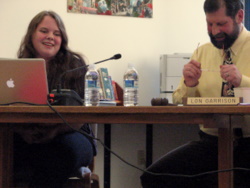
Sitka school board president Lon Garrison (r) congratulates student representative Jesseca Bartelds on her year of service on the board. The two agreed in principle — if not in practice — that absenteeism due to travel was a problem. (KCAW photo/Robert Woolsey)

The high cost of travel for extracurricular activities in Sitka’s schools has been an ongoing debate for years. Now, the school board is going to take a hard look at whether travel costs students and parents more than just money.

At its regular meeting Monday night (5-6-13), the board officially opened the question of whether Sitka’s students — and the teachers who coach them — spend too much time away from class.

For some kids, it’s a trip here and a trip there. For junior Ryan Apathy, who participates in Cross Country in the fall, and then in Drama, Debate, and Forensics through early spring, it can be consecutive weekends of competition. If those events are out of town, Apathy and his teammates will likely miss Thursday and Friday of school for travel.

And Apathy is also in Music, which accounts for three out of a total of:

“Ten trips this year, and missed 22 days.”

Nevertheless Apathy is succeeding in school, and excelling in the activities he’s involved in. Sitka’s school board is concerned that Apathy, and kids like him, are the exception, rather than the rule.

“We had a math audit that said that by the time a high school student is a junior, they’re already a year behind in Math. In terms of the amount of time they have been in class if they’re involved in activities,” said board president Lon Garrison, who’s interested in exploring a policy implemented recently in the Unalaska School District. The policy limits students to twenty absences from school per year for activities.

See the full story and hear from the students here:

How much school can a student miss?


Sitka flights reduced during runway repair

An Alaska 737-800 on approach to the Sitka Airport.
An Alaska 737-800 on approach to the Sitka Airport. (Photo by Jonathan Caves/Flickr Creative Commons)

Sitka will miss two Alaska Airlines flights a day during the month of May, in order to allow a paving contractor to replace the runway at the Rocky Gutierrez Airport.

Flight 70, which arrives from Juneau at around 11 PM every night, and Flight 73, which departs at 6 AM the next morning with the same plane, have been suspended as of this week, and will resume sometime around Memorial Day weekend.Only the airport terminal building is the property of Sitka. The airport runway, taxi areas, and ramp are owned and maintained by the state Department of Transportation.

DOT spokesman Jeremy Woodrow says May has the right combination of decent weather and lighter traffic to accommodate the work.

“The overlay is basically asphalt on the runway. The reason there’s a nighttime closure, and the reason it’s delaying the Alaska Airlines flight is that the construction company needs a long enough window to be able to pave the runway and then allow it to set.”

The contractor has been on site since April, hauling gravel and setting up paving equipment. Woodrow says work will begin each evening following the departure of Flight 67 at about 6:20 PM.


Read the rest of the story here:

Sitka flights reduced during runway repair

‘Day of loss’ as Bill Brady center closes its doors

It's over is written on a white board inside  the house where clients lived during their stay at the residential treatment program.
This message was written on a white board inside the house where clients lived during their stay at the residential treatment program. (Photo by Ed Ronco/KCAW)

Yesterday was the last day of operation for the Bill Brady Healing Center. The inpatient drug-and-alcohol rehab program has existed in its current form since 1996. Its closure is blamed on federal budget cutbacks. The center is part of the Southeast Alaska Regional Health Consortium, or SEARHC, which relies heavily on federal money.

Bill Brady’s last class graduated in mid-April, leaving a couple weeks for employees to tie up loose ends. KCAW visited employees as they packed up their desks and looked back at their time working for the center.

In the lobby of SEARHC’s Community Health Building, Doug Osborne leads me over to a red and black blanket hanging on the wall, behind glass.

“This blanket right here, at the end of the courses, they graduate people — maybe 10, 12 people — and at the end of this 40-day program, they do a really great job of honoring people,” Osborne said. “They do a cradling ceremony and sometimes they get wrapped in the blanket. They really know how to send people off. Today it’s about how well we can send them off.”

Charlie Bean uses fish boxes to pack up his workspace at the Bill Brady Healing Center. He jokes that people in other states probably don’t use fish boxes like this. (KCAW photo by Ed Ronco)

Osborne’s job at SEARHC includes running the employee recognition program and today, he’s planning a farewell luncheon for the 23 people who work at Bill Brady Healing Center.

“These guys were superstars,” he said. “They are really good, they’re passionate, ethical, dedicated. They worked hard, and did a good job. It’s a very sad day at SEARHC to see these guys go.”

Inside the center’s office building is George House. The bookshelves in his office are almost bare, as is his desk.

“I’ve been working at Bill Brady for 10 years now,” he said. “I started out as a temporary night-awake to earn a couple of bucks, and liked what I saw.”

As a night-awake, it was his job to make sure residents were safe at night — that things were turned off, and that everyone was where they were supposed to be.

“You know, you go through and make sure everything’s turned off, everything’s safe,” he said. “You count noses or toeses.”

And now he’s the evening shift leader. A job that began as simply a way to make some money turned into a calling.

“What I saw here was a lot of caring people helping others find their way,” he said. “I think what made Bill Brady click so well was mutual respect for each other among staff and among the clients that came through. It didn’t matter what your background was. They took you at face value and let you shine, you know?”

Lots of Bill Brady’s now former employees have stories like that.

Charlie Bean is in the basement of the house where clients used to stay. Down here, he led them through art projects. He’s wrapping stuff in plastic and joking about the uniquely Alaskan experience of using fish boxes to pack up your office.

“We’ve given away a lot of stuff,” he said. “Drums, and miscellaneous odds and ends. A lot of it’s going to go to Raven’s Way next door.”

Bean started working at SEARHC in 2001, and at Bill Brady in 2005. He’s definitely had his disagreements with the institution — he laments rules and regulations that he says distract from the day-to-day, hands-on work with clients, and he mentions spending increasing amounts of time doing paperwork. But he also says this is one of the best jobs he’s ever had. This team, he says, is close.

“I’ve never experienced anything like this,” Bean said. “I’ve had close friendships and stuff, but not a group of people like this. You come in and you jump on shift, and somebody’s going out the door, and they’ve got your back, and they know you’ve got their back, and there’s this seamless kind of flow that goes on between the people. That’s been special.”

A white board displays the names of all the employees.
The employees of the Bill Brady Healing Center were recognized at a private lunch Tuesday. This was in the front of the room. (Photo by Ed Ronco/KCAW)

Bean says he has possibilities for work in Anchorage and New Mexico.

“I’m always going to interact with clients. It’s just part of my life now.,” he said. “It doesn’t matter where I am. My life has turned into service. Wherever I go, I’ll be doing service of some kind.”

Of the three employees KCAW spoke to, Roberta Kitka has the longest tenure. She started here as an intern in 1998.

“I wanted to help people, because I’m in recovery myself,” she said. “I stuck my toe in the door doing my internship.”

Eventually, she put in for a full-time job (“Showed up for an interview and said ‘I’m here to put my Tlingit two cents in,’” she says) and most recently, she’s been in a supervisory role. Kitka says she likes watching the transformation in clients between their first day and the time they graduate.

“We more or less serve the people who are throw-away people,” she said. “People who end up making something of themselves. We had a woman call us up, ‘I’ve got my kids back,’ or ‘I’ve only got 30 credits left and I’ll finish my college degree.’ Things like that. They’re not throw-away people. That’s the way we look at it.”

Now that she’s done working at Bill Brady, she’s moving to Anchorage. Her daughter is up there, and so is Dena a Coy, a treatment center for women and children, where Kitka did her first internship.

“And the two ladies I did it with, worked with, are still there,” she said. “So I’m going to pop my head in and say hi, I’m back.”

Back in the Community Health building, tables and chairs have been set up for the farewell luncheon. Comment cards for people to leave memories are laid out at each place. And Doug Osborne is standing behind a lectern, going over his remarks. Next to him, a dry-erase board with the names of every employee.

Twenty-three names.

“So we’re making this nice, but there’s no way around it,” Osborne said. “This is really a sad day. This is a day of loss.”

Sitka girl, 15, shaves head for childhood cancer research

Celia Lubin, 15, shaved her head as part of St. Baldrick’s Day, a fund-raiser held nationwide for childhood cancer research. (KCAW photo)

Over the past decade, St. Baldrick’s Day has become a major fundraising event for pediatric cancer research. It all began in 1999 when a group of insurance executives in Manhattan shaved their heads in solidarity with young cancer patients.

The majority of participants in the event are males, but a few women join them. And in Sitka last Friday, a teenage girl decided to take the plunge, raising nearly $3,000 in the process.

“I’m Celia Lubin. I’m 15 years old. And I go to Sitka High School.”

Lubin looks like a lot of teenagers. “My hair is purply, browny, blondy and its braids, and yeah.”

She does a bunch of activities, like swimming, soccer, drama & debate, concert band, and has her own radio show. But she’s doing something that very few teenage girls would do.

“I am shaving my head for St. Baldrick’s,” she said. “People who do chemo and lose their hair, it can be kind of isolating, I think, so showing them support, not only with money and, ‘Hey I’m raising awareness for this cause,” but, ‘I’m going to stand there with you.’”

At the St. Baldrick’s event at the Sitka Elks Lodge, men and boys are sitting in barber chairs on stage, while local hair stylists shave their heads. A little boy is walking around collecting pledges and stuffing them into an envelope. A crowd of about 100 people are sitting at the tables, eating dinner. Eight people are officially signed up to have their heads shaved, but many others hop onto to stage spontaneously to get their hair buzzed.

Lubin’s mom, Lisa Busch, says she was skeptical about her daughter’s decision at first.

“I thought, ‘Really? Can we pay you to not shave your head?’” she said.

But now?

“I’m feeling pretty good about it. I’m feeling really excited for Celia. Just like proud of her for doing this. Wondering what she’s going to look like bald,” she laughs.

Lubin says she was contemplating shaving her head before, but this gave her a reason to take the plunge that was hard for her parents to argue with.

“They didn’t really have a lot of say,” she said. “If they did object, I was just like, ‘hey, I’m not doing drugs. I’m raising money for cancer.’”

At the Elk’s Lodge, the announcer introduces Lubin to the crowd: “Who at 15 years old, would have shaved their head? This is a very brave young lady…”

“I’m a little bit nervous but I’m really excited,” Lubin said.

The hair stylist who’s going to cut Lubin’s hair helps the teenager get comfortable.

“What’s your name?”

“Celia.”

“I’m Casey. I shaved my head last year. It’s awesome. You’re gonna love it. Ready?”

Buzzzz…

“Alright, here it goes.”

BUZZZZZZZ…

Because she recently dyed her hair with streaks of purple, Lubin’s scalp has some colorful spots on it.

“Yeah,” she said. “I figured that would happen.”

After Lubin has her head totally shaved, she visits with her family.

“It looks great,” they said. “It looks so good. I’m proud of her. She has a nice-shaped head. I’m a proud papa.”

“It feels so good,” said Lubin. “I’ve never felt anything like this before.”

Lubin raised nearly $3,000 in pledges for the St. Baldrick’s Foundation. By the end of the night, 18 people in Sitka had their heads shaved, and made more than $14,000.

Since 2004, the national organization has contributed more than $100 million to fight pediatric cancers.

Lubin does not see her participation as just a stunt.

“I know that I had a cancer-free childhood and it was really great,” she said. “I just think it would be really scary for kids my age and younger to have to go through something like a life-threatening illness like cancer, and I want to be able to help a little bit.”

And she says she’s not worried about her lost locks.

“I mean, it will grow back,” she said. “It is hair. It’s just hair.”

Stedman: Oil tax break a ‘gift’ to industry

Sen. Bert Stedman, a Sitka Republican.

Sen. Bert Stedman calls this year’s rollback of state taxes a “gift” to the oil industry. And while he’s not unhappy with many of the structural changes to the oil tax scheme in Senate Bill 21, he says the numbers just don’t make sense.

Stedman was one of nine Alaska senators to oppose the bill, which passed by a margin of one vote. He outlined his reasons for the Sitka Chamber of Commerce this week (4-24-13).

Bert Stedman has always been a numbers man. That’s why Gov. Frank Murkowski appointed him to the Senate ten years ago.

His defiance of his own party’s signature legislation this session was more mathematical than political.

Stedman told the Sitka Chamber that the costs of extracting oil from Alaska’s “legacy fields” — Prudhoe Bay and Kuparuk — were high, but not uneconomic. About $30 per barrel.

Given the price of oil, he couldn’t make sense of the billion-dollar-plus annual tax break.

“Oil today is at $100. You don’t need to move $1.7 billion. It doesn’t fix anything. So it was, in my opinion, quite a gift to the industry. And they have not come forward and expressed in any definitive terms or timelines what they’re going to produce.”

The Parnell administration, and even Stedman’s own Republican majority, frequently contrast declining production in Alaska with current booms in North Dakota and Texas. The economics of producing oil in the developing world were also debated this session.

Stedman pointed out that Alaska had the only publicly-owned super-fields in the world. Oil development in the lower 48, on the other hand, was taking place in areas where mineral rights are privately owned. (Note: KCAW News did not paraphrase this remark accurately as written here. A more accurate reading would be “…in the country” rather than “…in the world.” Listen to the source material here.)

As for the Third World, Stedman said the costs of obtaining oil in arctic Alaska were high, but there were advantages.

“We don’t have revolutions. So you’ve got to recognize that. We have a stable judiciary branch. You’ve got to take care of that. We’ve got shipping transportation across the Pacific that can be protected by our US Navy — we don’t have to go through choke points. You’ve got to take that into account. And you certainly have to take into account one of the top ten most prolific oil fields on the planet. This is not North Dakota.”

Stedman said Alaska’s North Slope could be producing for generations.

A citizen initiative to repeal SB 21 is already in the signature-gathering stage, with the hope of having a question on the ballot for the August primary election in 2014. Although the initiative is the brainchild of Democrats hoping to put the unpopular tax breaks before voters, Stedman is on board.

“I’m going to sign that thing if it comes around. That’s my opinion of it.”

Beyond the math, Stedman is concerned about the impact the loss of over $1-billion a year in revenues will mean for the state. He said Railbelt legislators were “circling the wagons,” and had no incentive to back issues important to coastal areas, like the Alaska Marine Highway.

He and four other senators from the Republican majority caucus organized a new caucus around coastal communities. Five doesn’t sound like a big coalition, but in the Alaska’s 20-member senate it’s enough.

“Once you have five, and there’s fifteen in the majority, it doesn’t take a mathematician to figure out you can’t get to eleven to move something without one of the Coastal Caucus members agreeing with that issue. So that changed the dialog internally with the senate. It changed their attitudes, quite frankly.”

Stedman says the reduction in oil revenues will force the state into deficit spending for several years, drawing down its $16-billion in reserves. As money gets tight, he expects the Coastal Caucus will ensure that rural and urban areas share the pain equally.

“So as this group coalesces and comes together you’ll see some of our rural issues on the table, or we’ll just start, hopefully, blocking and shutting down the system.”

Stedman said he’ll continue to push for funding for the Blue Lake Dam expansion in Sitka, primarily through working with the Alaska Energy Authority. A driving course at the Public Safety Academy, the Mt. Edgecumbe swimming pool, and a road to Katlian Bay all remain priorities for him.

Stedman’s financial discipline and ability to cross party lines on major issues seemed welcomed by the Sitka chamber. Asked by an audience member if he would ever consider running for governor he replied, “The Republican party is heavily dominated by oil service industry contributions. That pretty much puts it in a nutshell.”


See Original Story and hear the audio here:

Stedman: Oil tax break a ‘gift’ to industry

Sealaska legislation going before Senate panel

The revised Sealaska land bill will have its first Senate hearing on Thursday.

The chamber’s Energy and Natural Resources Committee’s Subcommittee on Public Lands will take up the measure.

Alaska Sens. Lisa Murkowski and Mark Begich are co-sponsors. A separate but similar bill sponsored by Congressman Don Young is in the House.

What’s called the Southeast Alaska Native Land Conveyance Act would transfer about 70,000 acres of the Tongass National Forest to the regional Native corporation.

Supporters say it’s a much-negotiated compromise completing Sealaska’s land selections.

“The current bills under consideration by Congress would fulfill a promise made to Alaska Natives and the public while resolving the discrepancies between 1970s priorities and today’s issues,” Sealaska President and CEO Chris McNeil Jr. said in a press release.

Opponents say it gives away valuable timber stands and threatens environmentally sensitive areas within the Tongass.

“Although some of the boundaries have changed, the percentage of old-growth forest proposed for harvest remains unacceptably high,” wrote Jerry Burnett, president of the Juneau-based outdoors group Territorial Sportsmen, in a letter to Oregon Sen. Ron Wyden, ranking Democrat on the committee.

The Sealaska bill is one of 20 public-lands measures listed for the hearing at 10:30 a.m. Thursday, Alaska time.

Other bills on the agenda address boundaries for Utah Indian reservations and a New Mexico national forest. Still others concern grazing rights and wilderness designations in other states.

Hear an earlier report on the measure.

Hear a report on reaction to the bill.

Site notifications
Update notification options
Subscribe to notifications