KCAW - Sitka

KCAW is our partner station in Sitka. KTOO collaborates with partners across the state to cover important news and to share stories with our audiences.

UAS to get $2.3M in federal funds to expand mariculture program

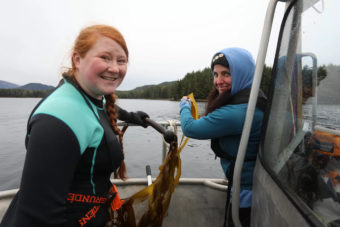
Two women in a boat, one of them holding some kelp
Assistant Professor Angie Bowers collects sorus tissue from fertile bullkelp with student Julie Sorrells to create seeded lines for outplanting in Sitka Sound. (Photo courtesy of University of Alaska Southeast)

On September 2, the White House announced $49 million dollars in funding for further development of Alaska’s mariculture industry — that’s mostly shellfish and seaweed. The Alaska Mariculture Cluster, led by Southeast Conference, was one of 21 winners in the nationwide “Build Back Better Regional Challenge” program.

$2.3 million of that money is going to the University of Alaska Southeast.

“Aquaculture and mariculture have been a part of our program for over a decade now,” said Joel Markis, who directs the applied fisheries program in Sitka. “But the mariculture side of things has really started to grow as the industry has started to receive more attention and more interest over the past years.”

Markis said the money will support their growing mariculture workforce development program by helping them hire a faculty member, a marketing and recruitment specialist and a technician. It will also fund a commercial kitchen and the development of a climate controlled growth chamber for spawning algae and kelp.

“Now that we’ve collected or harvested these organisms out of the ocean, what are we going to do with them? The hope is that, with the addition of a commercial kitchen space that’s FDA certified, we can actually prepare some of these things for food,” Markis said. “[And] give students a glimpse at that side of things of what does it take to actually…turn these different products into food. And then — are there ways that we can potentially add value to them through that culinary side of things?”

Markis hopes this investment in their program will help them bring the mariculture industry to a wider audience and help it grow.

“I think there’s a huge amount of potential out there. We’ve got tens of thousands of miles of coastline in Southeast Alaska alone, and the capacity to grow a lot of food in our waters,” Markis says. “If we can aid in doing that in a responsible manner, in a sustainable manner, and help support the industry by teaching people about the different aspects of mariculture, and of growing food in the ocean, I think it’s something that we’re all really excited about.”

The Alaska Mariculture Cluster was one of 529 applicants to the federal funding program. They have five years to spend the funding on eight different projects to develop and expand the industry throughout the state.

Sitka may be close to enacting new restrictions on short-term rentals

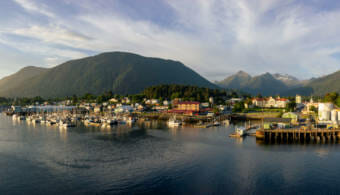
Panorama of Sitka in August 2015 (Photo by David Purdy/KTOO)

The rules governing short-term rentals in Sitka may be changing soon. When the assembly met on Tuesday, it greenlit changes that would affect new permits for short-term rentals in residential zones. But the ordinance needs to pass muster at the assembly table a second time before it can take effect.

Right now, a short-term rental is any property rented for less than 14 days, typically through sites like AirBNB and VRBO. The number of short-term rental permits in Sitka has nearly doubled since 2017, and concerns in the community have been mounting about how that’s affecting Sitka’s already tight housing market.

In March, the assembly narrowly voted down a one-year moratorium on new short-term rental permits. After the moratorium failed, some assembly and planning commission members held a town hall seeking ideas to address the impact of short-term rentals on Sitka’s housing market.

Under the proposed rules, a property would only be eligible for use as a short-term rental if it’s the applicant’s primary residence. That means the owner has to occupy the home for at least 180 days a year. Existing short-term rentals would be exempt from the new rules, with one exception. If the ordinance gets a final stamp of approval, all short-term rental permits will sunset when a property is sold, meaning they cannot be transferred to a new owner.

The planning commission approved the ordinance in a 3-1 vote on Aug. 17.

Commission member Katie Riley said it strikes a good balance between protecting residential areas and affordable housing, while allowing residents to continue to generate income on their properties through short-term rentals.

“These two restrictions, the primary residence and the sunset upon the sale of the property, were the most heavily supported throughout the community survey on short-term rentals that took place back in May of 2021, as well as the town hall that occurred this spring,” Riley said. “So we’ve seen long and enduring support for these common sense regulations. And I think that they’re going to help protect the integrity of our community in the long and short run.”

The new rules would only apply to short-term rentals in residential zones. Operating a short-term rental in a commercial zone doesn’t require a permit. The changes would not affect bed-and-breakfast permits either.

Several members of the public spoke in support of the ordinance, including Tory O’Connell Curran, who laid out statistics from a data published by the Pew Charitable Trust’s nonpartisan news organization last year. It  points to a nationwide trend of investment firms buying up homes, contributing to a housing shortage.

“Fully one quarter of all single family homes nationally were bought by investors last year,” she said. “In Alaska, there was a 37% increase last year, up to 17%. So that’s investors buying family homes not available then for families.”

Former Sitka Assembly member Richard Wein questioned whether the sunsetting of the permit made sense.

“If you have a B&B, you’ve kind of constructed your property around this type of service,” he said. “And so if you make a sale, it would be common sense and logical that the individual would be selling their business as well as their property. So I think that some of these aspects need to be considered.”

Assembly members on the whole supported the ordinance, including Mayor Steven Eisenbeisz. But he still had questions, like how it would be enforced or whether local data supported it.

“My number one concern with this ordinance is data. I’ve asked for it before, to show me something that absolutely indicates that short-term rentals are a cause, or are the cause, of not having long term rentals or houses on the market,” Eisenbeisz said. “And the reason that I need that is because I’m happy to make ordinance based on fact. I’m not happy to make ordinance based off of assumptions.”

Assembly member Kevin Knox, who co-sponsored the ordinance with Kevin Mosher, said the city doesn’t have the hard numbers on how many long-term rentals have been converted to short-term rentals, and he hoped they’d do a deeper data dive in the future. But he pointed to a recent planning meeting in which three individuals who are not Sitka residents secured a short-term rental permit for a single family home they purchased earlier this summer.

“But we do have that one very solid concrete one that just happened, this last planning meeting that we can point to,” Knox said. He added that he knew one example “doesn’t mean a whole lot. But it’s, you know, it’s there. It’s happening. That was a long term rental and was pulled off, that is no longer there.”

Ultimately the assembly approved the ordinance unanimously. It will come before them again at their first meeting in September — the last opportunity for Sitkans to give public comment. If approved it will go into effect on Sept. 14.

New dashboard warns Sitkans of landslide risk

“The Sitka Landslide Warning System is accessible through the website sitkalandslide.org. “We want to tell people about this,” Sitka Sound Science director Lisa Busch told the school board. “The idea is really so people can feel less anxious, or have or have an idea of what they should do. We want this to be a system that everybody can access.” (Photo by Robert Woolsey/KCAW))

A landslide warning system developed in Sitka is now available to the public as an online dashboard, and work is underway to export the project to other communities in Southeast Alaska.

The dashboard was unveiled at an Aug. 17 meeting of the Sitka School Board Wednesday.

Lisa Busch is the director of the Sitka Sound Science Center, which spearheaded the project. Busch is a 35-year resident of Sitka, and landslides were not on her radar until a very bad day seven years ago.

“This project got started in 2015, when we had a deadly landslide that killed our friends and family,” Busch said. “And I can say that I’ve been here 35 years and just never thought about landslides until then. As a big worry, mostly, we worried about tsunamis. And all of a sudden people had lots of concerns and lots of questions.”

What emerged from that disaster was an interdisciplinary research program funded by a $2 million grant from the National Science Foundation. Partners included NOAA, the USGS, the RAND Corporation, which did social science, and the Sitka Tribe of Alaska, which gathered oral histories.

In all, there were 30 scientists and university researchers on the team. Busch said the final product had to serve a unique purpose: to give people enough information about if and when to act.

“And people said to us, and I think this is very Alaskan, they wanted to make their own decisions,” Busch said. “They wanted a digital dashboard, where they could go and look at the risk and then make their own choices about if they should evacuate.”

Landslides result from cumulative factors, and some areas are much more at risk than others.

“We looked at where the more landslide prone areas are,” Busch explained, “and what part of Sitka is really most prone to landslides. And by the way, it’s not the whole town — it’s about 10% of our community. So when the landslides first happened, everybody said, ‘Well, we’re all in a landslide zone.’ That’s not true.”

The dashboard shows low, medium and high risk, and generates a curve based on current conditions — plus the forecast — to anticipate risk up to three days into the future. It’s got recommendations on how to evaluate the information based on where you live and what you should do if you decide to leave your home.

It’s still being fine-tuned. Emergency planners hope to create messaging to help residents manage landslide risk moving forward.

“What the emergency response people would like is for you to find a buddy — a buddy system,” said Busch. “So my house is close to the water, and so I’m more prone to being hit by tsunamis. And my friend’s house is someplace else where I can go when there’s a tsunami warning. And then when there’s a landslide warning, my friend can come down to my house and be in my safe house. We’re  saying go uphill for tsunamis, downhill for a landslide.”

Sitka is just the beginning for what Busch hopes becomes a regional landslide warning system. Work is already in progress to create similar warning systems in Hoonah, Skagway, Klukwan, Craig, Kasaan and Yakutat.

After an eye-opening supply-run, a former Sitkan fundraises for friends in Ukraine

A middle-aged man and a young woman bump fists in front of a bombed out apartment building
John DePalatis and his friend Julia (whose last name has been omitted from this story) standing in front of a badly charred building in Irpin. After a month of airstrikes and fighting, the Ukrainian military retook the city. (Youtube screenshot)

If you’re in Southeast Alaska, you may have seen this Youtube video circulating in your social media feed. A man wearing a burgundy polo and baseball cap gestures to a woman on his left, wearing a periwinkle dress peppered with tiny white flowers. She fist bumps him after he introduces her, and he cringes, rubbing his knuckles pretending to be in pain from the force of her fist. She laughs. It’s clear, in that moment, they’re good friends.

As Julia talks to the camera, she’s in sharp contrast to the building behind her, which is blackened from missile fire. She’s a former flight attendant turned military medic in the war in Ukraine. The man next to her is former Sitka music teacher John DePalatis. They’re raising money for medical supplies — or, as the name of their fundraiser suggests — to “Help John and Julia Save The World.”

But how did this American teacher end up in Ukraine? For eight years, between 2006 to 2014, DePalatis was the band and choir director at Sitka High School. Being a music teacher left his summers free to travel to far away places.

“I just walk the earth,” DePalatis tells me in an interview over Zoom, earlier this month. “So I have been all over the world. Generally, my style of travel is to go find really interesting things, sort of, in places where angels fear to tread. I happened to be in Iran in 2009, during the disputed elections there. Trouble seems to find me one way or another.”

He was teaching in Washington, but after a year of navigating teaching music during COVID, DePalatis decided to take a year off and use some money he’d saved to travel. He took the opportunity to visit some friends he’d made over the years in Ukraine — in Kyiv and some other cities.

Things would soon change, but at the time, the idea of conflict escalating with Russia felt unlikely even to Ukrainians.

“Most of the Ukrainians I talked to in November would say something like, ‘Oh this, Russia, you know, nothing happened.’ And then as things kind of got more and more escalated, by January, they weren’t really saying that anymore, and there was some concern,” he said.

His tourist visa ran out in February of 2022, so he went to Bucharest, Romania to secure a work permit. As he parted with friends, they had a running joke: if things went badly, he would meet them at the border.

“And that is ultimately what happened,” DePalatis says. He was in Romania when Russia invaded on Feb. 24.

“When the war started, I was just flabbergasted,” DePalatis says. “Everything I’d read told me this was a really bad mistake for Putin, by any metric. And so I couldn’t believe it was happening — people here couldn’t believe it was happening.”

“So I sat there for a week. And I was like, ‘Well, what do I do now? Do I just go home?’” he recalls. “Then I realized, I sort of remembered this joke that I made. And so I contacted my friends and I said, ‘Maybe you should come to Romania.’”

He reached out to a vacation rental in rural Romania where he’d stayed before, and they wanted to help. In the coming weeks, he brought two of his friends and their children there.

“We were living in a rural farmhouse, together with three women and six children, and hilarity ensues,” DePalatis says. “But, you know, I couldn’t stop the war, I couldn’t protect the people, but I could — I could protect these few. I could get them to safety, I could look after their children.”

Early on, his thoughts turned to his friend Julia. The day war broke out he called her, fearing for her safety. Eventually, she got back to him — she’d gone straight to the military recruiting office, and by the end of her first day she’d trained six officers in first aid. The two stayed in contact as they could. Then one day in June, he heard from her again.

“She sent me a message and said, ‘John, I need your help. My plate carrier has been damaged. And I’m about to ship out to Bakhmut.’ Which, if you know anything about what’s happening over there, that’s, that’s bad,” Depalatis says. “We didn’t know when that was going to happen.”

Julia asked if DePalatis could find her a protective vest in Romania and mail it to her, but the mailing options were limited — none of the major carriers were operating in Ukraine due to the war — and the Romanian Post Office said it would take six weeks.

“So at that point, it’s like, ‘Well, I guess I’m going to Kyiv.’ So I did, because what else could I do?” DePalatis says. “I mean, when your friends are in trouble, you take care of your friends.”

DePalatis filled a small suitcase with hemostatic bandages, tourniquets, and her protective gear. The trip took him around 30 hours on trains and buses, because planes don’t fly in anymore. When he finally made it, he met the Ukrainians in Julia’s battalion and understood that the suitcase he brought wasn’t enough.

“The needs are just endless,” he says. “And talking with the guys in battalion. These people are, you know, where just months ago, they were bus drivers, and they were store owners, and they were teachers and bakers, and farmers.”

DePalatis says he wasn’t much use there. He left a few weeks after he arrived, and he’s heading to Skagway this month — back to the music classroom. But before he left Ukraine, he filmed a video with Julia to fundraise for more medical supplies. He plans to get the money to her before her battalion deploys in a few weeks.

As of early August, they’d raised around $6,500.

“[It’s] enough that you can kind of look at and go ‘Wow, that is going to make a dent.’” he says. “You know that people are going to survive that wouldn’t otherwise.”

Even so, DePalatis knows that their fundraiser won’t exactly save the world.

“No matter what I do, no matter how much money we raise, no matter what I accomplish, it’s not enough. This war isn’t gonna stop for a long time, and people aren’t going to be saved for a long time,” he says. “I have the desire to fix it all — but I can’t, and so I have to do this. I have to.”

Court ruling on endangered killer whales could force a rewrite of federal fisheries policy

Orcas. (Creative Commons photo by Chis Michel)

A federal judge in Seattle has ruled that the National Marine Fisheries Service violated a key provision of the Endangered Species Act in 2019 when it published research on the harvest of king salmon in Southeast Alaska that failed to address its impact on a small population of killer whales in Puget Sound.

In a summary judgment granted to the Washington-based Wild Fish Conservancy, U.S. District Court Judge Richard A. Jones on Aug. 8 ordered that an “appropriate remedy” be found, that — while it could limit commercial trolling for chinook in Southeast — will more likely result in a rewrite of the biological opinion that led to the problem.

“I think we’ve won the recognition that this fishery was actually causing harm to threatened and endangered species, and for all intents and purposes was illegal,” said Kurt Beardslee, director of special projects for the conservancy.

The Wild Fish Conservancy filed suit against the National Marine Fisheries Service in March of 2020, arguing that the government failed to adequately address the impact of Alaskan king salmon harvests on southern resident killer whales, whose population has dropped to critically low levels.

The Wild Fish Conservancy says 97% of king salmon harvested by Southeast Alaska trollers don’t originate in Alaska, depriving southern resident killer whales of their primary food source.

The Alaska Department of Fish and Game puts the share of out-of-state chinook in the Alaska harvest much lower — 30-80%, depending on the year.

Matt Donohoe, president of the Alaska Trollers Association, says few if any of those are from Puget Sound, where southern resident killer whales spend several months each year.

“The Alaska technical committee (of the Pacific Salmon Commission) says that less than 2% of the king salmon we catch are from Puget Sound,” he said. “That’s fish nerd speak for none. Less than 2% is unmeasurable. So we don’t catch Puget Sound king salmon — the whole thing’s absurd.”

The trollers’ association intervened in the suit, along with the State of Alaska.

Donohoe trolls for kings in a 100-year old wooden boat, catching one salmon at a time on a hook and line, in a fishery that’s renegotiated with Canada every decade in a document called the Pacific Salmon Treaty. Southeast Alaska’s trollers have taken steep reductions in their harvest allocations in the last two treaty rounds – in the name of conserving stocks.

Donohoe says the Wild Fish Conservancy lawsuit unjustly characterizes Southeast trollers as intercepting fish they’re not entitled to.

“They’re from Southeast Alaska, British Columbia, Washington, Oregon, and Idaho,” Donohoe said. “And those are United States of America fish except for the British Columbia fish. And that’s all regulated by the Pacific Salmon Treaty. It’s not like we don’t have a legitimate claim on the harvest of those fish.”

Donohoe says it’s unfair that Southeast trollers have been singled out in the lawsuit, when in his view there are far more significant factors at play in the decline of this small population of killers whales: the rapid urbanization of the Puget Sound area, industrial pollutants in the water, large-scale whale watching, hydroelectric projects and a popular sport fishery for immature chinook he says are misleadingly called “black mouths.”

Kurt Beardslee, with the Wild Fish Conservancy, agrees that threats to killer whales can’t be reduced to just problem. But he doesn’t want to let trollers off the hook just because the other problems aren’t as well understood.

“Everybody also wants to point to something else, if they happen to get in the crosshairs,” he said. “But the problems are many, and it’s going to take a lot of change across the board to help us prepare for the challenges that are to come, and climate change is probably our biggest one.”

In a news release issued the day after the ruling, Alaska Department of Fish and Game Commissioner Doug Vincent-Lang wrote, “The State of Alaska abides by the terms of the Pacific Salmon Treaty and the Biological Opinion that is tied to it, and it is troubling that this ruling singles out our fisheries. We will be looking at our options in the coming weeks. In the meantime, Southeast Alaska salmon fisheries will proceed as normal.”

This is where the lawsuit will likely lead — not to a shutdown of trolling in Alaska, but to a better understanding of what’s brought the population of southern resident killer whales to near-extinction.

Linda Behnken is a noted fisheries advocate in Alaska, an environmentalist and a troller. She responded to news about the ruling while fishing for chum in Sitka Sound. She believes it’s up to the National Marine Fisheries Service to fix what’s broken in its 2019 biological opinion and try again.

“Bottom line, the agency needs to write a stronger biological opinion to back up their decision,” said Behnken.

If the remedy sought now by Judge Jones should somehow stop trolling, Behnken believes it would be a larger loss than the Wild Fish Conservancy imagines.

“The people who troll are advocates for healthy wild salmon,” said Behnken. “And that if the effect of  their lawsuit is shutting down the troll fishery, they are losing a strong voice for conservation, and a  strong voice for taking care of wild stocks.”

The case is far from over. The ruling steers the litigation in a new direction, and all parties now will submit briefs on a remedy that complies with Endangered Species Act.

Despite near-record job availability, more recent arrivals are choosing to leave Alaska

Moving Vans at the Capitol
Moving vans at the Alaska State Capitol, April 29,2016. (Photo by Jeremy Hsieh/KTOO)

People are leaving Alaska at a rate that’s generally faster than they have over the past thirty years, but it’s not because there’s a lack of work. There are more job openings in the state now than in recent memory, but there are fewer people to fill them.

The numbers on out-migration come from the August issue of Trends, the monthly report of the Alaska Department of Labor.

Thanks to Permanent Fund applications, Alaska has the rare ability to track the length of time people remain in the state. They show that people have been staying for less and less time since the 1990s, with the exception of residents who were either born in Alaska or turned eighteen here.

Some of the drops are precipitous. In the 1990s, just over half of people who moved to Alaska in their thirties stayed for at least 10 years. Lately that’s fallen to about 40%. For people who move to Alaska in their forties, about 5% more of them make it to the 10-year mark.

In good times and bad, roughly 27,000 people move to Alaska every year, and about 5,000 of them are children. Both those numbers have dipped recently, and demographers attribute that to an overall decline in the birthrate in the United States. Fewer people with children are headed to Alaska.

It’s demographic changes — rather than employment prospects — that are likely behind the numbers. The same issue of Trends shows that the number of job openings in Alaska is near an all-time high, and rates were climbing even before the pandemic.

The rate of job openings in Alaska is nearly double the national average.

Demographics likely play a role in job vacancies, too. Many are created by the departure of Baby Boomers born between 1946 and 1964, and there aren’t enough younger workers to replace them.

The authors of Trends speculate that given the difficulty of hiring staff, employers may be much less likely to let them go if the economy takes a downturn, potentially softening the impact of a recession if one were to occur.

Site notifications
Update notification options
Subscribe to notifications