Kevin Reagan

‘Harry Potter’ illustrator teaches workshops in Juneau

Graphic novelist Kazu Kibuishi taught a drawing workshop at Douglas Public Library on Saturday. The Washington-based artist designed the covers of the 2013 re-released editions of J.K. Rowling's Harry Potter novels. (Photo by Kevin Reagan/ KTOO)
Graphic novelist Kazu Kibuishi taught a drawing workshop at Douglas Public Library on Saturday. The Washington-based artist designed the covers of the 2013 re-released editions of J.K. Rowling’s Harry Potter novels. (Photo by Kevin Reagan/ KTOO)

From Hogwarts to lost cities above the clouds, Kazu Kibuishi’s illustrations have introduced fantastical places to legions of young readers. The graphic novelist visited Juneau over the weekend to teach workshops for aspiring artists.

Kazu Kibuishi is an artist who doesn’t like to overthink his work.

“Every time I draw, I really try not to be present. Me as an artist, I don’t want to get in the way of the reader and the experience. My job is to clarify it for them,” Kibuishi says.

Scholastic Books approached him in 2013 to submit sketches for the new cover art of the Harry Potter series; Kibuishi says he didn’t want to do it. He was intimidated by thinking of the popularity surrounding J.K. Rowling’s books.

(Photo courtesy of Scholastic Books)
Kibuishi’s 2013 illustration of “Harry Potter and the Chamber of Secrets.” (Photo courtesy of Scholastic Books.)

“I didn’t want to be the guy responsible for this because I liked the covers as they were,” Kibuishi says.

After collaborating with fellow artist Jason Caffoe, the two submitted some sketches to Scholastic Books. The publishing company picked Kibuishi to design the seven new covers within three months.

The Washington-based artist approached the project using skills he learned as a film student at the University of California, Santa Barbara.

“I just thought of myself as a cameraman that visited Hogwarts…” Kibuishi says. “I was just there to photograph it with my artistic technique and style.”

Kibuishi’s final seven covers showcased a new, modern perspective distinct from Mary Grand Pré’s originals. He used sharp, vibrant colors to depict different icons of Rowling’s world such as dementors and Diagon Alley.

Finding the right moment to capture in the covers was not always easy. Kibuishi says the second book in the series, “The Chamber of Secrets,” was the most challenging to design. After sketching over 70 drafts, he still could not find the right picture to communicate the book’s tone.

Kibuishi says he went back to the source material to solve this predicament. He asked himself what his emotional reaction was when he first read Rowling’s book.

“What do I feel about this book? What is it about this book? I feel like it’s a cup of tea. It feels like a tea party to me. It’s the one book that feels like a kid’s book almost. It’s the calm before the storm,” Kibuishi says.

Kibuishi decided on the elaborate home of Ron Weasley, best friend to Harry Potter, to put on the cover. Kibuishi says the setting is a place of comfort for Potter before battling his main antagonist, ‘He-Who-Must-Not-Be-Named.’

Kibuishi says drawing always came natural to him, but writing was a craft that took him years to develop. He was born in Japan and was brought over to the U.S. by his mother at age three. He says the abandonment of his father would later serve as inspiration for the plot in his graphic novel series, “Amulet.” Kibusihi says he’s learned to use life experiences to create emotionally powerful narratives.

Yet, there are times when Kibuishi still gets writer’s block. When running empty on ideas, he says he simply turns to doodling as a quick remedy — a tip he shared with about 30 school children at a drawing workshop on Saturday in the Douglas Public Library.

Young, aspiring cartoonists came prepared to pitch their grand story ideas. Xander Love, an 11 year-old student from Juneau Montessori School, showed Kibuishi personal sketches of pirate ships and robots.

(Xander Love, left, sketches a robot at a drawing workshop in the Douglas Public Library on Saturday. About 30 school kids attended to learn about the process of creating a graphic novel from Kazu Kibuishi. Photo by Kevin Reagan/ KTOO)
Xander Love, left, sketches a robot at a drawing workshop in the Douglas Public Library on Saturday. About 30 school kids attended to learn about the process of creating a graphic novel from Kazu Kibuishi. (Photo by Kevin Reagan/ KTOO)

“I think he (Kibuishi) found the perfect match between steampunk and fantasy,” Love says.

Kibuishi says because the graphic novel industry is still relatively new, he often gets asked to teach workshops on how to break into the business. He says educating the next generation of writers and illustrators is important for the industry’s survival.

“I’m hoping that all the work that I do has some element of teaching in it,” Kibuishi says.

While in the capital city, Kibuishi also made stops at Alaska Robotics and the 2015 Alaska Library Association Conference in Centennial Hall. He’s in the process of working on the last three books in his “Amulet” graphic novel series and recently signed a new book deal with Scholastic Graphix.

Kibuishi says he thinks the characteristics of a successful artist are a fruitful curiosity, steady determination and a little bit of that magic known as talent.

Economists: Statewide recession inevitable, but don’t panic

(Creative Commons Image by TaxCredits.net)
(Creative Commons image by TaxCredits.net)

A statewide recession will inevitably happen this year, say two economics experts from Anchorage. But don’t panic.

Mike Fisher, a senior consultant of Northern Economics, told the Juneau Chamber of Commerce on Thursday that the state has enough cash reserves to keep the economy stable through a recession.

“We don’t need to panic because we have some resources to tie us through and we’re all aware and we’re starting to act,” Fisher says.

Fisher says he predicts a net loss of 2,000 jobs across the state by mid-2016. The natural resources industry is projected to lose about 800 jobs — while the hospitality industry is expected to expand with about 350 jobs.

Fisher says the state is better equipped to endure a recession compared to the economic downturn experienced in the 1980s.

“The benefit that we have now is that we have reserves. We have a lot more money and the impact so far is not looking like it will be as severe,” Fisher says. “We really learned a lot 30 years ago, and as a result we’re able to go into this a little bit better informed and with better thoughts about how to make it through.”

Executive Director Greg Wolf of the World Trade Center Alaska says he’s optimistic about the economy because of the state’s strong trade relationship with China. He says getting China to invest more in state projects is key to strengthening that relationship.

Wolf says Alaska’s exports have doubled in the last 20 years, and the state traded $4.6 billion worth of goods in 2013. He says Alaska’s goods have a high demand among consumers such as seafood, which contributes almost 50 percent of the state’s exports.

“What we’re selling are the building blocks of a stable economy,” Wolf says.

Wolf notes that developing Alaska’s untapped coal and copper resources could thwart the impending recession.

You can watch Gavel Alaska coverage of the economists’ presentation here.

Capping caseloads ‘not realistic’ for state’s probation officers without funds

Rep. Chris Tuck addresses the Alaska House of Representatives, March 12, 2014. (Photo by Skip Gray/Gavel Alaska)
Rep. Chris Tuck addresses the Alaska House of Representatives, March 12, 2014. Tuck introduced a bill this session that attempts to cap the number of cases assigned to Alaska’s probation officers at 60. (Photo by Skip Gray/Gavel Alaska)

A bill in the Alaska Legislature would set a cap on caseloads for Alaska probation officers.

Anchorage Rep. Chris Tuck says the goal of the legislation is to reduce prison reentry rates, but the Department of Corrections commissioner says the proposal would not be realistic without additional funding.

When Brent Wilson started as a probation officer 10 years ago, he was managing over 100 cases. The state’s average caseload has dropped since then, but he says officers are expected to spend more time helping probationers find jobs and housing.

Quality time that Wilson says can keep ex-offenders from returning to prison.

“The more time you have to spend on any individual,” Wilson says, “I think it’s gonna pay dividends for us in the future.”

Wilson describes the job as a balancing act. One side requires a watchdog mentality to track high-risk probationers. The other demands an open-minded compassion to help offenders rehabilitate back into society. In between are the necessary duties of court visits, home inspections and piles of paperwork.

“You have to be able to multi-task, but this job really brings new meaning to that phrase,” Wilson says. “It’s not easy to plan a day and then see that plan actually happen.”

Easing the burden on probation officers is one of Anchorage Rep. Chris Tuck’s goals this session. He thinks targeting their caseloads is key to curbing prison reentry rates.

“When parolees do fall through the cracks that’s where they do end up — in prison, and prison is way more expensive than parole officers,” Tuck says.

Tuck introduced House Bill 22 to set a maximum limit of 60 cases per officer. But he says due to the state’s current budget deficit, the bill would not provide funds to hire more staff.

Department of Corrections Commissioner Ronald Taylor says capping the caseload at 60 is not realistic without increasing the budget.

“There’s some issues that we will have to work through in the caseload bill overall to ensure that that fairness is there and that balance is there for the department to be able to manage the resources appropriately,” Taylor says.

Taylor says the department has reduced the average caseload in Anchorage from 120 to 85 in the last few years by helping people get services that reduce their likelihood to reoffend, such as drug treatment and education. The number of offenders in Alaska to complete a drug treatment program has increased by more than 90 percent since 2011.

“What we’ve learned in the past is when we’ve not connected people to programming — when we’ve focused solely on the surveillance and enforcement aspect of it — that we get more failure in our system,” Taylor says.

Taylor says HB 22 does not take into account the state’s vast range of caseloads. For example, he says an officer in Sitka may have an average caseload of about 30, while an officer in Nome is handling up to 90 cases.

Eleven other states have set regulations on officer caseloads. Arizona’s cap is 65, but the probation officers in Maricopa County have a caseload cap of about 60.

“The job is not what it was 15 years ago when we were just checking off things and making sure people were doing what they were supposed to do,” says Kirsten Lewis, a probation officer in Maricopa County for the last 18 years.

She says her ideal caseload would be in the low 40s due to the more personal relationship expected between officers and offenders.

“The more we can treat them in a fair, firm and caring way, it’s a protective factor for recidivism,” Lewis says.

HB 22 had a hearing in the House State Affairs Committee Tuesday.

Committee Chairman Bob Lynn says he’s in favor of reducing caseload sizes. He compared the predicament to teacher classroom sizes — where finding the magic number that promotes efficiency is no simple task.

A filmmaker’s love story with salmon screens around Alaska

Mark Titus speaking to the audience of his film "The Breach" on Friday at the Rockwell Ballroom in downtown Juneau. The documentary chronicles mankind's history of exploiting salmon populations. (Photo by Kevin Reagan/ KTOO)
Mark Titus speaking to the audience of his film “The Breach” on Friday at the Rockwell Ballroom in downtown Juneau. The documentary chronicles mankind’s history of exploiting salmon populations. (Photo by Kevin Reagan/ KTOO)

“The Breach” is a documentary chronicling director Mark Titus’ love story with wild salmon, a fish he’s always considered sacred.

The Seattle-native started fishing when he was two, and says that started a lifelong appreciation for salmon. Titus, an independent filmmaker, decided to take this infatuation and put it on the big screen.

“I came up with this idea of telling a love story of salmon and there were people that rolled their eyes,” Titus says.

After four years of fundraising and production work, Titus is screening “The Breach” in a 12-stop national tour that came to Juneau Friday.

The film traces mankind’s exploitation of salmon from Europe to the Pacific Northwest. Dams, mines, over-fishing and hatcheries are presented as threats, leading to the fish’s dwindling population.

(Courtesy of August Island Pictures)

“It’s an animal that is so sacred that it deserves to have a chance to live and thrive because it feeds everything,” Titus says.

Titus says the documentary’s title comes from the image of salmon beating their heads against a dam as they attempt to swim upstream—an image of pursuit that reminded him of Shakespeare.

“It really kind of resonated with the idea in Henry V of ‘Once more dear friends, unto the breach’ and let’s just keep moving forward,” Titus says.

Most of the film was shot in Alaska—the last place in the world Titus says is doing anything to protect salmon.

The film focuses on Bristol Bay in Southwest Alaska, where locals rely on fishing for income and subsistence. Many residents are in conflict with The Pebble Limited Partnership—which seeks to build a mine near the headwaters of two of Bristol Bay’s major rivers.

Titus explores the dilemma of whether industry and nature can coexist for the sake of a stable economy — a question he says has no easy answer.

“I think the real question about what’s going on in Bristol Bay is not about whether the world needs more copper — the question is what do we value as a society,” Titus says.

“The Breach” had its world premiere in Ireland last summer, where it won the International Feature Documentary award at the 2014 Galway Film Fleadh Awards.

Dillingham Rep. Bryce Edgmon was one of more than 200 people to view the film at the Juneau screening in the Rockwell Ballroom. He thinks the film is an educational, accurate portrayal of salmon history.

“Well I think it tells the whole story,” Edgmon says. “It really lays out the thread that we have incrementally destroyed salmon habitat.”

Edgmon was raised in the Bristol Bay area, and says most residents oppose the Pebble Mine project because of the threat it poses to their fish resource.

“Salmon is the king 12 months out of the year in Bristol Bay,” Edgmon says.

Alaska voters in November passed a ballot initiative that requires legislative approval of large-scale mining within the Bristol Bay Fisheries Reserve. Anchorage Rep. Andy Josephson has taken that a step further, introducing a bill that would require the departments of Fish and Game, Environmental Conservation, and Natural Resources to sign off on such projects.

Titus says he attempted to interview supporters of the Pebble Mine project for “The Breach,” but was unsuccessful.

The film ends on an ambiguous note, with the fate of Bristol Bay’s fish undetermined. Titus says “The Breach” is less about the politics of salmon and more about an emotional connection to the fish.

“It strikes a chord in people’s hearts, and that’s why I made this film,” Titus says.

After its Alaska tour, the film will go on to screen in New York City and Washington D.C.

Filmmakers fear industry stagnation with Sen. Stoltze’s tax repeal

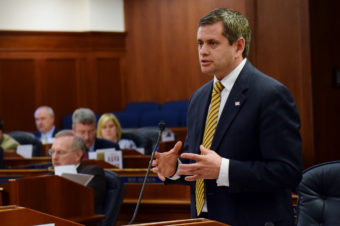
Sen. Bill Stoltze, R-Chugiak, testifies in the Senate Labor and Commerce Committee on SB 39, a bill he introduced that would repeal the State’s film production tax credit program, Feb. 19, 2015. (Photo by Skip Gray/360 North)
Sen. Bill Stoltze, R-Chugiak, testifies Thursday in the Senate Labor and Commerce Committee on SB 39, a bill he introduced that would repeal the state’s film production tax credit program. (Photo by Skip Gray/360 North)

Alaska’s film and television producers fear an attempt to repeal the 7-year-old tax credit system will stifle their growing industry.
Animal Planet, CNN and the Travel Channel are some credits University of Alaska Fairbanks film students have added to their resume thanks to the state’s film tax incentives.

Maya Salganek is the director of the university’s film program. She says 90 percent of her students have gotten professional work on productions since the tax incentive program began in 2008.

“It’s about getting the experience, and the confidence and the skillset in order to move forward,” Salganek says. “And that’s really where the incentives hopefully will go.”

Working as production assistants, editors and script supervisors, Salganek says her students earn valuable experience that teaches them how to produce their own stories locally.

“The tax incentive brings people up who have skills, and it lets us see this is a viable industry,” says Kavelina Torres, a student in Salganek’s film program.

Torres had about eight different production jobs in the last couple years — including for the 2012 feature film “Big Miracle.”

Torres says she hopes to produce feature films about Alaska Natives. Without the tax incentives, she says it’d be difficult to recruit the outside talent that could help her produce quality films.

“When those people don’t come, then we’re kind of fumbling in the dark. A lot of times I feel that way,” Torres says.

When the tax credit program was transferred to the Department of Revenue in 2013, regulations changed to incentivize Hollywood producers to hire more Alaska residents.

Ninety-one residents were employed by productions awarded tax credits in 2014.

Kelly Mazzei, the Alaska Film Office executive director, says hiring local labor is one of the standards her office considers when reviewing applications.

“We’re looking at the content, the number of residents that were hired, how is the film industry being supported? Is there an economic benefit to the state? Is it in the state’s best fiscal interest to approve this tax credit?”

Mazzei says measuring economic benefit in terms of revenue is difficult because Hollywood producers don’t have a tax liability in Alaska.

“Even though the economic benefit to the state is clear as far as bringing money in to businesses and local vendors, and hotels and catering,” Mazzei says, “as far as revenue coming into the state, there wouldn’t be any because we don’t have a broad-based tax system.”

Without a broad-based tax such as an income or sales tax, producers don’t contribute to state revenue.

It’s this lack of contribution that deputy revenue Commissioner Jerry Burnett says is what makes the tax incentives inconsistent with the state’s fiscal structure.

“From the state’s perspective as an operating entity, this is a subsidy; it’s a reduction in our revenues,” Burnett says.

Burnett testified before the Senate Labor and Commerce Committee on Thursday on Sen. Bill Stoltze’s bill that aims to repeal film tax credits. Senate Bill 39 prevents the Alaska Film Office from accepting new production applications after July 1, 2015.

Thomas Denomme is the chief executive officer of the Anchorage production company Sleeping Lady Films. He says threats from the legislature deter producers from wanting to work in Alaska.

“I still believe Alaska could be huge for film industry,” Denomme says, “It’s just setting it up properly and promoting it properly.”

Denomme is in the works of producing a screen adaptation of the 1993 novel “Two Old Women: an Alaskan Legend of Betrayal, Courage and Survival.” Without the tax incentive, he says he’ll probably have to shoot the film outside Alaska.

The committee is scheduled to take public testimony on SB 39 on Tuesday.

Alaska’s youth advocate foster care reform at Capitol

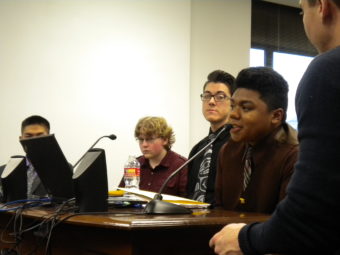
Benjamin Dahl-Rouzan shares his story of living in foster care before the House's Health and Social Services Committee on Tuesday. Dahl-Rouzan is a member of the Alaska Youth Policy Summit, which is a group that advocate changes to the state's social services. (Photo by Kevin Reagan/ KTOO)
Benjamin Dahl-Rouzan shares his story of living in foster care before the House’s Health and Social Services Committee on Tuesday. Dahl-Rouzan is a member of the Alaska Youth Policy Summit, a group that advocate changes to the state’s social services. (Photo by Kevin Reagan/ KTOO)

Members of the Alaska Youth Policy Summit shared stories of childhood trauma with legislators Tuesday. The group annually visits the state Capitol to give voice to children in the social services system.

In the 15 years Robin Ahqupuk spent in foster care, he lived in 48 different homes.

“I moved around a lot and didn’t feel connected with people…I was a loner,” Ahqupuk says.

The 20 year-old from Anchorage says he wants to make sure another Alaskan child will not have the same experience. Ahqupuk shared his story with the House Health and Social Services Committee.

Ahqupuk was one of five presenters of the Alaska Youth Policy Summit—an advocacy group that recruits young people throughout the state to visit the capital city and inform legislators on problems in the state’s social services.

Presenters spoke of childhood traumas dealing with drug abuse, mental health and being bounced around in foster care.

“I know the struggles of going through and having different case managers every other week, going to see different people, going to different places…having people tell you you’re doing one thing but you’re actually doing another,” says Benjamin Dahl-Rouzan, a 17 year-old from Anchorage.

Dahl-Rouzan spent five years in foster care before being adopted at age ten. He says the system could improve if the Office of Children’s Services collaborated more with community nonprofits to keep foster kids socially active.

Both Dahl-Rouzan and Ahqupuk said easing the burden of caseworkers is a necessary improvement. Anchorage Rep. Les Gara is targeting the workload of caseworkers in House Bills 27 and 28—both introduced this session.

“Alaska is failing its foster youth,” Gara says, “The state is its legal guardian; we need to treat them as we would treat our own children.”

Gara understands foster care problems because he used to be a foster kid himself. He says the 12 years he spent in the system were generally positive, but not without their faults.

“I saw a system that was stagnating,” Gara says, “if not getting worse because social work staff is so overburdened.”

Gara’s legislation tries to keep foster children in the same school after moving to a different home. He says maintaining a sense of permanency is important and that children should be placed in a permanent home within 18 months of being in foster care.

Office of Children’s Services director Christy Lawton says the department is mostly successful at finding permanent homes between 12-24 months—though older youth and those with special needs tend to be harder to place in permanent homes.

Lawton says the number of children entering foster care have increased in recent years.

“As we’re trying to do this work we’re having to increase the number of kids coming into foster care right now, and so that’s putting pressure on the whole system that is going to have more work than one person can reasonably do,” Lawton says.

HB 28 proposes a grant valued at $500,000 to support the staff of the Foster Care Independent Living Transition program. According to Gara, the program currently has six caseworkers helping 300-400 older youth with transitioning into adulthood.

Lawton says her department has not taken a position on Gara’s legislation. She says she’s uncertain if setting new legislative mandates on the department will be effective.

“I hope that we’ll be able to come up with something that will meet everybody’s needs and ultimately will make some improvements in areas that really do need improving,” Lawton says.

When asked how he stayed calm while presenting at the Capitol, Ahqupuk said it comes with living in a system that forces you to grow up too fast.

Site notifications
Update notification options
Subscribe to notifications