Kevin Reagan

Community partners help build traveling greenhouse

Juneau Douglas High School junior Malik Jones works on a wooden frame that will be part of a mobile greenhouse project. (Photo by Kevin Reagan / KTOO)

A greenhouse on wheels is in the works to teach Southeast Alaska students how to be less dependent on imported food.

Multiple community partners are pitching in to get the project up and rolling by the summer.

Lia Heifetz grew up in Southeast Alaska and has always been interested in food. When she returned home after graduating from the University of Oregon, she says she noticed a lack of food security in the region.

A blueprint of the mobile greenhouse project developed by Lia Heifetz. University of Alaska Southeast student Kaden Phillips designed the structure. (Photo by Kevin Reagan / KTOO)
A blueprint of the mobile greenhouse project being developed by the Southeast Conference. University of Alaska Southeast student Kaden Phillips designed the structure. (Photo courtesy of Lia Heifetz)

“There is little access that people have to local, fresh foods,” says Heifetz, the Southeast Conference’s food security coordinator.

In a 2014 assessment of the Southeast food supply, Heifetz found that about 95 percent of it is imported. She says there is a high demand for locally grown food, but lack of education in rural communities on how to grow and cultivate it.

Heifetz developed a project to construct a greenhouse on wheels to tour throughout the region. The mobile gardening center will be housed by rural schools for one year at a time.

“This mobile greenhouse is a tool to get people thinking about growing food but also a way to engage,” Heifetz says.

Heifetz says the greenhouse will be a multi-faceted classroom for educators to teach science, math and business. She says the intention is to demonstrate how to be less dependent on imported food.

“By producing our own food we have the opportunity to connect with our place more,” Heifetz says. “We’re depending on a system that’s super vulnerable.”

Heifetz says some of the factors that lead to food insecurity in Southeast include high transportation costs and weather hazards.

The mobile greenhouse is expected to be complete by May, and Heifetz says it could not be done without help from community partners.

Juneau Douglas High School teacher Andy Bullick brings students to the UAS Technical Education Center a few times a week to work on the mobile greenhouse. (Photo by Kevin Reagan / KTOO)

Juneau Douglas High School students are volunteering their labor for the project. Wood shop teacher Andy Bullick says it offers his students a chance to practice hands-on skills outside the classroom.

“People will see a greenhouse; I see it as a learning experience for my metals construction class,” Bullick says.

Bullick brings a handful of students to the University of Alaska Southeast Technical Education Center to build pieces of the project a few times a week. The greenhouse will sit upon a flatbed trailer and include adjustable shelves to hold potted plants.

“It’s good to do community projects in school like this so we’re always looking for ways to do that,” Bullick says.

Alana Peterson is the program director of the Sustainable Southeast Partnership, an organization sponsoring the greenhouse. The partnership typically works on projects that promote economic growth. Peterson says this project is different from others she oversees because of its strong educational component.

“What is unique about it is that it’s not specific to one community but it could benefit many communities,” Peterson says.

The culinary students of Thunder Mountain High School are scheduled to take in the greenhouse first. After that, it will likely journey to Kake or Hoonah.

Marshmallow maker needs kitchen to call his own

Jason Puckett makes about 20 pounds of chocolate-covered marshmallows each week in the Chez Alaska Cooking School. Puckett is trying to raise funds to rent a small kitchen space of his own. (Photo by Kevin Reagan/ KTOO)
Jason Puckett makes about 20 pounds of chocolate-covered marshmallows each week in the Chez Alaska Cooking School. Puckett is raising funds to rent a small kitchen space of his own so he can expand his weekly supply up to 400 pounds. (Photo by Kevin Reagan/ KTOO)

A Juneau marshmallow maker is seeking community support to turn his hobby into a small business before the tourist season begins.

Jason Puckett says he’s never had much of a sweet tooth, but admits to always having an appreciation for marshmallows.

“It wasn’t overly sweet. It’s just the consistency and the flavor and the feel in your mouth and it’s just something that is unique,” he says.

The former Marine and father of three grew tired of store-bought marshmallows with the added chemicals and preservatives. He decided one day to try making them from scratch. Ten years later, he’s nailed down a simple recipe that’s in high demand among friends and co-workers. Several of them encouraged Puckett to try expanding his hobby into a business.

Recently, he set-up shop in the rented kitchen space of Chez Alaska Cooking School and began producing about 20 pounds of chocolate-covered marshmallows each week.

Jason Puckett coats his homemade marshmallows with chocolate he buys from Alaska Fudge Company. (Photo by Kevin Reagan / KTOO)
Jason Puckett coats his homemade marshmallows with chocolate he buys from Alaska Fudge Company. (Photo by Kevin Reagan/KTOO)

Puckett’s operation is a one-man show requiring much attention to detail. He hand cuts each marshmallow with a trowel — purchased at a hardware store — then delicately plops them into a swirling pool of melted chocolate. After extracting them, he slabs on a final layer of chocolate with a mini-BBQ basting brush.

It takes Puckett up to four hours to make a batch of marshmallows, which can conflict with the kitchen school’s busy schedule. He recently launched a Kickstarter campaign to raise $2,500 for the first deposit on his own small kitchen space. Puckett’s already collected about $1,000 and says he’s been impressed by the flurry of community support.

“Everybody wants to help you in Juneau if you’re a new business starting out,” Puckett says. “So I’ve had a lot of people try to mentor me and help me along with my business.”

Alaskan Fudge Co. manager Phil Wheeler has been giving Puckett pointers on how to launch his business. Wheeler sells Puckett’s marshmallows in his store and describes them as a standout addition to his candy palette.

“It wasn’t exactly what I expected it to be. It’s a lot fluffier and softer than what I thought it would be,” Wheeler says. “I didn’t think something like that would dip in chocolate like the way it does.”

Wheeler says he’s seen many candy businesses come and go over the years. He says developing a regular clientele is key for surviving in the capital city.

“I don’t know if there’s room for more than a few candy stores here in town or anywhere in Southeast Alaska,” Wheeler says.

Puckett says he’s confident his marshmallows will attract business year round. He plans to broaden his products to include chocolates bars, peanut butter cups and pumpkin spice-flavored marshmallows.

“It’s really important to diversify and have a lot of different areas where you can do your business so you’re not just pigeonholed in one area,” Puckett says.

Puckett hopes to work in his own kitchen before the tourism season kicks-off next month. He’ll be accepting donations until March 26.

Legislator says mandating GMO-labels empowers shoppers

Rainbow Foods in downtown Juneau labels while products and do not contain genetically-modified organisms. House Bill 92 aims to require all foods sold in Alaska to have such labels. (Photo by Kevin Reagan / KTOO)
Rainbow Foods in downtown Juneau labels which products contain genetically-modified organisms. House Bill 92 aims to require all foods sold in Alaska to have such labels. (Photo by Kevin Reagan/KTOO)

A recent poll by the Pew Research Center reveals a quarter of Americans regularly check food labels for genetically-modified organisms.

A bill in the Alaska Legislature would help GMO-cautious consumers identify which products have been genetically engineered.

Anchorage Rep. Geran Tarr concedes that there is no clear consensus about whether eating genetically-modified foods is harmful, but she’s not taking any chances.

“We are learning new things every day and we can be more careful,” Tarr says. “In this case I’m on the side of giving consumers choices about which products they buy.”

Rep. Geran Tarr shows an example of how manufacturers might label foods with genetically-modified ingredients under House Bill 92. (Photo by Kevin Reagan/ KTOO)

Tarr introduced House Bill 92 requiring food manufacturers to label products containing genetically-modified organisms. She defines genetic engineering as transferring DNA material from one organism to another. The method is used to produce high amounts of corn, cotton, soy and sugar beets.

Tarr, who has a degree in botany and environmental studies, says because of the potential health hazards from eating those foods, she wants to better educate consumers about what’s going in their shopping cart.

“People want to know what’s in their food and they want to know that today. Without that 100 percent assurance then they want to have the option to buy something that they feel more comfortable with,” Tarr says.

University of Alaska Fairbanks professor Steven Seefeldt says he sees no hazard in eating foods made with GMO crops.

“When you’re eating anything that’s got DNA in it, which has been modified or not, the DNA is never harmful,” Seefeldt says.

Seefeldt says the problem with genetic engineering is not the science but how it’s managed. He says the practice can be used to create insulin for people with diabetes or produce milk that the lactose intolerant can drink.

But he points to concerns over products such as genetically-modified salmon. Seefeldt says he wouldn’t want those fish to escape captivity and compete with wild species. That’s why he thinks the GMO issue should be evaluated on a case-by-case basis.

“You have to treat each case separately,” Seefeldt says. “In some cases, the benefits outweigh and in other cases they don’t. Nobody can say overall the benefits outweigh the consequences.”

Legislation to mandate GMO-labeling has been introduced in more than 20 states. Vermont, Connecticut and Maine have passed laws. The law in Vermont is being challenged in court, while the Maine and Connecticut laws are contingent on other states adopting similar legislation. Tarr says opposition against such measures comes from food manufacturers.

“The manufacturers themselves will say the products are safe,” Tarr says. “They say that if you label a product it gives the suggestion that there is something wrong with it and they want to push back against that idea.”

Tarr says her bill does not dictate the size or placement of the label and gives manufacturers time to change their packaging to avoid any monetary costs.

She says the bill could allow shoppers to buy GMO-free foods that are less expensive than organic-certified products, because they would not undergo the same certification process as those given the “organic” label from the U.S. Department of Agriculture. Certifying organic foods can cost thousands of dollars — an expense that trickles back down to consumers.

“People want there to be healthy food … they want some fairness in our food system that makes sure that no matter what your economic circumstances, you’ll have access to healthy foods,” Tarr says.

Dave Ottoson, owner of Rainbow Foods, says prices for non-GMO products have decreased in recent years. His store tries to flag foods that contain GMO ingredients, but he says it can be an exhausting process.

“It’s really hard to keep up with,” Ottoson says. “I mean if you really want to be completely transparent and let people know what products are at-risk…it’s almost like a full-time job.”

Ottoson says manufacturers can avoid listing GMO-produced ingredients such as soy by using the alternative name “texturized vegetable protein.” He says sweet products that do not list the source of its sugar are most likely genetically-modified.

Tarr says she’s received over 100 emails of support for her bill. Her staff has been hosting statewide screenings of the documentary “GMO OMG” throughout the week to get residents talking about genetic engineering.

Food bank needs more space to meet higher demand

(Judy Brown volunteers every Saturday at the Southeast Alaska Food Bank. She says they quickly run out of meats and cheeses after opening at 8:30 a.m. (Photo by Kevin Reagan/ KTOO)
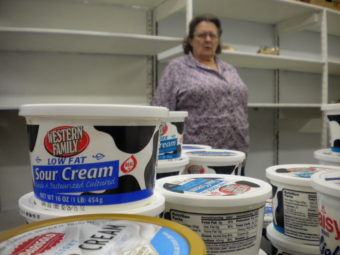
Judy Brown volunteers every Saturday at the Southeast Alaska Food Bank. She says they quickly run out of meats and cheeses after opening at 8:30 a.m. (Photo by Kevin Reagan/ KTOO)

The Southeast Alaska Food Bank  has doubled its inventory in recent years and is lacking the freezer space to preserve it all. The nonprofit hopes to expand its facilities on city-owned land to build additional storage.

It’s 9:15 on a Saturday morning and the shelves at the Southeast Alaska Food Bank are pretty bare. When the facility opened 45 minutes ago there were rows of chicken, cheese, soup and sandwiches — now all that’s mostly left is sour cream and a few loaves of bread.

Volunteer Judy Brown helps a man fill a box with packages of Oreo cookies. She says there’s no limit on how much an individual can take from the food bank.

“I just want to be fair,” Brown says, “I don’t want to see anyone not get anything.”

She says today’s supply is lighter than usual, so she asks visitors to take things sparingly.

The Southeast Alaska Food Bank allows any individual to visit on Saturday morning to take perishable goods such as milk, meat and cheese. The nonprofit gives its canned foods to local charities. (Photo by Kevin Reagan/ KTOO)

About 90 individuals visit the bank this morning and have walked out with roughly 2,700 pounds of food. The majority of it is locally donated from Walmart, Fred Meyer and Rainbow Foods.

Food bank manager Darren Adams says the amount of supply coming in-and-out has doubled in recent years.

“Once upon a time on a busy Saturday we would get 15 or 20 people showing up here to get food. When the economy started getting worse and worse, we started seeing more people and we had to move things around to accommodate that number of people,” Adams says.

The increased demand has led to plans for an expansion of the food bank by a quarter acre on a plot of city-owned land along Crazy Horse Drive.

Adams says the expansion would allow for the installation of walk-in freezers to store more meat — an item always first to go on a Saturday.

The added land would also permit the construction of a 1,840 square foot storage facility on the north side of the existing building.

Adams estimates the cost of the project to be minimal for the organization, but says the process is still very much in the “talking” phase.

Community planner Sarah Bronstein of Scheinberg Associates is helping the food bank navigate the complex process of getting the project off the ground.

“We will be just sort of looking over the shoulder of the city and making sure things are moving forward,” Bronstein says.

The Juneau Assembly needs to approve any changes to the food bank’s lease. Bronstein says it’s usually a three-month process, but does not foresee any hesitation from the Assembly.

“Part of the reason the city leases to the food bank is because it’s such a critical service that the food bank provides to the community,” Bronstein says.

The food bank also distributes nonperishable goods throughout the week to community partners such as The Glory Hole and the Boys and Girls Club of Juneau. Adams says roughly 25 percent of their supply is donated from individuals like the students of Floyd Dryden Middle School, who collected 1,140 pounds of food for the organization this past month.

“We live in a very generous community,” Adams says. “It never ceases to amaze me how willing people are wanting to step up and collect food for us.”

The city’s Planning Commission reviewed and approved the project at their Tuesday meeting. It now goes to the Assembly Lands and Resources Committee, which will decide whether to bring it before the full Juneau Assembly for approval.

Education liberates former Lemon Creek inmates

UAS assistant professor Sol Neely, left, demonstrates a special handshake with student Shawn Jessup. Neely advises the Flying University club, a campus support group for students transitioning from prison to college. (Photo by Kevin Reagan/ KTOO)

Inmates at Juneau’s Lemon Creek Correctional Center are using the works of Shakespeare and Dostoyevsky to get on the road to academia, and ultimately a better life.

They’re part of classes taught by UAS Professor Sol Neely, who brings college students behind bars with him each semester to learn writing skills alongside convicted felons.

Death, blood, despair — this is how Marcos Galindo describes prison gang life in a poem he wrote while incarcerated at Lemon Creek Correctional Center in the fall of 2013.

The 29-year-old is now a senior studying political science at the University of Alaska Southeast.

UAS student Marcos Galindo reads an issue of the Flying University literary journal. Galindo is one of the 15 former and current inmates of Lemon Creek Correctional Center to write contributions to the journal. (Photo by Kevin Reagan/ KTOO)

“Education opened my eyes to leaving old ideas in the past and adapting to a new, meaningful fulfilling idea which is critical thinking and being able to help others,” Galindo says.

Galindo says courses in philosophy and literature that he took while in prison gave him an escape. After serving two years for second-degree assault, he decided to abandon the gang lifestyle he’d been living since childhood and enroll at UAS.

Professor Sol Neely teaches the classes that inspired Galindo. He began teaching at the prison in 2012. Early on in the process, Neely says an inmate asked him point-blank why he was there.

“My response was I’ve done some things in my past and I have been fortunate not to land in jail, so I go in there because it could have been me,” Neely says.

Neely brings in a group of UAS students each semester to take a 10-week course alongside inmates. He says it’s important his UAS students not treat the program as a field trip — where they observe the prisoners at a distance.

“We’re not here to go in and to help these guys,” Neely says. “We’re to go in and learn from and co-study. It’s mutual.”

Neely teaches students to dissect the philosophical writings of Havel, Levinas and Dostoyevsky—writers who all at one point spent time in jail. Neely says the restrictive atmosphere of the prison is an appropriate place to discuss the themes of these authors.

Nathan Block is another UAS student and former Lemon Creek inmate. After serving in the Iraq War, he say ended up in prison after using skills the Army taught him in a negative way. Block says he immediately wanted to enroll at UAS after serving two years for armed robbery.

“I see education as a means to utopia in this world,” Block says. “Education leads to better things for everybody.”

Block writes about his military experiences in a poem titled “Bombs Under Freedom.” It was published with the works by 14 other current and former Lemon Creek inmates this month in a literary journal titled “Flying in Shackles.” Stories of rage, race and romance fill the pages, and Neely says it captures the individual, unique story of each prisoner.

“As you read the poems and the literature in this journal I think you have to listen for that story. If you want to access the existential depth, you’ve got to sit down with this book in your hand and you have to listen,” Neely says.

The journal was paid for by a grant from the university’s Undergraduate Research, Experiential & Creative Activities program. Neely says UAS faculty and staff have been supportive with students transitioning over from Lemon Creek.

Former inmates attending UAS joined together to form an on-campus club named The Flying University—an homage to the underground philosophy popular in Czechoslovakia during the Soviet invasion of the 1960s.

Galindo is the club’s founder and says their objectives are to promote social justice and recruit Lemon Creek offenders to enroll at UAS. Galindo says the transition is usually difficult for ex-convicts, but can be made easier thanks to Neely’s courses.

“There’s no reason why I can’t get a degree as well…If I could handle Sol’s classes I could handle any of these classes here,” Galindo says.

Shakespeare is the next topic Neely will be teaching at Lemon Creek. He says he’s excited to see how the inmates deconstruct the villainous personalities of the playwright’s famous works.

Why time zones are a sore subject for Juneau


(Creative Commons photo by Gillfoto)

Since World War II, the capital city has switched from Pacific Time to Yukon Time to Alaska Standard Time — and was even out of sync with the rest of Southeast Alaska at one point.

Sen. Anna MacKinnon says a new version of her Senate Bill 6 heals an old time zone “war wound” for Southeast while eliminating daylight saving time statewide.

The topic of time in Alaska has always been complicated. The state’s vast size has made the pros and cons of daylight saving time and time zones inconsistent.

“Because Alaska is so diverse in terms of its breadth of longitude, there’s no way that everybody can be happy,” says Frank Norris, a historian with the National Park Service.

Norris says communities had set their own time zones in the pioneer days. It wasn’t until the gold rushes at the turn of the century that the U.S. Army set the territory’s first singular time zone. Residents were reluctant to observe it, but the U.S. Congress mandated it along with daylight saving time in 1918 to conserve energy for the war effort.

“Alaskans have always been an independent bunch. And they haven’t over history necessarily thought of themselves as Alaskans first,” Norris says. “So because of that they’ve had differing notions about what time zone they want to be on.”

Folks in Skagway wanted to be on Yukon Time, while other Southeast residents preferred being aligned with Seattle — it was a conflict that divided Alaska in the decades following World War II.

This lack of unity and capital accessibility concerns prompted then-Juneau Mayor Bill Overstreet to act. Through an Assembly resolution, he requested the U.S. Department of Transportation move the capital city off Pacific Standard Time. The feds granted the change to Yukon Time, and Juneau fell out of sync with the rest of Southeast.

Pacific Time, all the time
By Jeremy Hsieh

On March 28, 1980, locals voted 2-1 in a single-issue special election to amend the City and Borough of Juneau’s charter regarding time zones.

The election came not long after Assembly members successfully petitioned the federal government to move Juneau off of Pacific Time. The charter amendment forced the Assembly to petition the federal government again to revert to Pacific Time, and continues to bar the Assembly from supporting anything but Pacific time.

The language remains in section 3.19 of Juneau’s charter:

“The assembly may not sponsor, petition, propose, recommend, refer or otherwise act in any way to provide for a change of the Pacific Time Zone applying to the area of the municipality.”

Juneau residents were not pleased.

The time zone issue drove Rich Poor to run for Assembly in the 1980s.

“Basically Juneau was kind of sandwiched in between Anchorage on one side and the rest of Southeast Alaska on the other side and we were kind of a no-man’s land for our time zone, and we were kind of in sync with nobody,” Poor says.

Poor says Overstreet’s time change spurred a local political uprising and a recall attempt of the mayor and four Assembly members.

“That caused such a commotion that the DOT came back, held more hearings and moved Juneau back to Pacific Time,” Poor says.

The city would not stay in this time zone for long. Then-Gov. Bill Sheffield sought to eliminate the two-hour gap between Southeast and the Railbelt by setting one statewide time zone. The legislature passed Sheffield’s proposal and Alaska Standard Time went into effect in 1983.

The state has been on the same system since and continues to observe daylight saving time. The legislature has introduced multiple bills attempting to exempt the practice, but none have succeeded.

Eagle River Sen. Anna MacKinnon says she learned her lesson when her first daylight saving time bill failed six years ago. She says eliminating daylight saving time is difficult without addressing the effect on the state’s singular time zone.

That’s why she added a provision to SB 6 requiring Gov. Bill Walker to petition the federal government to consider moving the state’s time zone.

“It was our original intent that we wanted to spring forward and stay on daylight saving time,” MacKinnon says. “And to do that from a time zone interpretation, that means we would go to Pacific and stay there.”

MacKinnon says her latest legislation “honors the sacrifice” Southeast residents made when switching off Pacific Time.

Regardless of what the federal government determines, SB 6 would still exempt the state from practicing daylight saving time. MacKinnon says studies correlating daylight saving time with increased rates of heart attacks and suicides prompted her decision to introduce the bill.

“The erratic nature of moving forward or falling back is at least starting to prove out scientifically and statistically that there is some kind of relationship between the two,” MacKinnon says.

Numerous local businesses testified in opposition to SB 6 before the Senate Finance Committee Tuesday. Stuart Cohen, owner of the clothing store Invisible World, says a loss of evening daylight could inhibit tourists from getting off cruise ships to shop.

“Adding one more obstacle, it’s not gonna put us out of business, but it’s just kind of makes it a little bit harder,” Cohen says, “And I just don’t see how anybody in Southeast Alaska benefit(s) from this at all.”

Anchorage resident Lynn Willis testified in support of the legislation, yet he objects to the added amendment because of the delayed sunrise central Alaska would experience if moved to Pacific Time.

That’s to be expected, says National Park Service historian Frank Norris.

“I think that those tensions will continue to exist just because Alaska is such a large place, it’s such a diverse place, and because people have differing needs on what they want to see from their time zones.”

Norris says as the state continues to develop and expand, the daylight debate will not be setting any time soon.

Site notifications
Update notification options
Subscribe to notifications