Kevin Reagan

Liquor license gives European-vibe to local coffee shop

The Paradise Cafe in the Mendenhall Valley began serving alcoholic drinks on Saturday. Mustaches serve as the logo for the cafe's new addition nicknamed "The Handle Bar." (Photo by Kevin Reagan/ KTOO)
The Paradise Cafe in the Mendenhall Valley began serving alcoholic drinks on Saturday. Mustaches serve as the logo for the cafe’s new addition nicknamed “The Handle Bar.” (Photo by Kevin Reagan/ KTOO)

Customers of Paradise Café in the Mendenhall Valley can now enjoy a cocktail with their coffee and scone. The local eatery celebrated its new liquor license over the weekend.

Walking into Paradise Café on a Saturday morning can feel like coming home for Thanksgiving—the place is packed with people, food and random home décor.

It’s an atmosphere owner Joan Deering has tried to keep authentic since taking over the café in 2003.

“I just want people to feel that when they come here that I care about them,” Deering says. “We care about them. You’re not just another customer. You’ve entered our house.”

Deering says she tries to go against the norm in her business—customers sit in the living room of an old home, food is on display like works of art and waiters chat with patrons instead of handing out menus.

Deering wanted to continue this spirit of intimate hospitality when she applied for a liquor license last year. She thinks the presence of mimosas and cocktails on the menu will extend the café’s casual, European-vibe.

Paradise Cafe owner Joan Deering makes a batch of scones on Saturday. Deering moved the cafe from its downtown location to the Mendenhall Valley three years ago. (Kevin Reagan/ KTOO)

“This is a home. It would be like you came to my home and I offered you a glass of beer or a glass of wine,” Deering says.

The process of getting a liquor license was more complicated than Deering expected. The state’s Alcoholic Beverage Control Board gave the last liquor license available in Juneau to The Lunchbox restaurant downtown. Deering tried to appeal the decision, but the Board did not rule in her favor. In a stroke of luck, The Lunchbox forfeited the license after deciding to shut down its business.

Deering was issued the license on Dec. 1, 2014, and started serving drinks at a Valentine’s Day celebration over the weekend. The café joins a handful of other local coffee shops to serve alcohol.

“I think it (alcohol) will bring more people in who haven’t really been here before, but I think it will stay the same wonderful, homey place,” says Paris Donhoe, a regular customer at Paradise Café.

Donohoe attended the Valentine’s Day event to taste new drinks, such as the special-made Buddy Beers—a tomato juice mixer named after a four-legged friend of the café’s.

Like other customers at the event, Donohoe was donning a fake mustache. It’s an emblem for the new addition to the café known as The Handle Bar. The name comes from an antique bicycle hanging off the café’s wall.

Deering says the addition of The Handle Bar will likely extend the café’s hours into the early evening, and the bar’s cocktail menu is still a work-in-progress.

“We’ll just kind of play-it-by ear is how I’m figuring,” Deering says.

Despite now having to check a customer’s ID, Deering says Paradise will remain a café where everybody knows your name.

Butch Laughlin serving wine at Paradise Cafe on Saturday. (Kevin Reagan/ KTOO)

ABC Board discusses problems in marijuana regulation

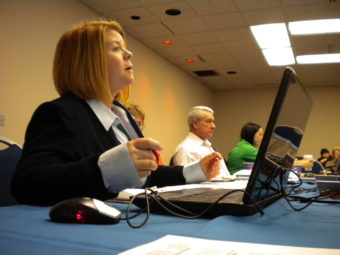
Alcohol Beverage Control Board director Cynthia Franklin meets with her board members on Thursday in Centennial Hall. She discussed problems she foresees in how the state will execute legalized marijuana. (Photo by Kevin Reagan/ KTOO)
Alcoholic Beverage Control Board director Cynthia Franklin met with her board members on Thursday in Centennial Hall. She discussed problems she foresees in how the state will execute legalized marijuana. (Photo by Kevin Reagan/ KTOO)

The state’s Alcoholic Beverage Control Board director has given recommendations to the agency’s board members on how to improve the rollout of marijuana regulation in the coming months.
During her trip to Colorado last month, Board director Cynthia Franklin realized Alaska won’t face the same problems in its marijuana regulations.

“What we were able to see a lot in Colorado were Colorado’s problems,” Franklin says. “Alaska’s problems are going to be different from Colorado problems.”

During a public presentation to the agency’s five-member board on Thursday, Franklin outlined potential problems she foresees when marijuana becomes legal Feb. 24.

Franklin says the manufacture of edible products is an issue in Colorado. She says the state first allowed edibles with 10 milligrams of THC per serving—a dose she says is too high for first-time users.

“We don’t have those on the shelves. We’re starting from zero. It’s my opinion that if we’re starting from zero and we know that five milligrams is a start-lo, go-slow amount, we should pick five,” Franklin says.

Franklin says Alaska’s legal definition of edibles should exclude pre-made food or drinks that have been infused with marijuana. For example, she says a package of Haribo gummy bears sprayed with marijuana concentrate should not as count as an edible product. However, edibles made from scratch would be legal. It’s this lack of distinction in Colorado’s definition of edibles that Franklin says is problematic.

“Colorado has regulated itself into that giant grey market loophole. We do not have to go there,” Franklin says.

Board member Ellen Ganley says the definition of edibles should be discussed when the agency begins drafting the state’s marijuana regulations.

“I think the edible issue is one we really have to work out. The way Colorado manufacturers have been taking recognizable candy and adding THC…I think we’ve got to think long and hard about that,” Ganley says.

The ABC Board has until Nov. 24, 2016 to set regulations for the sale and manufacturing of marijuana. The legislature has the authority to establish a marijuana control board at any time to assume responsibility for regarding marijuana. Franklin says creating another agency would be a waste of resources.

“It doesn’t make a lot sense to have new officers, new licensing staff, a new director, a new board and new agents all at once. It sounds a little bit like a recipe for disaster,” Franklin says.

Franklin proposes hiring six staff members to handle marijuana regulation. She says the agency’s budget is essentially in the “red” and that they’ll work with the state’s Department of Commerce, Community and Economic Development to find additional funding.

The ABC Board will meet again on Feb. 24 to begin the nine-month process of drafting regulations.

Rep. Drummond says “death with dignity” not same as suicide

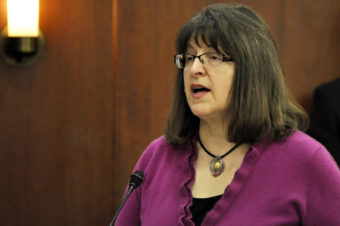
Rep. Harriet Drummond addresses the Alaska House of Representatives, Feb. 14, 2014. (Photo by Skip Gray/Gavel Alaska)

A bill introduced in the Alaska legislature this week reopens debate on “death with dignity” in the state. The legislation would allow terminally ill residents to request a lethal prescription to end their life.

Terms such as “aid in dying,” “physician-assisted suicide” and “death with dignity” may sound similar, but a 2013 Gallup poll found that Americans are less likely to support such laws if it uses the word “suicide.”

That’s why Anchorage Rep. Harriet Drummond is quick to say House Bill 99 is not an “assisted suicide” bill.

This isn’t about suicide. This is about somebody who is already going to die,” Drummond says. “They’ve been sentenced to die by their disease or condition.”

Drummond says she introduced the legislation this week after people who live in her district requested it. To her knowledge, it is the first bill in the state legislature to give terminally ill individuals with less than six months to live the option of requesting a lethal prescription from a physician.

Drummond says the bill is all about choice and tries to keep the process voluntary for all parties involved.

Nobody is being forced to do this, and should this become law, this is still a choice on behalf of everybody,” Drummond says.

University of Illinois law professor Eric Johnson says giving patients the choice to end their own lives could lead to wrongful suicide.

There are good reasons for being afraid that if a law permitting assisted suicide was passed, people who are vulnerable might decide to take their own lives in situations where they are less than entirely free to make that decision,” Johnson says.

The poor, mentally ill and disabled are populations Johnson thinks could fall victim to Drummond’s bill.

Johnson argued against assisted suicide in the 2001 state Supreme Court case Sampson vs. Alaska. His argument was that the dangers of legalized euthanasia could lead to individuals feeling pressured to take their own lives due to economic or personal factors. The court ruled in Johnson’s favor and left the debate for the state legislature to decide.

Drummond says her bill attempts to create safeguards for vulnerable populations. She says it’s modeled after Oregon’s “Death with Dignity” law enacted in 1997.

We believe the Oregon model is the model to follow and it has worked,” says George Eighmey, who is a board member of the Death with Dignity National Center in Oregon.

The organization helps other states draft legislation similar to Oregon’s law, which was the first in the nation. Eighmey estimates that it takes 2-3 legislative sessions for a state to pass a bill such as HB 99.

He says Drummond’s bill parallels Oregon’s law with how it requires two physicians to diagnose a patient as terminally ill. The patient must also make oral and written statements about their wish to die, and be the only one to administer and ingest the lethal medication.

No one can inject you, no one can pour it down your throat, no one can put it in your IV bag or anything like that. You have to be able to consume it yourself,” Eighmey says.

Despite these safeguards, some remain unconvinced.

Bishop Edward Burns of the Catholic Diocese of Juneau sees HB 99 as promoting a culture of death. He interprets it as giving doctors too much power to decide who lives and who dies.

I think it’s important for us to always stand up for the dignity of human life,” Burns says.

Because she’s a Democrat in a Republican-controlled legislature, Drummond’s not optimistic the bill will make much progress this session.

Unless there is a huge outcry of constituents that want it to be heard, I doubt it will get a hearing,” Drummond says.

HB 99 has been referred to the Judiciary and Health and Social Services committees. If the bill passes, Alaska would join Oregon, Vermont and Washington as the only states to legalize a “death with dignity” law.

A court decision in Canada recently made it legal nationwide in that country.

Baconfest promises an ‘explosion of flavors’

Brian Keeney, kitchen manager of V's Cellar Door, slices bacon for one of the dishes the restaurant is entering in Baconfest. (Photo by Kevin Reagan/ KTOO)
Brian Keeney, kitchen manager of V’s Cellar Door, slices bacon for one of the dishes the restaurant is entering in Baconfest. (Photo by Kevin Reagan/ KTOO)


Juneau’s Baconfest brings together local culinary talent to manipulate America’s beloved pork product. Bacon-infused ice cream, popcorn and cocktails are a few dishes attendees can taste on Saturday at the annual fundraiser.
The sound of slicing bacon is not quite what you’d expect to hear in the kitchen of an ice cream parlor. But Baconfest requires local restaurants to get inventive with the crispy breakfast-staple.

Coppa is a coffee shop specializing in homemade ice cream. Co-owner Marc Wheeler and staff are serving up a candy cap mushroom-flavored ice cream with six pounds of sliced, candied bacon mixed into the custard.

“Ice cream is kind of a medium that can be bent and twisted and done all sorts of things with,” Wheeler says.

Coppa’s head cook Isaac Stern begins the process by grinding up the candy cap mushrooms. He then whisks the grinded mushrooms into a simmering pot of sweet custard. The mushrooms have a similar flavor compound as maple syrup. Once dissolved into the custard, Stern says their natural sweetness will complement the salty bacon.

Candy cap mushrooms and bacon are central ingredients to the homemade ice cream Coppa is serving at this year's Baconfest. (Kevin Reagan/ KTOO)
Candy cap mushrooms and bacon are central ingredients to the homemade ice cream Coppa is serving at this year’s Baconfest. (Kevin Reagan/ KTOO)

“You can buy all kinds of flavors in jars, buy flavors in cans, and it’s not real flavor,” Stern says. “This is something made in nature that we’re putting into it. It symbolizes our need to use the environment.”

Coppa is one of 20 vendors to make bacon-inspired dishes for the 400 Juneau residents to attend Baconfest. This is the shop’s first year participating in the competition.

The annual fundraiser originated three years ago when the Juneau Glacier Valley Rotary Club was looking for a new, unique way of raising money. Baconfest co-chair Mandy Massey says the event is an outlet for restaurants to experiment.

“We’ve been so surprised by items that we would regularly never see out there,” Massey says. “These people, these professionals just keep coming up with incredible, creative items. It’s just an explosion of flavors.”

Massey says the event sold out a full week before Saturday. Attendees vote for their favorite bacon dishes in separate ‘sweet’ and ‘savory’ categories. The vendor with the most votes receives an advertising package from Juneau Radio Center valued up to $1,000.

Venietia Santana, owner of V’s Cellar Door, came in third place last year for her bacon wonton dish made with smoked Alaskan halibut. This year, she’s combining 4-5 different types of bacon into a dish that will include savory smoked fruits and bacon soaked in duck fat.

A finished batch of Alaska Fudge Company's bacon caramelized popcorn. The food vendor has made bacon-maple fudge and bacon caramel with chocolate in previous years for Baconfest. (Photo by Kevin Reagan/ KTOO)
A finished batch of Alaska Fudge Company’s bacon caramelized popcorn for this year’s Baconfest. (Photo by Kevin Reagan/ KTOO)

“I wanted to push the envelope even further, and see what exactly we could do with bacon,” Santana says.

The Rookery Cafe took first prize last year and returns to defend its title against other vendors including Alaska Fudge Company, Devil’s Hideaway, and Abby’s Kitchen and Bakery.

But no matter who wins, everybody at Baconfest brings home the bacon.

Glory Hole shelter reopens after repairs

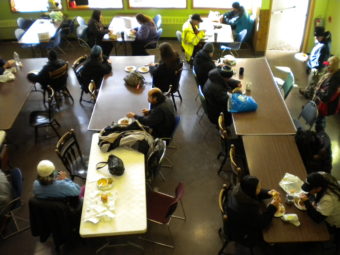
Glory Hole staffer Mindy Lee serves the first meal at the shelter's headquarters since the building shut down for repairs two months ago. (Photo by Kevin Reagan/KTOO)
Glory Hole staffer Mindy Lee serves the first meal at the shelter’s headquarters since the building shut down for repairs two months ago. (Photo by Kevin Reagan/KTOO)

The Glory Hole Shelter and Soup Kitchen reopened its doors Wednesday morning after plumbing repairs closed down its headquarters for the last two months.

Wednesday was move-in day for Mariya Lovishchuk at the Glory Hole.

The executive director of Juneau’s nonprofit homeless shelter has not worked at a desk of her own since a broken pipe flooded the building two months ago. Lovishchuk and her 10-person staff recently returned to their headquarters on Franklin Street to continue offering their full services.

“The transition period will be over pretty soon, it’s just really great to have the building back,” Lovishchuk says.

The shelter stayed in operation while its building was under repair. The Salvation Army and Holy Trinity Church helped the Glory Hole provide basic services to its regular patrons.

Lovishchuk says insurance covered most of the repair costs, and community donations allowed the Glory Hole building to undergo some much needed upgrades. New cabinet panels, kitchen stove and plumbing system were installed while the building was being serviced.

“Fortunately we have a lot of partners in the community and the state,” Lovishchuk says, “because of the help of our great partners it has not as been as horrible as it could have been.”

Lovishchuk’s staff prepared the first meal in the Glory Hole since re-opening on Wednesday to a crowd of about 20 people. On the menu was homemade chili and Subway sandwiches.

For Mike Davis, the chili wasn’t quite strong enough. He sprinkled some garlic salt on top — but it’s a ritual he does with all his food.

“Cold medicine is what it is actually,” says Davis, who has lived in Juneau since 1974.

Roughly twenty people arrived at the Glory Shelter for lunch on Wednesday. The shelter collaborated with the Salvation Army to continue offering meals while the building was under repair. (Photo by Kevin Reagan/KTOO)

Davis had been staying at Juneau International Hostel with other Glory Hole clients during the repairs. He doesn’t plan to stay in the shelter for very long but he’s glad to see it reopened for those who have nowhere else to go.

“I know it’s really important for a lot of these people,” Davis says. “They feel a lot more comfortable here, it’s a sense of security I guess.”

The Glory Hole is capable of housing 40 people at a time in its dormitories, and clients have been moving back in for the last couple of weeks.

With the building back in operation, Lovishchuk says it should be easier for the Glory Hole to continue its involvement with developing the capital city’s Housing First project to address chronic homelessness.

Juneau’s tobacco tax triples April 1

Emily Neenan testifies before the Juneau Assembly on Monday. Neenan claims an increase to tobacco taxes significantly reduce smoking among Alaska's youth population. (Photo by Kevin Reagan/ KTOO)
Emily Neenan testifies before the Juneau Assembly on Monday. Neenan claims an increase to tobacco taxes significantly reduces smoking among Alaska’s youth population. (Photo by Kevin Reagan/ KTOO)

Tobacco taxes in the City and Borough of Juneau will triple after a 6-3 vote by the Juneau Assembly to assess a $3 tax on each pack of cigarettes.

The new tax rate — which takes effect April 1 — replaces Anchorage’s $2.39 as the state’s highest tobacco tax. The Assembly also implemented a new tax on e-cigarettes.

Combined with state and federal excise taxes, the average price for one pack of cigarettes will increase to $10.50 in Juneau.

Mayor Merrill Sanford joined Assembly members Jerry Nankervis and Debbie White in voting against the ordinance. Nankervis found fault with how the estimated $1.7 million increase in tax revenue might be spent by the Assembly.

“I could support a tax increase on tobacco if it went entirely back to the costs of tobacco,” Nankervis says.

The city’s tobacco tax revenue currently goes to Bartlett Regional Hospital and various social service grants. The ordinance does not dictate how tobacco tax revenue is spent.

The Assembly heard testimony from eight people whose opinions ranged on both sides of the issue. Paul Thomas, owner of Alaska Cache Liquor, criticized the Assembly’s proposals to spend tobacco tax revenue on services used by non-smoking residents.

(Creative Commons photo by Thomas Lieser)

“Taxing a small segment of the population to increase the general fund for all in the city is wrong,” Thomas says. “Let’s face it, this is about generating tax revenue. Big Brother doesn’t like tobacco, so it’s illegal.”

Testifiers repeatedly mentioned keeping the city’s youth from smoking as a major benefit in passing the ordinance.

“Increasing that price does particularly affect youth use. That’s where we see the strongest impact,” says Emily Nenon, the state government relations director for the American Cancer Society

Nenon testified that the $2 increase hardly covers the estimated $19 one pack of cigarettes costs the State of Alaska. That number comes from a 2012 study measuring tobacco-related health costs and job productivity.

“That’s not smoke breaks. That’s lost productivity due to premature death,” Nenon says.

The Assembly also voted to include e-cigarettes under the definition of “other tobacco products,” taxing them at 45 percent of the wholesale price.

Matthew Farrelly is an expert in tobacco control studies at Research Triangle International in North Carolina. He says due to a lack of regulation and information on e-cigarettes from the Food and Drug Administration, communities across the nation are taking action to regulate them on their own.

“When there’s uncertainty it’s not surprising that they’re going to say ‘we’re going to discourage this until we have clear information that it’s safe’,” Farrelly says.

Farrelly added that excise taxes on tobacco have the most immediate effect at reducing sales. But he says states that invest in tobacco prevention programs see long-term decreases.

The Assembly has proposed using the increased revenue from the new tax rate to restore funding for the Social Services Advisory Board, which sponsors a tobacco prevention program for the Juneau School District. City budget cuts have threatened the board’s funding in recent years

Site notifications
Update notification options
Subscribe to notifications