Kevin Reagan

High winds cause damage around Douglas Harbor

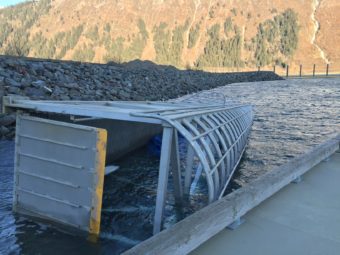
The harbormaster's office is looking for a crane to lift a gangway out of Douglas Harbor. High winds reaching over 70 mph pushed the gangway into the water over the weekend. (Photo by Lisa Phu/KTOO)
The harbormaster’s office is looking for a crane to lift a gangway out of Douglas Harbor. High winds reaching up to 77 mph pushed the gangway into the water over the weekend. (Photo by Lisa Phu/KTOO)

High winds rolled an 80-foot gangway over a rock embankment into Douglas Harbor Sunday afternoon.

The aluminum gangway weighs about 15,000 pounds and had been sitting unsecured in the harbor’s parking lot for the last three years.

Harbormaster Dave Borg says the gangway had survived many windstorms and he will now consider securing it. His office is looking for a company with a crane to lift the gangway out of the water and back to its original position.

The Juneau Office of the National Weather Service says high wind events like the one over the weekend usually happen in the spring. Weather forecaster Geri Swanson says high pressure moving up from Canada shifted cold air sitting on Juneau’s mountaintops.

“Basically it takes that wind and it pushes that cold air off the mountain and we get the higher winds,” Swanson says.

Swanson adds that Taku wind events occur a few times a year and range anywhere from 40 to 70 mph. She says high winds mixed with heavy rain have previously resulted in avalanches.

“This one we didn’t have the wet, wet ground so we didn’t have as much of an avalanche threat,” Swanson says, “but avalanche(s) can be a factor if the conditions are right.”

The harbormaster reports seven vehicles parked near Douglas Harbor had broken windows due to rocks and branches picked up by the winds. Borg encourages owners of vessels at Douglas Harbor to check for damages.

The Juneau Forecast Office projects another instance of high winds for this Thursday and Friday.

Headcount of city’s homeless conducted at charity event

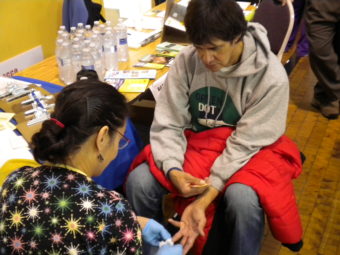
Locals experiencing housing or financial troubles could enjoy a free hot meal on Wednesday at the annual Project Homeless Connect event. Services from 28 local agencies trying to combat homelessness were also available. (Photo by Kevin Reagan/KTOO)

At Juneau’s Project Homeless Connect workers and volunteers tried to get more than 200 people on track to permanent housing on Wednesday. The annual, one-day event held at the Juneau Arts and Culture Center surveys the number of local homeless people to contribute to a national tally.

One of those counted as currently homeless is Guy Walther. He has a job interview later in the afternoon, but can’t make it there on his own because he doesn’t have a driver’s license.

It’s a reoccurring predicament among Juneau’s homeless population, finding decent transportation. Today though, Walther’s waiting for a caravan to shuttle him to the Department of Motor Vehicles to get his license back. It’s one of the many complimentary services offered at Project Homeless Connect.

“It’s very convenient downtown, and all the services are right here,” Walther says. “So if you don’t need one thing, you need another. There’s something here for everybody that needs help.”

Other free services at Project Homeless Connect include blood tests, footbaths, oral cancer screenings and haircuts.

Charles Wheaton gets his blood sugar checked by a nurse from Bartlett Regional Hospital at Project Homeless Connect. (Photo by Kevin Reagan/KTOO)

This is Walther’s second time attending the event. He’s spent the last couple years in and out of shelters around Juneau and now lives on a friend’s boat. His goal is to find full-time work so he won’t have to apply for subsidized housing. That process previously had him on a waiting list for almost two years.

“This event is a piece in a large puzzle of the services and providers around town,” says Mandy Cole, a member of the Juneau Coalition on Housing and Homelessness.

Cole has been working at Project Homeless Connect since it started in the capital city five years ago. She makes sure visitors meet with a volunteer upon arrival to complete a questionnaire on their living situation.

They’re asked how long they’ve been homeless and the primary reason for their homelessness. The data collected is sent to the U.S. Department of Housing and Urban Development, which requires communities receiving federal grant funding to complete this survey once a year.

In 2014, the department reported the nation’s total homeless population at over 578,000, with less than one percent of that number living in Alaska.

Cole says the number of attendees at Juneau’s Project Homeless Connect remains consistent at around 200. She says the homelessness could decrease with lower housing costs.

“My hope is that increased units in Juneau will drive down the price, such that people don’t necessarily have to have a voucher or have to have subsidized housing,” Cole says. “We can kind of use our ingenuity and connection between people to share spaces and to make the most out of what we have.”

Data collected from previous years reveals that the most common reason for homelessness in Juneau is job loss — a situation Guy Walther may be one step closer to rectifying.

“You know if it works out, it works out. You have to wait, things just don’t come instantaneously,” Walther says.

Results from this year’s survey will be made public in March.

Puppets showcase ‘low-tech, high magic’

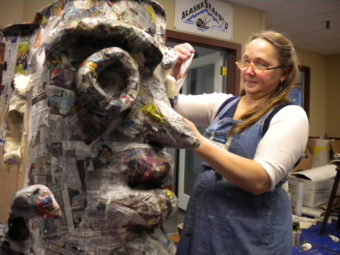
SueAnn Randall puts together a puppet at the Merchant's Wharf on Saturday, Jan. 24. (Photo Courtesy of Kevin Reagan)
SueAnn Randall puts together a puppet at the Merchant’s Wharf on Saturday, Jan. 24. (Kevin Reagan/KTOO)

Three visiting artists are helping Juneau residents spin cardboard into gold as they build a variety of life-size puppets.

It’s part of a project to create over 100 small and life-size puppets. Performers will wear them during the Governor’s Awards for the Arts and Humanities on Thursday, and they’ll serve as the pre-show entertainment for the Wearable Art Extravaganza on Feb. 14.

It’s a Saturday afternoon and a studio in the Merchants Wharf of downtown Juneau is filled with cardboard, fabric and old newspapers. The sewing machines and power tools hum as artists stitch, paste and staple materials together.

Patty Mitchell is in the middle of sewing neon feathers onto a giant black tutu.

The tutu will serve as the neck for a giant bird puppet being constructed as part of a month-long project. Most of the materials used for the project are donated by Juneau residents. Seatbelts, crutches and old dresses have already been dropped off at the wharf for the artists.

“You never know what people are going to bring, and so I’m kind of in a candy shop right now with everything I’ve ever wanted,” Mitchell says.

Mitchell, of Ohio, has been making puppets professionally for the last four years and estimates she’s crafted at least 200. She is one of three visiting artists helping local artist M.K. MacNaughton to complete the giant puppet project.

“I love that (in) art there aren’t any wrongs or rights in how you do things. Sometimes mistakes lead to the coolest outcomes.” – MacNaughton

MacNaughton raised over $8,000 for the community project. She and the three visiting artists will spend their days through Feb. 12 leading puppet workshops for Juneau schoolchildren. At night, they work in the puppet studio alongside local volunteers.

On the other side of the puppet studio, visiting artist Daniel Polnau is building a structure that will hold a giant puppet on a performer’s back.

“One of our mottos is low-tech, high magic,” Polnau says.

Polnau frequently walks along the beaches of Juneau, picking up long sticks he may or may not incorporate into his puppets. He says puppetry forces an artist to combine a number of talents.

“A project like this is almost like putting together a Thanksgiving dinner. You’re kind of scurrying around and creating 12 dishes at once,” Polnau says.

Dishes that include puppet sea goddesses, flying wolves and giant monsters. Even Juneau City Manager Kim Kiefer has influenced the artists’ imaginations, as a puppet resembling her is under construction for Wearable Art.

As visitors to Juneau, Polnau and Mitchell say they’ve been impressed by the range of artistic talent that strolls into the puppet studio. Passersby often walk in with little artistic experience and end up recycling trash into art.

“We humans are designed to be together and make things together and we just create a little bit of structure, foundation, opportunity for people to come in and investigate,” Mitchell says.

MacNaughton and the visiting artists will continue offering community workshops in the Merchants Wharf from 4 to 8 p.m. every weekday, and 10 a.m. to 5 p.m. every weekend until Feb. 12. They encourage anyone in Juneau to come in and try to think outside the box.

UAS professors examine Charlie Hebdo shootings

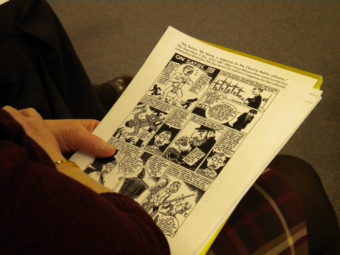
A comic strip by Joe Sacco was discussed by UAS professors during a public seminar named "I am (not) Charlie."
A comic strip by Joe Sacco was discussed by UAS professors during a public seminar named “I am (not) Charlie.” (Kevin Reagan/KTOO)

A professor of French pop culture history at the University of Alaska Southeast is questioning how Americans should show solidarity with France in the aftermath of the Charlie Hebdo shootings.

Professor Robin Walz held a seminar Friday called “I am (not) Charlie.”

When Walz first noticed #JeSuisCharlie –or I am Charlie—trending on American social media after the shootings at the French satirical magazine earlier this month, he found it somewhat misplaced.

“We can sympathize and empathize or object to the events that we see going on in France and the French responses. But whatever our responses, it’s our position from here in this continent and not from within the country in which things are going on,” Walz says.

Walz does not object to Americans showing sympathy for France, but finds it troubling when Americans try interpreting the tragedy through an American viewpoint. He says people should resist the urge to project American ideology onto France’s problems.

“Maybe there is a way they’re going to be dealing with things we can even learn from instead of always thinking that our American values are best and everybody should just follow us,” Walz says.

Walz organized the “I am (not) Charlie” seminar with three of his colleagues: Nina Chordas, Sol Neely and Lora Vess. He put the “not” in parentheses to highlight the outside perspective, where America’s First Amendment and freedom of the press may not apply.

The seminar drew in a classroom full of students and faculty. They were given a handout of cartoons penned by Joe Sacco, an illustrator for The Guardian newspaper. The cartoons are a collection of offensive racial stereotypes. Sacco ends his strip pondering the idea that the problem stems not from Muslim extremists but from France’s complex cultural identity.

“I wanted people to take away understanding that there are a lot of issues going on here,” Walz says, “and that there isn’t just sort of a position you stake out, line up behind it and then that’s the answer.”

Walz raised issues such as poverty, secularism and unemployment in France during the seminar; the point being there isn’t just one cause for the Charlie Hebdo incident.

Mel Scriven is a UAS student who spent last semester studying abroad in France. She observed some of those issues firsthand.

“The magazine seems so offensive, it seems like such a strange thing,” Scriven says. “Obviously public speech is a beneficial thing; it’s such a complicated subject area … but I wanted to learn more.”

Walz focused the seminar on the consequences that can result from the media crossing a line of sensitivity, a topic Scriven found led to even bigger questions.

“What would happen if we could not cross that line is maybe a more important question,” Scriven says.

The seminar ended with the consensus that the world has only scratched the surface on discussing this complicated subject.


State lawmakers to be welcomed with local goodies

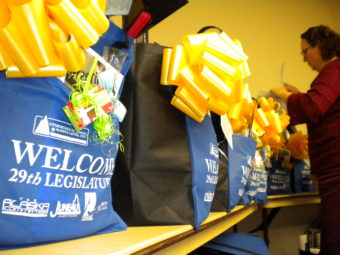
Juneau's Deputy City Clerk Beth McEwen stuffs gift baskets that will be given out to state lawmakers at the 30th annual Legislative Welcome Reception at Centennial Hall. (Photo by Kevin Reagan/KTOO)
Juneau’s Deputy City Clerk Beth McEwen stuffs gift baskets that will be given out to state lawmakers at the 30th annual Legislative Welcome Reception at Centennial Hall. (Photo by Kevin Reagan/KTOO)

Juneau residents can meet the 60 members of the 29th Alaska Legislature Thursday at the annual Legislative Welcome Reception at Centennial Hall.

Beth McEwen, deputy clerk for the City and Borough of Juneau and an organizer of the free event, says the welcome reception has grown over its 30 years. Even though this year the state faces an estimated $3.5 billion deficit, McEwen says there’s still a lot to be excited about.

“We have a lot of construction that’s been going on and will be going on in the near future, so this is just a little way of kind highlighting the fact that we are building for a brighter future,” McEwen says.

This year’s reception focuses on various state-funded construction projects in Juneau, such as the new State Library, Archives and Museum building and Sealaska Heritage Institute’s Walter Soboleff Center.

To illustrate the construction theme, yellow Tonka Trucks will serve as table centerpieces at the reception, courtesy of some younger residents.

“Even the kids of Juneau have donated their toys for the cause — loaned them, not donated them — they’re getting them back,” McEwen says. “But we’ve had some great outpouring of community support in just pooling everything together to make it happen.”

More than 60 local businesses donated items such as shot glasses, snow scrapers, bags of ground coffee and sockeye salmon. The items will be stuffed into gift baskets, one for each lawmaker. The gifts are meant symbolize the state’s cultural diversity.

McEwen estimates about 1,500 Juneau residents will be attending the reception. The event offers a rare chance for lawmakers to casually meet and greet with each other and local residents outside the Capitol building. The reception begins at 5:00 p.m. in Centennial Hall and will end just before Gov. Bill Walker is scheduled to deliver his State of the Budget address at 7:00 p.m.

Site notifications
Update notification options
Subscribe to notifications