KHNS - Haines

KHNS is our partner station in Haines. KTOO collaborates with partners across the state to cover important news and to share stories with our audiences.
After buying the Haines paper, a longtime Alaska journalist looks to boost local news statewide

Chilkat Valley News owner Rashah McChesney sits in her office in Haines, along with her malamute, Klondike. (Photo by Avery Ellfeldt/KHNS)

Late one night in January, a reporter sat working on the floor of an orange building in Haines. The building is home to the small town’s police department, fire station and morgue – plus the borough assembly chambers, which are often packed with concerned citizens.

The journalist, Rashah McChesney, isn’t just a reporter. She also owns the local newspaper, the Chilkat Valley News. The weekly paper has a circulation of 1,200 during the summer and 1,000 in winter. About 2,500 people live in the Haines Borough.

McChesney was covering the local assembly meeting – and was one of the last people there. That meant she was standing by when a heated exchange broke out between two borough officials in the parking lot.

The next morning – McChesney’s deadline day – her malamute Klondike strutted around her office while she talked shop with a local reporter. The reporter asked how McChesney planned to describe the incident.

“Oh, I’m just going to say, ‘Shouted a string of obscenities at him in the parking lot,’” McChesney said. “Because print is boring.”

Be that as it may, print is what brought McChesney to Haines last April. She bought the paper after a decade in public radio, including several years at KTOO in Juneau.

McChesney made the move even as news organizations across Alaska and the U.S. increasingly struggle to stay afloat amid soaring costs, declining readership and the explosive rise of social media.

Just 15% of Americans say they’ve paid for local news in the last year, according to a recent survey by Pew Research Center. And of those who do get their news from daily newspapers, the vast majority access the content online.

The result: more than 3,200 print newspapers closed over the last two decades, according to a 2024 report by Northwestern University’s Local News Initiative.

One-hundred-and-thirty print newspapers shut down between October of 2023 and October of 2024 alone.

In Alaska, papers including the Anchorage Daily News, Juneau Empire, Peninsula Clarion and Homer News have scaled back printing, citing readers’ growing preference for reading the news online.

Which is why McChesney isn’t just focused on Haines. She also recently co-founded a nonprofit called The Alaska News Coalition — a group of publishers and journalists around the state working to help independent, local news organizations stay in business.

“By and large, there’s a lot of publishers who are experts at making papers, and who have struggled to modernize their organizations digitally,” McChesney said. “I feel like I am building a collaboration with a group of people who really want what they were doing successfully in print, to be successful in digital, and maybe don’t necessarily understand or have the capacity to do that.”

The effort got a big boost in October, when it received a $100,000 grant from Press Forward, a national news initiative funded by philanthropy organizations. The Alaska-based coalition pools resources and ideas and provides grants to newspapers to help them digitize their work and distribute news.

All of this might make McChesney, a 41-year-old millennial, seem like a bit of an anomaly. But she says she decided to go all-in on local news in Alaska for a simple reason.

“Communities want local news. That’s why we have public radio stations that work as well as they do,” she said. “I think there’s this sort of myth that a small-town paper is just sort of like a losing proposition. And I just — I don’t buy that.”

“Haines’s paper is doing fine. It’s not making a ton of money, I’m not making a ton of money. But this [community] has consistently financially supported its paper since it opened in 1966,” she added.

McChesney said it’s been exciting to work alongside publishers of other Alaskan papers, including the Wrangell Sentinel and the Ketchikan Daily News, to reduce the likelihood that any more communities will lose their newspapers.

It’s also difficult, given that McChesney runs a business and reports the news at the same time.

That work is made even more interesting by the place where it happens. Haines is known for being politically divided and highly engaged. McChesney thinks that can make reporting challenging. But she also thinks it’s indicative of something bigger.

“People don’t fight about stuff they don’t care about. The opposite of love is not hate. The opposite of love is indifference,” she said. “You can’t accuse this town of being indifferent.”

Owning a newspaper in small-town Alaska also means something else. At least in Haines, she can’t ever just be “Rashah.”

“I don’t get a lot of [taking]-my-newspaper-hat-off time. If I want to do that, I’d go out into the Porcupine District and run around with my dog,” she said. “But I think that’s sort of the pressure of being a small-town journalist in general.”

Haines Assembly sticks with dock plan despite litigation with contractor

Haines Interim Borough Manager Alekka Fullerton addresses the borough assembly on Jan. 14. (Melinda Munson/KHNS)

After robust public comment, the Haines Borough Assembly voted to reconfirm the preferred design for the rebuild of its freight dock on Tuesday.

Assembly members who voted yes said the measure was necessary to meet grant deadlines and show that Haines was serious about the project.

Both the Planning Commission and the previous assembly voted in support of contractor Turnagain Marine Construction’s plan for the aging Lutak Dock in 2023. But community concerns about cost and environmental impacts, and legal problems with the contractor, have stalled the project.

The dock receives food and fuel for the remote town of Haines. The borough was awarded a $20 million grant in 2021 to update the infrastructure. The grant is overseen by the U.S. Department of Transportation – Maritime Administration, or MARAD.

Turnagain, the contractor, purchased approximately $10 million of steel piping for the project, but MARAD deemed those supplies ineligible for grant reimbursement. Turnagain billed the municipality for the steel and Haines declined to pay – then Turnagin sued the borough. The lawsuit triggered mediation between the two parties. They’re still working out who is responsible for the $10 million.

Alekka Fullerton is Haines’ interim borough manager. She says the guaranteed maximum price of $25 million for dock construction is still in place. It’s one of the issues contested by the contractor.

Fullerton told the assembly that the process has been confusing for many.

“I think I heard in a previous assembly meeting that there were questions coming from Southeast Conference, or maybe some other entities in Juneau, really unclear about what the Haines Borough is doing … I have even heard some of those questions from our congressional delegations and some of the people who have, in fact, made sure we have money available for this.”

While the assembly reconfirmed the design with a four to two vote, a majority of the Jan. 14 public comment was against the design.

Haines resident Katie Palmer testified about possible financial ramifications.

“Do not recommit the borough to a project we cannot afford,” she said. “Do not commit the citizens of Haines to pay for a project whose costs will exceed the grant monies. As Assembly member Gabe Thomas stated months ago, a bond is off the table.”

Kimberly Rosado was concerned about the cost of not fixing the dock.

“I want everybody to think what would happen if that dock failed right now, and the prices we would have to pay to ship it around,” she said. “We already pay so much for our groceries. To double or triple that, I don’t know who could afford to live here with that cost. So please get this back on track and fix our dock.”

While some residents testified that they hoped for a smaller design, one dock user said the space is necessary.

Haynes Tormey is a contractor who is intimately familiar with Lutak Dock.

“The existing footprint as it is right now at peak usage is barely enough,” he said. “There’s actually times when I’ve been forced to take freight that I’m not ready for so passing through freight can have a spot on the dock. So essentially, what needs to happen is the temporary guardrails that are in place need to be removed. So that way, the dock’s acreage could be expanded to its original footprint.”

Assembly member Kevin Forster wanted to delay the vote until mediation with Turnagain was complete. He and Assembly member Craig Loomis voted against the resolution.

Assembly member Cheryl Stickler said the borough should move forward with the project.

“We can’t afford the money. We can’t afford the time. And every day that we are stalled on this project, we are one day closer to dock failure,” Stickler said. “I just encourage us all to consider those things and to take steps to open up the conversations with Turnagain. This is our budget. This is our design. What can you do with this design within budget?”

The borough provided its environmental assessment of the dock plan to MARAD at the end of last year. That document is still confidential.

Skagway School credits community, teachers and a unique testing culture for its high test scores

Skagway School Superintendent Josh Coughran talks with students at lunch time. (Melinda Munson/KHNS)

Skagway School District has just one school, a one-story building that serves the families of the small Southeast Alaska community about 20 miles from the Canadian border. All of the district’s students, from preschool through twelfth grade, come to school in the same one-story building. For the 13th year in a row, those students had the state’s highest scores in all assessed areas, according to administrators.

Mary Thole teaches fifth grade. She’s been at Skagway School for 25 years. She starts testing days in a specific way.

“I like to make my students muffins – several of us do,” Thole said. “So they come in with a muffin on their desk in the morning. Just so they feel loved and that this is a week to celebrate their learning. And then we’ll go over their results once we get them.”

The desks are sectioned off with privacy folders to help students concentrate. Thole places a piece of gum at each spot to mitigate the wiggles.

There are two kinds of standardized testing at Skagway School. In the spring, grades three through nine take the AK STAR assessment, which is required by the state. And twice a year, in fall and winter, kindergartners through ninth graders take the MAP Growth testing, which is not state-mandated. It shows where a child is in their academic journey and measures progress throughout the year.

Thole said the MAP test is a powerful tool for identifying strengths and gaps.

“This really helps us personalize and individualize their education and treat them like individuals,” she said. “The test isn’t being done to them, it’s with them, and helps them sit in the driver’s seat for their learning.”

Testing happens for about an hour and a half per day during testing week. In the afternoons, the kids might play kick ball, hike or visit the local fry bread shop. The school gives students raffle tickets for things like a used laptop or a brand new bike. Some kids say it’s their favorite time of year.

In 2023, about 32% of Alaska students tested proficient or above in English Language Arts and math on the AK STAR. In Skagway, it was nearly 63% in English and 55% in math.

Thole credits the community for why Skagway students perform better than their peers.

“Our students feel supported in all aspects,” she said. “The Skagway Elks – they do fundraisers every Friday, all winter long. Their burger feeds are for the students and the student groups. And when our students have activities, our stands are full of all sorts of people that aren’t just parents.”

Jessica Ward is Skagway School’s math teacher. She’s been teaching for 17 years, seven of them in Skagway. There’s just one math teacher, so she teaches middle and high school. She’s also the district testing coordinator.

While the AK STAR assessment can tell Skagway how it’s doing compared to other districts, it can’t give a nationwide comparison. But Ward said MAP testing is administered nationally and can give a glimpse of how Skagway students compare to peers in other states.

“Generally speaking, our students are scoring at least a couple of grade levels higher, especially on the high school side or the middle and high school side, than the national average for those same tests,” Ward said.

That’s good news in a state that the U.S. News & World Report ranked as 46 out of 50 states for quality of education in 2024.

Wards knows how important testing is, but as a math teacher, she wishes she didn’t lose quite so many days to testing. She pointed out that Alaska schedules school for 170 days per year, while most states attend 180 days.

“So if we do testing three times a year, that’s nine more hours on average. That’s nine more instructional periods,” Ward said. “So now I’m 19 hours less instructional time, and still with the same expectation. And that’s an expectation I put on myself because my goal is to get them ready for college.”

Josh Coughran has been superintendent and principal of Skagway School since 2013. He is incredibly proud of the school’s test scores, but said it’s not necessarily the school’s “Super Bowl.”

“They’re important certainly, and I think they’re a great reflection,” Coughran said. “And I think that the school district has a responsibility to the community to keep these test results going. But it’s not necessarily the end-all and the be-all for us. It’s just a good indication of what we do and where we can go.”

Coughran gives credit to Skagway’s teachers, who created curriculums based on state standards.

He said the school also has low teacher turnover, with many teachers having served the school for a decade. The class sizes are also small – the school averages around nine students per classroom. The district provides free preschool. And every budget cycle, the local borough assembly votes to provide the maximum allowable contribution to the district.

“It’s been a fun experience to have all of those levers to pull and all of those tools at my disposal,” Coughran said. “Because I know for a fact that those things don’t exist in other places.”

STAR testing will take place in Skagway April 21 to 25.

The Skagway News looks for new owner

The former office of The Skagway News. (KHNS file)

The Skagway News is once again looking for a new owner. Gretchen Wehmhoff bought the paper in 2020 and is now looking to sell.

“So back in 2019 the owner at the time, Larry Persily, decided to offer it to someone who was from Alaska, who he thought would care about the community,” Wehmhoff said. “And my friend at the time, Melinda (Munson), and I decided to apply.”

So the two journalists bought the paper in the spring of 2020. The price?

“Twenty dollars,” Wehmhoff said. “He was going to give it to us for free, but we thought we should give him something. You know, you have to give something. So we gave them $20 and that first check bounced.”

Persily, the former owner of The Skagway News, advertised the paper to multiple potential buyers around the country, but was looking for someone he could trust.

“I got talked into it, got new staff, got some equipment, tried to get it closer to break even and then decided I want to give it away,” Persily said. “I don’t want to run it. I just want to see it continue. And no one could afford to buy it. So the idea was, find someone who will run it, own it, love it, live in Skagway — and I’m essentially giving it away. Got about 140 inquiries from around the world, and picked a couple people from Alaska and turned it over to them.”

Persily has been involved in Alaska journalism for decades. He also owns the weekly newspaper in Wrangell, the Wrangell Sentinel. He says running a weekly newspaper is, “A lot of work, and no money.”

“They are economically challenging,” he added. “How’s that for a euphemism. They take seven days a week, a lot of stress, a lot of sweat, a lot of anguish, and they’re not profitable. Some pay their own way. Some don’t even do that. It’s tough.”

After five years of running the paper, Wehmhoff has made the difficult decision to sell.

“You know, if I had reporters that were freelance or free, I probably could keep going,”
Wehmhoff said. “But unless I can get some freelance writing that doesn’t cost any money, it’s kind of tough. I mean, I can make a choice. I can write or I can layout the paper. Or I could do the business end of the paper. But doing all three, and then not bringing in any income for myself has been hard on me financially, as well as health wise.”

But Wehmhoff remains optimistic, saying that she hopes the new owner has a lot of energy and is willing to listen.

“I think the biggest struggle will be to remember to go to Skagway and listen to Skagway,” she said. “To really, you know, pay attention to what Skagway needs and what Skagway wants. I hope that the idea of still being very inclusive of residents of Skagway is part of it. I think it’s really important that we still look at it that way, that it doesn’t just become an advertiser, but it maintains its beauty of being a small town paper.”

And Persily has the same hopes for his old business.

“I hope she can find someone who will live in Skagway, put out a good paper, find a way to pay the bills and really live happily ever after. That was my intent four years ago. Didn’t work out.”

With multiple setbacks of trying to run a weekly paper remotely through a pandemic, Wehmhoff says she has no regrets of owning The Skagway News.

“I don’t regret for a second my decision to get involved with Skagway News,” she said. “Every single time there, it has been one of the most adventurous and exciting and challenging five years. Whether I was sick and I couldn’t do something, or whether it was emotionally draining, I do not regret for a second my decision to become an owner of The Skagway News. It’s been a real pleasure and joy. And I’d do it again.”

Wehmhoff said she will publish a formal press release in the near future.

Former Haines mayor says he did not authorize contested $10M steel purchase

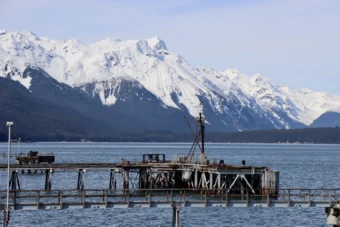
A view under Haines’ Lutak Dock shows where beams, corroded by saltwater, once fit into the concrete above. (KHNS file photo from 2018)

Someone made a $10 million mistake buying steel for a critical dock project in Haines. The dispute about who’s responsible for the bill – Haines taxpayers or the construction contractor – is now almost a year old, and continues to delay the project.

For nearly a year, the municipality has been in a $10 million disagreement with Turnagain Marine Construction, the company contracted to upgrade Lutak Dock for $25 million. The money for the project comes from a grant from the U.S. Department of Transportation – Maritime Administration, or MARAD. To meet grant requirements, purchases must follow federal guidelines and need prior MARAD approval.

In spring of 2023, Turnagain purchased approximately $10 million of steel piping for the project. MARAD deemed that steel ineligible for grant reimbursement.

Last December, Haines Mayor Tom Morphet said the assembly was surprised to learn that Turnagain had already bought the steel. Haines maintains that Turnagain wasn’t authorized yet. Turnagain says the pipe purchase was included in a schedule that the borough approved “upon execution of Phase Two Amendment on March 1, 2023.”

The dispute is headed toward mediation between borough staff and Turnagain. But it came up on Oct. 31 at a Port and Harbor Advisory Committee meeting.

In part, the purpose of the meeting was to allow assembly members to ask questions about the dock design. Assembly member Craig Loomis had questions about who authorized the steel purchase.

Port and Harbor committee member Don Turner, Jr. said that in February 2023, then-Mayor Douglas Olerud suggested Turnagain had permission after the city signed the contract to start that second phase.

“And Mayor Olerud told them at the time when they signed, that we’re signing that contract so you can buy the steel before the price goes up,” Turner said.

“I did not direct Turnagain to buy the steel for Lutak Dock, in either written or verbal form,” Olerud responded in an interview with KHNS.

Olerud said as mayor, he didn’t have unilateral authority to grant such permission. He explained the context of the statement the port member zeroed in on.

“I think the comment that Mr. Turner was referring to was one meeting in February ‘23, at an assembly meeting, where we’re discussing a resolution to authorize moving into phase two of the contract for the dock,” Olerud said. “And by moving into phase two, that would allow Turnagain to purchase this steel, once they had the pre-authorization from MARAD. And so that was still needing MARAD pre-authorization before they could proceed.”

Olerud was not at the Port and Harbor meeting and says anyone with concerns should speak with him directly.

Port and Harbor committee member Shawn Bell redirected the Lutak Dock conversation.

“I don’t know that this particular conversation is helping anything at the moment,” he said. “…I don’t see a benefit in arguing with what’s already occurred.”

Port and Harbor Advisory Committee Chair Jake Eckhardt said the steel issue isn’t his committee’s responsibility to resolve. The committee continues to back its design of an encapsulated dock.

“I’m not sure how much I want to spend trying to unweave some kind of tangled web that happened after that fact,” Eckhardt said. “That’s me personally … Let the weavers of that tangled web figure it out.”

Morphet said mediation is the next step. So far, there are no dates scheduled.

The Lutak Dock was built by the U.S. Army in 1953. Today, it’s Haines’ main off-loading point for fuel and freight. A grant to rebuild the dock was approved in 2021. Lutak Dock has become a political hot point as some citizens are concerned it could eventually be used to ship ore.

First all-female crew operates White Pass train

Lindsay Breen, White Pass & Yukon Route Railway’s first female engineer, gives a tour of her train cab on Oct 15, 2024. (Munson/KHNS)

The White Pass & Yukon Route Railway has operated out of Skagway for over 124 years. It regularly travels between Skagway and the Yukon, a scenic trip that is one of Skagway’s top attractions.

But one day in mid-October was special. That day an all-female crew drove a train full of tourists up the mountain, creating history.

On Oct. 15, approximately 600 chilly sightseers climbed aboard the White Pass train for a brief international ride through the Yukon.

Both the brakeman and the conductor who helped them aboard were female. Also on duty was Lindsay Breen, White Pass’ first woman engineer.

“I was the second female brakeman, second female conductor,” Breen said before departing from Skagway’s Ore Dock. “I was the only one who stayed long enough to get trained as an engineer.”

Breen has worked for White Pass for 12 years. She fell into her profession almost accidentally.

“I am one of those people that came up for one summer, way back in 2001,” she said.  “And here I am, 23 years later, married, kid, all the things. I just fell in love with Skagway and this community. Never thought that this is where I would end up. It wasn’t like a dream of mine – I didn’t play with train cars as a little kid or anything like that.”

Breen started as a train agent, then a dock representative, then she transferred to coach cleaning. Eventually she worked her way up to brakeman, conductor, then engineer.

A White Pass train is run by three crew members. The engineer operates the train. The conductor is in charge of the entire train, helps load and unload passengers and decides when to leave. A brakeman is the assistant to the conductor.

Breen described trains as “big, loud and obnoxious.” She said that blowing the piercing train whistle isn’t just for fun.

“I really sometimes don’t enjoy doing it, especially when you’re yard crew at 5 a.m. and bringing trains down and everyone’s still in bed,” she said. “But they’re actually part of our rules book. And so it is a federal requirement of what your whistle means. So, when we’re going across crossings, that’s when you hear what we call long and short. So, long, long, short. Long is coming through a crossing. Two shorts is you’re going ahead. Three is backing up.”

Breen’s days can sometimes be very long – 12-hour shifts with three trips up the mountain. But she said she loves it.

“I didn’t realize how much I would actually like the engineering job,” Breen said. “It’s a really cool job to have. And I just strive to make it as good as I can every day. Every run.”

Breen is incredibly proud of the two women on her team, and all the women she works with.

“It felt, can I say bad ass? That’s kind of how it felt,” she said. “It was really neat that it was finally happening. It took long enough.”

Eliza Myers was the conductor. In her early 20s, she already knows that she wants to be an engineer after an experience that happened in 2022.

“One of the trainmen, who’s actually a friend now, had me come up into the cab of the locomotive,” she said. “I sat in the seat, and I was like, ‘whoa. This is really cool.’ And they took a photo of me. And I was looking back at that photo the other day, because one day I will become an engineer. And I think that just really sparked my interest. That just being in it, and seeing the whole operation. Because I didn’t really think about it beforehand. I wasn’t like a little kid watching Thomas the Engine.”

Myers started out at White Pass at the ticket office and as a dock representative. She became a brakeman in 2023. There is no non-gendered term for the position. Myers said that’s okay with her.

As conductor, she is responsible for the safety and timeliness of the train, which sometimes means politely redirecting intoxicated train ticket holders back to their ship.

Myers said she loves the formal aspect and exactness of train etiquette. For example, the suit uniform and the protocol of radio communication.

“When you are talking to someone and they tell you something, you can say ‘roger,’” she said. “You don’t really say ‘copy that,’ because copy that technically means that you have specifically written it down and copied what they said.”

Myers said that she sometimes gets sexist comments from visitors, but has received only support from her employers.

“So, I’ve never felt from my co-workers or from management specifically that like, ‘Oh, I’m a girl, like, I can’t do this job.’ Or you can’t be hired because you’re a woman. I never felt that way with this company, which I really appreciated. It feels very empowering to be accepted,” Myers said.

White Pass currently employs five female train crew out of a total of 29. Two of those are engineers.

Site notifications
Update notification options
Subscribe to notifications