KHNS - Haines

KHNS is our partner station in Haines. KTOO collaborates with partners across the state to cover important news and to share stories with our audiences.

Haines’ unusual letter to the Yukon meant as a reminder of friendship

George Bahm and Vanessa Aegirsdottir of Wild Yukon Furs in their Skagway shop. As store owners in both Skagway and Whitehorse, Yukon, they’re closely following possible Canadian tariffs and customer sentiment. (Melinda Munson/KHNS)

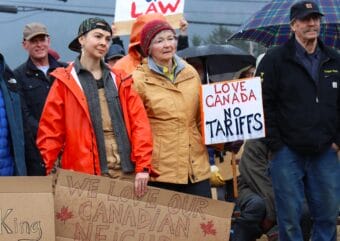
The Haines Assembly last week voted to send a friendly letter to its Canadian neighbors. That’s following U.S. President Donald Trump’s threats of tariffs and his musings that Canada could become the 51st state.

Haines Junction, Yukon is about 150 miles from Haines, Alaska. And Whitehorse is just 100 miles further. Although not in the same country, they’re Haines’ closest neighbors by road.

That’s one reason for sending them a conciliatory letter, according to Haines Mayor Tom Morphet.

“Reassuring them that we appreciate and reaffirm our long relationship of friendship, cooperation and mutual assistance,” Morphet said. “Everyone probably remembers when we had our slide event here in 2020. Whitehorse, I believe, sent us $15,000. The folks from Canada look after us, and we try to look after them.”

Another reason to reach out is economics.

Alaska’s Haines, dubbed the Adventure Capital of Alaska, relies on Canadian tourists as part of its independent traveler model.

Before approving the letter, assembly members shared stories of concern.

Assemblymember Kevin Forster said he spent the weekend with friends from Whitehorse for his wife’s birthday.

“And they said that even they themselves had received pressure to not come to Haines right now, and that amongst their friends, they have discussions about not buying American booze and not visiting” Forster said. “And so at least anecdotally, I think that this potentially is an issue.”

Assembly member Richard Clement, who is on the board of the Kluane Chilkat International Bike Relay, said he is seeing negative effects from new federal policies.

“Half our board is Canadians, and half Americans,” he said. “And we had a meeting last night, and there was some animosity. You know, as mentioned, Canadians may be reluctant to come here with all this talk that’s going on.”

Haines Tourism Director Reba Hylton told KHNS that she too is observing some pushback from northern neighbors.

“We have received one email at our Visit Hanes email address from a Canadian that lives in the Yukon, that specifically said they wouldn’t be visiting until the national situation kind of calms down a little bit,” she said. “That’s the consensus on the dozen or so comments that I have deleted off of our social media posts on Instagram and on Facebook.”

She said she’s occasionally seeing a similar sentiment on RV and cruise travel pages. While it’s not keeping her up at night, she says she’ll be paying attention.

Vanessa Aegirsdottir is also keeping a close watch. She’s a Canadian citizen who owns a business in Whitehorse, with a second location across the border in Skagway. She said when the news broke about a 25% tariff on Canadian goods, she nearly had a heart attack.

“I spent my entire day in front of my computer researching alternate suppliers … Meals were brought to me at the table. I barely even left to go to the bathroom,” she said. “I was, you know, researching manufacturers in India and China, desperately trying to find alternatives so that I could switch gears, like tomorrow, if I needed to.”

While Aegirsdottir is also seeing posts on Facebook encouraging Canadians to boycott American brands, she’s not sure the frustration will carry over into a significant decline of Yukon visits to Skagway and Haines.

“The general feeling is that we don’t hold individuals in Alaska responsible for all of the craziness,” she said. “And even predating this drama, I think a lot of us don’t actually characterize our friends and neighbors in Alaska as Americans. We actually see you guys in a more intimate, neighborly, familial kind of context. We see you as Alaskans.”

Trump’s tariffs are on a 30-day pause while the two countries negotiate around his concerns about border security and drug trafficking.

Alaska’s tourist season is just two months away.

State cancels Alaska’s annual tsunami warning test

A sign points out a tsunami evacuation route in Pelican, Alaska in July, 2023. (Clarise Larson/KTOO)

Alaska’s Emergency Operations Center has cancelled an annual test of the system responsible for alerting Alaskans about potential tsunamis.

Each month, the National Tsunami Warning Center tests the system that alerts the coast guard, Federal Emergency Management Agency and other entities to tsunami activity. But once a year, the test goes further – and the warning is broadcast on public radio and television stations and sent to residents’ cell phones.

That usually happens in late March, around the anniversary of the 1964 Great Alaska earthquake. But the test has been canceled for this year. According to an email the Emergency Operations Center sent earlier this week, the test would not happen “due to a few factors beyond our control.”

Jeremy Zidek, a spokesperson for the state emergency operations center, said the system has been activated two times since July of 2023, when it was triggered by real warnings.

“Based on that information and the data that was gathered, it just looked like the test wasn’t going to be necessary to gauge if the system worked or not,” he said.

The tsunami warning system was activated in December by an earthquake in California and again in July of 2023 after an earthquake near the Aleutian islands. Zidek said the tests are crucial to ensure the system is working as intended, but that it’s also important not to do them too frequently.

“We want to make sure that the system is fully working, and we believe it is,” Zidek said. “But we don’t want to overtest it and then people become a little bit desensitized to the warnings when they’re real.”

Both the tests and real warnings have malfunctioned before, highlighting issues with the system. That includes after the 2023 earthquake near the Aleutians. The system sent out emergency alerts to people in communities that were not actually at risk.

Also in 2023, the annual test did not reach a handful of communities it should have, including Ketchikan and Sitka. Dave Snider, the Tsunami Warning Coordinator with the National Tsunami Warning Center, said that was largely due to confusion over which test was happening. Another factor was a coding failure, which he said has since been ironed out.

The Tsunami Warning Center, the National Weather Service headquarters in Alaska and the state all agreed the warning wasn’t needed this year, Snider said. Still, he emphasized the importance of regularly testing the system to be sure it – and the communities who rely on it – are ready if a tsunami does happen.

“We haven’t had a big one, or, you know, one that’s locally impactful in a really long time. That doesn’t mean that they don’t exist,” Snider said. “So just reminding folks there in your community that you know they do need to have a plan.”

He added that natural warning signs in coastal communities can be just as crucial as alert systems. Think: hearing a deep rumble, feeling the earth shake or observing unusual ocean behavior.

“In places like Haines, those natural warning signs will save their lives,” Snider said.

Communities in Southeast Alaska are mapping their landslide risk. It’s complicated.

Members of the Haines Planning Commission examine new maps that illustrate landslide risk in the area. The maps are meant to inform future development and planning decisions. (Avery Ellfeldt/KHNS)

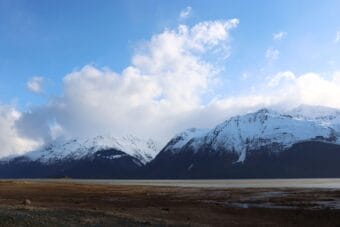
If you drive north on Lutak Road in Haines, you’ll see snow-covered peaks towering over the ocean below. If you look closer, you might notice something else: vertical gashes running down the mountain face. They mark places where landslides – or maybe avalanches – have struck, taking trees, soil and rocks down with them.

Patty Brown chairs the Haines Planning Commision. She pointed to one of the slide paths while out for a drive on a cold, clear day back in January.

“There’s probably been a history of different slides reshaping what that whole face even looks like,” Brown said. “All this is slide, slide, slide.”

new report aims to address that reality by mapping the local landscape and pinpointing areas that might be more prone to slides down the line. The goal: providing homeowners and the local government with a science-backed tool that can be used to gauge landslide susceptibility, and to plan accordingly.

The multi-year effort, which was paid for with federal funding, began after an atmospheric river dumped record levels of rain on Haines in 2020. The storm washed out roads and triggered landslides, including one that killed two beloved community members.

“It was associated with such a radical weather event,” Brown said. “Those are going to keep getting more dramatic and be beyond what we predicted. So we better have some kind of an inventory of what to expect.”

The 2020 event and resulting maps are part of a bigger story about intensifying natural disasters – and how communities across Alaska and the U.S. are responding. As climate change and development fuel more destructive disasters including floods, slides and wildfires, local governments are trying to get ahead of the problem without also threatening homes and livelihoods.

Mapping efforts  and pushback  across Southeast

The Haines report is composed of three different maps, which were published in January by the Alaska Department of Natural Resources. The maps were made using light detection and ranging technology, also known as lidar, which researchers attach to planes, drones or helicopters to fly over a study area. The lidar sends down light pulses that bounce off the trees, buildings and the ground. The time it takes for the pulses to return provides detailed data about the landscape and what’s on it.

“So you can think of it kind of like a flashlight that’s shining down. Where does that light hit? Where does it pass through?” said report co-author Jillian Nicolazzo, a geologist with the Landslide Hazards program at the Department of Natural Resources.

The data is then used to create the maps, which local governments, communities and homeowners can reference when making crucial decisions about where to build housing, roads, schools and more.

“If we’ve identified an area that might be susceptible to landsliding, and in 15 years someone wants to put a subdivision in that area, well, hopefully they’ll see that we’ve identified it as a higher hazard area, and they’ll take a closer look,” Nicolazzo said.

Haines is not the only community interested in mapping the risk. Similar projects have been completed or are underway in more than half a dozen other communities in Southeast, in part due to four fatal landslides in the last decade. Those disasters happened in SitkaKetchikan, Haines and Wrangell.

But the efforts aren’t without controversy. Efforts to map physical hazards have sparked opposition in Alaska, but also in other places, like New Orleans and Oregon. The pushback has typically come from homeowners who don’t want the state or local government to label their properties as high risk out of fear it will drive down their property values and make it more difficult to get insurance.

Ron Heintz is a senior researcher at the Sitka Sound Science Center, a nonprofit that’s played a key role in confronting landslide risk in Southeast. He said the issue routinely comes up during conversations about landslide risk in Alaska.

“Everybody wants to see a hazard map, and they want to see if they’re exposed to any sort of hazard. But they don’t want any sort of official acceptance or understanding of these hazard maps,” Heintz said.

Take Juneau. In 2020, the local assembly commissioned new hazard maps, which placed some neighborhoods in landslide zones for the first time. The move drew widespread concerns that the maps would drive down property values or impact insurance. Later, in 2023, the assembly decided against formally adopting the maps and eliminated landslide restrictions from the city’s land use code.

Todd Winkel is a Haines resident who owns property right next to the fatal 2020 slide. He said people in Sitka warned Haines residents to push back against potential risk mapping after the disaster.

That was partially due to worries over real estate. But Winkel said it was also because people felt the mapping would only be beneficial if the local government focused on helping landowners mitigate the risk. Winkel agrees. He said Haines should focus instead on reducing the threat in areas that are clearly landslide-prone.

“If you’re not going to do anything, don’t risk assess it,” Winkel said.

Risks can hide in plain sight

The Haines Planning Commission, for its part, hopes the maps will help the community better gauge and respond to the risk, both during future extreme weather events and when making long-term planning decisions.

That could include encouraging people to consult an engineer before developing somewhere that’s landslide prone, said Derek Poinsette, the planning commission’s vice chair.

Poinsette emphasized that the commission does not currently plan to use the maps for regulatory purposes, such as vetting building permits – and that the maps have a few important limitations.

Key among them is that they do not predict where slides will happen in the future. Instead, they identify areas that may be more susceptible to slides due to the slope angle, vegetation and more. Another caveat, he said, is that the maps rely heavily on lidar, which provides important information but is not the same as verifying the risk in the field.

“This isn’t the last word on any specific area,” Poinsette said. “Getting out there on the ground and actually taking soil samples and drilling cores and things like that is what ultimately needs to happen to do a final engineering type assessment for any location.”

Back in the car, Brown, the commission chair, said there is a long history of landslides in Haines, and that the community is highly attuned to that reality. Still, she said, the deadly landslide in 2020 made at least one thing clear: the risk can hide in plain sight.

“It was a forested slope, and we like to be confident – ‘Oh, it’s got plenty of vegetation holding the soil.’ But it’s steep. Once something’s really forested, I think you lose track of how steep it actually is under there,” Brown said.

“Part of what we have to pay to live in such a beautiful, dramatic landscape is sometimes, the drama looks like this,” she added.

The threat is only growing as temperatures rise – and weather grows more extreme – with climate change.

Authorities suspend search for skater who fell through ice in Haines

Chilkoot Lake (Alain d’Epremesnil/KHNS)

Authorities in Haines have suspended their search for a man who reportedly fell into Chilkoot Lake while ice skating on Thursday. In a dispatch, state troopers said local author Thomas McGuire, 79, had gone skating alone and failed to return, and that his vehicle was found in a parking lot near the lake. The dispatch said McGuire’s next of kin had been notified.

Late on Thursday afternoon, the Haines Volunteer Fire Department received a report that a skater had fallen through the ice at Chilkoot Lake. The call came from another skater, who used a Garmin inReach device to alert authorities. That person reported hearing – but not seeing – someone fall through the ice.

Jacques Turcotte, the Haines district park ranger, was the first person on the scene, at around 4:15 pm. He said he ran the search-and-rescue operation because Haines doesn’t currently have a local trooper, and the accident happened around a state park.

When the search-and-rescue team arrived, Turcotte said they found the person who called in the accident and ensured they got off the ice safely. Turcotte said the team made it more than a mile across the lake, but it became clear that it wouldn’t be safe to go any further to look for the missing skater.

“The ice was cracking, and water was bubbling up beneath my feet. So we turned back. At that point, with darkness coming in and unsafe ice conditions, we were unable to locate the victim,” Turcotte said.

Turcotte went up in a plane at first light Friday morning to scour the area. He saw pockets of open water near the far end of the lake, and he thinks that was where the skater fell in. But he said the search is no longer active, and authorities are focusing on recovering the victim.

“At this point, with no signs of life and no signs of a body and with ice conditions being what they are being, it’s too unstable and unsafe to send rescuers out onto the ice,” Turcotte said.

McGuire is a long-time Alaska resident. His most recent book, The Curve of Equal Time, tells the story of a woman who returns to Alaska from Seattle to work on a salmon fishing boat. He also published a book called Steller’s Orchid in 2019.

McGuire and his wife, Sally McGuire, built their home on the Chilkoot River, where they raised four children.

Haines residents have been skating at Chilkoot all week during a long spell of clear weather. But authorities are advising against that now due to unstable ice created by warmer temperatures, which Turcotte said can rapidly change conditions.

“Lake ice is inherently dangerous and unpredictable, and it can change quickly. You know, we’ve had cold temperatures,” he said. “We’ve also been getting warmer temperatures throughout the days, and it’s been sunny out too, and that affects everything as well.”

He advises people to skate with a partner, to wear life jackets when they skate, to continuously check ice thickness, and to bring rescue supplies. Among them: ropes, throw bags and ice picks that can be used to climb out of the water or help someone else do the same.

Alaska could see outsized impacts from Trump’s tariffs, if they all go into effect

The Fraser Border Crossing in Fraser B.C. (Mike Swasey/KHNS)

President Donald Trump sparked widespread concern in Alaska over the weekend when he announced steep tariffs on imports from the United States’ three largest trading partners.

By Monday morning, Trump had partially paused the policy. But that hasn’t stopped worries in Alaska. The tariffs could dramatically impact the state if they go forward. At stake is everything from grocery and lumber prices to the economies of border towns like Haines and Skagway.

“Things will become more expensive. That’s a fact,” said Gregory Wolf, the president of the Alaska International Business Center.

Wolf has worked on trade issues in Alaska for nearly four decades. He said tariff wars, no matter which countries they’re between, are nearly always a “lose-lose situation” – and that this time would likely be no different.

The tariffs came from an executive order on Saturday that placed 25% tariffs on Mexican and Canadian goods, with a lower tariff on energy resources from Canada. Trump also placed a 10% tariff on Chinese goods.

Trump said the tariffs were meant to push the three countries to curb the flow of undocumented immigrants and drugs including fentanyl into the U.S. But economists and lawmakers say the policy could have a sprawling set of unrelated impacts on Alaskans in particular.

Alaska’s unique vulnerability

Take the proposed tariffs on Canadian goods. Alaska is uniquely vulnerable to the policy, due in large part to the state’s reliance on Canada for timber, agricultural products and more. If the tariffs are implemented, the cost of Canadian goods could surge by as much as 25% for Americans, said Kevin Berry, chair of the economics department at the University of Alaska Anchorage.

“We are facing potentially higher costs from any good that’s produced and sold from Canada, as well as smaller markets for our own goods,” he said. “There’s also the potential for disruption when it comes to the Alcan, or transportation to the Lower 48.”

But Alaska also exports goods to Canada. If the tariffs take effect, and Canada were to respond in kind, that would make it more expensive for Alaskan companies to do business with its only neighbor, Berry said. Canada could also strike back by imposing fees for using Canadian highways, for instance, disrupting travel.

Canada is also a major investor in the state. The country has long been the largest investor in Alaskan mining operations, for example. That could change if the tariffs move forward, said Wolf.

Wolf said the same will be true of tariffs on China – and that Alaska has a lot to lose there, too. China has been the state’s top trading partner since 2011, with the exception of a period around 2018 when Trump imposed tariffs on China during his first term.

China already responded to Trump’s tariffs by imposing tariffs of its own on U.S. imports. The back-and-forth means Chinese consumers will pay more for products that U.S. companies want to sell them. Meanwhile, Americans, including Alaskans, will spend more on countless Chinese goods.

“It almost sounds, if you listen to the president, that China will write a check to us,” Wolf said. “That never happens. It’s never happened. It will never happen. The people who pay the tariff are the people in America who import the goods from China.”

Senate Majority Leader Cathy Giessel, R-Anchorage, shares the concern, though there’s not a lot state lawmakers can do about tariffs proposed by the president. Even so, she is drafting a resolution to formally oppose the policy. She says the tariffs would increase prices on a range of goods and necessities — bad news in a state where the cost of living is already exorbitant.

Giessel also emphasized that the tariffs also threaten something else: Alaska’s long-standing relationship with its only neighbor, including as it relates to military defense. She said Canada supports the U.S. Air Force, Navy and Coast Guard when Russian or Chinese aircraft threaten U.S. borders.

“These are significant partnerships that are being jeopardized by the proposal of these tariffs,” Giessel added.

Worries for border communities

Remote communities close to the border could also face impacts. That’s because their cost of living is already high, and they rely more heavily on goods coming from Canada.

“If we think about Haines or elsewhere, where a lot of the access to larger markets is in Canada, this can have an outsized impact on the cost of living,” said Berry, the economics professor from Anchorage.

There’s also Skagway, which sits close to Haines and just 15 miles from the Canadian border. Residents and businesses in the coastal tourist town frequently go to Whitehorse — two hours away — for groceries and other products.

Orion Hanson, a builder and member of the Skagway assembly, says he purchases supplies in Whitehorse for most of the homes he builds. He’s worried the tariffs, assuming they take effect, would make doing so more complicated and expensive.

He points out that Skagway and Alaska more broadly are both already grappling with housing shortages that tariffs would only make worse.

“As a builder, I have a lot of concerns about how much lumber prices would go up,” Hanson said. “I think steel prices would go up. I think concrete prices would go up. Let alone if fuel prices go up, that’s going to affect every facet of the economy.”

The tariffs may disrupt businesses like Hanson’s, depending on how much money they spend on Canadian goods. But the tariffs are less likely to impact residents who drive to Whitehorse for groceries or other supplies. That’s because they’re meant to target large scale importers and exporters, Wolf said.

The nitty-gritty details of the tariffs remain to be seen – as does whether they’ll even take force. But Hanson said the stakes are high.

“The cost of living is very expensive in Skagway. And I’m concerned that this would exacerbate that and make it worse and make it harder to live here year-round,” Hanson said.

The proposed tariffs on Canada and Mexico have been paused through February to allow for negotiations over steps the countries will take to crack down on border security and drug trafficking.

U.S. Senator Lisa Murkowski welcomed the pause in a statement on Tuesday.

“I’m glad to see that both Mexico and Canada are stepping up and working with President Trump to address border security and the fentanyl crisis. Our countries must work together to keep our people safe,” she said.

The tariffs on Chinese products took effect Tuesday. China responded by announcing its own tariffs on coal, crude oil and other U.S. imports.

New guide for kelp farmers chronicles more than 100 kinds of seaweed found in Alaska

Audubon intern Mali Tamone discovers ribbon kelp at the beach near the Rainforest Trail on July 15, 2022 in Juneau. (Photo by Paige Sparks/KTOO)

The waters of Southeast Alaska are an ideal environment to grow species ranging from Pacific oysters to ribbon kelp. But growing them successfully requires in-depth knowledge of dozens of species — where they grow, when they grow, and under what conditions.

A new tool aims to make that easier.

The National Oceanic and Atmospheric Administration released a new guide earlier this month that chronicles more than 100 species of seaweed commonly found in Alaska.

“To grow it for the kelp industry, you need to know where you can find those spores, what time of year,” said Jordan Hollarsmith, a mariculture-focused research biologist with NOAA. “Or if you want to harvest it, to eat it, you need to know what you’re looking for, where you can find that species.”

The guide aims to advance the state’s budding mariculture industry at a time when global demand for kelp products is on the rise. Alaska mariculture is still tiny compared to other coastal states, like California, Oregon and Washington. But it is steadily gaining ground. All told, the state boasts more than 1,300 acres permitted for mariculture, according to a NOAA report from last year.

And more mariculture farms are coming. On average, Alaska received more than a dozen applications for new sites each year between 2019 and 2023. That’s more than double the average for the five years prior.

“A decade ago, I don’t know if there was a single farm,” Hollarsmith said. “And now we see multiple around Kodiak, some pretty small-scale ones in Kachemak Bay and in Prince William Sound, and then a few smaller, medium-sized ones and a large one as well in Southeast Alaska.”

Hollarsmith didn’t author the updated guide. But she says it will be a crucial tool as the industry develops across the state. Right now, the highest concentration of mariculture is in Southeast, with forty permitted farms, according to the 2024 report.

NOAA is also exploring where other farms might thrive. At one point that included the waters around Haines. But the agency later dropped Haines from the list because the area is near several state marine parks, which cannot overlap with farm lease applications, Alicia Bishop, a regional coordinator for NOAA Fisheries, said in an email.

Siting new farms is one of the key obstacles to growth. That’s because new sites have to meet several key criteria, including the right environmental conditions and limited overlap with other marine activities.

“You can’t set your farm where there’s already a fishery, where there’s military installations, a ferry route, those sorts of things,” Hollarsmith said.

Still, the industry is growing – and fast.

That’s largely due to a $49 million federal grant awarded in 2022 to a coalition of companies, agencies, tribes and researchers working to boost the industry. NOAA said at the time that the grant could help grow the industry to be worth nearly $2 billion within the next decade. A state task force, meanwhile, set a goal in 2016 to develop mariculture into a $100 million industry by 2040.

Driving the state’s interest in part is the industry’s potential to boost Alaska’s coastal economies. Hollarsmith thinks mariculture could offer more opportunities for people already working on Alaska’s waterfronts.

“We see a lot of people that participate in commercial fisheries also participating in the mariculture industry,” she said.

Hollarsmith says untapped opportunities for Alaskan oyster farms could also fuel growth. Kelp, meanwhile, is becoming an increasingly popular health food, and can also be used for other purposes. The industry is exploring how different species can be used as a strengthening ingredient in concrete, or in fertilizer to boost crop production.

While the new field guide doesn’t focus on the quickly growing industry, it does provide detailed information about dozens of seaweed species commonly found in Alaska. That was made possible in part by new genetic techniques, like DNA sequencing, that have allowed researchers to better classify seaweed and identify new species over the last decade.

“It’s really important that we’re all using the same name to describe a given species,” Hollarsmith said. “Especially in this time of kelp industry growth, when farmers are experimenting with new species and trying to understand what species are out there and what kind of benefits they might have.”

Site notifications
Update notification options
Subscribe to notifications