KHNS - Haines

KHNS is our partner station in Haines. KTOO collaborates with partners across the state to cover important news and to share stories with our audiences.
Skagway leaders move toward 15-year waterfront lease, but some hurdles remain

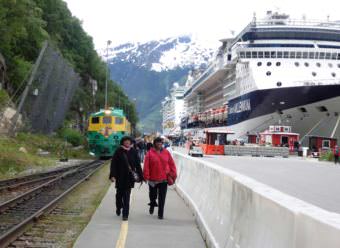
A Disney cruise ship tied up at Skagway’s ore dock. (Photo by Emily Files/KHNS)

Skagway leaders are moving ahead with a new 15-year tidelands lease proposal and they’re hoping to get it to voters this October.

The Assembly put some tough questions to the White Pass and Yukon Route Railroad president at a public meeting Thursday.

The executive told them the railroad is willing to compromise on some things, but it needs a 15-year lease guarantee.

The urgency driving this conversation comes from Skagway’s need for a new floating dock.

The dock would allow the cruise ship-reliant town to keep up with bigger boats arriving in 2019.

White Pass Railroad leases most of the port. In order to cooperate on the floating dock, it wants a 15-year new lease that would pick up after the current one ends in 2023.

“The only agenda we have it toward a mutually beneficial conclusion,” said White Pass President John Finlayson, who was at the Thursday meeting.

Orion Hanson asked Finlayson if he would be willing to tie contamination cleanup in the ore basin to the current lease. Meaning, the cleanup would happen in the next five years. Finlayson said yes.

He also said OK to the city capping its financial contribution to the cleanup at $1.5 million.

But when Jay Burnham asked whether White Pass would look at just the floating dock, without the new lease, Finlayson said no.

“Could we talk about just that floating component?” Burnham asked.

“Jay, look, we’ve had this conversation before,” Finlayson said. “We put forward what we think is a benefit to White Pass. We also think it’s a benefit to the city.”

That seemed to get through the Assembly. They made some changes to the proposal, but none to the 15-year term.

Previously, the Assembly voted for the city to take over as cruise terminal operator during the new lease.

Hanson moved to reverse that decision.

“It is a non-starter for White Pass,” Hanson said. “So this is a concession.”

On the motion for White Pass to continue as cruise terminal operator, the Assembly was split: Hanson, Tim Cochran and Steve Burnham Jr. voted yes. Jay Burnham, Spencer Morgan and Monica Carlson voted no.

Mayor Mark Schaefer broke the tie in favor of the motion.

Throughout weeks of discussion on this new lease, the Assembly has agonized over whether it’s a good deal for Skagway.

Hanson brought up one part that he thinks is a major benefit: after the 15-year lease, the city will be able to take over the Broadway and ore docks without having to pay millions of dollars.

“What we really get here is a path to where we own our assets and our waterfront,” Hanson said.

In the new lease proposal, there is a schedule for how much the city would have to reimburse White Pass for capital improvements to the property. It starts at 10 percent in 2029, up to 100 percent if the improvements happened in the last year of the lease.

The Assembly also voted to add language giving the city authority to regularly inspect the leased area and to deny a proposed sale or transfer of the lease.

The group also agreed to wording requiring White Pass to obtain a surety bond to hold the company accountable for contamination cleanup.

The city negotiating team will take these changes to White Pass. Then, the Assembly will continue the discussion at a special meeting Aug. 9.

It’s still not a given that the Assembly will agree on the 15-year lease. Jay Burnham and Monica Carlson have been especially skeptical.

“I keep hearing everybody saying ‘it’s a nonstarter for White Pass, it’s a nonstarter for White Pass,’” Carlson said. “Well, excuse my French, but what’s a nonstarter for the city? We need to take a little more gumption and effort and get what we want.”

So, there’s the question of Assembly approval. Then there’s the question of whether they’ll be fast enough to put the lease question on this October’s election ballot.

The deadline is Aug. 17, though the clerk said she could maybe stretch that a little bit.

And perhaps the biggest question is whether the lease will pass a public vote.

Steve Burnham Jr. said he was having flashbacks to 2015, when voters rejected a 35-year tidelands lease.

“Are we getting the message out? Or are we going to be perceived as ramming it down their throat?” Burnham asked.

But Hanson pointed out that this time around, most of the lease discussions are happening in public, instead of behind closed doors. He said if people are not paying attention, they should be.

Following trooper loss, Haines looks at expanding police service

The Haines Police service area does not include residents who live along the Haines Highway. (Photo by Abbey Collins/KHNS)

Haines’ loss of state trooper may trigger a major change to the way local police service is funded and structured. The trooper loss might result in an expansion of Haines police jurisdiction – from just the townsite to borough-wide.

“I want to compel you that not doing something is not the correct answer,” said Haines Police Chief Heath Scott at a Tuesday Assembly committee meeting.

Haines’ Alaska State Trooper post was moved to Bethel earlier this year. Scott and his three officers have picked up the slack in the absence of that trooper.

For example, the most recent police blotter shows an officer responding to a reckless driving report out Lutak Road.

“We’re currently not funded to go out the road,” Scott said. “But when people call 911, regardless of what people feel in here or think in here, we have a duty to respond.”

Right now, Haines has two different income pools and expenses that are based on geography.

One is the townsite service area fund, the other is areawide.

People pay different amounts of property and sales tax in the townsite than they do in the outer parts of the borough. And they get different levels of government services.

The police department is one of three things paid for by the townsite fund. But police aren’t staying in the townsite boundaries. With the trooper absence, they’re going throughout the borough.

“I feel that when the police leave the townsite in order to take care of an emergency outside their jurisdiction, that the people of the townsite are paying for that cost,” said Assembly member Stephanie Scott. “And it’s not fair.”

So, the idea is to take police service out of the townsite box, and make it an areawide service.

Borough staff have proposed a new “community safety” service area, which encompasses police, emergency medical response and related dispatch time.

The question then becomes how to pay for it.

Property and sales tax are two obvious sources. Other possibilities have sparked a backlash.

“We would just like to leave our medical service tax dollars out of the calculation,” Darwin Feakes said. “Leave us as we are for something that works.”

Feakes was one of several Haines Volunteer Fire Department members who spoke out.

They’re worried about combining emergency medical response in the new service area.

The medical service fund is paid for through a half-percent dedicated sales tax. The EMS and fire crew doesn’t want this new “community safety” service area dipping into that money.

The fire department also is opposed to the idea of an ambulance fee as a funding source.

“We’re gonna end up with some tragedies that come out of that because people are gonna go, ‘I can’t afford $500 for an ambulance call,’” Feakes said.

Borough manager Debra Schnabel said the ambulance fee is just an idea at this point. She said the new service area could be created and funded in a way that protects EMS money.

The firefighters weren’t the only ones with objections.

“The sky is not falling,” said Brenda Josephson, who owns property in the Chilkat Lake area. “It’s government bureaucracy growing for the benefit of government bureaucracy, and not for the benefit of the people.”

If the Assembly did want to move forward with establishment of a new community safety service area, it would require a vote of the people.

That’s another concern from out of townsite residents. They’re worried their voice would be outweighed by the townsite voters.

“I don’t think you should ever have an areawide vote where the majority of people can overrun the vote of a minority group,” Mosquito Lake resident Paul Rogers said.

So what happens next?

The first question is whether the Assembly will pursue expanding police jurisdiction borough-wide with a new service area.

The second question is how that should be funded.

And the third is whether it should go to a public vote this October.

Borough clerk Julie Cozzi urged the Assembly not to rush the question to the October ballot.

The Assembly may provide some answers to these questions at a meeting Aug. 8.

Walker expresses hope that Haines trooper loss isn’t permanent

The Haines state trooper car parked outside of the courthouse. (Photo by Emily Files/KHNS)

Alaska Gov. Bill Walker says he hopes the shutdown of Haines’ Alaska State Trooper post is not a long-term solution.

The head of troopers says right now, he has no plans to re-instate the position. The lack of a clear answer may further confuse Haines’ exploration of an expanded police service area.

Walker was in Haines on July 29. It was his first visit since the borough lost its only Alaska State Trooper several months ago.

In a brief interview, Walker said the main challenge the troopers are facing is in recruitment.

“The funding’s there, we just can’t find the troopers,” Walker said. “We just can’t find the folks to fill in the positions and make it through the academy.”

Walker says the state is about 20 troopers short right now.

“It’s not a matter of necessarily shifting it onto the municipalities, we just don’t have the troopers, is the problem,” Walker said. “I hate to say it, some areas that really require a lot of law enforcement activity really get the attention. I know that that’s not a long-term solution.”

Walker saying it’s not a long-term solution seems contrary to statements from the trooper division itself.

“Right now, I don’t have any intention of putting someone back into Haines,” said Col. Hans Brinke, who inherited the Haines’ trooper decision from his predecessor, James Cockrell.

“But we always have to evaluate,” Brinke said. “If the recruitment efforts are successful, we’re able to fill all our positions, the funding comes back, we will always evaluate the needs of the communities that are out there.”

This puts Haines leaders in a difficult position.

The local police department is only funded to serve a small portion of the borough, the townsite service area. The Assembly is looking into creating an expanded police service area, which would pay for law enforcement response in areas previously served by the trooper.

Would that lower the chances of the troopers reinstating the position in Haines? Here’s Brinke’s response to that question:

“Well if (the borough is) going to be responsible for it and they’ve accepted that responsibility, that would be a decision point we would need to take into consideration.”

Brinke’s message was that a lot of things have to work out for the Haines’ post to come back.

In addition to the troopers’ recruitment problems, Haines has a comparatively low crime rate and the state doesn’t have a long-term financial plan.

Walker also put blame on that.

“We don’t have a full fiscal plan and that’s what we need,” Walker said. “We’re living off of savings. Until we get the fiscal gap not necessarily completely closed but have the structure for it to become closed, I’m sure we’ll look again at those issues.”

‘It makes my heart beat:’ Chilkoot culture camp comes back to life

Culture camp participants, friends, and family share a potluck on the last day of the July camp. (Photo by Emily Files/KHNS)

Along the banks of the Chilkoot River near Haines, there’s an old culture camp that stood empty for years.

A group of young people recently decided to revitalize the traditional site.

The Chilkoot Indian Association and the Haines Public Library worked together this year and last to put on the event.

A few minutes before feasting on fish and berries, the 15 or so culture camp kids line up in front of a crowd of family and friends.

Leader Heather Powell asks them what they want to teach their future grandkids.

“How to live off the land,” one child says.

“I want my grandkids to know that no matter what, everything happens for a reason and they’ll be accepted,” says another.

“When we very first started camp, we asked the students, what do you want your grandchildren to know?” Powell explained.

Powell is Tlingit language teacher currently working in Hoonah. She has spent much of her summer teaching Tlingit and traditional skills at culture camps.

“They say when your language goes, the culture is soon to follow,” Powell said. “But in this camp we heard many of these kids take that commitment very serious, to continue learning, to continue trying, to not be afraid to fail and make mistakes. I think that’s comforting.”

Powell is one of the camp counselors with ties to this gathering place. She said some of her relatives helped Austin Hammond with the inception of the Chilkoot Culture Camp decades ago.

Ted Hart tells the story of why Hammond started the camp.

“He kept having this dream. There were tables full of food out, but no one was eating it,” Hart said. “He was trying to figure out what it meant. He finally figured out, you’ve got to tell these people it’s OK to go to the table and start eating the food. He had to bring them in, he had to tell them to come to where they’re needed. So he created this culture camp for the kids.”

Hart is with the Chilkoot Indian Association. He’s one of the people who helped bring this camp back to life. He kept driving by, seeing it empty.

“I just felt it was really important to get these kids together, working on putting up food and respecting the land,” Hart said. “We’re all creating future leaders right now.”

“It’s the tradition of how we learned and how it used to be and how we talked to animals and stuff,” said 11-year-old Douglas Adams.

He shares one memorable experience from the camp.

“This carver named Wayne Price … he adzed these paddles,” Adams recounted. “And after he did that, we took this big canoe, it’s red and black. We took it out and we walked it and we started singing a Tlingit song when we got out there. We started canoeing and singing and having fun out there. It’s really tradition for me to be here and I want to learn all about the culture of what we used to be.”

“I really like culture and I like learning about cultures, so that kind of intrigued me,” said Matilda Rogers, who is almost 13 years old. This is her first culture camp.

“My favorite part is probably listening to the stories our grandparents had to tell us,” Rogers said. “Because it was really interesting to learn what they have seen and how they grew up.”

Smith Katzeek Sr. is one of a handful of elders who told stories and shared knowledge at the camp.

“It makes my heart beat,” Katzeek said. “It’s like life coming back.”

Ted Hart said the Chilkoot camp is part of a cultural resurgence in Haines.

“The culture’s been pretty quiet around here in previous years,” Hart said. “But we’re making steps to getting stronger.”

Hart and the other organizers hope to keep the culture camp alive in years to come.

They say the children are already talking about next year.

Alaska capital budget re-appropriates half of Juneau Access money

A sign at the end of Glacier Highway in October 2016. The Juneau Access Improvements Project extension would begin here.
A sign at the end of Glacier Highway in October 2016. (Photo by Andrew Kitchenman/KTOO)

Late last year, Alaska Gov. Bill Walker said he would not pursue construction of the controversial Juneau Access Project.

The project’s goal was to improve transportation between Juneau and the road-system-connected Haines and Skagway.

After Walker’s decision not to move forward with the road extension, people wondered what would happen to millions of dollars earmarked for it.

The passage of a capital budget last week gives some indication, though it’s still unclear exactly what the Juneau Access money will be used for.

Walker proposed re-appropriating all $47 million to other transportation and infrastructure needs in Northern Southeast.

House Capital Budget Coordinator Paul LaBolle said that was a sticking point during negotiations.

The Senate wanted to get rid of Walker’s re-appropriation, the House majority wanted to keep it. So, they met in the middle. About $21 million stays in the Juneau Access pot, and $21 million goes to Lynn Canal transportation and infrastructure. (Four million dollars went to Kivalina school construction.)

“It’s important to me that the money stays in the region,” Walker said.

Walker was in Haines shortly after the legislature agreed on a capital budget.

He attended the Southeast Alaska State Fair with his family and Lt. Gov. Byron Mallott.

When asked what brought him to the fair, Walker quipped “the Fairweather.” (The Fairweather is an Alaska Marine Highway ferry.) “I had not been on a ferry in a while, so it was good to be on one today.”

It’s the ferry system that many residents in Haines and Skagway want the state to focus on.

Walker visited the Upper Lynn Canal last fall, as he was deliberating on the future of Juneau Access.

Residents here said they wanted the state to invest in a stronger, more reliable ferry system, not a road.

Walker did not say whether the $20 million re-appropriated for Lynn Canal infrastructure would be invested in the marine highway.

“You know, that’s one of the things that I’m looking at, to see if there are projects in the works,” Walker said. “I’m not sure that there are at this point. There’s other uses for portions of it. In fiscal times like this, every dollar finds a home. There’s a lot of tugging and pulling at that money, I’ll tell you that.”

The Department of Transportation also does not have an answer yet about the fate of the re-appropriated Juneau Access money.

“There are no specific projects listed in that appropriation right now,” DOT spokeswoman Aurah Landau said. “At a later date, a process will be set up to determine the use of those funds.”

In addition to the general health of the ferry system, there are other expensive Haines and Skagway transportation and infrastructure projects on the horizon.

For example, Skagway needs a new ferry dock. DOT says replacing the dock would cost about $26 million.

Haines’ Lutak Dock is in desperate need of repair. That facility is the town’s entryway for freight and fuel. The cheapest repair is price tagged at $21 million.

So, as Walker implied, it may be a tug-of-war for the Juneau Access millions.

Some Haines residents object to local taxes on pot and tobacco

Haines Borough Assembly members are divided on so-called “sin taxes” on tobacco and marijuana.

They heard some opposition to the proposal at a meeting Tuesday when residents raised concerns that the taxes could hurt low-income people and a budding industry.

Over the last few months, three Haines residents have applied for five pot business applications with the state. That prompted the Assembly to think about how, if at all, the borough should regulate and tax marijuana.

The group directed manager Debra Schnabel to draw up an excise tax ordinance for both pot and tobacco products.

That idea doesn’t sit well with everyone.

“It’s a really high tax for a small percentage of our people,” said Donnie Turner, who spoke against the tobacco tax, which among other things, would levy a $2 fee on cigarette packs.

Turner said this would unfairly affect low-income people.

“You take somebody that’s an elderly person that I know that smokes a pack a day, that’s on a fixed income … they’re not gonna quit,” Turner said. “They’re just gonna eat less or turn their heat down or do something else.”

Jason Adams spoke out on the other half of the ordinance: a marijuana excise tax.

Adams is the manager of a prospective Haines pot cultivation and retail business called Glacier Bay Farms.

“It could be harmful to the business,” Adams said. “And if it pushes us down, which raises our prices to the consumer because the consumer will pay the tax.”

The State of Alaska already imposes a $50 per ounce tax on marijuana growers in the newly-legalized industry.

The Haines ordinance would add an additional $5, a fee that would be charged to the cultivator when he or she sells product to a dispensary or other business.

The Assembly members had a range of opinions.

Sean Maidy was concerned about both the marijuana and tobacco taxes.

“A tax on tobacco disproportionately affects the lower class,” Maidy said.

Tom Morphet was OK with the tobacco tax because it’s purpose is to discourage the use of cigarettes and other tobacco products.

But he thought the borough should target alcohol instead of marijuana.

“I think it would tend to inhibit this industry,” Morphet said.

Heather Lende and Ron Jackson were in favor of the marijuana tax.

Lende said that only relying on sales tax revenue might not make sense, because the Haines cultivators may ship their product to other towns.

One potential cultivator already said that was her plan, Lende said.

“Our product very well may be the raw product, and we might be shipping it to places like Juneau or Anchorage or Seattle, for that matter,” Lende said. “it seems as if a small excise tax would be wise.”

Lende and Jackson also pointed out that some towns have levied much higher excise taxes on marijuana.

For example, Petersburg collects $25 per ounce.

“Why are we going $5 an ounce and other cities are going $20?” Jackson said. “It seems kind of lowball.”

The Assembly didn’t come to consensus on the issue.

There is one more public hearing on the excise tax ordinance Aug. 8, where community members will have another chance to weigh in.

Site notifications
Update notification options
Subscribe to notifications