KNBA - Anchorage

KNBA is one of our partner stations in Anchorage. KTOO collaborates with partners across the state to cover important news and to share stories with our audiences.

After Brian Smith’s Anchorage murder conviction, MMIP advocates hope for change

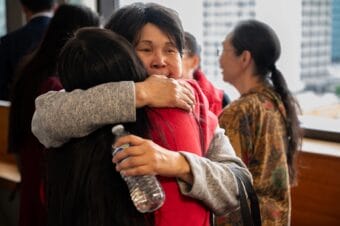
Rena Sapp hugs her sister Margie Lestkenoff, after the guilty verdicts in the Brian Smith trial were read. Both are sisters of Veronica Abouchuk, who Smith confessed to killing sometime around 2018. (Rhonda McBride/KNBA)

The dark and disturbing trial of a man who killed two Alaska Native women, and shot footage of their murders, ended with his conviction last week — but the sound of Brian Smith’s voice on those videos, with his thick South African accent, will likely haunt those who sat in the courtroom for a long time.

two women
Kathleen Jo Henry (left) and Veronica Abouchuk (right). Henry was 30 when she was killed and Abouchuk was 52. (Facebook/Courtesy Mary Dan)

The national media dubbed the case the “Memory Card Murders,” with coverage that focused on Brian Smith and his terrible crimes.

Before the verdict was read, Veronica Abouchuk’s family huddled together in the back of the courtroom, as they had each day of the trial, along with advocates for both Abouchuk and the killer’s other victim, Kathleen Henry.

a trial
Throughout the three-week trial, family members and advocates for the victims sat on the wooden courtroom benches, often tearful as they watched graphic images of the killings. (Matt Faubion/Alaska Public Media)

They hoped their presence would show the jury how much they cared. And whether that was a factor in the final outcome, the jury reached guilty verdicts on all 14 counts against Smith in less than two hours. The unusually quick verdict came as a relief for Veronica Abouchuk’s older sister, Margie Lestenkof.

two women
Rena Sapp and Margie Lestenkoff wait on Feb. 24, 2024 for the verdict in the trial of Brian Smith, who was convicted of killing their sister, Veronica Abouchuk. (Matt Faubion/Alaska Public Media)

“It was pretty hard on all of us, but we tried to be strong in our hearts,” Lestenkof said. “But it still hurts a lot.”

Lestenkof says there is at least closure in knowing what happened to her sister, who was 52 when she disappeared. And although the amount of evidence was almost overwhelming, Lestenkof says she’s grateful it convinced the jury of Smith’s guilt and that he now faces a life sentence.

Much of the testimony focused on an SD memory card that gave police their big break in the case. The card, labeled “Homicide at midtown Marriot,” came from a sex worker, who told them she found it on the ground. It had footage of Kathleen Henry’s torture and murder — and in the background, Smith’s chipper voice with his South African accent, gleefully narrating the footage, as he taunted Henry for being too slow to die.

“In my movies, everyone dies,” he said.

Only the jury, attorneys and court staff saw the footage, but everyone in the room heard the sound.

“It was just sitting there, hearing the gasping for air,” said Golda Ingram, a Victims for Justice advocate, who said it was painful to hear Smith say, “You live. You die. You live, you die,” as he took his hands on and off Henry’s throat.

Ingram said she watched Smith as the recording was played and he appeared to be proud of what he did.

a murderer
Brian Smith listening to closing arguments in his murder trial. (Matt Faubion/Alaska Public Media)

Ingram says she’s used to hearing about violence in her line of work.

“But this is beyond anything that I’ve ever experienced. I was not prepared for the extent of the trauma,” she said.

But Ingram said it helped to spend time with the Abouchuk family, as they quietly supported each other. She said their kindness and perseverance helped to restore the dignity of the victims.

three women
From left to right, Margie Lestenkoff, Rena Sapp and Veronica Rosaline Abouchuk — three sisters in happier times. (Courtesy Rena Sapp)

When there was a break in the testimony, they would sit together at a table in the courthouse lobby, to share food and memories. Margie Lestenkof says she wishes everyone could have known the sweet girl she remembers from childhood.

“My sister Veronica was a real nice person,” Lestenkof said. “She never cussed. Didn’t have a mean bone in her soul.”

a woman in a graduation cap and gown
Veronica Rosaline Abouchuk graduating from high school. (Courtesy Rena Sapp)

Lestenkof says Veronica was also known for her beautiful grass baskets and dolls. But throughout the trial, her sister, as well as Kathleen Henry, also became known for their addictions and risky choices.

From what Kathleen shared on her Facebook page, it was clear she had her struggles, but there was one proud post — that she had earned her GED at the age of 24 at the Hiland Mountain Correctional Center, where she was remembered as someone who loved to write poetry. She died six years later.

Both women were originally from small coastal villages in Western Alaska. Veronica’s daughter, Kristy Grimaldi, says her mother was not able to raise her, as well as her sister and two brothers. She believes her mother’s troubled life goes back to her childhood in St. Michael, where a Catholic priest molested her.

“After that, I looked at my mother very differently,” said Grimaldi, who, after hearing her story, began to feel understanding and compassion for her mother.

Grimaldi says, after her first child was born she invited her mother to live with them, happy to discover they had the same favorite snack of rice and melted cheese.

There were other visits, but after a few weeks, her mother would return to the streets. And then in 2018, she disappeared.

“I remember when I didn’t know what happened to my mother, waking up and feeling like you’re in a complete nightmare,” Grimaldi said. “Just not knowing.”

a woman
Martha Tom was the youngest sister of Veronica Abouchuk, who was last seen by her family in 2018. Tom’s body was found under a picnic table at an Anchorage park in 2005, badly beaten. Her case remains unsolved. (From Anchorage Crime Stoppers)

Grimaldi had reason to fear the worst. Her mother’s younger sister, Martha Tom, had been found badly beaten under a picnic table at an Anchorage park in 2005. She died later at the hospital. Her case remains unsolved. She was only 35.

a couple
Kristy Grimaldi and her brother Sean Hinson. Their mother, Veronica Abouchuk, had another son and daughter. Grimaldi and Hinson say women like their mother need compassion and understanding but have been stigmatized because of their struggles to survive on the streets of Anchorage, making them vulnerable to killers like Brian Smith. (Rhonda McBride/KNBA)

“We’re just one story,” said Sean Hinson, Grimaldi’s younger brother. He says his family is not alone, that all too many Alaska Native families have had loved ones, gone missing or murdered.

“We’re one piece of that puzzle. Everyone has their own piece,” he said. “You never know what someone is going through and what baggage they’re carrying.”

Hinson says the stigma of homelessness and addiction make women like his mother faceless to the world and easy prey for men like Brian Smith.

After police confronted Smith with video of Kathleen Henry’s murder in 2019, he surprised them by confessing to Abouchuk’s murder. The prosecution played video from a police interview with Smith, in which he sounded almost casual about the killings.

“OK,” said Hinson. “He’s talking about someone’s daughter, talking about someone’s mom, talking about someone’s sister. It’s not clicking in the brain, what he was doing.”

During the trial, the family also saw footage from a flash drive police seized from Smith’s home that had images of Abouchuk’s last moments. It had been erased from the drive, but investigators were able to restore the footage, which showed scenes before and after her murder, in which Smith treated her body like a trophy.

“What hurt me really most, when he had taken her clothes off,” said Lestenkoff. “She was dressed when he killed her.”

But despite all that she saw and heard during the trial, Lestenkoff says she will always be grateful to Valerie Casler, who gave the police the SD card that ultimately led to Smith’s arrest.

“If it wasn’t for that,” she said, “we wouldn’t have known what he did to my sister and Kathleen.”

Lestenkof calls Casler a hero, even though she initially lied to police about the history of the SD card she turned over to them.

In court she admitted the video was from Smith’s cell phone, which she stole — and when she saw what was on it, copied the footage to a stolen SD card. As a sex worker and a drug addict, she feared police would arrest her if she told them the truth.

“She is an absolute brave, amazing woman,” said Amber Nickerson, a member of Community United Safety and Protection (CUSP), an advocacy group for sex workers.

“Rather than just saying, ‘Oh it’s too difficult. I don’t know what to do, I’m just going to leave this the way it is and go on with my life,’” said Nickerson. “She chose to go above and beyond to get that information to police.”

Nickerson says it wasn’t easy for Casler to admit she was a deeply addicted drug user, who lived in a tent and survived as a sex worker. She told the court she had been on what she called “a date” with Smith, when she stole his phone from his truck. And while her testimony may have been messy, Nickerson says we cannot ignore what the footage revealed.

“I hope this causes some people to say, ‘Enough is enough,” Nickerson said. “We need to look deeper when someone’s body is found on a park bench, when a woman’s body is found in the woods. We need to do more.”

MMIP advocates hope what the memory cards revealed won’t be forgotten – the violence that went unchecked because the killer thought no one would really care.

There are also two names among the loose ends in the case, Alicia Youngblood and Ian Calhoun, who Smith purportedly confided in, to impress them about the killings.

Prosecutors say Youngblood went to police to report what Smith had revealed to her but later took her own life. The investigation into Smith appeared to be on hold until a detective recognized his voice on Casler’s memory card.

During the trial, prosecutors showed texts between Calhoun and Smith, which indicate that Smith wanted to show him Kathleen Henry’s body, before he disposed of it along the Seward Highway.

In 2018, the Urban Indian Health Institute listed Anchorage as one of the top three cities for Missing and Murdered Indigenous Women and Girls. Alaska was also ranked fourth in having the highest number of MMIP deaths.

Advocates like Dr. Charlene Apok, director of Data for Indigenous Justice, says she hopes this case will bring attention to some of the underlying issues that she calls “pre-MMIP.”

“Our unhoused relatives are the pre-MMIP, as people who are targeted, most at risk and most vulnerable in our communities,” she said. “They are targeted by perpetrators.”

Apok says housing is one of many pre-cursors to being targeted, which need to be addressed to stop the violence.

Michael Livingston, a retired Unangax police officer, who has researched the role of historical trauma and colonialism in MMIP deaths, says the Smith case has forced us to confront the horror of racial violence, just as the Emmett Till lynching did in 1955.

“When his mother insisted on an open casket to show the world the ugly face of racism, she launched a civil rights movement,” Livingston said.

And while the two situations are very different, there are hopes that the deaths of Veronica Abouchuk and Kathleen Henry will help to fuel a movement for change and not be lost in vain.

Jury makes quick decision in Brian Smith murder trial, convicting him in deaths of two Native women

Brian Smith, 52, is seated in court on Thursday to hear closing statements in his trial. (Photo by Matt Faubion/Alaska Public Media)

In just a little over an hour on Thursday, an Anchorage jury reached a guilty verdict in the trial of Brian Smith, accused of killing two Alaska Native women. They convicted Smith on all counts in the deaths of Kathleen Jo Henry and Veronica Abouchuk.

During the three-week trial, police and prosecutors showed how Smith preyed upon the women’s vulnerability. Both came from small communities in Western Alaska and struggled with homelessness and addiction in Anchorage. Henry was 30 and Abouchuk, 52.

Kathleen Jo Henry (left) and Veronica Abouchuk (right). (Facebook photo of Henry, Abouchuk’s photo courtesy of Abouchuk Family)

In the final moments of the trial, the prosecution recapped scenes from videos and photos stored on an SD card, which showed Henry being tortured and strangled. Police said someone found the card on the ground, labeled “Homicide at the midtown Marriot.” The voice of a man could be heard in the footage with a thick South African accent, which police connected to Smith, who had been under investigation in a different case.

Debate over the memory card was a source of contention throughout the trial, as well as the credibility of Valerie Casler, the woman who gave it to police.

During her testimony, Casler changed her story and said the footage actually came from a cell phone, she stole from Smith’s pick-up truck and copied to the SD card.

Timothy Ayers, the defense attorney for Brian Smith, asks the jury to consider the quality of the evidence, not the quantity.
Timothy Ayers, the defense attorney for Brian Smith, asks the jury to consider the quality of the evidence, not the quantity. (Photo By Matt Faubion/Alaska Public Media)

Smith’s attorney, Timothy Ayers, argued in closing statements that Casler’s testimony alone was enough to give the jury reasonable doubt.

“Whether she wanted the limelight, whether she wanted to hide something, whether she doesn’t have a good memory,” Ayers said, “she is a very comfortable and constant liar, and there is reasonable doubt there.”

Ayer also told the jury that the state cluttered their case with a lot of weak evidence and did not do enough DNA testing to support its case.

Heather Nobrega, co-counsel for the prosecution, reminded the jury to remember the videos and photographs they saw on the SD card that Valerie Casler gave police. And even though Casler lied to police about how she obtained the images, Nobrega told them what they saw was the truth. (Photo By Matthew Faubion/Alaska Public Media)

But the co-counsel for the prosecution, Heather Nobrega, asked the jury to consider the totality of the evidence, which included cell phone data, text messages, surveillance footage and video from another cellphone police seized from Smith, which showed him toying with Abouchuk’s dead body.

“The defendant violently and brutally murdered two women. That is why we are here today,” Nobrega told the jury. “That is why the state is asking you to convict Smith of the crimes charged, and that the state has proved its case beyond a reasonable doubt.”

While the trial yielded an exhaustive amount of testimony, there are still many dangling threads in the case – the possibility that at least two people knew about Smith’s murders, because he had bragged to them about the killings.

Earlier this week, prosecutors showed texts and Facebook messages between Smith and Ian Calhoon, a heavy metal drummer, who seemed to know about Smith’s murders. In one text exchange, it appears Smith is trying to arrange a time with Calhoon, to show off Kathleen Henry’s body before disposing of it.

Smith also apparently confided in a girlfriend, Alicia Youngblood, about the murders. It was Youngblood, who went to police to warn them about Smith and led them to investigate him. The prosecution says Youngblood has since died by suicide, but there was no explanation about why the case went dormant — only that detectives recognized Smith’s voice on the SD card that Casler gave them from their earlier investigation.

“And he’s proud of what he’s done. He has bragged about it. He has shown videos and photos. He told Alicia Youngblood about what he did to Miss Abouchuck,” Nobrega said in her rebuttal to the defense’s closing statement. “He showed her where he dumped the body. He showed pictures about what he had done to her, after he killed her.”

“And based on his text messages,” Nobrega said, “it’s likely that Mr. Smith showed Ian Calhoon what he had done to Kathleen Henry.”

Calhoon made an appearance at the trial this week but said he would only testify about Smith, if he was offered immunity from prosecution.

In closing, Nobrega said, “It is difficult to explain the callousness and the brutality that the defendant has perpetrated on both of these women.”

Throughout the three-week trial, family members and advocates for the victims sat in the courtroom benches, often tearful as they watched graphic images of the killings. (Photo By Matt Faubion, Alaska Public Media)

But in their unusually quick decision, the jury demonstrated that they learned enough to hand out a long list of guilty verdicts. As the judge read each of the 14 convictions against Smith out loud, he sat, stone-faced, while families and advocates for the victims, cried and embraced each other. Throughout the duration of the trial, they said they hoped their presence would send a message of strength and caring, but most important of all, bring justice.

Trial of Brian Smith, accused of murdering two Alaska Native women, enters third week

Kathleen Henry (left) was killed in a midtown motel room. Police say Veronica Abouchuk was murdered a year or two earlier in Brian Smith’s home. Both cases came to light after a woman stole Smith’s cell phone, copied the images to an SD card and gave it to police. (Photo of Kathleen Jo Henry, courtesy Of Facebook. Photo of Veronica Abouchuk, courtesy of the Abouchuk family)

The trial of a Brian Smith, a man accused in the murders of two Alaska Native women, resumed on Tuesday. The case, which has drawn national attention, has been dubbed by Court TV as the “Memory Card Murders.” Smith, who is 52, is originally from South Africa.

Last week, jurors saw cell phone videos of the murder of Kathleen Jo Henry, a 30-year-old Native woman – and heard Smith admit to police that he killed another woman, 52-year-old Veronica Abouchuk.

As the trial got underway two weeks ago, the prosecutor apologized to the jury for the horrific images they would see, that might live on in their heads long after the trial.

But those who are not in the courtroom may also be affected by what they see and hear about the trial.

Advocates for Missing and Murdered Indigenous People (MMIP) say the Brian Smith case is part of an ongoing pattern, made worse by historical trauma.

“I hope that we ultimately, as a state, and we as a community, do a better job of respecting all human lives,” said Michael Livingston, a former police officer and historian.

Livingston, like many Alaska Natives, has been following the Smith trial, as it’s covered in newspapers, local television and streamed live on Court TV.

Last week, the core of the case finally unraveled, the story of two murders — one that took place in 2019, and another, sometime a year or two before that.

The courtroom was rearranged so that the TV monitors faced away from the gallery. Only the jury, Smith and those involved in the trial could watch the last moments of Kathleen Jo Henry’s life, which Smith is accused of recording on his cell phone.

Everyone else in the courtroom could hear the sounds of Henry being tormented and taunted in a midtown hotel room as she lay dying. In a gleeful voice, a man with a thick South African accent beseeches the woman to die quickly. Police say that man is Brian Smith.

The jury also saw an interview police recorded with Smith, in which they confront him about the videos. Afterwards, he confesses to killing another woman later identified as Veronica Abouchuk, who like Henry, had also struggled with homelessness and addiction in Anchorage.

Last week, Livingston gave a training session on Zoom.

“The title of my presentation is serial killers in Alaska and MMIP,” Livingston said, as he began his lecture. Livingston is Unangax̂ and currently works on the Healthy Relationships Team for the Aleutian Pribilof Islands Association.

He told the group that there is a connection between modern serial killings and Alaska’s long history of dehumanizing Indigenous people. He traces it back to the late 1700’s, when the Russians battled to dominate the fur trade and enslaved or killed the Unangax̂ people, who were scattered across the Aleutian chain. Although memories of those mass killings are gone, he says place names and collective trauma remain.

“Places such as Murder Point, Massacre Bay, Massacre Beach,” Livingston said. “And Krasni Point. Krasni is the Russian word for red. The ocean water was so red from the blood of the Unangax̂ people that the Russians named it Krasni Point.”

Livingston says Russians called Native peoples savages, as did the colonists who followed them.

“And savages is a code word for a non-human being,” he said, “and you cannot murder a non-human being.”

Livingston says this word helped to normalize the historical lack of attention given to Native murder cases. He says serial killers today capitalize on society’s lack of caring for the most vulnerable among us.

“That’s wrong thinking,” Livingston said. “Just because someone happens to drink, or someone has a drug challenge, or someone chooses a lifestyle that we don’t think is safe, does not give anybody the right to think that they’re less human than we are.”

Livingston says the Brian Smith murder trial is a chance for all of us to do some soul searching — not just about the women in this case – but their many sisters, who have also suffered at the hands of other perpetrators.

Livingston says we need to ask ourselves some important questions.

“Are some human beings less human than others? And when we reflect on that, if we do, I think it’s important that we change our way of thinking,” he said.

About 50 people attended Livingston’s lecture, a training certified by the Alaska Police Standards Council. He closed with a warning that details from his lecture and the trial may hit the Alaska Native community hard.

“Meditate and do something that helps rest your mind,” he said, and if need be, call 988, a 24-hour-crisis line that offers listening and support for those in distress.

Livingston offers his training to any organization that makes a request at no cost. The groups can be small or large. The training also includes information about victim services and how people can protect themselves and each other from predators.

Julie Kitka to step down as longtime head of the Alaska Federation of Natives

Alaska Federation of Natives President Julie Kitka is hopeful the state can create a seat at the federal table. (Photo courtesy Alaska Federation of Natives)

A major transition is ahead for the Alaska Federation of Natives. AFN leaders have announced plans for Julie Kitka to step aside as president before this fall’s convention.

Next month, AFN will open up the application process, the first step in choosing the next person to lead state’s largest Native organization.

In an announcement, AFN leaders said it was Kitka’s choice to leave this role.

Kitka was elected president in 1990, but her service to AFN goes back four decades. From healthcare to fulfilling the goals of the Alaska Native Claims Settlement Act, Kitka has had a hand in almost every one of AFN’s major achievements.

Paul Ongtooguk, an Alaska Native Historian, says Kitka’s long tenure has enabled her to shepherd AFN through historic issues, which have had a huge impact on Alaska Native peoples. The downside, he says, is that it’s always tough for a legacy leader to decide when it’s the best time to leave.

“No one lands on that squarely that I’ve ever seen,” Ongooguk said. “There’s an enormous amount of appreciation that needs to be given for all the time and enormous effort that she’s put in, year after year.”

Ongootuk says presided during a time of great change, and AFN has benefited greatly from her thoughtful leadership.

Kitka first joined AFN in 1984 as a special assistant for human resources. She has also served as AFN’s Washington D.C. lobbyist and vice-president.

AFN’s board of directors has created a succession committee and hired The Foraker Group to help with the search and transition. Foraker is an organization that helps non-profits grow and adapt to change.

AFN is also asking its members to fill out a questionnaire to help choose a new president.

Ongtooguk says the survey is a good idea and that it’s especially important for the younger generation to weigh in. But more important, he says, is for today’s AFN leaders to listen carefully to what they say — that young people may offer ideas they aren’t capable of even imagining.

Ongtooguk says the new leader of AFN must deal with a changing demographic, in which AFN membership will be dominated by urban natives, as rural Natives opt for city life and become less connected to subsistence and the Native way of life.

He says the new president will face different challenges than Kitka, as well as different opportunities.

“The way people think about that role and what it could be and should be for the future. It really does need to take a fresh bend in the river,” Ongtooguk said.

The plan is to have the new president in place by October to lead the 2024 AFN Convention, the largest gathering of its kind in the state.

Kitka says she has no comment at this time but will not leave the picture completely. She says she plans to take up a new role at AFN, to be announced sometime in the near future.

AFN’s Co-Chair, Joe Nelson said in a statement that it’s difficult to imagine an AFN without Julie Kitka at the helm, but AFN leaders are committed to a healthy transition.

Nellie Moore leaves behind a huge footprint in Native journalism

Nellie Moore , who spent 44 years as an Alaska broadcaster, was no stranger to the microphone. (Photo courtesy of the Moore family)

Editor’s note: Rhonda McBride was a former colleague of Nellie Moore’s and a longtime friend. Currently McBride works for KNBA.

Nellie Moore was one of the first Indigenous reporters in Alaska. She could sew an atikluk, an Iñupiaq overshirt, as well as stitch news and information into stories that made a difference.

From radio to the Internet, the fabric of Moore’s life spanned a huge revolution in technology. She died Jan. 31 at the age of 69 from complications due to a long illness.

Moore leaves behind a huge body of work that blends the best of Iñupiaq culture and modern Western journalism.

You can thank her parents for that. Her mother, Ada Ward, instilled the Iñupiaq values of hard work and caring for community, someone who always kept a sack of pancake mix on hand to feed stranded travelers at a moment’s notice.

Nellie Moore’s mother, Ada, on the left and Moore on the right. (Photo courtesy of the Moore family)

And there was her father, Ed Ward, who came to Kotzebue as an FAA flight service specialist. In a 2016 interview on a statewide public radio show, Talk of Alaska, Nellie described her dad as a man who was “crazy” about radio and kept a big stash of electronic parts in their home.

“I would always find the tubes that somebody needed,” she said, “And put them in the tube tester to make sure they worked.”

As a teenager, Moore earned her First Class Radio Operator’s license and learned to use the Morse code to communicate over the radio.

You might say, radio was in the blood. Today, Nellie’s sister, Lenora manages KOTZ, the public radio station in Kotzebue. But in the 1970s it was a gleam in her Dad’s eye, a passion project, one that would soon become Nellie’s.

Just as the station was about to become a reality, Alex Hills met Moore at the Kotzebue Airport.

Her father had taken her there to meet Hills, who would soon become the station’s first manager.

Alex Hills was both an engineer and general manager at KOTZ. He’s pictured here at the controls in the KOTZ studio. KOTZ was the second rural Alaska public station to go on the air, following KYUK in Bethel. (Photo courtesy of Alex Hills)

Hills has written extensively about the pioneering days of radio and telecommunications in Alaska and wrote about Moore and her father in a book called Finding Alaska’s Villages and Connecting them.

When KOTZ went on the air in 1973, Moore was barely out of high school, but Hills hired her to be the first news director.

“I thought she was a rare find in many ways,” Hills said. “Effervescent Nellie Moore.”

“Nellie, later as most people in Rural Alaska know, became Alaska’s leading Native journalist,” he said. “But then she was just a young 19-year-old. Kind of spunky, actually.”

Moore eventually took over as the station manager. She and Hills also worked together to start the OTZ Telephone Cooperative, Kotzebue’s first telephone company.

Nellie Moore graduated from Kotzebue High School’s first graduating class in 1971. (Photo courtesy of the Moore family)

Moore came of age at a time when many Alaska communities were almost completely dependent on radio to communicate with the outside world, especially those that were not connected to a road system. Back then, people felt lucky to have just one phone in the village.

Moore said there was a lot of excitement when communities got connected to the telephone cooperative’s network and recalls the time when an engineer asked her to make the first phone call to Deering, a community 60 miles south of the Kotzebue Sound.

Moore called her aunt, who was shocked to get a call from outside the village, flustered that she couldn’t figure out where her niece was calling her from.

As Moore juggled other responsibilities, she continued to grow as a journalist. Hills said one of his favorite photos was when she interviewed the late Gov. Jay Hammond at the airport, dressed in a pair of denim overalls, with a blue bandana on her head. The year was 1976.

“Nellie had her tape recorder and a microphone. They say a picture is worth a thousand words,” Hills said. “In this case, Nellie was leaning forward, and the governor of Alaska was leaning back. That told me a lot about her interview style.”

It is said the pen is mightier than the sword, but Nellie was armed with perhaps a more potent weapon – humor, which she used to soften up those she interviewed.

Nelllie Moore interviews the late Gov. Jay Hammond at the Kotzebue airport in 1976. (Photo courtesy of the Moore family)

“She just knew how to make people feel comfortable,” said Paul Ongtooguk, who later worked with Moore at the Northwest Arctic Television Center in Kotzebue. “It was like conversation over coffee.

Ongtooguk and Moore produced videos and educational materials about Iñupiaq culture and history at the Television Center. It was then he discovered she was a zen master in the traditional Iñupiaq art of teasing.

“We had a director, who everybody was sort of intimidated by. But not her,” Ongtooguk said. “And Nellie would tease him just as much as anybody. And I think he actually enjoyed it.”

Nellie’s daughter Liz Cravalho said teasing in Iñupiaq culture is a friendly way to keep egos in check.

“Gentle correction. That’s what I think of it as,” she said.

Teasing is how Moore got politicians to answer some of her most pointed questions.

“She was a village girl,” Cravalho said, “and she wasn’t going to be shy about talking about important issues.”

Paul Ongtooguk is an Alaska Native historian and taught Native studies at the University of Alaska Anchorage. He worked with Nellie Moore at the Northwest Arctic Television Center to produce documentaries about Native culture and history. (Rhonda McBride/KNBA)

Moore’s Iñupiaq name was Iriqtaq, which means “Something hidden.”

“When I was little, I used to say, ‘What’s hiding mom?’ and she would just laugh,” Cravalho said.

As a reporter, Moore kept a lot to herself, mainly her own opinions – but Ongtooguk said her stories revealed sharp powers of observation, that are prized in Iñupiaq culture. Ongtooguk said Nellie was a good judge of human character as well, necessary to effectively tease people into doing the right thing.

Ongtooguk said Moore demonstrated that journalism could serve as a voice for Alaska Native communities, a mirror, to help them understand themselves. And in so doing, Ongtooguk said Moore introduced local news to a whole region, and that is perhaps one of her most important legacies.

Ongtooguk said Non-Natives tried to do that.

“But you always knew it was an outsider’s perspective, from the very questions that they were asking,” he said.

Moore and Ontooguk also worked together to produce a groundbreaking series of videos about the Alaska Native Claims Settlement Act, legislation that changed not only Alaska’s Indigenous peoples, but the whole state, forever. The five-part series is still used today in schools and universities.

“ANCSA is a powerful social document,” Ongtooguk said. “She was someone who knew enough, so she knew how to ask questions about the unexplored aspects of ANCSA.”

Ongtooguk said Moore produced documentaries on subsistence and Iñupiaq traditional knowledge while she worked on the ANCSA series. He said the cultural projects informed her work on ANCSA, heightening her awareness about the potential social impacts.

Moore also helped the Children’s Television Network produce a series of TV segments on Iñupiaq culture.

While all this was going on, Moore met her husband Greg, who arrived in Kotzebue to do polar bear research. The family later moved to Fairbanks, so he could study for his master’s degree. Moore found work at KUAC, the Fairbanks public radio station, where she was one of the instigators of water pistol fights in the hallways.

Although Moore liked to have fun, she had a reputation for taking her work seriously. It was in Fairbanks that she reconnected with Jane Pender, an Alaska author and journalist, who used to own the newspaper in Kotzebue. Pender wrote extensively about the impact of development on Alaska Native communities and their way of life. Moore’s daughter said Pender’s mentorship fueled her passion for telling stories and helped to prepare for her next big step in journalism.

In 1992, Moore joined KNBA in Anchorage, the first urban Native radio station in the nation, where she was one of the early hosts of National Native News.

KNBA’s President and CEO Jaclyn Sallee said Moore was hired as news director, but also helped to produce popular features like the Native Word of the Day and Stories of our People, which continue to air today.

“The Alaska Press Club, National Federation of Broadcasters, and the Native American Journalists Association honored Nellie’s work,” Sallee said in a statement.

Nellie Moore speaking at an ANCSA@40 panel discussion at UAA, Anchorage Alaska April 8,2011. Natural resources writer Tim Bradner is seated to her right. Former Anchorage Mayor Jack Roderick is seated next to Bradner. (RobStapleton/Alaskafoto)

Moore was also active in the community and often worked with Irene Rowan, a Lingít elder, who asked Moore to help her host forums on Native issues and the impacts of ANCSA.

“She just brought inspiration, whenever she came on the air,” said Rowan. “She was just amazing, absolutely brilliant.”

Rowan and Moore worked together to form the Alaska Native Media Group, founded to attract young Natives into the communications field. By then, Moore had already been a mentor to many, including Sharon McConnell, a TV anchor she recruited to join the KNBA team, to host a national talk show on Native health.

McConnell said it was an exciting time to be at KNBA, where Moore was the newsroom’s mother hen.

“To have that many Natives working in communications at the same time in one room,” she said, “it was just phenomenal.”

McConnell said Moore was a natural leader and preferred to work behind the scenes, orchestrating new programs.

“People would gravitate towards Nellie because she had that kind of personality, where she was always teasing and smiling,” she said.

But after eight years at KNBA, Moore left the station in a dispute.

“I don’t think it was an easy decision,” McConnell said.

But Moore moved on as an independent producer — and with help from her husband Greg, she started her own Native news service, Native Voice Communications, which pioneered the use of the Internet to distribute programs in Alaska and nationwide. Prior to that, rural stations had to use expensive satellite services to send and receive programs. As stations geared up to download Moore’s programs, they invested in new technology, which gave stations a faster and more cost-effective ways to share digital recordings.

“Nellie was just one of those powerhouses in Native journalism,” McConnell said, “and I don’t think there will be another person like that really.”

Anchorage’s white raven has become a local legend

Kathrin Seymour, owner of Kat’s Wilderness Photography, says she made a lot of friends with other photographers, as they passed the time in Spenard parking lots, hoping to catch sight of the white raven. (Courtesy Kathrin Seymour, Kat’s Wilderness Photograph)

Since October of last year, Anchorage has been visited by a rare, feathered celebrity — a white raven, which appears to have taken up residence in the Spenard neighborhood.

Last summer, the raven was spotted south of Anchorage on the Kenai Peninsula, where biologists confirmed the bird is not an albino but leucistic — which means it has a gene that causes a loss of pigmentation. It also has blue eyes. Biologists believe it’s most likely the same bird that has delighted Anchorage this winter.

Almost every day you can find new photos of the raven on Facebook on a page called Anchorage White Raven Spottings. There, you can see the bird aloft with its feathers, translucent through the light, or at play with another raven in the snow. Someone recently snapped a shot of the raven, as it strutted with a slice of pizza in its beak.

There’s also footage on Facebook of the raven loosening a bolt on a streetlamp and carrying it off in its beak, and a guy in conversation with the bird from its perch near McDonald’s.

Glen Klinkhart, a retired Anchorage police detective, says he uses some of the surveillance skills he learned in law enforcement to track the raven down. (Courtesy Glen Klinkhart)

Among the most recent posts, there are regal photos of the raven perched on a spruce bough as the moon rises in the backdrop. Many faces of the bird have been captured by a ravenous Anchorage paparazzi, who don’t seem to compete against one another but cooperate by sharing tips on how to photograph their quarry.

“It’s just so different. It is so out of the norm,” says Glen Klinkhart, a retired Anchorage police detective who has almost made tracking the raven a full-time job.

“We all know what a raven looks like. We all know the shape, how it’s supposed to look,” Klinkhart said. “And then when you see this, this white raven with this genetic difference, it just kind of stops you.”

Michelle Hanson captured a shot of white raven paparazzi behind Billiard Palace and Bar. (Courtesy Michelle Hanson)

Scientists say the white raven is very rare. But how rare? Rick Sinnott, a wildlife biologist, says he knows of only two other white raven sightings in Anchorage. The last one was 20 years ago in the Midtown area.

“It wasn’t as white as this one,” said Sinnott, who remembers that its feathers were tipped with a bronze hue. “It was shiny bronze. It was very beautiful.”

Sinnott says another white raven was spotted 20 years before that and believes three sightings over the course of four decades meets the definition of rare, especially when you consider the genetic odds. Sinnott says it would take both a male and a female with a recessive leucistic gene to mate — and even then, maybe one of four chicks would be white, if any at all.

Ravens are smart enough to know what they look like and can recognize themselves in mirrors, so Sinnott worried that other ravens would pick on the white raven because it’s different. But he’s glad that doesn’t appear to be the case.

“When it’s around other ravens, it doesn’t seem to raise feathers around the top of its head, which would suggest it’s not subordinate,” Sinnott says.

Glen Klinkhart took this photo of the raven after it had a squawking match with four other ravens over a carton of Häagen-Dazs ice cream. (Courtesy Glen Klinkhart)

In fact, the white raven behaves more like an “alpha” bird. In a recent post, Klinkhart shared pictures of the raven in a spat with four black ravens over a discarded Häagen-Dazs carton of White Raspberry Chocolate Truffle ice cream. In the last photo in the series, the raven shows off its prize.

It’s one of more than 10,000 photos Klinkhart has taken of the raven since October. But there’s one that he’s especially proud of, taken on a day in which he found the bird completely alone. He laid down on the ground to watch, with camera in hand.

“It started getting closer and closer. And I just froze. I’m like, ’Don’t move. Don’t affect its behavior. Let it behave,’” said Klinkhart, who wondered if the bird was just curious.

“That white raven came (within) about two feet of me and looked in my camera lens,” he said. “Then it tilted its head. And then it waddled off.”

Klinkhart says he was so close to the bird that the photo showed his reflection in the bird’s blue eye, a magical moment. Since that first time, the raven has come close to Klinkhart’s lens a couple of times. In a video, the bird comes so close that Klinkhart is unable to focus his camera.

In many Alaska Native stories, the bird is a mystical being.

Meda DeWitt, a Lingít healer who works with medicinal plants, says she first heard about the white raven’s meaning years ago from another traditional healer, the late Rita Blumenstein, known as Grandma Rita — a Yup’ik from Southwest Alaska, trained by her elders from childhood to ease pain and suffering.

“This is one of the stories that she would tell that brought hope,” DeWitt said. “She would say, ‘We will see a white raven, and that’s when we’ll know that humanity as a whole is shifting towards one of peace.’”

DeWitt says it’s a prophecy Grandma Rita heard from her elders, an example of the white raven’s long history throughout the world as a messenger bird. Even the Greek god Apollo had one, which turned from white to black after displeasing him.

Rita Blumenstein at the 2019 Rural Providers Conference at Alaska Pacific University. Blumenstein, who was known as Grandma Rita, was known for her healing hugs. (Rhonda McBride/KNBA)

In Alaska Native stories, Raven also transforms. DeWitt says not to forget that Raven is a trickster who finds trouble. Her uncle tells a story about how Raven wanted to bring mankind fresh water to drink, so he tried to steal a bucket from a chieftain’s house. Soot blackened his feathers as he escaped through a smoke hole. In another version of the Lingít story, Raven turns black after he steals the moon, the sun and the stars to bring light into the world.

DeWitt believes Raven has transformed yet again and has returned to encourage mankind to save the planet, a message especially important to Alaska Natives.

“Our whole job is to steward the earth, and if the earth is sick, that means we’re sick,” DeWitt said. “When I see something like White Raven, it gives me a profound sense of hope. Even beyond hope, knowing that we’re going to be successful.”

Floyd Guthrie, another traditional healer who is Tsimshian, Lingít and Haida, says he has waited a long time for the white raven to appear.

“It makes our hearts feel good, because we connect to the truth of his existence,” said Guthrie, who believes the raven has always been around to watch over humans but not necessarily visible.

“It’s so wonderful to see White Raven with the blue eyes,” Guthrie said. “In his own way, he just has to tell us, ’I’m not very far away from you.’”

Guthrie and his wife, Dr. Marianne Rolland, specialize in treating trauma. Years ago, when Rolland was searching for a name for their counseling center in Anchorage, she says the words “White Raven” came to her, not in a voice, but from what she calls a place of knowing.

“White Raven is reminding us of our own spirituality and of what we’re here on earth to do,” Rolland said. “That we’re not just physical human beings, but we’re spiritual beings.”

Rolland says she’s not surprised by the hundreds of raven photographs that have been posted on Facebook, which include artwork the bird has inspired. From paintings to sculptures to beaded earrings, there’s almost a cottage industry of art featuring the raven, not to mention mugs, stickers and keychains.

“White Raven opens hearts, and opening up hearts opens up creativity,” said Rolland.

Jerrod Galanin of Sitka was inspired by white raven photos to make a copper and silver bracelet. He says not long afterwards, the raven found him as he was driving in Anchorage. (Courtesy Jerrod Galanin)

After seeing the photos, Jerrod Galanin felt the urge to fashion a Lingít-style, copper armband with the white raven in silver. Not long afterwards, it was as if the bird sought him out.

“The flight pattern was like sporadic and kind of crazy,” said Galanin. “And so, I looked closer, and it landed on a light post, right on top of us.”

Some Facebook followers have speculated about whether the white raven is male or female. Biologists say it’s hard to tell for sure. The males are a little larger and can have pouches with a bigger bulge under their throats. Rick Sinnott, the biologist, says males also like to show off during courtship.

“He’ll fly up in the air and drop sticks and fly down and pick them up, catch them as they fall. Or do all kinds of aerobatics, like you see them flipping on their back and doing all kinds of things,” Sinnott said. “When males are trying to impress females, they go into quite a frenzy of that kind of behavior.”

Sinnott says the mating season begins at the end of January and runs through March, so we may soon find out whether the raven is a him or a her. Or maybe not. Sinnott says sometimes ravens just like to entertain their buddies.

Sinnott says when ravens take up urban life, you can usually find them hanging out near busy intersections, where there are restaurants and grocery stores. And for the white raven, that means plenty of dumpster dining. Seems the bird has favored those at the Spenard Roadhouse. As one Facebook poster put it, “At least the white raven has good taste.”

Michelle Hanson, a photographer who recently moved from Colorado, now has a photo business in Alaska, mhphotoco. She has been following the white raven’s interactions with other ravens. She says the two ravens were atop a light pole and appeared to be having a tender moment. The photo she posted on Facebook has some speculating that there might be a raven romance going on. (Courtesy Michelle Hanson)

From the progression of photos from October, the raven appears to have fattened up, but maybe it’s just the bird’s feathers fluffing up to survive the subzero temperatures.

Sinnott says it’s likely the raven will move on come spring and head out into the wilderness. Ravens are known to travel hundreds of miles away. Some birds tagged in Anchorage have been spotted as far away as Juneau, Fairbanks and the North Slope.

But for now, the white raven brings warmth and cheer into the heart of an Anchorage winter.

As Floyd Guthrie says, it is here to say, “I see you.”

Editor’s note: Audio of the white raven unscrewing a bolt on a street lamp was from a Jennifer Collin’s video. Sound of the bird preaching to the choir came from a Todd Billingslea video.

Site notifications
Update notification options
Subscribe to notifications