KUAC - Fairbanks

KUAC is our partner station in Fairbanks. KTOO collaborates with partners across the state to cover important news and to share stories with our audiences.
Three snowmachiners rode from Minnesota to Alaska: ‘No day was like the day before’

The “3 Old Guys” at Northern Power Sports in Fairbanks (left to right): 72-year-old Paul Dick, 70-year-old Rex Hibbert, and 65-year-old Rob Hallstrom. (Dan Bross/KUAC)

Three snowmachiners based in the Lower 48 have completed an epic backcountry journey from Minnesota to Alaska. They’re known as the 3 Old Guys: 70-year-old Rex Hibbert of Idaho and 72-year-old Paul Dick and 65-year-old Rob Hallstrom, both from Minnesota.

Hallstrom says the three friends have a done a lot of long distance snowmachine racing and riding over the decades and were looking for a new adventure.

“When you think of adventure, Alaska comes up, of course,,” Hallstrom said. “I started looking at a map and kind of connecting some old trails and lakes and rivers and talked about how we might be able to do it.”

The guys left on March 6 for the 4,500-mile trip. Hallstrom says the first thousand miles were on trails. But that changed in Flin Flon, Manitoba, where the next leg followed a long-abandoned cat track that required bushwhacking.

“Cutting down trees and willows — we had a real hard time getting through some of those stretches,” he said.

After that Hallstrom says they rode across Lake Athabasca, down the Slave River, across Great Slave Lake, down the McKenzie River to Inuvik, then on to Ft. McPherson, and through the Richardson Mountains to Old Crow.

“At Old Crow, we went down the Porcupine River,” he said. “About 330 miles of river travel where no one travels, so that was all breaking trail.”

During the five-week trip, Hallstrom says they drove over a range of surfaces.

“Broken ice, slush, rocks the size of grapefruits, deep powder snow, gravel roads,” he said.

And they got stuck a few times.

“Our record was all three snowmobiles and sleighs stuck in the slush at one time,” he said.

And they suffered a few breakdowns, including successive issues this week which forced them to end the trip a little early, along the Steese Highway.

“We didn’t actually ride into Fairbanks,” he said. “But our goal was to ride to Alaska, so we feel like that was a success.”

Hallstrom says the trip was highlighted by amazing country.

“No day was like the day before,” he said. “I mean, every turn in the river there would be something that would come up that made it fun and challenging.”

And Hallstrom said they met a lot of great people who helped them along the way.

“We would stop into a little community, and they would tell us, ‘Well, you’re going over to this building, and they got supper waiting for you. You can put your machines over here and work on your machines — this guy’s got a shop,’” Hallstrom said. “They would have everything laid our for us and do everything they could to help us. That just made the whole trip.”

A little sore and a lot thinner, Hallstrom says the 3 Old Guys are ready to head home and rest, but suspects after a few weeks they’ll start dreaming up another adventure.

EPA fines owner of Interior Alaska gold mine for mishandling hazardous waste

Australia-based Northern Star Resources owns the Pogo Gold mine, located about 35 miles northeast of Delta Junction. (KUAC file photos)

The Environmental Protection Agency has fined the owner of the Pogo gold mine $600,000 for improperly storing, treating and disposing of nearly 365,000 tons of hazardous materials into the mine near Delta Junction.

The EPA said in a news release issued Tuesday that it fined Australia-based Northern Star Resources for 81 violations of the Resource Conservation and Recovery Act, or RCRA. The violations mainly involved hazardous wastes discovered in and around an assay laboratory at the mine.

“There’s a concern that they don’t have a good handle on the types of hazards that they were generating in that laboratory,” says Brett Dugan, an EPA attorney based at the agency’s Region 10 office in Seattle.

Dugan says the violations were discovered during a June 2019 inspection at the mine and two underground tanks beneath the lab.

“They were accumulating acidic waste in one tank underneath the laboratory, and then cyanide-bearing waste in another,” he said, “and then treating them on-site.”

Dugan says the tanks didn’t comply with federal regulations. And neither did the way Northern Star was getting rid of the hazardous materials.

“They were disposing of this waste by mixing it with all the other wastes that are generated as part of the mine, (and) they were disposing it on-site,” he said in an interview Tuesday.

Dugan says workers at Pogo got rid of waste by mixing it in with a concrete slurry and injected it into the mine. He says the process violated federal regulations and posed potential environmental concerns.

According to a Sept. 27, 2022 consent agreement between EPA and Northern Star, “between at least June 3, 2019, and May 29, 2021, Respondent (Northern Star) stored, treated, and disposed of hazardous waste at the Facility without a permit or interim status in violation” of provisions of the EPA-administered hazardous waste-permit program.

A Fairbanks-based Northern Star spokesperson said in a written response Tuesday that the company’s disposal of hazardous wastes at the mine “did not result in any negative impact on or damage to the environment.” The spokesperson added that “Northern Star has already taken steps to enhance its current training in RCRA compliance to address any gaps identified to meet RCRA requirements.”

Dugan said Northern Star has agreed to stop using the tanks and seal them. He said it also agreed to stop disposing of the waste in the mine, and instead to store it in containers and ship it to a permitted disposal facility, as the RCRA law requires.

Editor’s note: KUAC Senior Reporter/Producer Dan Bross contributed to this story.

State cuts 13-mile firebreak west of Delta Junction

A heavy masticator like this was among the pieces of heavy equipment used by state Forestry and a contractor to clear vegetation from the fuel break the agency cut in an area west of the Delta River and the City of Delta Junction. The masticator knocks down trees and then grinds them up into chips. (Alaska Division of Forestry)

The state Division of Forestry has cleared a wide swath of trees and vegetation from a fire-prone area west of Delta Junction. It’s one of several fuel breaks that Forestry has cleared over the past year to protect other communities around the state from wildfire.

Forestry Division crews used earthmovers and other equipment last winter, while the ground was frozen, to clear a 300-foot-wide, 13-mile-long swath of forest west of the Delta River. That’s where several big wildfires have burned in recent years, like the Oregon Lakes Fire that blackened 35-thousand acres in 2019.

“That area has a got a frequent-fire history,” says Norm McDonald, who heads up Forestry’s Fairbanks-based fire and aviation operations. “The combination of fire starts and the wind — that’s just an area of concern for us.”

McDonald says agency officials have long considered cutting a fuel break in the area, to eliminate vegetation that feeds a fire and to create safe areas for staging crews to fight wildfires. And the Oregon Lakes Fire, along with increased state and federal funding for wildfire prevention, motivated them to get the job done.

“It gives us a toe-hold,” he said, “a place where we can safely put firefighters to protect whatever values that we identified.”

That toe-hold is the 349-acre fuel break, west of the Delta River and the city of Delta Junction on state land near military training areas that are littered with unexploded bombs and other munitions.

“We know it was used actively by the military for training, and we know there’s unexploded ordnance out there,” he said, “So we have not and will not put firefighters in there.”

North of that area, there are several cabins scattered about and structures that are part of the faith-based Whitestone community, where about 60 people live. The area is vulnerable to wildfires sometimes sparked by military training that can spread quickly through dry, dense vegetation, often driven by high winds.

“Having a pre-identified or pre-established fuels break in that area just makes a lot of sense,” McDonald said in an interview Wednesday.

He said Forestry hopes to begin work on the bigger phase 2 of the Delta River-West project late next year. He says it’s part of Forestry’s “proactive approach to fire management” that’s being applied statewide.

“We’ve got projects going in Fairbanks and Kenai and Anchorage and Mat-Su Valley. So, across the state, people will notice more fuel-reduction activity than we’ve ever had.”

The Sunset Fuel Break in the Mat-Su, for example, which was completed last month, will help protect the communities of Houston, Meadow Lakes and Wasilla.

McDonald says state and federal fire officials believe fuel-reduction projects are more important now that climate change has made wildfire seasons start earlier and last longer, with larger and more destructive fires.

He says fuel breaks also offer another benefit, in the form of firewood

“We found people are excited to have a fuel break that protects their community,” he said, “but they’re also really excited to have a place to get firewood.”

McDonald says area residents can contact their local Forestry office to find out how to apply for a permit to pick up firewood left over from the projects, once they’re completed.

North Pole man, once stymied by blizzard, finally gets a new heart

Patrick Holland and his wife Haley Holland with their four children, Samuel, 4, Lily, 12, Laura, 15, and Michaela, 17. (Courtesy Haley Holland)

A North Pole man who was delayed by bad weather on his way to Seattle for a heart transplant in December finally got a new heart over the weekend.

Patrick Holland got the call late Thursday telling him a heart was available, and he went into surgery at University of Washington Medical Center, said his wife, Haley Holland.

“ Now we can look forward to 10 years together, 20, 30 — I joke about wanting to see our 45th wedding anniversary,” she said.

The Hollands were married in 2006. They have four children together, all of whom were able to fly down on Friday, while Patrick was in the operating room.

“We landed at seven o’clock in the morning — we landed like 15 minutes early and at like 7:06 the surgeon calls me and says that surgery’s done,” Haley Holland said.

This was long-awaited news. Holland, 57, has had congestive heart failure since his late 20s. Three years ago, doctors told him he needed a transplant.

Many Alaskans heard Holland’s story last winter. The medical center told him Dec. 22 that a heart that was a perfect match was waiting for him in Seattle. He and his brother boarded a plane out of Fairbanks early the next morning, but it was diverted from Seattle by a terrible ice storm, and the plane turned around and landed in Anchorage. Holland had to let that heart go to another person on the transplant list. That week, he said, he decided to move to Seattle.

“Because I’m not gonna miss another chance; it’s not going to happen,” Patrick Holland said.

Holland has been living with a couple in Seattle’s Capitol Hill neighborhood close to the hospital for the last three months, while Haley and the kids stayed in North Pole. He tried to keep active.

“ You know, he came down here and got a part-time job working with clients with severe dementia. That’s just what he has a heart for,” Haley Holland said.

Since January, there were three times when he was called to the transplant center to receive a new heart, but they all fell through. Once before in March, Haley and the kids flew in only to hear the operation would not happen.

“We have been completely knocked askew with every aspect of our life,” Haley Holland said.

Since the transplant, she said she has been able to visit twice a day, and has had the children, ages 4 to 17, in, one or two at a time. She is learning what comes next.

“Well, it has just been replaced by a different uncertainty. Getting a heart transplant is replacing one disease with another,” she said.

She said she knows some patients don’t live to recover. There are rejection and complications.

“And that’s the life we’re facing now,” Haley Holland said.

Patrick Holland won’t be coming home to North Pole for several months. He’ll be in an ICU for three to four weeks, then move to a recovery facility called Transplant House for three to four months of occupational and physical therapy and cardiac rehabilitation.

Haley Holland anticipates being in Seattle about two more weeks for this trip.

“There is nothing different about being here from being at home in terms of laundry and dishes and feeding the kids and occupying their time,” she said.  “Having the kids with me is probably the only thing keeping me from turning into a puddle of tears. I’m making sure that this is an adventure for them and not a traumatizing experience.”

She said she has much to be thankful for, and reminds people to register as organ donors.

Army’s 11th Airborne to host large training exercise in Interior Alaska

A group of Army vehicles travel along the Richardson Highway last year en route to the Donnelly Training Area near Fort Greely, where Joint Pacific Multinational Readiness Center-Alaska training exercises have been conducted in recent years. (Alexander Johnson/U.S. Army/DVIDS)

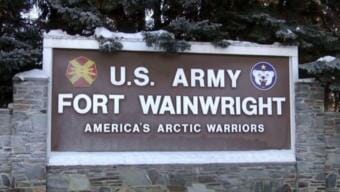
The Alaska-based 11th Airborne Division will host its first large-scale training exercise next week on ranges around Fort Wainwright and Eielson Air Force Base. That means more than 500 Army vehicles that’ll take part in the exercise will be traveling on the Parks Highway and the northernmost stretch of the Richardson Highway.

The exercise is called the Joint Pacific Multinational Readiness Center-Alaska, and this year it’ll be hosted by the 11th Airborne Division — not U.S. Army Alaska. That’s because the Army de-activated USARAK last summer and reactivated the 11th Airborne to assume command of Army Alaska-based troops and assets.

The change was part of the Army’s new Arctic strategy.

“It’s an ongoing effort to kind of regain the muscle memory that we had in years previous for dealing in Arctic temperatures and conditions and terrain,” says John Pennell, 11th Airborne spokesperson.

Paratroopers with the 1st Battalion, 501st Parachute Infantry Regiment, a unit that’s part of 4th Brigade, 25th Infantry Division formerly assigned to United States Army Alaska, conduct a Joint Forcible Entry Operation onto Donnelly Drop Zone near Fort Greely as part of last year’s Joint Pacific Multinational Readiness Center exercise. (Christopher B. Dennis/U.S. Army/DVIDS)

Observers have for years pointed out that Alaska-based soldiers frequently were deployed to faraway conflict zones in hot, arid places like Afghanistan and Iraq. Pennell says those rotations hindered the soldiers’ familiarity of how to operate in Arctic.

“We lost a lot of that knowledge, a lot of that ability, during the 20 years (when) we were focused primarily on rotating in to the global war on terrorism,” he said in an interview last week.

Another change in the exercise this year is the venue.

“The primary training area is going to be the Yukon Training Area, closer to Eielson Air Force, as opposed to the Donnelly Training Area, down near Fort Greely,” he said.

Army officials decided to move the exercises to the Yukon Training Area to determine whether it can accommodate large numbers of troops and equipment, he added. Some 8,000 soldiers and more than 500 military vehicles will take part in the exercise.

“In the past, we haven’t used it for this kind of a large-scale exercise,” he said. “So we’re wanting to put that area through its paces, as well as our forces.”

Pennell says participants in this year’s exercise will include special operations personnel, trainers from the Joint Readiness Training Center in Louisiana, and observers and soldiers with allied nations from Canada, Europe and Japan.

Trucks transporting troops and materiel for paratroopers with the 725th Brigade Support Battalion, 4th Infantry Brigade Combat Team (Airborne), 25th Infantry Division, stage near the Donnelly Training Area in preparation for last year’s Joint Pacific Readiness Multinational Readiness Center. (DVIDS/U.S. Army)

Military-vehicle traffic around Fairbanks, Parks Highway through April 6

Staging the exercises in the Yukon Training Area will mean the soldiers and equipment from Joint Base Elmendorf Richardson mainly will be traveling to and from Fort Wainwright over the Parks Highway and the northernmost 30 miles of the Richardson Highway.

“That doesn’t mean that you might not see a military vehicle over on the Rich,” he said, “but the Parks is our primary means of getting there.”

Convoys from JBER started rolling toward Fort Wainwright over the Parks Highway on Wednesday, and they’ll travel from Wainwright to the Yukon Training Area near Eielson and back over the Richardson Highway beginning next Wednesday. They’ll begin returning to JBER the following week, on April 6.

UAF scientist finds evidence of recent volcanic activity on Venus

This computer-generated 3D model of Venus’ surface shows the summit of Maat Mons, the volcano that is exhibiting signs of activity. A new study found one of Maat Mons’ vents became enlarged and changed shape over an eight-month period in 1991, indicating an eruptive event occurred. (NASA/JPL-Caltech)

A University of Alaska Fairbanks scientist has found evidence of relatively recent volcanic activity on Venus. UAF Geophysical Institute professor Robert Herrick reviewed radar imagery of the surface of Venus collected over eight months in 1991 by NASA’s Magellan spacecraft and found evidence of lava flow at a vent on Venus’s largest volcano: Maat Mons. 

“Not only is it 9 kilometers high, it covers an area that is over a thousand kilometers across, so we’re looking at a very small part of a gigantic volcano,” Herrick said.  

A paper outlining the discovery was presented at the Lunar and Planetary Science Conference happening this week in Texas. Speaking during a press conference Wednesday, Herrick explained the time lag between collection of Venus imagery by Magellan and the identification of active lava flow on Maat Mons. He said the ability to screen the vast amount of imagery gathered by Magellan was initially limited by technology.

“The type of analysis that resulted in this discovery, really required the ability to pan around few hundred gigabyte data sets and zoom in and out,” he said.

Herrick’s co-author, NASA’a Scott Hensley, emphasized that there’s no algorithm to search out the geographic changes caused by lava flow.

“This is still a manual task,” he said. “So you do need that new technology for displaying things because we can’t write mathematical code that can search through all the data to find that.” 

Herrick and Hensley’s research, which was published Wednesday in the journal Science, adds Venus to a short list of bodies in our solar system known to be volcanically active. Herrick says future Venus observation missions will likely document volcanic flows that have happened since those seen in the images captured by Magellan over 30 years ago.  

Site notifications
Update notification options
Subscribe to notifications