KUAC is our partner station in Fairbanks. KTOO collaborates with partners across the state to cover important news and to share stories with our audiences.
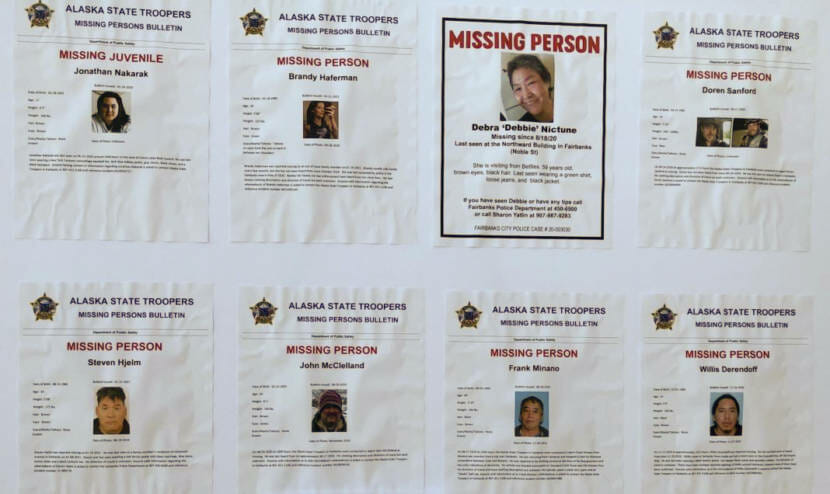
Missing person bulletins posted by Alaska State Troopers (Dan Bross/KUAC)
A nationwide scam is targeting family members of missing Alaskans. Alaska State Troopers spokesperson Austin McDaniel said scammers are searching social media posts to find relatives of missing people.
“Locate phone numbers of names associated with missing persons, and they’ve been texting or contacting the phone numbers that are listed, claiming that they have that missing person and they’re demanding ransom,” McDaniel said.
A trooper press release warning Alaskans about the scam said the caller claims the missing person was kidnapped and now is sick and demands money for their safe return. There are numerous recent missing person cases in Alaska, but McDaniel would not say whether scammers are targeting family members of any particular cases.
“There have been multiple instances occurring within the state of Alaska, and we hope that Alaskans will become aware of this type of scam occurring,” McDaniel said.
McDaniel stresses that anyone contacted should not respond, but instead reach out to the law enforcement agency handling the missing person’s case referenced.
“Additionally they can email the information to: AKVIC@Alaska.gov. Forward that communication you had with the scammers over to that address and they can look into it,” he said.
McDaniel would not say whether anyone in Alaska has lost any money as a result of the missing person scam.
A large solar array was quietly installed in the wilderness at the edge of Denali National Park over the last two summers. The remote system is drawing recognition from solar and renewable energy analysts because it could generate 90 kilowatts and power a small ecotourism resort called Camp Denali.
Conditions were perfect in the spring of 2019 for Camp Denali to start building the array. There was very little snow, and the ground was still frozen.
Trucks carried the photovoltaic panels along the 92-mile Park Road along with all the electronics that go with them — and 18 21-foot steel piles to be driven into the ground.
Simon Hamm runs the 70-year old resort with his wife, Jenna. It has 20 cabins and lodge buildings spread out over 67 acres.
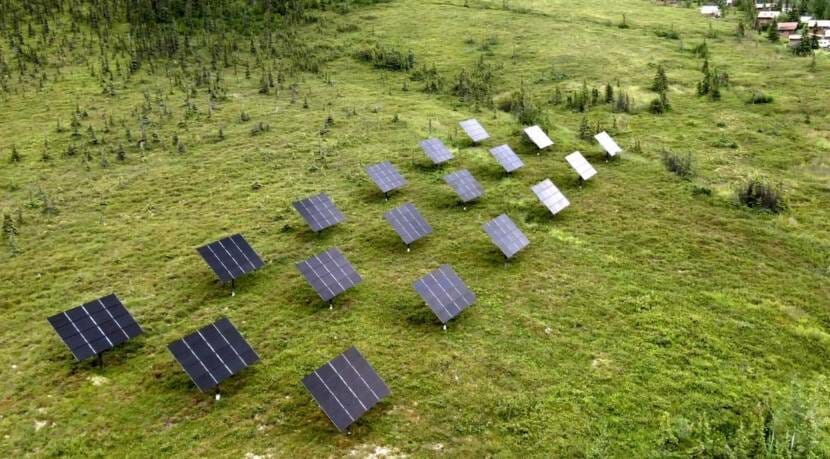
“Our aim was to entirely power a commercial operation. The 16 panels times 18 arrays works out to 288 panels, and it’s capacity is about 90 kilowatts,” Hamm said.
The impressive remote solar spread took two summers to install. The panels and electronics were designed and hooked up by Greg Egan of Remote Power.
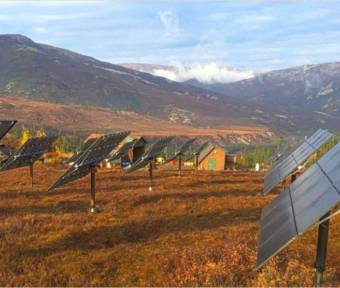
18 tracking solar arrays make up the 90KW electricity-generating system at Camp Denali, 92 miles down the Denali National Park Road. (courtesy of Camp Denali)
“It is a cool project,” Egan said. “It is a big, complicated system. It’s the biggest I’ve worked on for a long time.”
Egan built up the equipment and bench-tested it in his Fairbanks shop before bringing it down and through the park.
He was impressed at the environmental standards the Hamms worked to.
“They really wanted to take care of the taiga,” Egan said. “50 years ago, maybe 60 years ago, the original homesteaders, they drug a big tree across the tundra there, and there’s a 4-foot ditch there. Because they squashed, you know, the memory foam. They damaged it, and it doesn’t come back.”
A mobile rig from Denali Drilling out of Anchorage came to the site to drill 18 holes for the support stands that hold the arrays. But bringing a piece of heavy equipment to the wilderness took some planning, Hamm says, and a lot of hand work.
“We made things harder on ourselves, in the stewardship piece,” he said. “We didn’t want the tundra all ripped up. Back-breaking effort by our staff, our crew of Camp Denali, to lay protective mat on top of tundra, replace tundra manually, by hand any time that it got disturbed in the slightest. Proud to say that it’s hard to tell that there’s been a drill rig out there.”
As work went along in the summer of 2019, it was time to bring in the nickel-iron batteries, which can withstand being left dormant in low winter temperatures.
“Our batteries weigh about 18,000 pounds,” Hamm said. “They arrived to the park entrance the day after the subsidence at Pretty Rocks closed the park road for 2019.”
The slipping road surface caused the NPS to close the road in August, and that meant a halt to some of the work at Camp Denali that year. Then in 2020, the pandemic hit. That meant canceling all the reservations, and laying off some of the 50 staff members that run the camp.
But it also meant finishing the solar installation without disturbing any guests.
“Because we weren’t doing guest operations, we could focus pretty exclusively on projects, including getting the solar much farther along,” Hamm said.
The installation has drawn the attention of renewable energy organizations in Alaska and Outside. In 2021, the system will have a chance to prove what it can do.
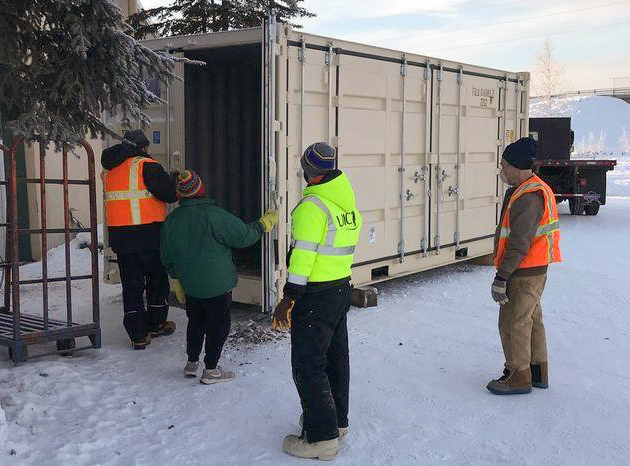
A shipping container provides the basic structure for the kitchen-bathroom module. (Courtesy of Cold Climate Housing Research Center)
A shipping container outfitted as a kitchen and bathroom unit will be incorporated into a home built in the Norton Sound community of Unalakleet. The module is central to a small house project aimed at lowering the cost of residential construction in remote villages.
The National Renewable Energy Lab’s Cold Climate Housing Research Center in Fairbanks is working with the Native village of Unalakleet to build the prototype kitchen-bathroom module inside an 8-by-20-foot steel shipping container.
“Basically, looking at how a container could be used to make a semi-modular home in rural Alaska,” said Aaron Cooke, architect and project manager. He says the idea is to prefabricate the two parts of a house that require the most specialized materials and expertise so they can be shipped out whole.
“Then the container holding the bathroom and the kitchen will just be plugged into the house like a cassette. And then the rest of the house will be built around it and roofed,” he said.
Cooke says that’s important to preserve local construction jobs. Native Village of Unalakleet housing director Kari Duame says having the kitchen and bathroom components completed offsite gets around the need to bring in skilled trades people.
“Once you do get somebody out here you’re paying so much for the cost of their flights and all their equipment and tools and their housing – the cost is just astronomical,”
Duame says avoiding these costs will make federal Indian housing block grant dollars go further in the community.
The high costs of rural housing have real effects in how people live in rural Alaska, says Thomas Simonsson, a community development coordinator with the Norton Sound Economic Development Corporation. He’s also part of a regional group formed to help find solutions to the housing shortage.
“Overcrowded housing is so common. It’s so expensive for people to get out of their parents’ or their grandparents’ house and get their own,” he said.
Simonsson sees the shipping container small house project as a model that could help more people get their own places.
“I know how important it could be to just have your own little space but also have it efficient and make it work,” he said. “Not just four walls and roof, but can you actually have it be meaningful and functional?”
The shipping container kitchen-bathroom unit is being outfitted at the Cold Climate Housing Research Center facility in Fairbanks and will be barged to Unalakleet in the spring, then plugged into the rest of the home built on-site there this summer. The Native Village of Unalakleet will conduct an application process to select a recipient for the new home based on income and other qualifications.
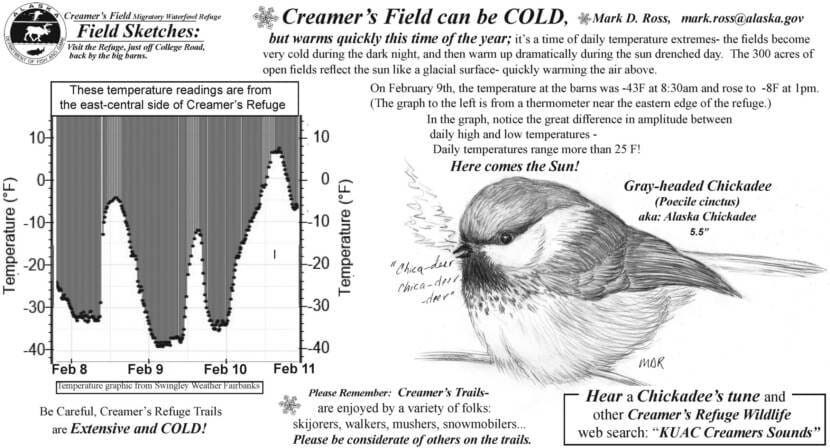
Courtesy of Mark Ross / Alaska Department of Fish and Game
Temperatures of 40 below zero might send most of us to our couches, but not Creamer’s Field Migratory Waterfowl Refuge biologist Mark Ross. He grabbed his recorder and some water.
He wanted to see if you could hear water freeze immediately on a cold surface in extreme cold. His recorder also caught the sounds of hairy woodpeckers, redpolls and chickadees on a frigid morning at Creamer’s Field in Fairbanks.
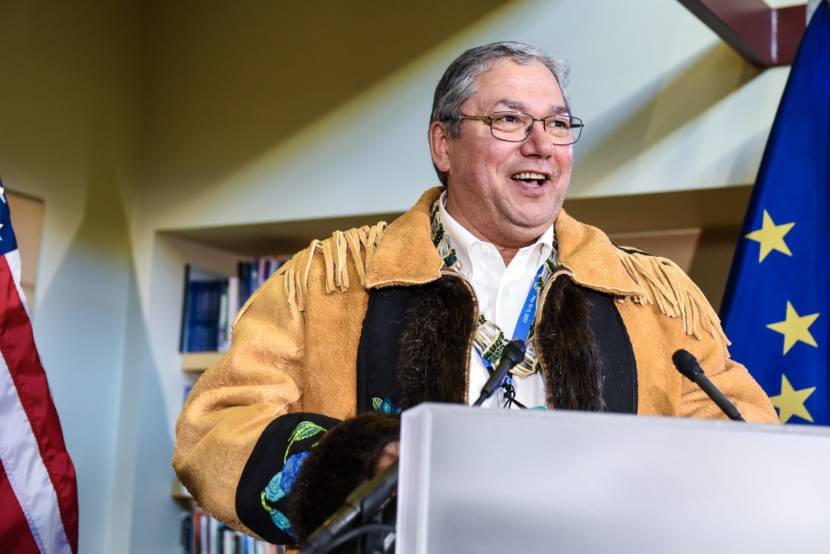
Former Tanana Chiefs Conference Chief and Chairman Victor Joseph has been appointed to a federal task force set up by the Biden administration to ensure all Americans are tested and treated for COVID-19 fairly.
Former Tanana Chiefs Chairman Victor Joseph says he’s gratified to have been selected to serve on theCOVID-19 Health Equity Task Force.
“It is a real honor to participate at this level,” he said in an interview Wednesday.
Joseph has worked more than 20 years for Tanana Chiefs, including seven as its health director and six as its chief and chairman, a position he held until his second term expired in October.
Joseph says his work with the organization contributed to his selection to serve on the task force, including “my experience over the years, being in health care and being in administration.”
A White House news release announcing the task force appointments says the COVID-19 pandemic has “exposed and exacerbated severe and pervasive health and social inequities in America.” It says “People of color experience systemic and structural racism in many facets of our society and are more likely to become sick and die from COVID-19.”
Joseph says ensuring equity in providing care for all communities is the task force’s central mission.
“I want to do whatever I can to ensure that there is equity throughout this,” he said.
Community Health Aide Nicole Gregory gives 93-year-old Virginia Johnston a COVID-19 vaccination on Dec. 21– the first elder to receive the shot at the Yukon-Koyukuk Elder Assisted Living Facility in Galena. Tanana Chiefs Conference has been coordinating COVID vaccinations for communities in the TCC region of Alaska. (courtesy Tanana Chiefs Conference)
The White House says problems with incomplete data that doesn’t track race and ethnicity are undercutting COVID testing and treatment in those diverse communities.
The release says data that’s not broken down by race and ethnicity on COVID-19 infection, hospitalization and mortality rates, as well as underlying health and social vulnerabilities of those people, has “further hampered efforts to ensure an equitable pandemic response.”
The release also says inequities in rural and tribal communities require “a place-based approach to data collection.”
The task force will recommend ways to address those inequities, according to the news release.
President Biden created the task force last month by executive order. It’s headed by Health and Human Services Secretary-designate Xavier Becerra, and it will include officials from other agencies, along the 12 task force members.
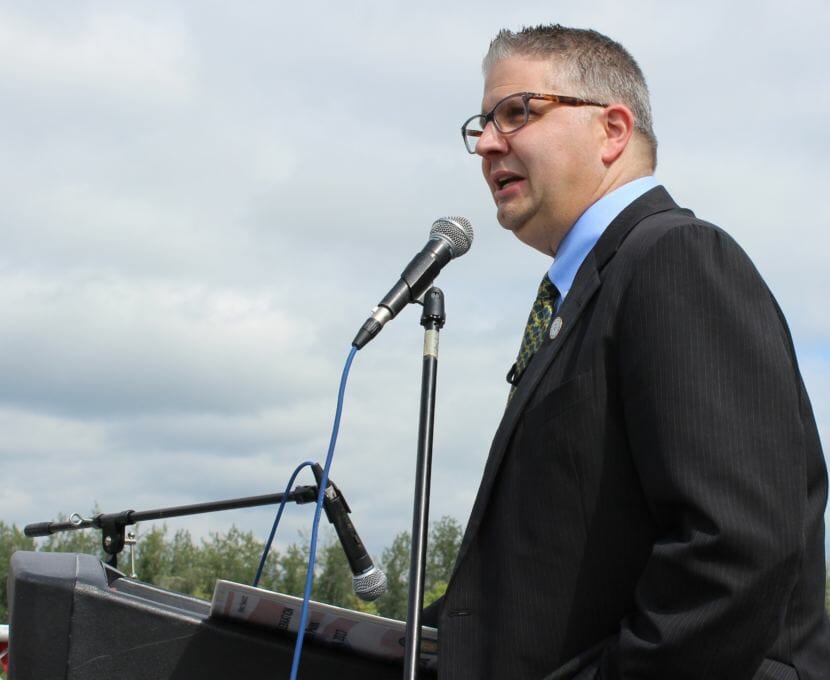
Fairbanks Mayor Jim Matherly speaks from the deck of the historic S.S. Nenana steamboat at Pioneer Park in Fairbanks on July 4, 2017. (Photo by Mary M. Rall/U.S. Army Alaska Public Affairs)
There’s concern about the process that Fairbanks Mayor Jim Matherly used to review applicants vying to be the city’s next police chief. At a city council meeting this week, some public comments were critical of a process that screened out applicants prior to the interview stage.
Mayor Matherly described one step in the process, where Juneau Police Chief Ed Mercer and consultant Greg Russell screened applications.
“They reviewed the 18 applications we got,” Matherly said. “We got 18 of them, and they reviewed every resume for minimum and preferred experience and qualifications.”
Matherly said Mercer and Russell selected 10 candidates to be interviewed by a local review committee. The panel ultimately selected 5 finalists for participation in a public forum scheduled for tonight.
Although the council was sent a memo about the process on Jan. 25, council member Valerie Therrien took issue with the mayor’s lack of transparency about the screening process.
“You never advised us that there would be two people that would be deselecting individuals to be interviewed by the committee,” she said.
Therrien said the situation is especially concerning because two local candidates were among those screened out prior to the interview stage. Fellow council member June Rogers said she’s received a lot of public feedback about the issue.
“So many letters and calls from people who are concerned,” she said. “It doesn’t bode well for us.”
Rogers joined Therrien in suggesting a pause in the hiring process. Council members Aaron Gibson and Jim Clark underscored that both the mayor and council have roles to play.
“He has that right to choose who he wants for police chief,” Clark said. “And we have, as a council, the right to either agree with him or send him back to the drawing board.”
The finalists for the police chief job include two internal applicants: acting City Police Chief Rick Sweet and Acting Deputy Chief Ron Dupee. The other three finalists are from Outside: Koula Black is a major with the Mocksville Police Department in North Carolina, Derek Bos is Brush, Colorado’s police chief and Todd Richardson is a sheriff’s deputy in Beaver County, Utah.
The city’s diversity council is hosting tonight’s public forum for the five finalists. City spokeswoman Teal Soden says it will be similar to the last time the city hired a police chief.
“This is the way for the applicants to introduce themselves to the community, and for the community to hear them answer a few questions provided by the Fairbanks Diversity Council,” Soden said.
All five candidates will answer two questions sent to them yesterday, followed by additional questions not provided in advance. Soden says the questions were written by the diversity council.
“Some of the questions are specifically about diversity, and so we thought that they would be the best ones to think about what they would like to see in a police chief,” Soden said. “And also the Fairbanks Diversity Council covers many sectors of our community, and we wanted them to participate as well.”
Close
Update notification options
Subscribe to notifications
Subscribe
Get notifications about news related to the topics you care about. You can unsubscribe anytime.