"As Managing Editor, I work with the KTOO news team to develop and shape news and information for the Juneau community that's accurate and digestible."
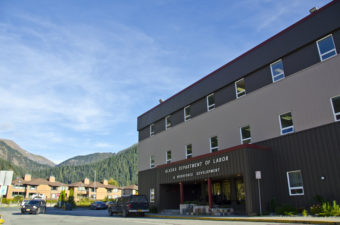
“This is a very uncertain time about what’s going on with the federal funds and I know it’s making people anxious and we’re here to try to help,” Calloway says.
Depending on how long the furlough lasts and if individual claims meet eligibility, the state would pay furloughed federal workers from the unemployment insurance fund, then bill the federal government for reimbursement after the quarter ends December 31.
If federal workers receive unemployment benefits, then are paid retroactively for the time they were furloughed, Calloway says it’s unclear if they would have to repay those benefits.
“That’s a question that is up in the air but unfortunately we can’t ask the federal government because they’re closed,” she says.
“Our position would be to pay them as long as they’re eligible at the time,” says Lennon Weller, who’s currently in charge of managing Alaska’s unemployment insurance trust fund. “Later on if the situation becomes that they end up getting retroactively paid for those weeks, then that’s not for us to determine at this point. I think our biggest worry is to obviously put money in people’s pockets in the immediate time frame if they’re currently obviously not working or not able to work and aren’t receiving a paycheck.”
Weller says he doesn’t know how many federal workers have filed for unemployment insurance since the government shut down, but he expects it will be higher than normal.
“It’s looking like the latest tallies that are coming which of course would be just activity that’s happened in the last day or two does seem to be indicating a significant bump in demand at least for the federal workforce or ex-federal workforce.”
Weller says the maximum weekly unemployment payment is $370.00, not including dependents. If the furlough continues, the earliest payment for a federal worker who filed last week would be October 15.
Inside the kitchen of Coppa, a new ice cream and espresso shop. (Photo by Lisa Phu/KTOO)
Coppa is family friendly. There's a changing table in the restroom. (Photo by Lisa Phu/KTOO)
Coppa owner Marc Wheeler invested $75,000 into opening Coppa, which included the purchase of this $10,000 batch freezer to make ice cream. (Photo by Lisa Phu/KTOO)
Marc Wheeler makes all the ice creams and sherbets from scratch in Coppa's kitchen. (Photo by Lisa Phu/KTOO)
V's Cellar Door serves Mexican food infused with flavors from other cuisines, like Korean. (Photo by Lisa Phu/KTOO)
V's Cellar Door is in the location that was formerly occupied by Olivia's de Mexico. (Photo by Lisa Phu/KTOO)
Venietia Santana, owner of V's Cellar Door in Juneau, pours a drink in 2013. Santana used to run a food truck called V's Grinders. (Photo by Lisa Phu/KTOO)
V's Cellar Door opened at the end of August. (Photo by Lisa Phu/KTOO)
B's Bakery and Bistro was closed for one week for small improvements. It reopens this week. (Photo by Lisa Phu/KTOO)
B's Bakery and Bistro serves what owner Rebecca Gaguine calls "gourmet comfort food." (Photo by Lisa Phu/KTOO)
Rockwell is undergoing a major renovation. Co-owner Deb Barry says when it reopens in early November, "Everything will be different." (Photo by Lisa Phu/KTOO)
Juneau’s downtown dining scene has some new additions while a couple established eateries are making changes.
Coppa is the Italian word for cup, when referring to a cup of ice cream, which was Marc Wheeler’s main inspiration. Wheeler’s decision to open the shop with his wife Jessica Paris is partly based on the success he had selling homemade rhubarb sherbet during this summer’s Food Truck Fridays.
“It was so rewarding to make something with your hands, make people happy, and make money at the same time,” Wheeler says.
Coppa specializes in homemade ice cream and sherbets, baked goods, and espresso drinks, which requires the work of two baristas and a baker. It opened at the end of September.
“I knew it would be some work to build this place, but I didn’t know how much work. I had no idea of how much work and all the decisions you have to make to basically build a place from nothing,” he says.
Wheeler says he’s invested about $75,000 into renovating the space and buying kitchen appliances, including a brand new $10,000 batch freezer that makes six quarts of ice cream in eight minutes.
Coppa is located on Glacier Avenue in the same building as Seong’s Sushi Bar near the Federal Building. It opened a week before the government shutdown which Wheeler says has caused business to decrease by 20 percent. He says that wasn’t part of his business plan.
Wheeler is a semi-finalist in the Path to Prosperity business competition. If he’s selected, he’ll have access to a consultant to develop a business plan. He hopes to get into the wholesale ice cream business.
In the heart of downtown on Seward Street, Venietia Santana has been serving Mexican fusion at V’s Cellar Door since the end of August.
Santana took over the space that formerly housed Olivia’s de Mexico. She pulled the carpet out, bought new furniture, added lighting, and changed the color scheme.
So far, she says, business is better than expected.
“Apparently people like it and keep coming back. It’s not just my friends feeling bad for me,” Santana says laughing. “It’s actually people who enjoy the food and keep coming back, so it’s been really, really busy. We’ve been meeting or exceeding our goal every day.”
Santana employs seven people including two cooks and three wait staff. Aside from trying to keep prices down – dinners are around thirteen dollars – Santana says her main priority is customer service, “I want people to come in here and feel comfortable. I want them to know that they’re going to be able to get what they want and the way they ordered it and everything is top notch.”
The biggest challenge for Santana is getting ingredients. She says her menu includes Mexican dishes infused with other cuisines, like Korean and Italian. Most of the supplies she can’t find locally are mailed by friends and family in the lower-48.
“Some has come from Korea that we’ve had to wait weeks for,” Santana says.
Santana says the Small Business Administration (SBA) helped her a lot, “The SBA really does the paperwork with you and that foundation, that groundwork that makes you okay with and plan for how do you get your doors open. They’re a free service for business. Without them I wouldn’t be open.”
B’s Bakery and Bistro on 2nd Street was closed last week for touch up work on the kitchen.
Owner Rebecca Gaguine says when customers return this week, they won’t notice any changes since most of the work was done in the back. B’s currently has 9 part-time employees.
The eatery most known for its cupcakes also serves breakfast and lunch.
“During the summer, we had a really good breakfast crowd, so I’m excited to see what it’s like during the legislature,” Gaguine says.
Around the corner and down the street, Rockwell is currently undergoing a major renovation.
Co-owner Deb Barry says Northwind Architects came up with a design that involves new walls, a new bar, a stone fireplace, and a tin ceiling. She says everything will be different, including the menu.
“We’ll be adding to the menu. We’ll have a lot more ability to do steaks and seafood and things like that,” Barry says.
The renovation will increase dining room seating capacity to about 80. Rockwell’s 20 employees include six cooks. Rockwell, which has been open for about a year, serves breakfast, lunch, and dinner.
Barry says she hopes to reopen Rockwell in early November.
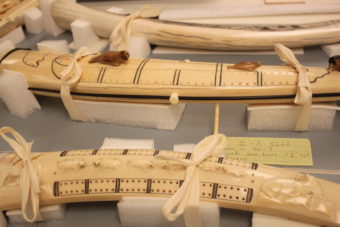
Museum professional Jon Loring takes a break from creating custom storage mounts for ivory pipes. He makes 12-15 a day. (Photo by Lisa Phu/KTOO)
“Some of these are really complicated and you have to cut exactly the right angle to support the object and it’s not so easy,” says Jon Loring on making storage mounts. (Photo by Lisa Phu/KTOO)
Alaska State Museum conservator Ellen Carrlee wants to ensure a walrus stomach drum from the 1974 Arctic Games remains unharmed during the move to the new building. (Photo by Lisa Phu/KTOO)
Alaska State Museum conservator Ellen Carrlee leaves handwritten notes on every cabinet detailing how different items should be packed for moving. (Photo by Lisa Phu/KTOO)
This piece of red tree coral stands more than 3 feet tall and will be moved to the new building in this custom-made structure. (Photo by Lisa Phu/KTOO)
Museum registrar Addison Field says some paintings may need to be hand carried to the new building. (Photo by Lisa Phu/KTOO)
These ivory figures are among the smallest items in the museum’s collection of over 32,000. The largest item is an 18-ton locomotive. (Photo by Lisa Phu/KTOO)
Museum volunteer Fran Dameron affixes numbers onto mining artifacts. (Photo by Lisa Phu/KTOO)
Ivory cribbage boards sit in custom storage mounts made by museum professional Jon Loring. (Photo by Lisa Phu/KTOO)
And inside the old building, a small team of museum professionals and volunteers are preparing to move. They’re packing up the entire Alaska State Museum collection – ranging from a 45-foot umiak to half-inch-tall ivory pieces.
Only five percent of the museum’s collection is displayed at any given time. The rest is stored in the basement.
As conservator for the Alaska State Museum, Ellen Carrlee is responsible for figuring out how to pack up more than 32,000 objects. It involves opening every drawer in every storage unit and coming up with a plan for each item.
“Like this drawer for example has several boxes in it already, which are really easy to travel,” Carlee says as she pulls out a drawer, “but this drum which is from the Arctic Winter Games. It’s a walrus stomach drum from 1974 and it has signatures of people all over. It’s very delicate.”
Carrlee says she and other museum staff members pack and move objects all the time – for exhibits or to go on loan – that’s part of their job description. But moving an entire collection is a once in a career type of thing.
There’s no manual on how to pack up a museum collection, so Carrlee resorted to more pedestrian means – she Googled it.
“If you look on the internet for good methods for packing museum artifacts, and you try to search Google images or whatever, you’d think there’d be a lot of images but there’s not nearly as many as we’d like to see,” says Carlee.
Move bynumbers: A quick look at what makes up part of the Alaska State Museum’s collection
600 masks from Alaska’s various cultural groups
1,100 baskets from around the state
3,000 framed fine art pieces
70 carved ivory pipes
One 18-ton Baldwin Locomotive from the Alaska-Gastineau Mine
One 45 foot walrus hide umiak
So she’s had to improvise. Carrlee has come up with about a dozen different techniques for packing various artifacts, including dance fans with feather appendages, ivory cribbage boards, spruce root baskets, and a three-foot high piece of red tree coral.
She walks around the basement with a yellow legal pad, scrutinizing each artifact and writing down a plan to stabilize it. After she’s gone through all the objects, she tapes her handwritten notes and diagrams to the outside of the cabinet.
“Every cabinet, every drawer, every item has to have a plan,” she says.
Carrlee heads up a team of staff and volunteers who are tackling different aspects of the packing.
On this day, museum professional Jon Loring is focused on ivory. He wears cotton gloves and is in the process of making custom storage mounts for carved ivory pipes.
“Ivory is one of the most fragile objects in the collection,” Loring explains.
Loring sits by a table filled with cutting materials, measuring devices, a glue gun, a spool of cotton ribbon, and different size scraps of foam and cardboard.
“Some of these are really complicated and you have to cut exactly the right angle to support the object and it’s not so easy. I can probably do about 12-15 of these a day,” he says.
The museum has 70 ivory pipes in its collection. Loring is also making custom mounts for masks. There are 600 of those.
Volunteer Fran Dameron has been helping out at the museum for 14 years. At the moment she’s putting numbers on mining artifacts.
“Did you see these enormous wrenches down here? I wouldn’t try to lift it. That’s why I was working on the floor,” Dameron laughs.
The numbers are linked to the museum’s database which keeps track of all the collection items.
Carrlee says the process of having to look through every storage unit has helped the team locate what are called “registration problems” – items without a number. “This museum goes back to 1900 so we’ve got 113 years of potential clerical errors.”
There’s also the chance of finding something that was missing, or two pieces that were separated.
“Right now I’ve got a bag that has a wing in it from a taxidermied bird and I know that through this process, I’m eventually going to find a bird with one wing and we’re going to reunite the bird with its wing,” Carlee says.
The team has until the end of February to pack up the museum’s collection. Once that’s all done safely and securely, Addison Field is in charge of moving the collection.
The majority of it will travel in carts through a tunnel to be built between the current building and the new one.
Field says other items, like paintings, may take more care. He anticipates many will need to be hand carried. “One object and one person and that’s not the most efficient way to do things, but when you’re dealing with things that are really truly treasures and need to be safeguarded, that’s the safest way to do it,” says Field.
And then there are the items that won’t fit through the tunnel, like the 8-foot wide, 45-foot long walrus hide umiak, which was originally assembled inside the building. Field doesn’t know how that will be moved. But what he does know, is when the doors of the new State Libraries, Archives and Museums building open in the spring of 2016, the umiak will be there unscathed.
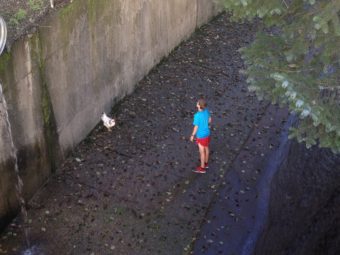
JDHS cross country runner Nick Heidersdorf stands near the chicken. (Photo courtesy of Linda Mancuso)
Runners on the Juneau-Douglas High School cross country team rescued a chicken last night from Gold Creek at Cope Park.
Students spotted the chicken during practice and saw that it was stuck.
Runners Riley Moser and Madeline Handley worked together to get the chicken out.
“One kid lowered my daughter into the water down there in Gold Creek to save the chicken and yanked my daughter and the chicken back up,” says Catherine Reardon, Handley’s mother.
The chicken is described as large and white with black around its neck and on its tail.
Another runner on the cross country team Soren Thompson took the chicken temporarily to his residence where his family has a coop.
JDHS cross country team is anxious to return the chicken to its owner. For more information on how to claim the chicken, call 463-5110.
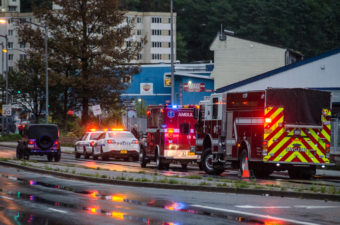
Juneau police responded to a report of a death along Egan Drive shortly after 7 this morning. (Photo by Heather Bryant/KTOO)
Story updated 2:52 p.m.
Juneau police says foul play is not suspected in the death of a Juneau homeless man whose body was found near Egan Drive this morning.
Juneau police says foul play is not suspected. (Photo by Heather Bryant/KTOO)
A man was found lying between a wood wall and chain link fence in the area of the Coast Guard subport parking lot across Egan Drive from the Goldbelt Hotel at 7:16 am, according to a release by Juneau police.
Juneau police department and Capital City Fire and Rescue found 52-year-old Juneau resident Peter Karl John, Jr. had recently died.
“We do believe he may have been struggling with a substance abuse problem and that can make people vulnerable in a number of ways – the substance itself, the weather, other illnesses,” says Lt. Kris Sell.
Lt. Sell says police have no listed residence for John.
He was a frequent visitor to Juneau’s soup kitchen in recent years. Glory Hole cook Michael Monte says John was a good friend:
“When I heard about it this morning, it really hurt me. I wish I was there to help him before all this happened.”
Monte last saw John a couple months ago.
As part of the investigation, communications director Erann Kalwara says Juneau police spoke with two individuals that were in the area this morning and know John personally.
The state medical examiner will conduct an autopsy to determine the cause of death.
Kalwara says John’s relatives in Juneau have been notified.
Editor’s note: This story has been updated to reflect new information from Juneau police department’s Lt. Kris Sell.
Story updated 10:41 a.m.
A body of a man was found lying down between a wood wall and a chain link fence in the area of the Coast Guard subport parking lot across Egan Drive from the Goldbelt Hotel at 7:16 a.m., according to a release by Juneau police department.
Juneau police department and Capital City Fire and Rescue found 52-year-old Juneau resident Peter Karl John, Jr. was recently deceased.
One lane of inbound travel on Egan Drive was closed this morning during part of the investigation.
In the release, Juneau police says foul play is not suspected at this point.
The state medical examiner will be conducting an autopsy to assist in determining the cause of the death.
Story updated 9:19 a.m.
The scene has been cleared. Both lanes of traffic are now open.
Original Story: 8:39 a.m.
The Juneau Police Department is investigating a death near the intersection of Whittier Street and Egan Drive. Police arrived on the scene sometime after 7 a.m. this morning.
One lane of inbound travel on Egan is shut down..
This is an ongoing story. Check back here for updates.
Hotel Impossible designer Blanche Garcia in the lobby of the Alaskan Hotel on the third day of shooting. (Photo by Heather Bryant/KTOO)
This sign was posted on the window of the Alaska Hotel last week. (Photo by Lisa Phu/KTOO)
Hotel Impossible host Anthony Melchiorri has managed several hotels, including the New York Plaza. (Photo by Heather Bryant/KTOO)
The Alaskan Hotel and Bar was placed on the National Register of Historic Places in 1978. (Photo by Heather Bryant/KTOO)
Hotel Impossible wrapped up filming at the Alaskan Hotel on Saturday. (Photo by Lisa Phu/KTOO)
Hotel Impossible hired local contractor Stopher Construction to help out with the makeover. (Photo by Lisa Phu/KTOO)
Travel Channel’s reality show Hotel Impossible wrapped up filming at Juneau’s famed Alaskan Hotel this weekend.
KTOO caught up with the show’s host and designer during their third day of shooting.
Anthony Melchiorri is the host of Hotel Impossible.
“If people are looking for this hotel to be restored, to come into the lobby and see it completely redone, and just, ‘Oh my god,’ that’s not going to happen,” he says.
Most TV viewers want to see the ‘before’ and ‘after’ effect of a hotel makeover, but Melchiorri says his job is more about what’s not as obvious.
“My show is not about renovation. My show is about repositioning hotels and really giving them the plans to move forward. I’m more interested in the infrastructure of the operations and how people communicate and deal with each other. My job is to reengage the spirit of the hotel,” explains Melchiorri.
The Alaskan Hotel in downtown Juneau opened one-hundred-years ago and is the oldest operating hotel in the state. Owners Bettye Adams bought the hotel in 1977 with her husband Mike; it was placed on the National Register of Historic Places in 1978.
“I think of the hotel as beyond wood and nails. It is organic, it is a process, it’s a state of mind, it’s a historic museum, it’s a family,” says Bettye Adams.
Adams remembers the phone call that got her on Hotel Impossible.
“The first thing that the fellow said, ‘Well, how would you like an hour on the Travel Channel on national television?’ and I went, ‘Hmmm, let me think about that – yes,'” she says laughing.
After she accepted the offer in August, Adams says she watched episodes of the show and got nervous about being humiliated on television. By the third day of shooting, Adams was over it.
“You just have to decide that they’re going to stomp on your ego and let it go,” she says.
That same day, Melchiorri says he was about to have a nervous breakdown.
“Every single time I take over a hotel on this show, I feel like I’m going to throw up. People think this is fake. Ask anyone I dealt with today if this is a fake show. I isolate myself. I don’t speak to anyone unless the cameras are rolling and I don’t know what they’re going to say or what I’m going to say.”
Outside of television, Melchiorri is a hotel consultant. He’s managed numerous hotels, including the New York Plaza, and was senior vice president of a hotel management company.
When asked what he thinks is a challenge for the Alaskan, “The bar is loud, and when you have 45 rooms sitting on top of a bar, that’s like a bear wrestling a fish, the bear always wins, so that’s a problem,” Melchiorri says.
On the positive side, Hotel Impossible designer Blanche Garcia says the hotel’s historic value is a strength.
“As a designer, you get a lot of inspiration, so I, of course, would not put a New York SoHo loft in here, whatever I did, or put grass on the walls or things like that, so you’re working apropos to the area,” she says.
Will the beloved Alaskan bar be part of the makeover? Nope, says hotel owner Adams.
“I think the bar would stand up and just resist. No, it’s not going to change,” Adams says.
The episode at the Alaskan Hotel will kick off Hotel Impossible’s fourth season which will air sometime next year.