Lisa Phu

Managing Editor, KTOO

"As Managing Editor, I work with the KTOO news team to develop and shape news and information for the Juneau community that's accurate and digestible."
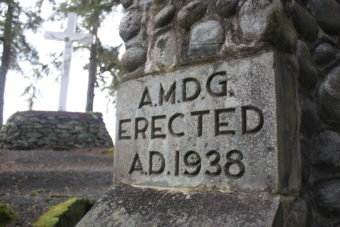
Volunteers and staff continue to give life to the Shrine

The Shrine of St. Therese has gone through various stages of use and deterioration in its 75-year history. It even closed in 1985 but a small group of Juneau residents gave it another life. Since then, the Shrine has remained open to the public for various activities while undergoing small and large renovations.

The Shrine has only survived and thrived through the hard work of Shrine staff, the generosity of volunteers, and the spirit of St. Therese.

The Shrine of St. Therese is rooted in community support.

Shortly after the cornerstone of the chapel was laid 75 years ago, 83-year-old Albert Shaw attended summer camp at the Shrine. “I remember we helped get the rocks for the causeway, throw them in the dump truck,” he says.

Help came from other groups as well.

“During the depression, during the 30s, fellows would show up here and go up to the church looking for a handout and Father LaVasseur would say, ‘I’ve got something for you to do,’ and ship them out to the Shrine and put them to work,” Shaw recalls.

Over the decades, the Shrine has gone through cycles of high use and deterioration, until 1985 when Thomas Fitterer got involved.

“It was basically closed down for use. There were many buildings that were falling apart. It was in a real slump. It really needed a lot of love and tender care,” he remembers.

Fitterer says he had an inner calling to help the Shrine, “The diocese was even talking about possibly selling it because it was such an expense, but God had another plan.”

Fitterer along with a small group of Juneau residents were passionate about getting the Shrine back to being a place of spiritual retreat.

A board of directors formed in 1986 and Fitterer and his wife Mary were asked to be Shrine directors. “When we took it over, it was in the red,” he says.

With the help of a dedicated board and other volunteers, the Shrine slowly got back on its feet. Within ten years, the Shrine was bringing in its own money.

Throughout his 25-year career as Shrine director, Fitterer says his main job was figuring out how to bring about new infrastructure and new facilities, “A lot of times it was just getting out of the way and allowing the people who had the gifts to bring them forth.”

Improvements included a new road, a bridge, a new water system, new sculptures of the Stations of the Cross, the Columbarium, and the construction of the Jubilee and Little Flower retreat cabins.

“So often I would scratch my head and say, ‘Lord how are we going to do that?’ and somehow or another I could ask somebody or somebody would volunteer,” say Fitterer.

In recent years, that somebody has often been Sam Bertoni. Almost every day for the past 13 years, Bertoni is volunteering at the Shrine doing one job or another.

“We have our own water system, our own septic system, so that takes some attention. Minor carpentry work and electrical work and plumbing work and plowing,” lists Bertoni. “We do our own plowing and sanding, so pretty much, it’s kind of like a little village.”

Bertoni’s hours depend on what project he’s working on.

“I’ve never spent a night here in 13 years, but I’ve been out here in the middle of the night thawing out pipes,” Bertoni says.

The Shrine has a couple dozen volunteers throughout the year. If there’s a bigger project, more will show up. Past work days have brought out more than a hundred people.

The Shrine is named after St. Therese. Born and raised in France, St. Therese became a nun when she was only 15. In 1897, at the age of 24, she died of tuberculosis. Alaska Bishop Joseph Crimont knew her family and when she was canonized, he declared St. Therese Queen and Patroness of Alaska.

St. Therese is also called ‘The Little Flower’ because she knew the importance of small contributions.

Diocese of Juneau Bishop Edward Burns says that’s like the Shrine’s history.

“[St. Therese] spoke in her journal about how even a small smile to a passerby means so much. It’s a connection. So with the little things that we offer, it helps transform society,” says Bishop Burns.

Now, Shrine director Deirdre Darr is introducing the Shrine to a younger generation.

“The whole history of the Shrine is just everyday people in Juneau and outside of Juneau who have just loved it and I think it’d be great to introduce it to another generation so that they can start to step in and take over for those who are getting older who have been loving and caring for the Shrine,” Darr says.

At times, Darr is overwhelmed with being in charge of the Shrine’s future, but knows she’s not alone.

“We can’t forget that we’re not the ones ultimately who are responsible, that hopefully there will be some divine inspiration to help us figure out what the future will be,” she says.

The combination of divine inspiration and human ingenuity is likely to guarantee the Shrine will be around for decades to come.

Shrine celebrates 75 years of retreats and reflection

The Shrine of St. Therese  kicked off a year-long 75th anniversary celebration on Saturday. The cornerstone of the chapel was laid and blessed by Alaska Bishop Joseph Crimont on October 30, 1938.

The Shrine was originally built as a place to inspire devotion to God. At the time, there were no other spiritual retreat houses in Alaska and Father William LeVasseur saw the need to build one.

But throughout its 75 year life, the Shrine has welcomed people of all beliefs. Residents of Juneau, Southeast Alaskans, and visitors go to the Shrine for all kinds of reasons.

As you drive out Glacier Highway from downtown Juneau, you eventually start winding along the coast with intermittent views of the Chilkat Mountains. Past Tee Harbor, you start driving up. Soon, you descend through a hemlock forest.

Turn left at mile 23 and find “a lot of trees, streams. As you walk down, you see log structures, you see the ocean,” describes Thomas Fitterer, director of the Shrine of St. Therese for almost 25 years. “You see a causeway. On the other side of the causeway is an island, Shrine Island. So you walk over to Shrine Island and suddenly you see a church made out of rock.”

Surrounding the church are the Stations of the Cross, each station depicting a scene of Christ’s final hours on earth and the resurrection.

“Then you look out and the ocean waves are hitting against the rocks, so you have God and nature so prevalent there that you cannot help but be influenced – whether you’re a believer or non-believer – somehow or another, one is touched by the peace, by the gift of natural beauty, and by the spirit,” Fitterer says.

From the beginning, the Shrine has been a place where everyone is welcome, even in the 1940s, Fitterer says, when religious groups tended to stay separate.

“Back then even, people of all denominations or no denomination felt comfortable coming to the Shrine and that’s been the flavor ever since and that’s something that I would never want to see lost,” he says.

The Shrine was built as a place to hold religious retreats, escape normal activities and be with God through prayer and reflection. It’s still a place to retreat, but in many different ways.

“The good thing about the Shrine,” Fitterer says, “is you can do everything from have a picnic on the beach to fish to rock climb to rock find to walk the labyrinth. It fulfills the needs of so many people in so many ways.”

The Shrine has always been seen as a place to escape this busy world full of distractions. “You’ve got your iPhone and you’ve got your tweets and you’ve got whatever else, a lot of people just get caught up into that pattern,” says Fitterer.

Over the years, visitors have told Fitterer about how much they enjoy being at the Shrine. People have talked of experiencing miracles and feeling close to God, even when they didn’t have one.

Fitterer recalls one visitor who have traveled all over the world, but felt a special presence at the Shrine, “She just could feel it, and she said I’ve never seen and felt a more beautiful place on earth.”

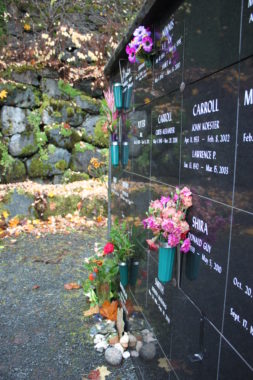
At the Shrine, volunteer Sam Bertoni walks to the outdoor columbarium where the ashes of his mother and another 200 individuals are laid to rest.

“Some people come and visit all the time,” says Bertoni. “I know people that come out here on a regular basis every week to put flowers or to communicate with their loved ones. Some folks come out here many times a week.”

A semi-circle of six black granite walls, each about seven feet tall and 11 feet long face the ocean.

“And it’s a fantastic view. You know I can’t afford beachfront in this life, but maybe in the next life,” Bertoni laughs.

The Shrine offers church services during the summer and other holidays throughout the year. Bertoni remembers one Easter service. “There must have been 100 people and there must have been 150 sea lions out here yelping because of the killer whales, and there was so much commotion, you couldn’t even talk. It was like a hundred dogs barking. It was really something,” Bertoni says.

Over the decades, the Shrine has grown beyond the original structures of the chapel, lodge, caretaker’s house, and the post office. It now offers five separate rental cabins which are used regularly for day use, overnights, weekends, and longer stays.

Caretakers Jack and Jeanne Jordan are in charge of the daily happenings at the Shrine. Besides being used by the Catholic Diocese of Juneau, the units are rented out by many other groups.

“We have other churches, the state of Alaska, the school district, the Coast Guard, different businesses utilize it, we have yoga groups sometimes, women’s retreats and sewing groups, scrapbooking groups, anniversary celebrations, birthday celebrations, family reunions,” says Jeanne Jordan.

It could be as simple as wanting a quiet place to walk around or as complicated as pondering the meaning of life. Jordan says people in search of something often visit the Shrine of St. Therese and find what they’re looking for.

Foundation surprises DZ principal with $25,000 award

Dzantik’i Heeni Middle School principal Molly Yerkes has been honored with the national Milken Family Foundation Educator Award. Yerkes received the award before 430 students during a school assembly.

Since 1987, the foundation has honored outstanding educators throughout the nation. This year up to 40 educators will be presented with awards; Yerkes is the only one in Alaska.

Thursday morning’s event was billed as a typical assembly, but it wasn’t.

Dzantik’i Heeni Middle School principal Molly Yerkes convened the assembly that was scheduled to feature state education commissioner Mike Hanley.

Hanley talked about respecting others. He told the students not to laugh when someone was being teased or bullied, and how that would discourage unacceptable behavior.

A few special guests sat in the audience – Juneau representatives Beth Kerttula and Cathy Munoz, district superintendent Glen Gelbrich, and a few school board members.

The assembly took a turn when Dr. Jane Foley announced, “The Milken Educator Award goes to Molly Yerkes.” Foley is a senior vice president of the Milken Family Foundation

The award caught Yerkes off guard.

“I was incredibly surprised and so appreciative. I just – I still am in shock,” Yerkes says laughing.

[youtube https://www.youtube.com/watch?v=gQDOkPISkd0]

Yerkes has spent thirteen years in education including five years as a teacher at Floyd Dryden Middle School and six years as assistant and interim principal at Dzantik’i Heeni.

As a principal, Yerkes practices shared leadership

“I really value the staff at Dzantik’i Heeni,” she says. “They work with our students one-on-one, so the more that I can include the voices of our staff in decision making, I really find that our decisions are much stronger.”

The rapport with staff is part of the reason why Yerkes was given the award.

“She’s had educators that say if she moved to another school, they would follow her and they delayed their retirement to stay here because she was their leader now,” Foley says.

Dzantik’i Heeni middle school students have similar sentiments. Eighth grader Selma Houck says Yerkes is often in the classrooms, “One time last year I was struggling a lot in math and I actually raised my hand and asked a question and the teacher answered me but I was still a little confused.”

At that point, Yerkes went over to Houck and helped her figure out the math problem. Houck says those are the kinds of things that the students really notice.

“I felt really happy and kind of proud that she would come over and help me with that and thankful that we have such a great principal to come and do things like this,” Houck says. “I’ve moved a lot and have gone to a bunch of different schools and not all principals are this nice.”

Eighth grader Josef Monsef says he’s really excited that his principal got the Educator Award, “She’s just a role model to everyone here. You’d just be joking around with your friends laughing, having a good time, and then you see her come and it’s like – ‘Oh, Ms. Yerkes’s coming. Straighten up,’ something like that. But, yeah, we really just want to make her proud.”

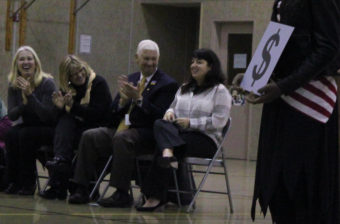
The Milken Educator Award includes a financial element revealed at the assembly just before the big announcement. Standing next to Foley, five students held up placards displaying a dollar sign and the number 2,500.

Foley asked, “Commissioner Hanley, could you find one more zero?”

Hanley pulled the last zero from under his chair to reveal the total amount – $25,000.

Yerkes says she doesn’t know what she’ll do with the money, but she’s sure she’ll have fun coming up with ideas.

Disturbing the peace code would define “unreasonable noise”

Another version of a draft disturbing the peace code went before the CBJ assembly and planning commission during a joint meeting last night, and there are still issues with the ordinance.

Boats anchored in Juneau's harbor watch the fireworks.
Assembly members wondered how fireworks would be treated under the draft ordinance amending the disturbing the peace code. (Photo by Heather Bryant/KTOO)

Fireworks were brought up by a few assembly members during discussion on the disturbing the peace code. City attorney Amy Mead explained how fireworks fit under the new language on “unreasonable noise”:

“A violation hinges solely on whether the reasonable person would find it unreasonable, so fireworks on the Fourth of July, most people would not find that unreasonable. Fireworks going off on May 2nd – that might be found unreasonable by the majority of people, in which case it would be a citable offense.”

Assembly member Jesse Kiehl asked for the meaning of “pure tones,” which is one of the factors for determining “unreasonable noise.”

“Are they a good thing or a bad thing for purposes of enforcement?” he wondered. “Or do they just need to come out if we’ve got a reasonableness standard anyway?”

Mead said despite not knowing the definition of “pure tones,” the language may become useful for enforcement, “I would hesitate to take it out when it doesn’t change the ordinance in any way. It adds a factor that can be considered. It doesn’t hurt to leave it in.”

“If I don’t know what it does,” Kiehl replied, “I don’t know whether it hurts to leave it in or not.”

Assembly member Jerry Nankervis had a problem with the liability section of the ordinance. He said the owner of the property where noise is coming from is not always the one responsible.

“I go out of town. My 21-year-old is tasked with house-sitting my house. They have a party that makes a lot of noise without my approval, without my consent. The police get called. They come. Am I responsible, am I the one that’s going to get the ticket?” Nakervis asked. “I firmly believe that citing the person responsible for making that noise and that is sometimes not the owner.”

Mead said the liability section of the ordinance is not new language. She said, in the example, the 21-year-old would be responsible and cited. The ordinance assumes that the owner of the property has caused the noise or allowed it to happen, but that assumption can be argued.

The CBJ assembly and planning commission met in a special joint session Monday night. (Photo by Lisa Phu/KTOO)

“The person who owns the house can come in and prove that they didn’t know, and they didn’t approve, and they didn’t allow it, in which case, they would escape any responsibility,” Mead explained. “But it does give us an avenue if we think that there is some responsibility that should attach to that person.”

While problems were still found with the draft ordinance, planning commission chair Mike Satre said he likes the direction it’s going in. He said the ordinance has a several year history with city staff and planning commissioners, “The recommendation from staff to put it back to the assembly was to go back to the disturbing the peace ordinance, ensure that it was simple and it was going to be enforceable and it was something the community members could rely upon.”

City staff will continue to work on the ordinance before it goes back to the Assembly during committee of the whole.

Alaska Robotics hopes to satirize 2014 legislative season

Filmmaker and illustrator Pat Race wants to create a satirical news series documenting the 2014 Alaska Legislature, and he hopes crowdsourcing will make it happen.

Pat Race, Lou Logan and Aaron Suring are the guys behind the Alaska Robotics label. In 2007, the trio created the online short Buy Back Alaska to satirize the VECO corruption scandal.

During it, Race explains, “Based on recent ethical violations, our political scientists estimate the cost of renting an Alaska state legislator for a session is about $250,000, although some could be had for much less.”

[youtube https://www.youtube.com/watch?v=2e1DDGSD4DM]

In the 2007 Frank Murkowski Tribute, Juneau performer Collette Costa sings, “But I’m leaving on my jet plane, don’t think I’ll give it back again, oh the state should make it mine,” to the famous John Denver tune.

[youtube https://www.youtube.com/watch?v=26yyxg73iFQ]

In the recent 2013 Legislative Update, Race introduces his newscast, “Good day. This is Pat Race reporting from Juneau, Alaska, where the legislature is in session and out to lunch.”

[youtube https://www.youtube.com/watch?v=-d4MlIWS4Uw]

Since 2004, Alaska Robotics has occasionally produced short satirical web videos. Now they want to create a web series during the 2014 legislative session called Alaska Robotics News.

“We would follow the news, we’d follow what’s going on in the capitol building and we would offer commentary and criticism and humor and create sort of a parody news show along the lines of like Weekend Update or the Daily Show, but more localized,” says Race.

Race says no one would be safe in the upcoming series, “I want to make fun of both sides of the aisle. I don’t want to protect anyone and attack anyone.”

Politically, Race considers himself middle of the road.

“My dad is pretty conservative and my mom is pretty liberal and I feel like I’m in the middle on a lot of issues, though I think that George Bush probably pushed me more in the liberal direction most recently, but Obama is doing a good job of pushing me back,” Race says.

While he may not be able to say definitively what political box he’s in, Race knows what he cares about – personal freedom, everyone having a voice, and political satire. Race says it engages people, keeps them informed, and it can be powerful.

“It’s like the court jester who can say anything to the king and kind of get away with it,” Race explains. “It’s important to have political satire because you can hold this up as a reflection and it’s a little bit of a funhouse circus mirror reflection, but it is a reflection of our society. Humor is a way to offer commentary on issues in kind of a safe environment.”

Race says Alaska Robotics News is targeted to all Alaskans. There’s already a fan base.

“I get a lot of state workers and people that are in the capitol building that aren’t, for whatever reason, allowed to really have a political opinion or express it very well, and they really enjoy seeing our shorts because I think it gives them a chance to sort of decompress or blow off some steam or laugh at the position they’re in,” says Race.

Race says it’s important that politicians know how to laugh at themselves.

“I thought Sarah Palin did a great job when she went on Saturday Night Live. I think that was one of the things that really made her stand out as a human being, more than just a political candidate. And I’m not going down that road of what I think about Sarah Palin, but that was something that really impressed me,” he says.

During the last legislative session, Race had Senator Bill Wielechowski on his program, and he hopes Governor Sean Parnell will make an appearance on Alaska Robotics News this coming session.

If you want to see the 2014 Alaska Legislature reflected in a funhouse mirror, you can find Alaska Robotics News on Kickstarter. The project is now live.

The pledge levels mimic the political hierarchy. If you pledge $5 or more, you’re an intern, $15 or more moves you up to page. Pledging at the $75 or $100 level makes you a representative or senator. $500 makes you a good ole boy. Pledge $4,000 or more and you’re in the corrupt bastards club.

Interest in healthcare enrollment expected to pick up in Juneau

Enrolling in the new federal marketplace is off to slow start in the capital city. Ongoing technical issues with the insurance website have made it difficult, but those charged with helping Juneau residents enroll expect interest will pick up.

The federal insurance website is still experiencing technical difficulties, but Enroll Alaska has more than 1,700 individuals interested once it’s functioning properly. (Photo by Lisa Phu/KTOO)

Tyann Boling, Enroll Alaska’s chief operating officer, says, “I’ve stopped enrollments.”

But that hasn’t stopped Alaskans from trying – four have been successful on the federal marketplace.

“We have well over 1,700 individuals that we will be working with to get enrolled once the marketplace is up and going,” Boling says.

Of the 1,700, more than 75 are from Juneau.

The Affordable Care Act allows each state the opportunity to build its own marketplace. Governor Sean Parnell opted not to do this, so Alaskans are dealing with the same difficulties as others dependent on the federal website.

Enroll Alaska currently has one agent in Juneau. Boling hopes to eventually add two more.

“We will have more join that team there; however, we are not deploying agents to our locations because the marketplace is not functioning. We don’t want to discourage the consumers. We’re definitely in a holding pattern,” she explains.

When the Marketplace is functioning properly, Boling says Enroll Alaska agents will be placed at Bartlett Regional Hospital and Wal-Mart.

“We’re ready,” says Boling. “Our spaces are ready and we’d love to be there today, but we don’t want it to be a service that we’re not able to provide.”

United Way navigator Crystal Bourland says interest from Juneau in enrolling for healthcare is increasing week by week. (Photo by Lisa Phu/KTOO)

United Way navigator Crystal Bourland has been stationed at the National Alliance on Mental Illness office in Juneau since earlier this month. Bourland has been educating people on the marketplace, eligibility for subsidies, and the difference between insurance plans. Each week, she’s getting more and more calls.

“The interest is growing especially as people are finding their way to me. Even today, I’ve set up several appointments for the coming week,” Bourland says.

Bourland has not enrolled anyone from Juneau in a healthcare plan yet, but she’s not discouraged.

“There may be some frustration out there, but I’m finding in the interactions that I’ve had that people are really in the information-gathering stage and they just have a lot of questions about the marketplace and what options are available to them,” says Bourland.

Schedule an appointment with navigator Crystal Bourland by:

  • calling 523-1147
  • emailing cbourland@ak.org

Contact Enroll Alaska by:

  • calling 855-385-5550 or 907-770-5100
  • emailing info@enrollingalaska.com
  • go to the website
Alaska has 140,000 uninsured residents – more than 5,000 are in Juneau – and Bourland’s main job right now is reaching out to those people.

“We’re still getting started so just continuing to create awareness and outreach opportunities to see what that need is,” she says. “There are thousands of people in Juneau and thousands of people in Alaska that are uninsured so knowing that there are new healthcare options out there, I think the interest is strong.”

Bourland says the majority of calls she gets are from people looking for individual plans, a few have asked about plans for dependents, but there’s been no interest in Juneau from small businesses, businesses with fifty or less full-time employees.

Bourland hopes this will change.

Site notifications
Update notification options
Subscribe to notifications