"As Managing Editor, I work with the KTOO news team to develop and shape news and information for the Juneau community that's accurate and digestible."
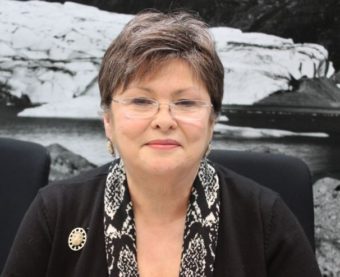
CBJ assembly member Karen Crane will be the next president of the Alaska Municipal League. (Photo by Lisa Phu/KTOO)
CBJ assembly member Karen Crane will be the next president of the Alaska Municipal League board of directors. Currently, Crane is first vice president. She’ll take up her new position at the end of this week’s AML conference in Anchorage.
Crane says she’s excited to be working with communities around the state. On top of the annual meeting in November and meetings in the spring and summer, Crane says she’ll be busy throughout the legislative session as AML responds to various pieces of legislation.

“We are watching everything that’s proposed, deciding where the league might be helpful and providing testimony and information to the legislature as they do their work,” Crane explains.
Crane says a big issue coming up is making sure revenue-sharing funds are available to all communities in Alaska, “Municipal league only works on those issues that concern all communities in the state and have agreement. We do not take positions on issues that divide.”
This is Crane’s fourth year in the municipal league. Crane originally became second vice president through an AML election, and automatically succeeded to first vice president, and now president.
Juneau’s soup kitchen, Glory Hole, needs more turkeys for their annual Thanksgiving boxes. (Photo by Ruocaled)
Juneau’s soup kitchen still needs more than 140 turkeys for their annual Thanksgiving boxes.
Glory Hole executive director Mariya Lovishchuk says boxes will be given in shifts this year. Currently, the organization only has 14 turkeys, which isn’t enough for the first round of pick-ups on Sunday.
Other needed food items include potatoes, stuffing, cranberry sauce, butter, and canned goods, like corn, fruit, and green beans.
This year, 160 families have signed up for Thanksgiving boxes from Glory Hole. Lovishchuck says this number is slightly higher than last year’s.
“We have a lot of families who are just working parents with kids. They’re trying to clothe their kids, they’re trying to pay rent, they’re trying to pay for utilities, and then once you count up all the stuff in the turkey box, it actually does come out to be a lot of money, and so I think that some folks are just having a really hard time making that happen,” she says.
The second round of Thanksgiving box pick-ups will start on Wednesday.
Turkeys and other food items can be dropped off anytime between 7 am and 9:30 pm at the Glory Hole, which is on 247 South Franklin Street.
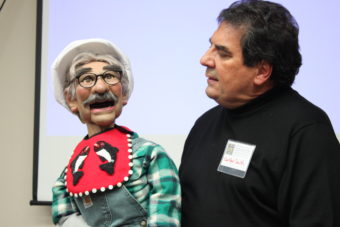
Charlie is Carlton Smith’s second puppet. Smith first started doing ventriloquism 50 years ago as a ten-year-old boy. His first puppet was named Jerry. (Photo by Lisa Phu/KTOO)
Tlingit teachers Roby Littlefield and Bessie Jim demonstrate a simple Tlingit dialogue with sock puppets – an activity that can be used with children. (Photo by Lisa Phu/KTOO)
Charlie's wardrobe is exactly how the real Charlie James, or Shanak'w Uwaa, dressed when he was alive. (Photo by Lisa Phu/KTOO)
Session participants, including ANB Grand President Bill Martin and poet and translator Richard Dauenhauer, all practice Tlingit ventriloquism with sock puppets. (Photo by Lisa Phu/KTOO)
While trying to throw their voices, Smith has participants count in Tlingit as well as say clan and place names in Tlingit. (Photo by Lisa Phu/KTOO)
Three Native elders have fun making up a Tlingit dialogue with their sock puppets. (Photo by Lisa Phu/KTOO)
Charlie sings the killer whale song and the Alaska Flag Song. (Photo by Lisa Phu/KTOO)
One of the conference organizers, Ishmael Hope. (Photo by Lisa Phu/KTOO)
Native elder Florence Sheakley shares a warm smile with Charlie. About ventriloquism, she says, “It was awesome to see that Tlingits can do this.” (Photo by Lisa Phu/KTOO)
According to Smith, Charlie is a figure, not a 'dummy.' The difference, says Smith, is that Charlie has features that move, like his eyes, mouth, and eyebrows. Charlie can even cry. (Photo by Lisa Phu/KTOO)
Like many other indigenous languages, Tlingit is in survival mode. Revitalizing the language was the focus of this year’s Tlingit Tribes and Clans Conference held in Juneau last week.
A Juneau resident has one solution for how to keep the language alive. During a conference session, realtor and assemblyman Carlton Smith gave participants a lesson in how to teach Tlingit to children with puppets. And he does it with the help of a special guest.
Charlie introduces himself in Tlingit to the room. As is traditional, he recognizes his mother’s relatives, his fathers’ relatives, then his grandparents, and finally, he recognizes everyone else.
Charlie’s Tlingit name is Shanak’w Uwaa. He identifies his moiety (Eagle), his clan (Keet Gooshi Hit’), and where he’s from (Klukwan, or Jil’ kat kwaan).
Charlie is wearing grey Carhartt overalls, long underwear, a green and white flannel shirt, and tan work boots. He has a full head of grey hair, dark bushy eyebrows and mustache, and black-rimmed glasses.
He’s roughly three and a half feet tall and can only talk when he’s sitting on Carlton Smith’s lap.
Smith got into ventriloquism fifty years ago as a ten-year-old boy living in Haines. When Smith was bedridden with hepatitis for four months, his father bought him his first puppet from a Sears-Roebuck catalog – a red-headed figure wearing a green suit named Jerry.
“There were children walking below my bedroom window and Jerry and I were talking to them as they would walk home from school,” Smith tells the audience. “The first day or two, there were five or six children, the second day there were eight or nine. By the end of the week, there were 20 children that came to see this little green man that wanted to talk to them from a second story window.”
Like many childhood toys, Jerry was eventually forgotten, until three years ago when Smith rediscovered Jerry in a trunk.
Then, another discovery on a flight to Anchorage.
“I was looking out the window and I realized I could count to ten without moving my lips in Tlingit. And then I was going right down the list of clans and place names and I thought, ‘Oh, this is kind of cool.’”
That’s how Smith got the idea of doing Tlingit ventriloquism, but he wasn’t sure how the community would receive it. So he went to the late Tlingit elder and religious leader Dr. Walter Soboleff for advice. Soboleff liked the idea but said it couldn’t be done with Jerry. He advised Smith to create a new figure – a Native one.
“My namesake, Shanak’w Uwaa, means ‘in the image of the ancient people.’ Walter said, ‘He was one of my best friends from Kilisnoo.’ He said, ‘What you do is you create a brand new figure in the image of the person you’re named after.’”
As Smith looks at Charlie, he says, “That’s who this is – Shanak’w Uwaa.”
Shanak’w Uwaa is the Tlingit name of Charlie James of Klukwan, who would be 108 years old if he were alive today. Smith never met his namesake.
Using photos of Charlie James, Smith worked with a figure maker in Michigan on details like skin tone and hair color.
Charlie, says Smith, was created for one main purpose, “This is really about children.”
For a year and a half, Smith and Charlie went to Tlingit and Haida Headstart every Friday. “These little kids would just want to grab him, claw him,” Smith recalls.
Charlie would sing songs in Tlingit and count to ten.
Smith says children are captivated by the animation which makes learning Tlingit easier.
Later on in the conference session, participants are asked to pair up and make basic Tlingit dialogue with sock puppets, an activity that can be done with children. Two Tlingit teachers – Roby Littlefield and Bessie Jim – pair up.
“She asked me what my name was and I pretended not to hear her,” Littlefield says, interpreting. “So she asked me louder. One of us asked where do you live?”
Neither has spoken the language with puppets before, but both like the idea. Jim plans to bring the technique back to her students in Carcross, Yukon.
“I think they’ll get a lot more out of it and it’s more fun. And my brother used to say, ‘The language is fun.’ He said, ‘They’re always laughing,'” Jim says, laughing herself.
Littlefield says teaching with puppets can help her middle school students in Sitka with something they’re working on right now, “We’re learning the animal names and we have little stuffed animals and little hard animals. So they’re going to learn the name of the animals and then talk to each other in whatever puppet voice they choose.”
The most important thing, says Smith, is having fun. His goal at the conference was to share a different way of teaching Tlingit to children, a way that might breathe new life into a challenging task. And he hopes Charlie will help accomplish that.
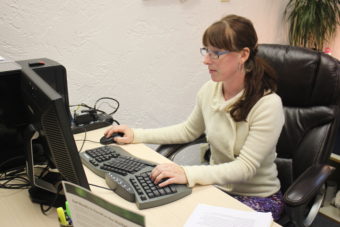
United Way navigator Crystal Bourland is based at the NAMI office off Glacier Highway, but she is also mobile and can enroll people who aren’t able to get to her. (Photo by Lisa Phu/KTOO)
Juneau’s United Way navigator Crystal Bourland enrolled one person for a health insurance plan on Tuesday.
While she’s happy to have her first successful enrollment, she’s not totally surprised it worked. Bourland says over the past couple of weeks, the healthcare.gov website has been improving.
“Just going through the application process with someone else, it was a lot faster and it just seemed to be connecting everything very well, so the functionality, at least from my own experience, is working a lot better,” Bourland explains.
Bourland is reaching out to individuals who contacted her before the website was working and hopes to schedule follow-up appointments to enroll more people.
She is also planning a series of educational programs at Juneau public libraries to begin at the end of November. “It’s going to be a presentation on the health insurance marketplace, an overview – what this means for people and financial assistance options and then just enrollment assistance and resources in the community, such as myself,” explains Bourland.
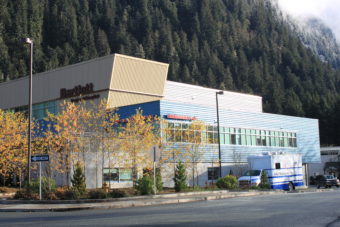
Bourland’s office is located at the NAMI office off Glacier Highway. And starting next week, Juneau will have more help enrolling for healthcare at Bartlett Regional Hospital and Walmart.
Schedule an appointment with navigator Crystal Bourland by:
Enroll Alaska will have one agent at each location. Chief operation officer Tyann Boling is excited to finally deploy agents to Juneau.
“There’s a lot of need in Juneau and I think they will be really helpful to the members of the community there,” Boling says. “There’s a lot of small businesses all across Southeast so I think that there’s a lot of opportunity there and a lot of individuals that need health insurance.”
Since the healthcare.gov website has started to work properly, Boling says phones at Enroll Alaska have been ringing and at least six more people were enrolled Wednesday, “Word is getting out and the interest is picking up and, you know, if I had ten more licensed agents, I would have them full-time in these areas. There’s not enough agents for the demand right now.”
Elsewhere in Southeast, Enroll Alaska plans in the future to have agents in Sitka and Ketchikan.
In order for insurance coverage to begin January 1, people must enroll by December 15.
October 28 was Jeff Egbert’s first day as interim CEO for Bartlett Regional Hospital. He anticipates being around for six to nine months. (Photo by Lisa Phu/KTOO)
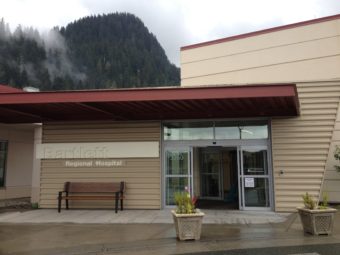
Bartlett Regional Hospital’s interim CEO Jeff Egbert wants to create a culture of open communication with hospital staff and stability, something the hospital hasn’t had for a while.
Jeff Egbert is the latest chief executive officer at Bartlett Regional Hospital. He’s serving in an interim capacity to get the hospital back on track.
“Moving the organization from what seems to be a loss of momentum to forward progression is what I’m focusing on,” Egbert says.
Egbert attributes the loss of momentum to the turnover within hospital leadership.
Complaints surfaced earlier this year about a hostile work environment created by the senior leadership team. At the time, the team included CEO Chris Harff and human resources director Norma Adams. The city hired a private investigator in June and launched a personnel investigation. Shortly after the investigation ended, both Harff and Adams resigned.
Sue Gardner was one of many hospital employees interviewed during the investigation.
Gardner moved to Juneau four years ago to become the director of materials management. Prior to working at Bartlett, Gardner had more than 30 years of experience in the hospital business. Gardner’s spouse, Ron Gardner, says his wife experienced bullying and intimidation by some hospital officials.
“When she moved up here, she loved it. She loved the community. She loved going to work every day. She loved her job. She loved what she does,” Gardner says. “But she got to where she couldn’t stand going to work. She’d come home crying. She was so depressed. It was hard on her health.”
Chief of nursing Billy Gardner – who is no relation to Sue or Ron Gardner – recognizes the tension at the hospital.
“I’m a part of the leadership team and sometimes these are high stress positions,” Gardner says.
Interim CEO Jeff Egbert poses with executive assistant Toni Petrie. (Photo by Lisa Phu/KTOO)
He hopes Egbert’s arrival will bring more stability. Gardner says Egbert is already making strides with forward progress and building a culture of open communication. “First and foremost, he’s visible,” he says. “He’s walking around to each unit. He’s introducing himself to folks that he meets. And his communication techniques are really strong, and so you feel relaxed. You’re able to talk to him and he listens to your ideas.”
Interim CEO Egbert says that’s how he learns about the organization.
“When you’re meeting people, you visit with them. You’re able to find out what are the challenges in their department, the barriers to good workflow and patient care, and we can start working on improving those things. It’s old management adage – management by walking around,” says Egbert.
To improve communication, Egbert may reinstate an employee newsletter. He also plans to eventually hold employee meetings.
“I’ve only been here two weeks, so there’s not a lot I can tell these people,” he says. “Mostly it’s me learning from them and when I do know enough and we’re moving forward, then I’ll have employee forums, then I can share meaningful information with them.”
Despite being temporary, Egbert still wants to foster a sense of stability among the medical staff and employees. He says being visible and accessible will help accomplish that.
“Culture doesn’t happen overnight. Trust is built over time with consistency and good communication,” Egbert explains. “It’ll take a while.”
Aside from Egbert, Bartlett’s current senior leadership team includes chief financial officer Ken Brough, human resources director Mila Cosgrove, and CNO Billy Gardner.
Egbert anticipates being the hospital’s interim CEO for six to nine months.
Juneau residents took their questions to healthcare experts Monday night and got them answered by Alaska Native Tribal Health Consortium navigator Monique Martin, United Way navigator Crystal Bourland, chief operating officer for Enroll Alaska Tyann Boling, and chief administrative officer for Enroll Alaska Chanel Moesh.
Monique Martin, Alaska Native Tribal Health Consortium navigator
1. What is the difference between a healthcare navigator and a healthcare broker?
As a navigator we are really just sort of there to help people navigate healthcare.gov. Brokers can really help people to give them specific direction and suggestions on what plans might best fit their situation, versus a navigator, we’re there to just help them through the process and couldn’t direct them to a plan that might best fits their needs.
2. Will I get the same information about healthcare plans from a navigator and a broker?
Yes. Brokers and navigators are both able to help people on the marketplace. A broker might have more options outside of the marketplace. For instance, I believe Aetna is one that’s really offering a lot of plans. But they don’t offer plans on the marketplace. So a broker would be able to give you more options whereas a navigator just helps you on those plans that are available at healthcare.gov.
Currently the federal government has stated that by November 30, they expect to have the website up and functioning. Once we are confident in the subsidy calculation and the functionality of the marketplace, we will deploy in full force to get individuals enrolled.
4. Since the website isn’t working properly, I keep hearing that I can enroll by phone or mail. Is this true?
The bottom line is no. The website, healthcare.gov is the one location where individuals can enroll into the federally facilitated marketplace. If the website is not functioning, individuals cannot enroll over the phone.
Tyann Boling, chief operating officer for Enroll Alaska
5. What’s the difference between enrolling for an insurance plan through healthcare.gov and enrolling straight from a provider?
If you qualify for a government subsidy, the only way to enroll into a health insurance policy and have that subsidy apply to your premium is through healthcare.gov. If you do not qualify a government subsidy, you can go direct to a carrier.
6. How do I qualify for a government subsidy?
You qualify for a subsidy really based on your household income, so for household income, we use the federal poverty guidelines. If you’re somewhere in between 100-400% of the federal poverty line in this state then most likely you’re going to qualify for financial assistant – aka, a subsidy – to help you pay for your health coverage.
7. What is Alaska’s federal poverty line?
For an individual, it would be $14,350 all the way up to around $57,000. So 100% of the federal poverty line in Alaska is that $14,350 and then four times that is at that $57,000. So if you’re an individual and you are somewhere in between that income level, then most likely you’re going to get financial assistance in the marketplace and you should definitely pursue that.
8. If I’m Alaska Native and I use the tribal health options that are available to me in my community, do I have to enroll in a new health plan?
No, if you go to a tribal health facility, you can keep going there just like you’ve been doing, that stays the same, but you do need to sign up for that exemption called the Indian Status Exemption so you aren’t subject to a tax penalty at the end of the year.
Crystal Bourland, United Way navigator
9. Do military have to apply for an exemption like Alaska Natives do?
No, if you get benefits, VA benefits or any sort of veteran benefits, then you don’t need to prove or apply for an exemption. And then in addition, if you’re on government programs like Medicaid or you have Medicare then you don’t need to apply for an exemption. You’re considered someone who has health insurance.
10. And finally, I keep hearing about bronze, silver, gold packages. What are they?
All plans have to offer what are called ten essential health benefits. So if they are really offering the same coverage, they’re going to differ in this metallic rating of bronze, silver, gold. If you have a bronze plan you’re probably paying less per month but maybe more in your out-of-pockets expenses when you go to the doctor for your copays or deductibles. Compared to someone who has a gold plan, they’re probably paying more per month for their premium, but then when they go to the doctor, they might have a smaller copay or deductible as part of that plan.
Additional questions:
Where can I find prices of different healthcare plans so I can start shopping around by myself?
On the bottom of healthcare.gov, there’s an option to preview plans that are available in your state. You just select Alaska and then you’ll see 36 different plans available on the marketplace, and you can start to see what your monthly payment will be. If you’re just shopping around, it won’t calculate or tell you what your premium subsidy would be to offset your costs, but it will start to give you an idea of what is available out there for Alaskans.
Chanel Moesh, chief administrative officer for Enroll Alaska
What do the acronyms ACA, FFM, and QHP mean? Are there other healthcare acronyms that I might need to know?
ACA refers to the Affordable Care Act, which is the health reform law, also known as Obamacare.
FFM refers to the Federally Facilitated Marketplace, and that includes Alaska. Alaska chose not to partner as a state with the federal government so we’re what’s called a federally facilitated marketplace and we’re using healthcare.gov as our route to apply for marketplace coverage.
QHP refers to Qualified Health Plans. They are covering essential health benefits, which make them qualified to be sold in the marketplace.
Besides acronyms, there’s a lot of health insurance speak, things like, ‘deductibles,’ ‘copays,’ ‘cost-sharing.’ If you’re not in the world of health insurance or if you haven’t gone through the process of finding a plan on your own before, that’s confusing. There’s a lot of insurance speak and jargon. If you’re someone who needs a breakdown of those, there are resources on Premera and Moda’s website as well as healthcare.gov, but seek out help whether through a navigator, an agent, an in-person assistor and ask those questions. Those are fundamental terms that you want to know to help you make an informed decision on your healthcare needs.
What information should I have prepared for when healthcare.gov does work?
Some things people should get together is – if you’re a family and you may have children – social security numbers, dates of birth, tax forms from the previous years, maybe pay stubs from 2013 to get an idea of what your income might look like for 2014. You might want to have a list if you have any special prescription drugs that you have to take so that we can compare plans and make sure the plan you select covers those prescriptions. Bring your list of doctors as well.
How can I find out what my subsidy might be?
There are different tools available to calculate your subsidy or what you might qualify for. On healthcare.gov, there is the Kaiser Family Foundation subsidy calculator and we’ve found that to be a pretty good guess. However I’d say that navigators, as well as licensed agents and brokers, do have some other tools that are more manual and include percentages, so they’re probably going to be a little more accurate. But if you’re just curious, you can definitely go to Kaiser Family Foundation calculator or go to healthcare.gov, type in subsidy calculator and you will find it. There are ways to get it online, but know that it’s probably not exact; it’s just a rough calculation.
What if I buy insurance in Alaska but move to another state?
You’ll have to change your policy to the state where you reside at that point in time. You’ll have a certain time frame that you can switch over that insurance and it should be a seamless transition of coverage. It ends on the 30th of the month and starts on the 1st of the next month. In your new state exchange or federally facilitated marketplace, they have to recalculate the subsidy based on where you are residing at that time.
Why did my insurance plan get cancelled?
Individuals are getting cancellation notices because those individual insurance policies do not meet the requirements of the Affordable Care Act and, therefore, they are being cancelled. Individuals will then have to go out and purchase new insurance. If they qualify for a subsidy, they need to purchase an insurance plan on the marketplace, which is healthcare.gov. If they do not qualify for a subsidy, they can purchase a plan on the marketplace or outside the marketplace.
So if my insurance plan got cancelled, I have to shop for a new one? My insurance company won’t just automatically enroll me into a new plan?
Insurance carriers will map your coverage over, but they won’t determine if you’re subsidy-eligible or not, so they’re encouraging individuals to see if they are subsidy-eligible when they go pick a new plan. Insurance carriers won’t just outright cancel you. For Moda and Premera – the two insurance carriers we have within the Marketplace – they will map you over to a new plan. They will send out the new plan and tell you at that point in time, ‘This is your time to make a plan choice. Stick with the one we’ve given you and take the premium increase, or go to the marketplace and determine if you’re subsidy-eligible.’
Close
Update notification options
Subscribe to notifications
Subscribe
Get notifications about news related to the topics you care about. You can unsubscribe anytime.