Lisa Phu

Managing Editor, KTOO

"As Managing Editor, I work with the KTOO news team to develop and shape news and information for the Juneau community that's accurate and digestible."

What leadership looks like

Clockwise from top left: Tilani Meyers, Lilli Pothier, Nick Bouker, and Abbey VandenBerg were some of the teens talking about youth leadership at the Second Annual Prevention Summit in Juneau. (Photo composite by Lisa Phu and Sarah Yu/KTOO)

Youth leadership programs in Alaska are making a difference. That’s what a panel of teens said Wednesday during the second day of the Prevention Summit put on by the state Council on Domestic Violence and Sexual Assault. Eight teenagers from Southeast Alaska spoke about youth leadership programs like Rebound, Lead On, and Sitka Youth Leadership Committee.

18-year-old Juneau resident Lilli Pothier participated in AWARE and SAFV‘s outdoor leadership program Rebound, in which she and several other female teens went on a week-long kayak expedition. She says the lessons she learned help contribute to the prevention of sexual assault and domestic violence.

“The statistics on sexual violence and assault are well known,” Pothier states. “Many, many women in Alaska have been impacted by these problems, and to stand up and speak out against it, we need to be intact, we need to feel whole, and we need to have a sense of our own power, and that’s what this trip gives to participants.”

Here’s what the teens said about what makes a good leader:

Korbyn Powers: I think leadership is just not judging people for anything they’ve done, just being there for other people in your community and respecting everyone’s differences.

Lilli Pothier: Leadership is service and it’s service with respect and compassion, and leadership is being connected to the people and the place that you’re in.

Tilani Meyers: Being a leader is being positive. Like first you have to kind of take what you say to people, like, “You should do this and this.” You should actually be what you’re telling people to do, like, I like to see positivity in my community, so recently I’ve changed from my negative ways, I guess, and now I’m a really positive person and it’s helped me a lot.

Nick Bouker: A favorite quote I like to go by is, “Be the change you want to see in the world.” Everyone knows that by Gandhi and I think that’s a great example of what a leader should be, is be the change, set examples, and tell your peers what you think they should do to better their future and better themselves.

Analicia Castaneda-Felipe: I think setting a good example for your peers and others in your community. It doesn’t seem as easy as it is. Just doing things that you think is right and hopefully somebody will see that and be inspired to do the same.

Justin Wantanabe: You may not think that you may be able to change the world, the entire world, but even if you just do some positive changes and try to do the best you can in the small communities that we have here, you can definitely see a change.

Abbey VandenBerg: I think leading by example is very important but I also think there’s something to say about being willing to take responsibility and step up and kind of organize movements of change. I think that that’s really what’s needed with youth leaders is the willingness and the confidence to take the initiative and be the driving force behind a movement. I feel like, a lot of times, teenagers especially, we want to do something but we don’t know exactly how and I feel like that’s a role that a youth leader can really step into.

Editor’s Note: This story has been updated to correct the organizations that run Rebound. A previous version of this story had stated that Rebound is run by AWARE. Rebound is actually run by both AWARE and SAFV (Sitkans Against Family Violence).

Participants voice hopes and realities at domestic violence Prevention Summit

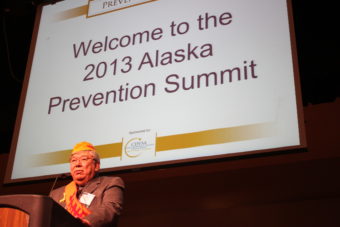
Alaska Native Brotherhood grand president Bill Martin speaks during opening remarks of the Prevention Summit sponsored by the Council on Domestic Violence and Sexual Assault. (Photo by Lisa Phu/KTOO)

The Second Annual Prevention Summit kicked off Tuesday in Juneau. Sponsored by the state Council on Domestic Violence and Sexual Assault, the three-day summit at Centennial Hall brings together teams from 19 communities with the goal of exchanging ideas about prevention.

At the start of the summit, participants told KTOO about what is working in their community and what they hope to gain over the next couple of days.

Tasha Bird (Photo by Lisa Phu/KTOO)

Tasha Bird is a rural outreach coordinator for the women’s shelter in Emmonak, a Yupik village of about 800 people. “My job is to educate youth and young women to stop domestic violence from happening to them and their children, their neighbors,” she says.

Bird also reaches out to 13 surrounding villages. She says the nine-bed shelter has been busy all year. The six extra cots have also gotten a lot of use. Bird says domestic violence and sexual assault in Emmonak is often caused by drinking or jealousy.

“We try to ask them to go get marriage counseling or to go talk to the elders, and they could also come to the shelter and talk to us,” Bird says, “but it’s the men who don’t want to participate or they don’t want to come forward and deal with everything.”

Being able to reach the men in her community is part of what Bird hopes to get out of the Prevention Summit. She’s heard about the statewide program Alaska Men Choose Respect and wants to learn more.

Winifred Kelly-Green (Photo by Lisa Phu/KTOO)

“Lots of the guys at home like to play basketball and maybe I’ll work with the city league and see if they could help me with something because I know lots of the young boys, they look up to those guys,” says Bird.

Bethel resident Winifred Kelly-Green is the healthy families coordinator for the Association of Village Council Presidents. She says she has started working on healing historical trauma, “The attempt to assimilate Yupik people – with that there was a lot of traumatizing things that happened, including the great death, but there were other things – boarding schools, taking children away.”

Historical trauma, Kelly-Green says, is linked to domestic violence and sexual assault in Bethel, “We have parents now who don’t know how to be parents because they weren’t home. They weren’t being parented because of the boarding schools.”

Through forced assimilation, Kelly-Green says Yupik men lost their capacity to pass knowledge to younger generations.

“In the Yupik culture, our men had a place that they called the qasgiq. It’s the men’s house where they gathered and worked together, taught the young boys. And that was their way of maintaining whole health,” Kelly-Green explains. “And with the Christianity that came, they saw that as something bad, so they went up and down the river in every village and burned the qasgiqs down, and leaving our men lost.”

Greg Marxmiller (Photo by Lisa Phu/KTOO)

In Dillingham, Greg Marxmiller works at SAFE, a domestic violence prevention agency, and runs the youth program called Myspace. “The youth program there is huge,” he says. “Getting kids a place to go that’s consistent, that they’re able to have somebody that cares about them and have advocacy and being trained to become leaders and lead in their town and making it a better place.”

In Marxmiller’s opinion, everybody in Dillingham comes from a place where there’s domestic violence and sexual assault.

“It’s something that everybody in the community has to deal with because we’re a community and we all have to deal with our ills, so in essence, everybody from Dillingham comes from an issue of domestic violence and sexual assault,” Marxmiller explains. “So knowing that, there are a lot of people who are working to do something about it and try to stop this domestic violence and sexual assault epidemic.”

Marxmiller’s goals for the Prevention Summit is to network, take new ideas back to Dillingham, and get resources to continue the prevention efforts that are already taking place.

Alaska communities join forces to prevent domestic violence and sexual assault

Communities from around Alaska will meet in Juneau to talk about domestic violence and sexual assault prevention. (Photo from the Council on Domestic Violence and Sexual Assault)

Community members from Alaska towns as large as Anchorage and as small as Allakaket are in Juneau for the second annual Prevention Summit sponsored by the Council on Domestic Violence and Sexual Assault. The council is under the state Department of Public Safety.

The three-day summit at Centennial Hall brings together teams from 19 communities. Each team has at least three members. “They’re victim service providers, first responders such as maybe law enforcement or healthcare providers, tribal representatives, as well as just people interested in preventing violence in their community,” says council executive director Lauree Morton.

Teams will be working on strengthening existing prevention strategies and developing new ones.

“It’s an opportunity for communities across the state to get together and talk to each other about what is working and what else they want to do to prevent domestic violence and sexual assault,” Morton explains.

The summit features presenters from around the state and outside the state, many who are experts in their field. One of the workshops will be with Green Dot, a national non-profit organization that is working with several communities in Alaska on an intervention program.

Morten says youth from Juneau and Sitka will also be highlighted at the summit, “young adults who are actually implementing strategies in their high schools on reducing violence.”

First Lady Sandy Parnell kicks off the second annual Prevention Summit Tuesday at 11 am. Opening remarks will also be made by Morton, Alaska Native Sisterhood grand president Freda Westman, and Alaska Native Brotherhood Grand President Bill Martin.

How to save an endangered language

By speaking Tlingit at home, Mischa Jackson wants to give her daughter Michaelyn something she didn’t have. (Photo courtesy of Alfie Price)

Speaking an endangered language at home is the essence of language revitalization, according to author Leanne Hinton. She’s written the book Bringing Our Languages Home and was recently in Juneau for the Tlingit Tribes and Clans Conference.

Mischa Jackson and her husband are speaking Tlingit to their 10-month old baby Michaelyn.

“We do little words and phrases and commands at home and try to expose her as much as we can to elders that speak conversationally, so she can just hear it. And she loves to hear it. It gets her attention better than English does,” Jackson says laughing.

Jackson herself doesn’t speak the language well. Her family has roots in Klukwan, but Jackson grew up in Anchorage, then lived in southern California. Her mother taught her Tlingit songs, and that’s about it.

By speaking Tlingit at home, Jackson wants to give her daughter something she didn’t have. Jackson’s husband, on the other hand, was exposed to the language growing up in Kake. “Her dad got to listen to his grandparents and he’s a much better speaker because of it, whereas for me, I can’t make the same sounds as easily as he can, so I know it makes a huge difference,” says Jackson.

Jackson is doing exactly what Leanne Hinton recommends for parents who may not speak a language but want to make it a part of their home.

“All it really takes is dedication to the language. It doesn’t even take fluency because you can be learning with your children,” Hinton explains. “Like many of the families I know started from scratch when their children were already born and as they learned, they were bringing it home bit by bit and making it more and more the language of their home.”

Author of the book Bringing Our Languages Home, Leanne Hinton is professor emeritus of language at the University of California Berkeley. She spoke at the recent Tlingit Tribes and Clans Conference in Juneau. (Photo courtesy of Alfie Price)

Hinton is professor emeritus of language at the University of California Berkeley. She specialized in American Indian languages, sociolinguistics, and language loss and revival. She’s written a number of books on keeping endangered languages alive and says speaking the native language at home is the key.

Home, she says, is the last place where it disappeared.

“To get it back into the home again is the one time that the language is actually going to become naturally acquired again by children so that actual native speakers are occurring. Once people are learning it at home and using it, then you feel like you’re beginning to be out of danger for the language,” Hinton says.

Hinton says ideally parents would only speak the endangered language at home, but that’s usually not the case. “Most of the people that I’ve interviewed are lucky if they use it 50 percent of the time, and 50 percent of the time is actually a fairly good ratio,” she says, “but you want more for an endangered language if possible.”

Parents, like Jackson, who speak their Native language at home will likely face some challenges when their children go to school and their peers and teachers are speaking English. Hinton says children may then refuse to speak the Native language at home, but there are ways to tackle this problem.

“One way is to start trying to talk about how important it is to use the language but that may not go over with a 5-year-old,” says Hinton. “Some parents just simply won’t respond to their kids if their kids talk to them in English. They’ll talk to the kids in their endangered language and if the kids talk back in English, they just say, ‘I don’t understand.’ Sometimes that works quite well.”

Another option is making language a game. Imagine jars with pennies inside. Every family member gets one. If a person catches another saying something in English that could be said in their indigenous language, that person gets to take a penny out of the other’s jar and put it into their own jar.

At this point, Jackson doesn’t have to worry about those challenges yet. She says her daughter Michaelyn isn’t saying much, in English or in Tlingit, “Every once in a while we laugh because it sounds like she’s says, ‘dlaa,’ like she’s saying, ‘haa dlaa,’ so we crack up whenever she does that.”

That’s Tlingit for, ‘Gee whiz.’

Enroll Alaska sees growing demand in Juneau

Enroll Alaska agent Mike Clark is stationed at Bartlett Regional Hospital. (Photo by Heather Bryant/KTOO)

Juneau’s Enroll Alaska agent Mike Clark has so far seen about 24 people, and appointments continue to come in.

After a delayed launch in Juneau, Clark started helping people sign up for health insurance at Bartlett Regional Hospital last week. “We have a backlog of about 75 people that have been wanting to get enrolled and I just see that increasing as we get closer to the December 15th cut off for January 1 starts,” he says.

Clark has seen individuals, families, and a couple small businesses owners – people from across the income spectrum.

“There are people that are eligible for subsidies, there are people that aren’t eligible for subsidies, there are people that are eligible for Medicaid, there are people that are just researching if they can get a better policy than their employer offers – a lot of shopping going on right now,” says Clark.

Clark says his normal schedule at Bartlett will be Tuesday, Wednesday, and Thursday afternoons, 1 to 5 .pm. With the holiday this week, Clark will be available for appointments on Friday afternoon.

Enroll Alaska’s Chief Operating Officer Tyann Boling says a second Juneau agent will be located at Walmart, hopefully, within the next two weeks, “Next week is the week that the website is supposed to be functioning better and we are going to be making a trip to Juneau and getting one of our other agents up and on board and then he will be working at the Walmart.”

Boling says healthcare.gov is still experiencing problems, making it difficult to sign people up for an insurance plan.

Clark says he’s had some positive experiences with the website but hasn’t completed an enrollment in Juneau yet.

Enroll Alaska makes plans to set up shop in Juneau’s Walmart

An Enroll Alaska agent will be at Bartlett Regional Hospital today from 1 to 5. Anybody interested in getting help signing up for healthcare can either call Enroll Alaska to make an appointment or simply stop by the office, which is located off the hospital lobby.

According to Enroll Alaska’s Chief Operating Officer Tyann Boling, a second Juneau agent will be located at Walmart, hopefully, within the next two weeks.

“Next week is the week that the website is supposed to be functioning better and we are going to be making a trip to Juneau and getting one of our other agents up and on board and then he will be working at the Walmart,” she says.

Boling says the healthcare.gov website is still experiencing problems making it difficult to sign people up for health insurance. Juneau’s agent started last week and Boling says he hasn’t completed an enrollment yet.


Site notifications
Update notification options
Subscribe to notifications