Lisa Phu

Managing Editor, KTOO

"As Managing Editor, I work with the KTOO news team to develop and shape news and information for the Juneau community that's accurate and digestible."
Juneau’s Filipino Community raises $21,000 for typhoon relief

Juneau’s Filipino community will contribute more than $21,000 to the relief effort for victims of Typhoon Haiyan in the Philippines. That’s the amount raised during Saturday’s fundraising dinner.

The dinner was scheduled to start at 5 pm but by 4:45, there was already a line of people waiting outside the Filipino Community Hall in downtown Juneau.

By 5:15, the building was packed. “It’s pretty busy,” says Mayden Cristobal, who was selling tickets. “We are swamped. There’s a lot of people and we have a lot of donations.”

Tickets cost $15 per plate. “Some were paying $50 and some were giving out $100 bill for a $15 plate dinner,” says Dante Reyes, president of Filipino Community, Incorporated.

Shortly after Typhoon Haiyan struck the Philippines November 8th, the non-profit decided to cancel its annual free Thanksgiving Day meal and, instead, hold a fundraising dinner and auction.

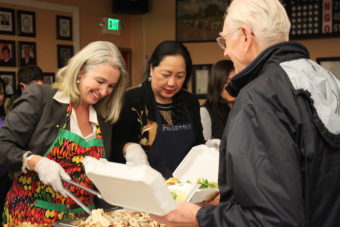
State legislators and past and present assembly members stood with members of Filipino Community, Inc to help serve food to about 515 people. The evening brought in more than $21,000. Reyes says some of the gifts were very personal, like Gabriel Kelley’s donation. Reyes says Kelley was raising money for his own trip to France and decided to give half of it to the fundraiser.

“I opened the envelope and I was very, very surprised with the amount. It was a $1,000 check,” describes Reyes. “I am not an emotional person but at the time I am holding back something. Somebody – not a Filipino, not related to a Filipino – instead of having that for himself, he shared it to those who need that big amount of money in the Philippines.”

A portion of the total money raised will go to Juneau’s sister city in the Philippines, Kalibo, which is in Aklan province. “Aklan, too, was damaged by Typhoon Haiyan,” explains Reyes. “It is also on the path of Typhoon Haiyan going out of the Philippines. And it also has devastated not only homes and properties but also some human lives.”

Josielind Ferrer is on the Filipino Community, Inc. board of directors. Ferrar is from the Visayas region, one of the areas hardest hit by Haiyan. Almost every Filipino at the fundraiser was affected in some way by the typhoon.

“We are doing okay,” says Ferrer. “As far as mental, emotional, we are hanging in there. We’re all strong, keeping everybody strong for each other, but with the help of the community – the whole Juneau community – this is definitely giving us more of a boost.”

She says she was overwhelmed by how many people were at the dinner, especially since it was such a last minute event, “but it looks like, just like the Filipino community, Filipinos managed to put it all together and hang in there and like they say, rise up Philippines, and we will do that.”

Reyes says funds will go to a few different organizations, including an international foundation based in the US and Philippines, Catholic Relief Services, and Red Cross.


SEARHC Front Street Clinic soon to be under new management

As of May 1, SEARHC will not longer be operating Front Street Clinic. (Photo by Lisa Phu/KTOO)

Southeast Alaska Regional Health Consortium (SEARHC) decided to cut funding to Juneau’s homeless medical center at the end of September due to budgetary constraints.

Front Street Clinic got a six month reprieve when the community was able to raise more than $120,000.

Now, a coalition of local organizations have joined together to keep the clinic open, hopefully, forever.

Glory Hole executive director Mariya Lovishchuk is the president of the newly formed Front Street Health Center board of directors. (Photo by Lisa Phu/KTOO)

Front Street Clinic is in the process of becoming its own non-profit organization with a new name – Front Street Health Center. It will still offer the same services – medical, dental, and behavioral health. And it’ll be run by a board of directors from agencies involved in the care of the homeless population.

“I think that all of these agencies just realized that if the Front Street Clinic disappeared, this huge gap would appear that nobody could fill,” says Mariya Lovishchuk, executive director of The Glory Hole, Juneau’s soup kitchen and shelter.
She’s also the president of the newly formed Front Street Health Center board. Other members come from AWARE, Bartlett Regional Hospital, Catholic Community Services, Juneau Alliance for Mental Health, REACH, and St. Vincent de Paul. The board also includes a physician, a public health nurse, and an accountant.

“Because so many entities are coming together, the clinic will be able to function really affordably and in a really sensible manner because the burden is now shared across so many caring and competent organizations,” says Lovishchuk.

Board members are providing resources and services to help run Front Street. For example, Catholic Community Services will take care of Medicaid and Medicare billing, REACH is in charge of janitorial services, and an accountant for Elgee Rehfeld Mertz will do Front Street taxes. “I just feel so grateful to live in a community that has so many dedicated and caring individuals and organizations coming together to ensure that people have access to a very, very basic thing which is primary medical care,” says Lovishchuk.

Board vice president Dr. Carlton Heine was one of several emergency room doctors who donated money when Front Street was in danger of shutting down in October. He says they recognized that if the clinic closed, most of its patients would end up in the ER.

 “We’re very good at heart attacks and broken bones and lacerations. We’re not very good at chronically managing diabetes or hypertension or chronic health care,” Heine explains. “We’re good at acute care, not at chronic ongoing primary care, and the Front Street Clinic does a much better job of providing that kind of service for these patients.”

Dr. Carlton Heine is an emergency medicine physician at Bartlett Regional Hospital. He’s the vice president of the new Front Street board of directors. (Photo by Lisa Phu/KTOO)

Bartlett Regional Hospital will provide laboratory and imaging services for Front Street. If a patient needs an x-ray or blood test, instead of being sent to SEARHC, the patient would go to Bartlett. “Paying a little bit for these appropriate tests ordered through a primary care doctor is certainly a less expensive route for the hospital than having these patients become much sicker, patients in the emergency department with those tests being done through the emergency department, and then potentially sick enough to be admitted to the hospital because they haven’t had the appropriate primary care,” Heine says.

The plan is for Front Street Clinic to become Front Street Health Center when SEARHC gives up management. “Currently SEARHC is operating the clinic through the end of April and we are working very closely with the homeless coalition in Juneau to make – if at all possible – a seamless transition,” explains Dan Neumeister, the organization’s chief financial officer.

Partial funding for Front Street Clinic comes from a $160,000 grant from the U.S. Health Resources and Services Administration, which ends April 30th. The new Front Street Health Center board hopes to secure the same federal grant, as well as pursue other funding sources.

SEARHC operated Front Street at around $600,000 a year. Lovishchuk says the anticipated budget under the new board is 30 percent lower.

Another difference is that more people will be able to access services. Front Street Health Center will still cater to the homeless, but will also be available to low-income people and others in need of medical care.

Juneau charities missing crucial Thanksgiving ingredient

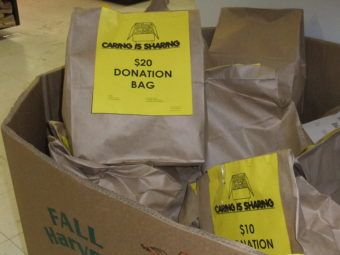
Foodland IGA has sold more than 400 donation bags that go to the Southeast Alaska Food Bank. Friday is the last day to buy one at IGA. (Photo by Rosemarie Alexander/KTOO)

Thanksgiving is less than one week away and Juneau’s charity organizations still need turkeys and other donations.

The Glory Hole, St. Vincent de Paul, and The Salvation Army are relying on community generosity to fill Thanksgiving baskets and boxes, and feed the community.

St. Vincent de Paul is handing out 500 baskets starting Saturday, but still needs items to fill them up.

The organization started the program with 25 baskets. Ten years ago, when Louise Wertheimer began volunteering, they made 200 baskets.

“We didn’t realize that the need was so great in Juneau, and it just grew,” says Wertheimer. “We want to make sure that everyone who needs help, that needs assistance, that we’ve got the food and the turkey to help them, and that’s why we do 500 now.”

Juneau’s soup kitchen The Glory Hole is already giving out Thanksgiving boxes to more than 160 families, and will continue this weekend until Tuesday. Turkeys – large and small – are still needed.

Executive director Mariya Lovishchuk says, while Thanksgiving boxes are not an essential service, they really cheer people up, including Glory Hole patrons.

“It’s just really wonderful to see our patrons contributing to the community by assembling these boxes, by carrying them out, by putting them in people’s cars, by saying, ‘Have a Happy Thanksgiving,’ to people, and then people say, ‘Happy Thanksgiving,’ to them,” she describes.

The Salvation Army plans to feed up to 400 people at The Hangar on the Wharf on Thanksgiving Day. The free meal will be served from 11 to 2:30. Everyone is welcome.

“We’ve had the governor, we’ve had the mayor, we’ve had several legislative representatives. We have people who need a meal, we have people who are homeless, we have people who just simply don’t want to be alone and so they come down just to share a meal and have fellowship, we have people come in and just bring their families,” says coordinator Carol Pitts. “So it is open to anyone living in or visiting Juneau on Thanksgiving.”

Turkeys and other food items can be dropped off at:

  • St. Vincent de Paul
    8617 Teal Street (behind Nugget Mall)
  • The Glory Hole
    247 South Franklin Street
    7 am – 9:30 pm every day
  • The Salvation Army
    439 Willoughby Ave.
    8 am – 5 pm on Saturday
    9 am – 4 pm weekdays

The kitchen needs 45 turkeys for the community meal and Pitts hopes people taking advantage of turkey deals at local grocery stores will help meet the demand. “Sometimes people will already have their turkey but they’re still buying some groceries and so if they take the opportunity of getting that turkey and they don’t need it, then we certainly can use it,” she says.

Another way to help out during the holiday season is by buying a donation bag at a local grocery store. It’s a pre-filled bag of groceries that will go to Southeast Alaska Food Bank.

Safeway has been offering donation bags for three years. According to assistant store manager Matthew Cabrigas, the store usually sells about 400.

“It allows community involvement for the holiday season just to help people who aren’t able to fill their shelves with the necessary items, just for eating really,” says Cabrigas. Donations bags will be at Safeway until the end of the month.

Turkeys and other donations can be dropped off at St. Vincent de Paul, Glory Hole, and the Salvation Army.

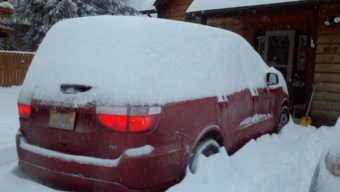
Up to 12 inches of more snow forecasted for Juneau

By 8 a.m., Thursday, 11 inches of snow had fallen in Juneau’s Mendenhall Valley. (Photo by Rosemarie Alexander/KTOO)

Juneau can look forward to more snow followed tonight and early tomorrow morning  by heavy rain, wind, and potentially freezing rain.

According to National Weather Service meteorologist Nicole Ferrin, as of noon today, Juneau’s Mendenhall Valley  had approximately 11 inches of snow. An additional four to 12 inches is expected through the evening.

The snow will likely turn to rain late tonight, “but there could even be an hour or two of freezing rain and then heavy rain through the morning, so it’s going to make conditions very messy,” Ferrin adds.

Ferrin warns the weather could cause some power issues and downed trees. There’s also a small chance of slides once the wind kicks in. Gusts up to 40 miles per hour are forecasted.

On the roads, Juneau’s streets superintendent Ed Foster says conditions aren’t too slick, but warns motorists to drive reasonably. He says his crew of 17 still has a lot of work to do.

“The day crew’s going to be working late tonight and the night crew is going to come in early so we’re going to be working through the night trying to get all this snow cleared up before it starts raining,” Foster explains.

According to Foster, his crew started clearing the interior streets and housing areas around noon. Those are the last areas that get cleaned up.

Juneau has cruise industry feeling thirsty

Juneau’s water utility is not meeting peak demand during the summer cruise ship season. That caused the city to drastically reduce the amount of water it could sell to the cruise industry this year.

The city says the problem is due to aging wells at its main water source, Last Chance Basin – a problem that both the city and the cruise industry want to see fixed.

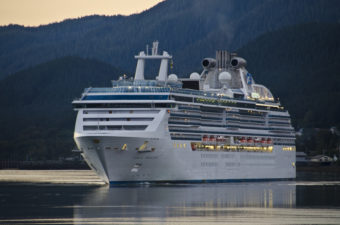
Six cruise ships docked in Juneau at once can guzzle about 1 million gallons of water a day. That’s 20 percent of Juneau’s daily water usage in the summer.

Cruise ships like to hook up two hoses when in port and buy as much water as they need. But the ships were limited to a total of 200,000 gallons a day this past summer due to unusually hot temperatures and an aging well system.

“There were many days where four ships in port had to basically share one hose over the course of a day,” says Kirby Day, director of shore operations for Princess Cruises. “So somebody would get the hose for a couple hours in the morning, somebody would get it a couple hours in the afternoon, a couple hours in the evening, which really cuts down the amount of water that we can purchase from the city.”

Cruise ships can get water from other ports, like Ketchikan, Skagway, Whittier, Seward, and Vancouver, but Day says ships prefer to buy water in Juneau because it’s right in the middle of a voyage. “If it was the first call or the last call, it might not be as crucial to buy water, but you’re basically about halfway through your itinerary,” he says. “Plus this is typically the longer of the port calls, so they’d like to be able to take as much water as we could without obviously creating a detriment to the city.”

David Crabtree, Juneau’s water utility superintendent, says, “We limited their use a bit but in previous years we let them take as much as they could take and it really put the hurt on our system.”

Juneau’s water supply comes from five wells in Last Chance Basin as well as from Salmon Creek Reservoir. On average, the utility distributes 3.5 million gallons of water a day. In the summer, that number can spike to five million gallons a day.

This recent summer saw those peaks, even with the ships taking a lot less. Crabtree says Juneau’s water needs come first; the cruise industry’s is a close second.

“It was balancing the struggle between keeping our reservoirs full and keeping the town adequately supplied versus having the ability to sell water,” he explains.

The wells at Last Chance Basin aren’t keeping up with demand. Production rates have declined so, as Crabtree explains, the utility keeps the wells running for up to 23 hours a day.

“Just because you design a water system that has the capacity of doing five million gallons a day doesn’t mean you do five million gallons a day every day,”  he says. “That hurts your wells. They need to be able to relax.”

Some of the wells are 42 years old. Juneau’s engineering director Rorie Watt says the best thing would be to replace one or two of them, “Our wells essentially are reaching the end of their useful life and so the most rational thing to do is just drill a new well 20 or 30 feet away in the same part of the aquifer.”

This could cost as much as $3 million. Juneau has requested a state grant to upgrade Last Chance Basin, but Watt says it’ll be at least another couple of years before the cruise ship industry can take as much water as they want.

Even though limits are difficult, the industry will be patient, according to Day.

“That’s part of the business, I guess,” he says. “We come to Juneau for a lot of reasons, and it’s not just to come here to take water. And so we understand if the city is having an issue with the system, and if we shouldn’t take water or have to limit the water we take so they can get their water system back on line, we’re happy to work with them.”

With limits in place this past summer, Juneau sold about 25 million gallons to cruise ships, translating into about $78,000 to the city.

Over the past ten years, cruise ships consumed the most water in 2006 – almost 98 million gallons – bringing the city roughly $273,000.

On average, cruise ships consume about 61 million gallons of Juneau’s water per year, about 11 percent of the city’s total summer production.

Juneau could begin work on the wells as soon as this summer if funding is secured. At a recent Public Works meeting, the committee approved appropriating $300,000 toward project planning – half would come from utility reserves and the other half from marine passenger fees.

Enroll Alaska launches in Juneau despite ongoing issues

Enroll Alaska sets up office at Bartlett Regional Hospital starting Wednesday. (Photo by Lisa Phu/KTOO)

Wednesday is Enroll Alaska’s first day in Juneau.

Agent Mike Clark will be at Bartlett Regional Hospital Wednesday and Thursday from 12 to 5 pm. Enroll Alaska hopes to expand hours next week.

Chief operating officer Tyann Boling says people can get help signing up for health insurance by scheduling an appointment through Enroll Alaska’s main office (907-770-5100) or stopping by the hospital. The Enroll Alaska office will be located off the hospital’s lobby in room C.

Despite finally starting up in Juneau, Boling says the healthcare.gov website is still not working well.

“If an individual has a very simple case, you know, let’s say it’s one single person, they just want to get themself enrolled, it’s a simple enrollment. If it’s a family, if it’s one individual who’s got VA and the other does not, any complicated issue – which that should not be complicated at all – the system has a really hard time with,” Boling explains. “So, we’re still dealing with a lot of system issues.”

The health insurance broker said last week it planned to have two agents in Juneau – one at Bartlett and one at Walmart – but Boling says there are not enough agents at the moment.

Site notifications
Update notification options
Subscribe to notifications