State lawmakers in Juneau and local law enforcement are preparing for the possibility of violence after the FBI warned of potential armed protests in each state capitol this coming Sunday.
Alaska’s largest Alaska Native organization is calling for President Donald Trump to resign.
Just before Christmas, the Juneau Assembly discussed putting more money into two grant programs intended to pay people who are financially hurting because of the pandemic.
The Juneau School Board is considering starting all of its meetings with an acknowledgment of local Alaska Native claims to their lands.
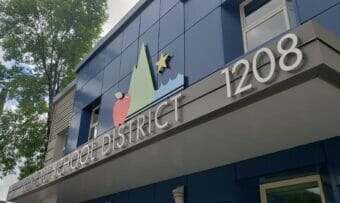
The offices of the Juneau School District, pictured here on Aug. 6, 2020, are located at 1208 Glacier Ave., in Juneau. (Photo by Jeremy Hsieh/KTOO)
Juneau’s school board is considering starting all of its meetings with an acknowledgment of local Alaska Native claims to their lands.
If approved, the board would make time to recognize Tlingit people as the land’s original inhabitants before opening its meetings.
Board member Martin Stepetin, who is Unangax, says he feels good about the idea.
Martin Stepetin Sr., watches results roll for a school board seat he has been running to fill on Tuesday, October 1, 2019, in Juneau, Alaska. (Photo by Rashah McChesney / KTOO)
“I think it represents where we stand in our values,” said Stepetin. “That’s how I feel as a school board member. And I would support having a land acknowledgment here on the school board.”
Board president Elizabeth Siddon says she’s optimistic about moving forward with a proposal to the board.
“This comes from a place of respect and is an opportunity for us as a board to both recognize the trauma, the history of trauma, and as a way to sort of acknowledge and honor the culture here in this place where we live moving into the future,” said Siddon.
The seven-member board voted unanimously to refer a proposal to the policy committee.
The concept of land acknowledgments in Alaska has been gaining ground in recent years. Late in 2020, Ketchikan’s school board started reading a land acknowledgment at the start of their meetings. In December, the Sitka School Board voted to consider adding a land acknowledgment to their meeting agendas.
Students returned to in-person classes this week at Juneau Douglas High School. (Photo courtesy of Kristin Bartlett)
Students at Juneau-Douglas High School had their first in-person classes in 10 months on Tuesday. Superintendent Bridget Weiss says things are going smoothly so far.
“The student response has been amazing, they are really happy to be at school. It doesn’t look like school used to look,” said Weiss. “Every kid I talked to I asked them, you know, are you still happy to be here, even though it doesn’t really look like normal and they were all just very happy to be at school.”
The return to in-person classes is still optional for families, so schools have been at much lower capacity than normal. Weiss says at elementary schools, there are between four to eight students in each classroom. And families who chose to have their kids return to school have also been cooperative.
Weiss says that the district is also prepared for any COVID-19 cases that could potentially be reported on campus.
“If we were to end up with a situation in a school that was concerning to us, we might stop in-person learning at a school for a little bit,” she said. “If the health status and you know changes and take some significant increase spike, then we would reconsider overall operations.”
Weiss also says with the vaccine now on its way, the district is looking forward to adding that to its mitigation strategy, along with voluntary testing for staff.
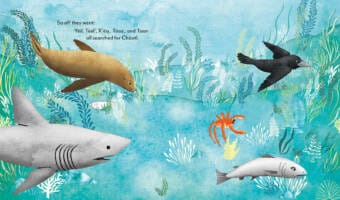
In “Raven and The Hidden Halibut,” Raven (Yéil) enlists a group of animal friends to help find Halibut (Cháatl). (Image courtesy Sealaska Heritage Institute)
Sealaska Heritage Institute has published four new books to bolster its efforts of teaching Indigenous language and culture to kids. One is an original story written by kids from Harborview Elementary School in Juneau.
In “Raven and The Hidden Halibut,” two animals that are complete opposites want to play with each other.
“Halibut really wants to play with the Raven and has to talk him into it, and they end up playing hide-and-seek. And Halibut, as it turns out, is a very good hider,” said Katrina Hotch, who worked with the students who wrote the original story.
In the story, Raven enlists a group of ocean creatures to help look for Halibut.
“Raven, or Yéil, works with Téel’, dog salmon, Náakw, octopus, X’éix, king crab, Tóos’, salmon shark and Taan, sea lion,” said Hotch.
Hotch says it’s a testament to the strength of the school district’s Tlingit culture, language and literacy program that the students wrote the story.
Now the book is available through Sealaska Heritage Institute’s Baby Raven Reads program, along with three other books published entirely in Indigenous languages. Two of them are in Lingít, and one is in Sm’algya̱x.
Am’ala (Sm’algya̱x) is one of the newly translated books recently published by SHI. In this traditional Tsimshian story, a young man who is teased by his brothers for being lazy and dirty trains secretly with a spirit and gains superhuman strength. He takes on warriors, animals, and even a mountain before facing his greatest challenge – the world itself. (Image courtesy Sealaska Heritage Institute)
Tess Olympia is the program’s manager. She says it all started in 2014 as a pilot project in Juneau.
“And it was very successful,” Olympia said. “After that, it was able to expand to nine communities in Southeast Alaska through partnership with Tlingit & Haida Head Start programs.”
Olympia says three of the books are the first to be published by Sealaska entirely in the region’s native languages.
Nax̱too.aat! (Let’s Go!) teaches about Tlingit, Haida and Tsimshian subsistence harvesting activities. (Image courtesy Sealaska Heritage Institute)
“We have a lot of language learners that have been asking for this. So we’re excited to be able to be at the point with our publications, that we could make that happen,” she said.
Olympia also says the program is currently serving more than 350 children throughout Southeast Alaska. In December, the institute mailed out 1400 books to families. And more than two thirds of those families report reading daily.
Olympia says she’s gotten feedback from families all over the region who are touched to have these stories in their home.
“When they didn’t grow up with stories, like books, to represent their own selves and their own culture and their homes and so, it’s finally this opportunity to have to have that happen. And for children to see themselves in the stories, it’s very validating,” she said.
As for whether Raven was able to find Halibut, readers can find out for themselves. The new books are available to buy from the Sealaska Heritage Store.