Pablo Arauz Peña, KTOO

Newscast – Wednesday, June 2, 2021

In this newscast:

  • A group of Juneau residents who want to limit cruise ship traffic in town didn’t get enough signatures to advance their proposed ballot initiatives.
  • Glacier Bay National Park and Preserve in Gustavus is poised for another lean year after half of its operating budget was erased by the pandemic’s impact.
  • For years, a small American flag was all that marked the grave of WWII soldier from Unalaska, George Fox.
  • Authorities in Metlakatla reported the community’s third COVID-19 related death on Tuesday evening.

Newscast – Tuesday, June 1, 2021

In this newcast:

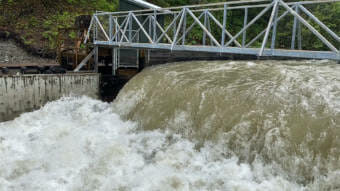
  • Local rivers ran high and rainfall drenched Memorial Day cookout plans in Juneau over the long weekend.
  • The Juneau Assembly got together in-person, mostly, for its regular meeting last week for the first time in over a year.
  • 72-year-old Albert Kookesh was an Indigenous rights advocate, culture bearer, politician and basketball player.
  • The Biden administration has suspended oil and gas leases in Alaska’s Arctic National Wildlife Refuge.
Newscast – Friday, May 28, 2021

In this newscast:

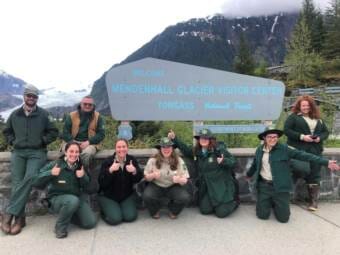
  • The Mendenhall Glacier Visitor Center will open to the public on Tuesday, June 1.
  • Over the weekend Juneau Drag performers hosted their first live show in 15 minutes.
  • Like other events in the pandemic era, the Wearable Arts Extravaganza was virtual but that didn’t keep the artists involved from having fun in 2021.
  • A tall, thin man wearing a hood and mask was caught on a security camera plastering Nazi stickers on a Jewish museum in Anchorage.

Winning design at Juneau Wearable Art Extravaganza features discarded COVID-19 vaccine vials

Amy Dressel and Nic DeHart were the winners of this year’s Wearable Art Extravaganza hosted by the Juneau Arts and Humanities Council. The concept for their outfits was titled “So Long and Thanks For All The Fish.” (Photo courtesy of Juneau Arts and Humanities Council)

Each year, the Juneau Arts and Humanities Council hosts its Wearable Art Extravaganza. It’s a fundraiser for the council’s fine arts scholarships and individual artist grants.

Like many other events in the pandemic era, most of it was virtual, but that didn’t keep the artists involved from having fun in 2021. This year, the show had a sci-fi theme and featured outfits that were out of this world.
Amy Dressel and Nic DeHart dance and wave their thumbs up in synchronized movements to the energetic beat of electronic music for this year’s Wearable Art Extravaganza. The theme this year was “Intergalactic” and their outfits were a perfect fit for the cosmic occasion.

Dressel and DeHart sport mango-colored spandex jumpsuits and rainbow wigs made out of plastic straws. They have space packs with tubes that connect to their facemasks.

Dressel says the story behind their outfits is that they’re space travelers looking for a good party.

“Nic sewed some jumpsuits and then we like, adorned it with all kinds of different stuff that was recycled,” Dressel said.

That recycled stuff included discarded COVID-19 vaccine vials that decorate their headbands, wrists and space packs.

Dressel is a pediatrician and has also volunteered to administer COVID-19 vaccines. She says using the empty vials worked well with the outfit’s theme.

“That would probably be good for us to be vaccinated against whatever celestial stuff is out there,” Dressel said. “It kind of was fun to be able to include that.”

DeHart says the concept for the outfits — titled “So Long and Thanks For All The Fish” — was inspired by a popular sci-fi novel series.

“We kind of did a little nod to Douglas Adams’ ‘Hitchhiker’s Guide to the Galaxy.’ And I just thought it was kind of a fun idea,” DeHart said.

The outfits won first place in the wearable art competition, which was decided by judges and votes based on construction, innovation and presentation.

For Dressel, who’s taken part in the annual Wearable Art Extravaganza for 19 years, it was a truly special moment because it was her first time winning.

“It was definitely unexpected,” Dressel said. “It’s kind of a little bit overwhelming to be like, wait, what, after all these years of watching other people and being impressed by other people and saying yeah, that definitely should have won. That was a great outfit, and then all of a sudden be like, ‘Whoa, we won?’”

DeHart says he was shocked they won.

“I really didn’t think that we’re gonna win, and I never do it — so I never participate to win. That’s not really my goal. It’s just to have the experience,” DeHart said.

And he says, now that they have bragging rights for best of show this year, they’re already planning for the next one.

Editor’s note: KTOO Public Media is a partner for the Juneau Arts and Humanities Council’s Wearable Art Extravaganza.

Newscast – Monday, May 24, 2021

In this newscast:

  • President Biden today signed a bill that will allow cruise ships to return to Southeast Alaska this summer.
  • The leaders of Sealaska, the Native corporation for Southeast Alaska, are asking its shareholders to approve the creation of a type of tax shelter called a trust.
  • After considering raising, then lowering the local property tax rate, the Juneau Assembly decided to keep it the same.
Juneau’s liveaboards dodge fee increase, but harbor board says rate hikes are coming

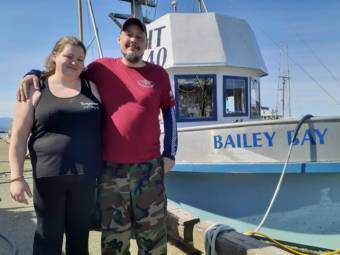
Erika Judson and Mike Riley usually live on the Bailey Bay at Statter Harbor. They were against the proposed rate hikes for harbor residents. (Pablo Arauz Peña/KTOO)

Juneau’s Docks & Harbors board has been considering a residence fee hike, but residents of the harbors say that would make it difficult for them to get by. The proposal failed to pass in a vote by the Docks & Harbors board Wednesday, but board members say rate increases are still coming.

Erika Judson and Mike Riley are commercial fishermen who usually live on their boat. Judson says she was born and raised on the water, and living at the harbor is just common sense.

“It’s so much more affordable than an apartment,” Judson said. “You know, you rent a studio apartment for 1,000 bucks a month when you could pay a couple hundred bucks and live on a boat and enjoy the simple life and not have the stressors of, ‘Can I can I afford this?'”

Recently, Riley and Judson have been staying with family to care for Riley’s mom. When they live on the harbor, they pay a monthly residence surcharge of $69 per month along with moorage and service fees. Altogether, they pay about $312 a month to live at Statter Harbor.

About 140 people live in Juneau’s harbors. Juneau’s Docks & Harbors board proposal would have hiked their fees by 100%. 

Riley says many of his neighbors are folks who, like him, just want to live a simple life. Many are elders who just can’t afford to live anywhere else.

“I believe that to a point it’s, I think, it’d be city-sanctioned gentrification,” Riley said. “They’re trying to get this place for tourists. Doubling liveaboard fee with a bunch of people that I know that actually are liveaboards that are pensioners — it’ll break them.”

Another issue for Riley and Judson is the facilities and public services. They have basic bathroom facilities and sewage pumps, but they’re not always available. 

Security is also a problem. Riley says while there’s not a lot of crime in Statter Harbor, there is some.

“I’ve seen boats on fire on purpose,” he said. “I’ve seen people fighting. I had thousands of dollars and fishing equipment sold off my boat in the 15 – 20 minute period.”

The Docks & Harbors board voted against raising residence fees after extensive public comment against the hike.

But Port Director Carl Uchytil says Juneau’s harbor system still has financial needs to meet. The last time rates for liveaboards were raised was in 2008.

“The bottom line is that we’ve got to remain solvent,” he said. “And the asks of our harbor patrons — not just liveaboards but all harbor patrons — is growing, and our ability to fund with rates that haven’t changed in over a dozen years needs to be addressed.”

On top of the lack of funds, Uchytil says Docks & Harbors hasn’t seen any steady income since October 2019, before the COVID-19 pandemic. The lost tourism season in 2020 had a severe impact on the harbor system, which he says left it right on the cusp of a negative fund balance.

Uchytil says Docks & Harbors needs money to pay for various infrastructure projects, including rebuilding the north end of Aurora Harbor and expanding the North Douglas Boat Lodge, along with paying off a leased property between Aurora and Harris harbors.

He says regardless of the rate hikes being voted down, Juneau’s docks and harbors have growing funding needs.

“The Docks & Harbors board will deliberately look at our fees and look to see what’s appropriate to increase, and they’ll be looking at probably the oldest fees or the fees that haven’t been touched first, and try to adjust appropriately,” he said.

As for the charge of gentrification in Juneau’s harbors, Uchytil says that’s not the intention of the board.

“We’re not targeting a group for the purpose of moving them out,” he said. “We’re looking at opportunities to adjust fees that have not been adjusted in a long time to serve the community without a burden on sales or property tax.”

Uchytil says he can’t say where the fees will increase, but — one way or another — someone has to help pay the bills.

Editor’s note: After the original publication of this story, KTOO learned Mike Riley and Erika Judson are not registered residents at Statter Harbor. They have lived in the harbor in the past three years and plan to register with Docks & Harbors to continue living there. Information clarifying Riley’s and Judson’s current living arrangements has been added to this story.

Site notifications
Update notification options
Subscribe to notifications