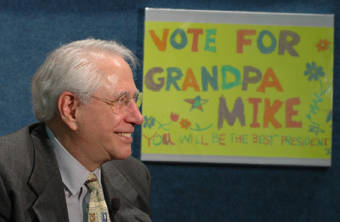
During his twelve years as a U.S. Senator for Alaska, Mike Gravel stirred up a lot of controversy. But on Saturday, he died quietly at the age of 91, surrounded by his family in Seaside, California.
It’s gotten a little harder for Alaska patients to get telehealth appointments with their doctors who are outside of the state.
Sealaska shareholders have elected two new directors to the Alaska Native corporation’s board of directors.
The Alaska House has reached an agreement intended to avoid a partial government shutdown just days ahead of the new fiscal year.
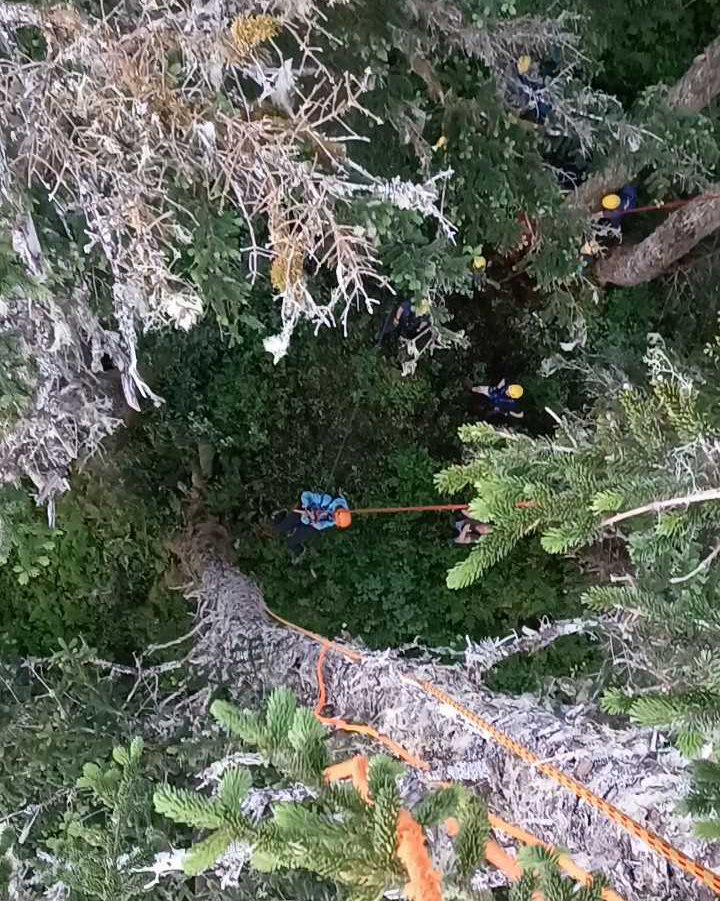
A paraglider who was stuck between two trees on Mt. Roberts Sunday was saved by Talon Lobaugh. (Screenshot from image courtesy of Talon Lobaugh)
Talon Lobaugh owns Everybody’s Tree service, and he really knows how to climb a tree. That’s why some residents call him whenever a drone or a pet gets stuck high up in the trees.
But he’d never saved a person — until Sunday — when he got a call from Capital City Fire and Rescue about a paraglider who got stuck between two trees on Mount Roberts. After several hours, Lobaugh was able to save her.
Lobaugh, in an interview, explained how it happened.
So what happened on Sunday?
Somebody called me from search and rescue, inquiring about a paraglider that had gotten caught up in the tree, roughly 60 feet off the ground at the Mount Roberts tram. So I went ahead and drove myself to the parking lot at the tram. Parked, put my gear back on, got to the site. By about seven o’clock I was getting into a tree, the tree that she was in.
So what was the process like trying to save her?
Finesse, honestly. I was so tired. I pulled a 12-hour day in the trees before I even got there. So, I just had to have my wits about me. And it wasn’t too complicated. I mean, granted, I’m dealing with somebody, instead of like a piece of wood. Or like, maybe if I go and do a rescue for a cat or something like it was I was definitely a little more nervous about it, but I just did what I do. And that was set, block and tackle, basically as if I were to rig out a tree over somebody’s house.
Yeah, I was real, real gentle about it, obviously. I had her secured before I even set everything up to lower her down. I’d actually cleared prep the tree on the way up clean all the branches that were going to be in the path of her to sit down so she didn’t get scratched up and all that she was a little heatstroked, you know, I’ve been stuck in the sun for I don’t know how long.
How’s she doing now? Is she OK?
Yes, to the best of my knowledge. I just talked to her. She just actually had a husband come by and pay me for the job.
Have you done something like this before?
Actually, earlier in the week, I rescued two blue herons out of a nest. Two juvenile blue herons out of a nest that had been there. I think the mom had gotten taken out by an eagle. Yeah, I got those guys out and they went to the Raptor Center.
OK, but never a person?
No, no. I’ve helped other climbers and like, you know, working for other companies or working under me at my company like I’ve had to repel people out of the trees, like show him how to get themselves down because they get up there thinking they can do it and they get too scared kind of deal. But this was just like, ‘Oh, I don’t know if she’s supported. I don’t know if the wind starts blowing like, there’s a high possibility that she’s going to float out of it and then crash down to the ground.’ Like definitely an emergency situation. Yeah, it’s something totally new to me.
How are you feeling after you’ve saved a person out of a tree?
I feel like anybody who just pulled a 17-hour day yesterday in this heat? Just doing hard labor. That’s how I’m feeling. A little worn out, man. I’m stoked. I’m really happy and really fortunate that I get to actually service my community in these matters.
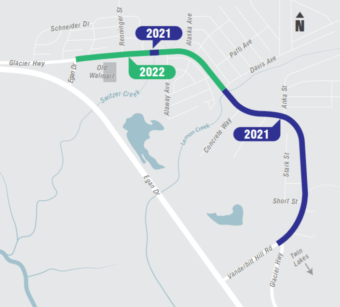
Glacier Highway near Vanderbilt Hill Road. (Alaska Department of Transportation image)
Construction is underway as workers fix the bumpy roadwork on Glacier Highway to improve access for pedestrians and vehicles.
The two-year project will resurface and improve Glacier Highway from the Glacier Highway access road to the intersection with Vanderbilt Hill Road. The current phase of the project is being done between Vanderbilt Hill Road and the Lemon Creek Bridge.
Garrett Paul is the project manager with the state Department of Transportation.
“The roadway is in pretty rough shape. There’s lots of patches,” Paul said. “Lots of work that’s happened along this corridor for other reasons. It’s kind of left the road a hodgepodge of paving patches.”
A map of the two phases of the Glacier Highway improvement project. (Courtesy: Alaska Department of Transportation)
Paul says workers are currently making underground improvements to culverts and drainages.
“The end goal is to have the whole southern half of the project done in 2021. So, this year,” Paul said. “We’re gonna hopefully get everything done up to Davis Avenue, which is just north of Lemon Creek Bridge.”
Paul says workers are trying to keep delays down to a maximum of 20 minutes. They’re also keeping two lanes of traffic open at all times. Drivers can expect the center turn lane to be used as a traffic lane. Drivers can also take a detour through Lemon Creek on Egan Drive.
Pedestrians will still have sidewalk access through work areas or will be directed by workers through the work zone. Paul says the next phase of the project will be completed next year between Davis Avenue and Renninger Street near the old Walmart.
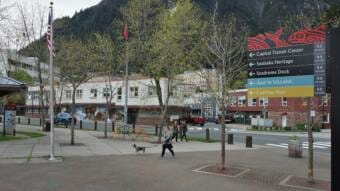
Pedestrians walk through Marine Park in downtown Juneau on June 1, 2021. The wayfinding signage, installed in 2020, incorporates Tlingit place names and voices through audio narratives. (Photo by Jeremy Hsieh/KTOO)
The Juneau Assembly started to include a land acknowledgment as part of its regular meetings in February and made it an official part of meetings in May.
Wayne Klusaa Áak’w Smallwood represents the Áak’w Kwáan Coalition Council. He says T’aaḵu Kwáan aren’t Native to the Juneau area and that they came from up the Taku River, in what is now Canada, to Juneau during the Gold Rush era.
“It’s just, CBJ shouldn’t be acknowledging anybody on our territory period, unless they acknowledge it correctly, which is Áak’w Kwáan,” he said.
Assembly member Christine Woll says the assembly made room for changes when it made the acknowledgment part of its regular meetings.
“We did receive a letter from the coalition, but we also received several other letters from others over the last few months, and so we’ve been evolving it as we go,” she said.
She says the assembly changed the language to mention the more inclusive “Tlingit people” instead of specific clans to make sure it’s honoring the intent of being respectful to the people who are Native to this land.
But for Smallwood, the change doesn’t go far enough.
“So I understand when it says you’re just going to acknowledge the Tlingit country, but there’s no tribe called the Tlingit tribe,” he said. “‘Tlingit’ the word itself means human.”
He also says it doesn’t resolve the issue of a totem pole at Savikko Park in Douglas, which also acknowledges the T’aaḵu Kwáan. The coalition sent a separate letter to the city about the totem pole.
Ben Ooskan Coronell who speaks for the T’aaḵu Kwáan says his clan is also a part of the Juneau’s past.
“What we’re missing out on is history,” he said. “When you deny it — our ancestors, our history — you’re denying that we exist.”
He says he’s not interested in disputes but wants to meet with the Áak’w Kwáan and the city about the land acknowledgment and the totem pole.
“I’m more interested in, what can we do to help develop this community,” he said. “And we’d be willing to compromise and meet with them to see what can we discuss.”
President Richard Chalyee Éesh Peterson of the Central Council Tlingit and Haida Indian Tribes of Alaska said in a statement that the council is glad the city is starting the long-overdue practice of a formal land acknowledgment.
But he says the council is not taking sides on the issue between Áak’w Kwáan and T’aaḵu Kwáan because it does not “involve [itself] in clan business.”
Editor’s note: This story has been updated to correct a typo.
The Biden administration announced Friday intentions to reinstate protections for Tongass National Forest.
Glacier Bay National Park and Preserve broke ground last week on a $6.5 million dollar project to connect the park to renewable hydroelectric power by the end of the year.
For the first time in years, the Fort William H. Seward barracks building in Haines will be open to the community for a public auction, with some of the items dating back to the 1940s.
This weekend kicks off the Qagruq Whaling Festival in Point Hope.