Rashah McChesney

Daily News Editor

I help the newsroom establish daily news priorities and do hands-on editing to ensure a steady stream of breaking and enterprise news for a local and regional audience.
Alaska’s oil production future could be bright, but it’s also unpredictable

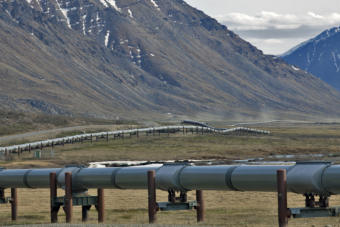
ConocoPhillips’ CD5 drill site is producing far more oil than initially estimated. The company thinks there’s more oil potential farther west. (Photo by Elizabeth Harball/Alaska’s Energy Desk)

Alaska’s oil production has remained relatively flat in recent years, but there could be changes on the horizon as new fields come online on the North Slope.

The state House Finance Committee heard an update from the Department of Natural Resources on Wednesday.  They were told that the legacy fields — those that are currently producing oil — are still the backbone of the state’s oil production.

“But as we go out, you know, five-to-six years out, projects that are expected to come online beyond this fiscal year begin to play a more important role,” said DNR Commercial Analyst Maduabuchi Pascal Umekwe.

There are new projects coming online, like Hilcorp’s Milne Point Moose Pad, ConocoPhillips’ CD5 expansion and Greater Mooses Tooth 2. There are also new discoveries in development, like Oil Search’s Pikka.

But just how much oil those new fields will bring to the state over the next several years is difficult to predict.

Over the next two years, the state is forecasting that new fields will bump production up to more than 533,000 barrels per day on the North Slope by 2020 — that could translate to more than $2 billion for the state.

Still, production from those legacy fields is declining. Umekwe told lawmakers that it’s not easy to predict when a new field will come online, or how much oil they will produce. That means the range of predictions gets more uncertain in the future. By 2027, the state could be producing close to 700,000 barrels per day, or fewer than 400,000.

The production forecast is primarily used by the Alaska Department of Revenue to predict how much money the state will get over time. Lawmakers use that to build the budget.

DNR has been forecasting oil production for the state since 2016. Before that, the state used a private contractor.

But during its first year on the job, DNR was criticized after it predicted an unprecedented — and inaccurate — drop in oil production.

That prediction was better last year: Umekwe showed the House Finance Committee its forecast of last year’s production. It was off by fewer than 1,500 barrels.

Watch the latest legislative coverage from Gavel Alaska:

Legislative Finance gets ready to release its version of Dunleavy’s new budget

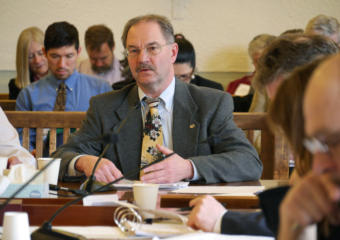
Legislative Finance Director David Teal testifies before the Senate Finance Committee on April 3, 2017. (Photo by Skip Gray/360 North)

Imagine having a to-do list so complicated, so meticulous that you need an Excel spreadsheet to keep track of it.  

That’s what Division of Legislative Finance budget coordinator Amanda Ryder and her boss, director David Teal, pulled up out of the sea of open tabs on Teal’s computer to talk about their process of reviewing Gov. Michael Dunleavy’s newest budget.

Ryder pointed at the list. “David can you scroll down so we can get … I would look at line 18. This is something. It’s a technical (change).”

When her office got the governor’s budget on Dec. 15, one of the half-dozen eagle-eyed analysts in the office found language in the fire and safety section that had the wrong fiscal year in it.

Ryder pushed some papers aside on Teal’s desk and pulled up an annotated copy of Dunleavy’s newest budget.  

“Going to public safety,” she said as she flipped through a few pages. “Yeah, this year. Public safety, fire and life safety … That has not been corrected.”

When Dunleavy’s budget came out, a lot of people in the state Capitol retreated to their offices to read through it. They were looking for trends. What made it in? What got cut? How exactly does the state balance its budget? And while those reports are trickling out about the obvious changes — cuts to education, Medicaid and the marine highway system — a lot of people are waiting for a deeper analysis.

Ken Alper talks to other legislative staff as he looks at the new budget released by Gov. Michael Dunleavy’s administration on Feb. 13, 2019, in Juneau. (Photo by Rashah McChesney/Alaska’s Energy Desk)

Ryder, Teal and the fiscal analysts are tackling a portion of the massive database that the Office of Management and Budget, or OMB, transferred to Legislative Finance: tens of thousands of entries — each with its own budget code and many with explanations about what the governor’s administration wants to accomplish with its budget.

They’re checking to see if the numbers match up, if the language is correct. They’re flagging research they may need to do once lawmakers start asking questions about how the new budget could affect the state. And they’re trying to do it fast. Because the state Legislature is waiting for them to translate that new budget into something lawmakers can use. 

Typically, this process would be done by now. The governor is required to release a budget by mid-December, and Legislative Finance has about a month to get through this before lawmakers come into session.

But that didn’t happen this year. The version of the budget they got in December, it turns out, was something of a placeholder. Dunleavy’s administration warned that it would be putting out a new one in February — after the session started.  This one is a little different. 
“We haven’t had a balanced budget in years,” Teal said.

In order to balance what the state spends with what it makes, this budget has deep cuts to things like Medicaid and the university system. It also proposes eliminating a wide range of programs, like Alaska Grown, the senior benefits program and funding for the Ocean Ranger program.

These are all things that are likely to cause debate in the Legislature this session. So lawmakers need that budget sooner rather than later.

Teal and Ryder said their division is getting through it faster than usual. 

One big reason for that? They didn’t have to spend nearly as much time cleaning up the language in the budget that OMB sent over.

“We ask OMB, year after year, to please use the budget that passed as the starting point for next year,” Teal said. “They continually use the budget they submitted, and so we make the same language changes year after year after year. They’re nonsense. It’s putting a semicolon here and an ‘an’ there.”

This year? After more than 20 years of asking, Teal and Ryder said they finally got it their way and it’s saved them hours of tedious editing.  

The first reports could be posted as soon as Friday evening.

Credit rating agencies watch as Alaska pivots toward a new budget

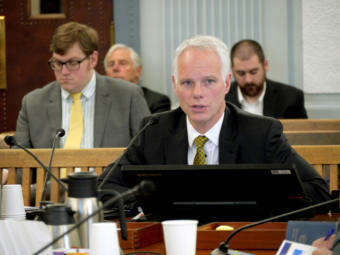
Deven Mitchell, state investment officer at the Alaska Department of Revenue, gives an overview of the state’s credit ratings and debt to the Senate Finance Committee, Feb. 4, 2019. (Photo by Skip Gray/360 North)

A lot of Alaskans are waiting for Gov. Michael Dunleavy’s administration to release its proposal for next year’s budget. It is widely expected to contain deep cuts to state services as Dunleavy’s administration tries to balance state spending to revenues.

But Alaskans aren’t the only ones who are waiting to see what’s on the chopping block — the credit rating agencies are watching too.

There are some basics to the formula that go into calculating a credit rating. If bills get paid on time, the credit rating goes up. Pay them late, or not at all, and it goes down. A credit rating is, essentially, a measure of how willing and capable a person or entity is to pay the bills.

At some point this year, the state of Alaska’s Department of Revenue plans to borrow $740 million to pay down some of its debt. A big part of how cheaply the state can get that money is its credit rating.

But there are some factors that determine the state’s credit rating that the average Jane doesn’t have to worry about.

For one, oil prices. That’s the main source of revenue that Alaska has to pay its bills. So when oil prices crashed in 2015, the state’s credit rating took a beating.

“Over the course of the last four years, we’ve been downgraded seven times, and I bet there’s been twice that many rating agency reports with negative news on the state of Alaska,” said Department of Revenue State Investment Officer Deven Mitchell. He’s the state’s debt manager.

Back in 2017, staff at the Department of Revenue — where Mitchell works — went out on a mission to try and convince the credit rating agencies to stop downgrading the state. They argued that Alaska could, in fact, pay its bills.

They laid out their argument using the $60 billion in the Alaska Permanent Fund. Think of it as a gigantic savings account the state has had in its back pocket for the last 40 years.

Department of Revenue managers met with the ratings agencies — Moody’s, Standard & Poor’s and Fitch — arguing that even though it had never been done it before, if the Legislature chose to use the permanent fund’s investment earnings to pay for state government, there would actually be plenty of money available to pay its bills.

And it worked. In late 2017, the outlook on Alaska’s credit rating went from “negative” to “stable.”

“I think we changed the outlook to ‘stable’ based on the idea that the state had come up with a way to fund itself using its permanent fund earnings as a sort of mechanism to fund a big chunk of the operating budget,” said Moody’s analyst Ted Hampton. He’s the lead analyst for Alaska at the credit rating agency.

Hampton said Alaska has been experiencing the downside of relying on oil to fund state government, because prices are volatile. When prices crashed, some of those basics of a credit rating kicked in, because even though the state was willing to pay its bills, it was no longer clear that it was capable of doing that.

There’s one more thing that Alaska has to deal with when it comes to its credit rating: PFDs. Those checks Alaskans get every year come out of the earnings of the permanent fund, too. And for the last few years, those checks were capped by the former governor and the Legislature, with the idea of leaving more money to fund state government.

It’s not that the act of paying dividends is a problem for the state’s credit rating from Moody’s.

We’re agnostic, really, on the issue of whether the state is paying dividends or how big those dividends are. I mean, the big question, really, is whether the state is able to demonstrate budget balance from year to year, even when the economy is not doing so well,” Hampton said.

If the state shows that budget balance, Hampton said it could potentially trigger an upgrade in its credit rating “regardless of what kind of dividends are being paid out to citizens. But it does appear that increased dividend payments — you know, the way things are set up now — might make it more difficult for the state to achieve budget balance.”

Right now, there’s a plan in place that kept the state’s credit outlook stable.

But there’s a new governor, and his administration has a new plan for the state’s budget — one that doesn’t involve capping PFDs. Instead, it relies on cutting state government. Though that may be easier said than done.

Moody’s isn’t likely to jump at changing the state’s credit rating based solely on Dunleavy’s new budget when it comes out. Hampton said they tend to wait for proposals to become reality.

That new budget is set to come out on Feb. 13.

Watch the latest legislative coverage from Gavel Alaska:

Newscast – Friday, Jan. 25, 2019

In this newscast:

  • A Juneau man charged with double homicide wants to get rid of his attorney months before his trial
  • Alaska’s biggest port is in dire need of repais and according to the latest estimate for the port in Anchorage, those repairs will be twice as expensive as originally forecasted
  • A federal judge has rejected the cruise industry’s motion to specify how Juneau can spend revenue earned from its $8 per passenger fees
  • Groundwater contaminated with perflourinated substances was discovered at the King Salmon airport Thursday. The chemical known as PFAS, in a component of firefighting foams used during regular equipment testing at the airport
  • A pair of sled dog races has been canceled, and another may be in jeopardy due to poor trail conditions in the Mat-Su Valley

Newscast – Thursday, Jan. 24, 2019

In this newscast:

  • The partial government shutdown is affecting federal court proceedings in Alaska
  • The U.S. Senate failed to pass two bills that would have ended the partial government shutdown
  • A Dunleavy appointee has been accused of lying to lawmakers
  • Concerns over a hostile workplace culture surfaced Tuesday at the Sitka Assembly during a presentation calling for higher police wages
  • The U.S. Air Force and Missile Defense Agency plans top modernize the Cobra Dane Radar site on Shemya

Dunleavy appointee resigns after being accused of lying about his credentials

Commissioner-designee John Quick talks to the Senate Finance Committee during a confirmation hearing on Jan. 22, 2019, in Juneau. (Gavel Alaska video still)

Update (8:20 p.m.)

After less than two months on the job, Department of Administration Commissioner John Quick has resigned.

In his letter to Gov. Mike Dunleavy, Quick says, “Though I strongly refute some of the claims made against me over the last 48-hours, I do not want to become a distraction to your agenda and the positive work you are doing on behalf of Alaskans.”

Dunleavy has named Paula Vrana as acting commissioner. Vrana is a lawyer who Dunleavy says joined the Department of Administration on Jan. 2.

Original story

The commissioner-designee of the state’s Department of Administration is being accused of lying to the state’s Legislature during his first confirmation hearing.

Gov. Mike Dunleavy appointed John Quick as the state’s new commissioner of the Department of Administration in late November.

John Quick's resume.
John Quick’s resume. (Source: Senate Finance Committee)

Quick claims on his resume he was an owner and investor in a number of businesses in Washington state.

However, the owner of one of those businesses — Anthem Coffee & Tea — disputes that. Janie Reynolds of Puyallup, Washington, sent a letter to several lawmakers this week saying that Quick lied during his confirmation testimony to the Senate Finance Committee.

In the letter, Reynolds says that Quick was hired in 2011 to organize the family-owned business but that he was fired in 2012 and never had any percentage of ownership in the company. Reynolds also said Quick lied about helping to recruit and secure investors for the company.

There are other factual errors on his resume and online biographies.

Quick claims that he attended Wayland Baptist University in Texas for two years and received an MBA; the school’s registrar said he attended for about nine months and did not graduate.

Dunleavy’s press secretary Matt Shuckerow said Quick is aware of the allegations. He did not respond to a request for comment.  However, his office forwarded a response to members of the Senate Finance and State Affairs committees on Thursday evening.

In it, Quick says he had a verbal agreement with the Reynolds family for an equity-stake in the business. When that verbal agreement didn’t turn into a written one, Quick says he parted ways with the company.

He apologizes for telling senators that he sold an ownership stake in the company rather than clarifying that he’d just parted ways with them.

He did not address the inconsistencies about his educational background in his written and online biographies.

Before he joined the Dunleavy administration, Quick was chief of staff to the Kenai Peninsula Borough Mayor Charlie Pierce. He’s also the registered owner of a business called Empire Consulting that provided campaign assistance to Soldotna Republican Sen. Peter Micciche.

The department that Quick has been tasked with running oversees administrative services for state agencies on everything from personnel to mail distribution. It had a more than $343 million budget last year and about 1,200 positions.

This story has been updated.

Correction: A previous version of this story misidentified the department Quick had been appointed to oversee. Quick was commissioner of the Department of Administration.

Watch the latest legislative coverage from Gavel Alaska:

Site notifications
Update notification options
Subscribe to notifications