I help the newsroom establish daily news priorities and do hands-on editing to ensure a steady stream of breaking and enterprise news for a local and regional audience.
An LNG tanker fills up at the ConocoPhillips liquid natural gas export facility in Nikiski, Alaska. When it opened in 1969, it was the only facility of its kind in the U.S. to get a license to export its gas to Japan. For more than 40 years, the state has attempted to develop similar projects to bring natural gas from the North Slope to market, but none of those projects have broken ground. (Photo courtesy ConocoPhillips)
BP and ExxonMobil have committed up to $20 million to the state-run Alaska LNG project.
It’s the first time in years that private industry in the state has pitched in money to move the gasline project forward. Both companies, and ConocoPhillips, were investors in the project but backed out in 2016 citing unfavorable market conditions.
Lt. Gov. Kevin Meyer told a crowd at an oil and gas conference in Anchorage that the money will be used to get the project through the federal environmental review process. Meyer said Thursday that the two companies will also help the state determine whether the project can be more competitive.
“When the governor took office, he made it clear that we needed participants with the credentials and the resources necessary in order to make a project of this scope work. The involvement of BP and Exxon provides confidence that all future decisions regarding Alaska LNG will be rooted in world-class LNG experience,” Meyer said.
The Alaska LNG project would pipe natural gas from the North Slope to Nikiski, then transport it to Asian markets.
Damian Bilbao, vice president of commercial ventures for BP in Alaska, said the company has at least one big reason to put money into the project.
“Alaska gas remains BP’s single largest global undeveloped resource,” he said.
Bilbao said it’s significant that industry and the state are collaborating on the project again.
He credits Gov. Mike Dunleavy’s administration with working to bring private industry back into the process of getting the state’s natural gas to market.
“The governor talks about being open for business, and big businesses like ExxonMobil and BP step forward when both the project and opportunity make sense, but also when the right relationship exists with the sovereign,” he said.
Still, that doesn’t mean that the company believes the Alaska LNG project is more economically viable now than it was when BP stepped away from it.
“The state has made good progress over the last several years. And, working together with Exxon and (the Alaska Gasline Development Corporation), we think we can unlock some additional opportunities. But we’ll just have to see in a few months — after some work gets done — where the project is relative to other opportunities around the world,” he said.
The state’s gasline corporation will have about $23.5 million in the bank at the end of the current fiscal year. But corporation spokesperson Jesse Carlstrom wrote in an email that it will likely cost about $30 million to get through the environmental review with the Federal Energy Regulatory Commission. If that process stays on schedule, the state could get the final federal go-ahead by 2020.
Still, the project needs final engineering and design work as well as investors and customers to be economically viable.
The University of Alaska sent layoff notices to 48 employees as it consolidates its statewide HR system,
Eight conservation groups filed a lawsuit against the U.S. Forest Service in federal district court on Thursday over the controversial sale of thousands of acres of trees on Prince of Wales Island,
Tracking the number of Native women who have disappeared in Alaska is tough, but Alaska has the fourth largest number according to available statistics, one group gathered in Anchorage to begin an effort to heal,
And Bethel Rep. Tiffany Zulkosky has introduced a bill that would allow tribal regalia at certain public events.
Alaska’s Senate has passed its version of an operating budget for the state.
The debate over amendments took several hours, but ultimately the Senate majority accepted three out of the 25 that were proposed.
One amendment they passed would add $800,000 into a program that pays benefits to low-income seniors.
Another would distribute $20 million in one-time state education funding. That’s money that was already appropriated, but Gov. Mike Dunleavy’s budget proposal asked legislators to keep that money instead of dispersing it.
That money is also the subject of a lawsuit that was filed against Dunleavy on Wednesday.
The budget contains deep cuts to state services.
“I don’t know for sure, but I think it’s probably the biggest operating budget reduction in history of the state. I’d have to go back and look at that. But it’s significant,” said Sitka Republican Sen. Bert Stedman, who co-chairs the Senate Finance Committee.
Despite that, it’s more than $200 million in spending over last year’s budget. That’s because senators included a roughly $3,000 dividend payment in their version of the budget.
It’s also not balanced — there’s a funding gap of about $1.2 billion. They also plan to move $12 billion from the Alaska Permanent Fund’s earnings account — that’s the one that legislators can spend from — into an account that is constitutionally protected and cannot be touched.
When the Senate’s operating budget bill came up to vote, 19 voted yes, with just one — Juneau Democratic Sen. Jesse Kiehl — voting against it. He said he couldn’t support a budget that isn’t balanced.
But it’s not the final version of the budget. The House and Senate must now meet in conference committee to negotiate over the differences between their two budgets. That budget then heads to Dunleavy’s desk for approval.
Watch the latest legislative coverage from Gavel Alaska:
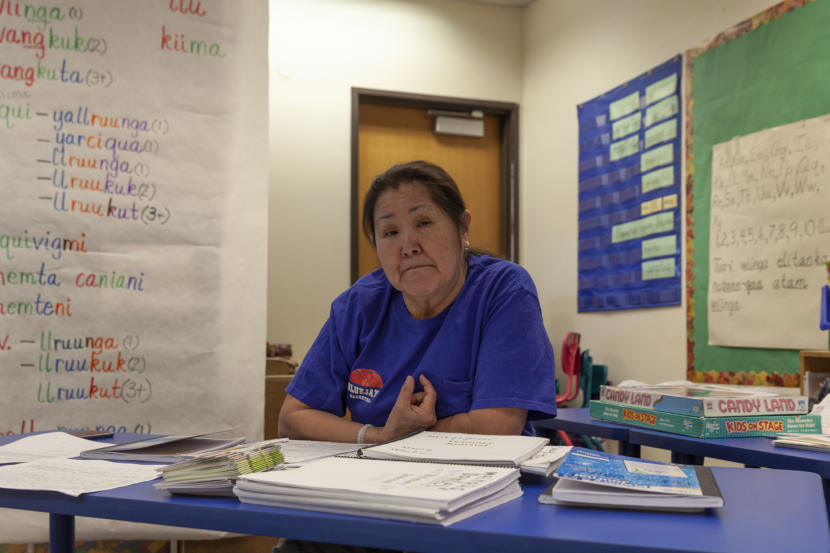
Alice Fitka in her classroom on April 3, in Tuntutuliak, Alaska. (Photos by Rashah McChesney/Alaska’s Energy Desk)
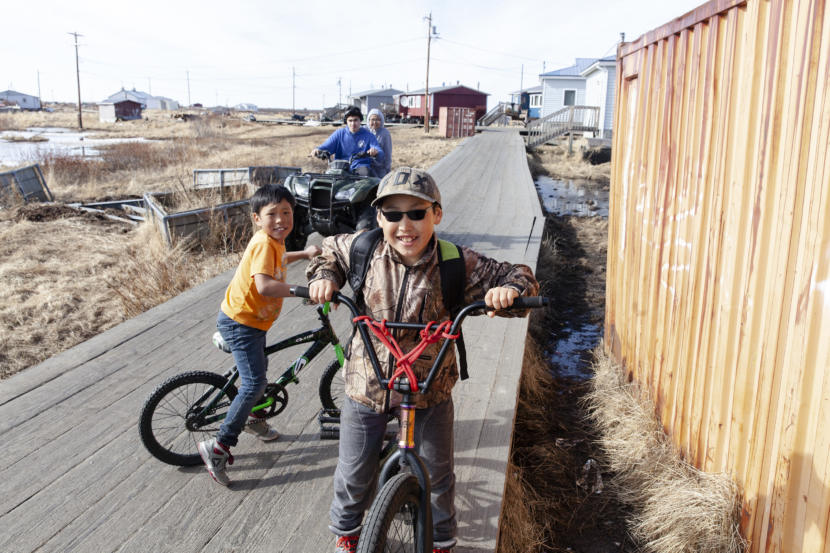
On a warm, sunny day in the village of Tuntutuliak, a group of children run around each other on a boardwalk outside of the bright blue building that houses the village’s K-12 school.
Their shouting is a blend of Yugtun — that’s the Yup’ik word for their language — and English.
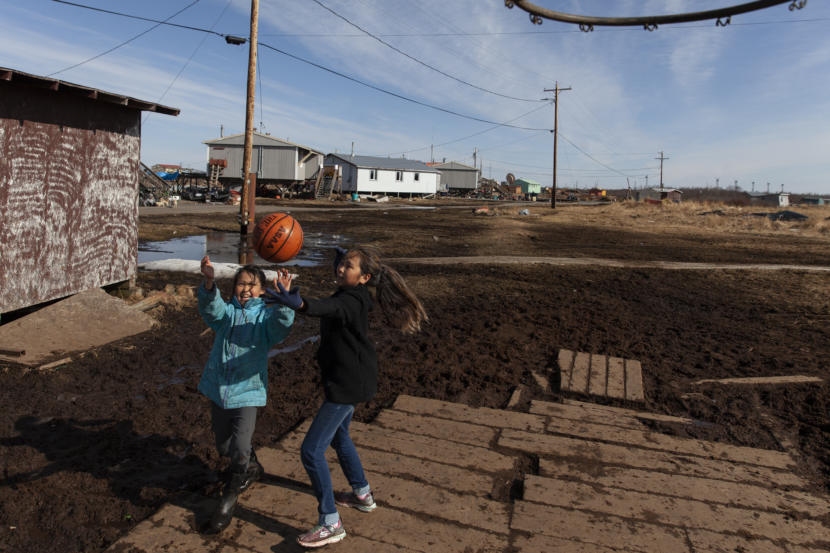
After school, kids play on the boardwalk that snakes through Tuntutuliak.
That blend of languages is mirrored inside the school. Small, flippable signs hang on the outside of each classroom door. They designate the language of the day. Some days it is English. Others it’s Yugtun.
In Alice Fitka’s class, it’s always Yugtun.
Walk in the door of her classroom, and you’re greeted with an explosion of colors, numbers and letters: Letters of the alphabet are strung above the whiteboards and colorful posters decorate the walls. Behind Fitka’s desk is a large poster of the Yugtun alphabet and the numbers 1-10 — Fitka sings both to the familiar tune of “Twinkle Twinkle Little Star.”
It’s in this classroom where kindergartners and first graders in the Western Alaska village of Tuntutuliak learn their Yup’ik language. They get their grammar, along with a healthy dose of life lessons and cultural knowledge from Fitka.
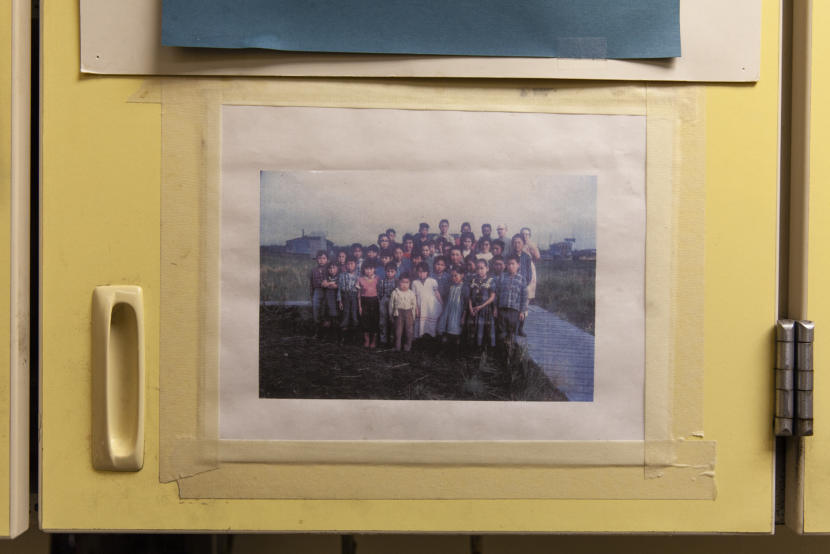
Students from a former Bureau of Indian Affairs school in Tuntutuliak.
Fitka, 62, has been teaching Yugtun in the village school for 37 years.
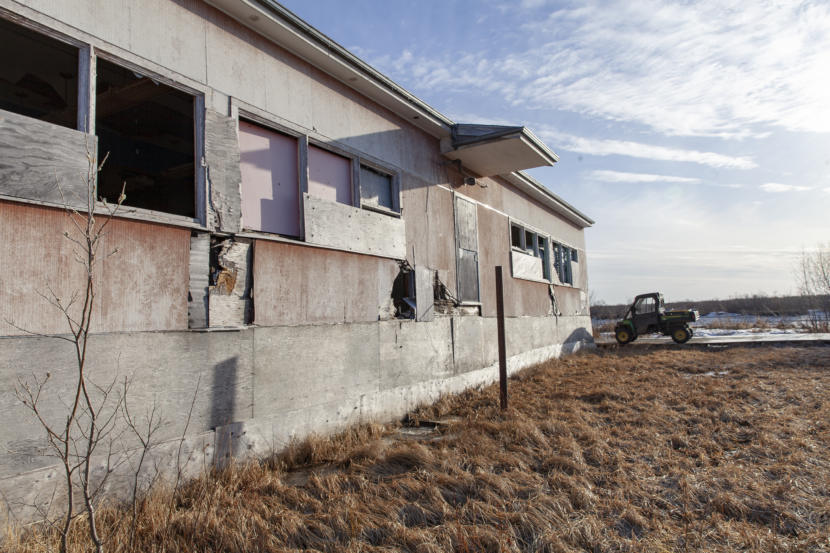
Just a few turns away on the wooden boardwalk that snakes through town, right along the edge of the Tagayarak River, is a decrepit, abandoned building that used to be another school. This one was run by the Bureau of Indian Affairs.
Fitka remembers a lot of things about that school. She remembers that it was not big enough to have a cafeteria, so the students pulled boards down from the walls and ate in the hallways. She also remembers a completely different experience with her Native language when she was a kindergartner in the 1960s.
She picks up a ruler from a nearby corner and looks at it, turning it over a few times.
“My hands would be hit with a wooden ruler,” she said. She gives her palms a few sharp slaps demonstrate. The jarring sound reverberates throughout her classroom.
Each time she broke the rules and used Yugtun, the teacher would write a mark next to her name on the board. Too many marks and she was punished.
An abandoned former Bureau of Indian Affairs school in Tuntutuliak.
Many Alaska Native children were punished for speaking their Native languages — an outgrowth of a U.S. educational policy designed to assimilate Indigenous children into Western culture and a different way of thinking.
When Fitka talks about it, her voice still breaks.
“Being treated like that, you know, for being hit on my hands for the first time in my life at 5 years old, having never been hit in your life. You know, that’s traumatic.”
It was hard, but she started with survival English at first. “You know, ‘Can I use the bathroom?’ ‘Can I drink some water?'”
But, Fitka said, she considers herself lucky, because her parents didn’t speak any English.
“Had they known English, and had they known that I was being punished at school, I think they would have spoken to me only in English,” she said.
Now she can pass along her language — and everything that comes with it — to her students.
But she sees trouble ahead.
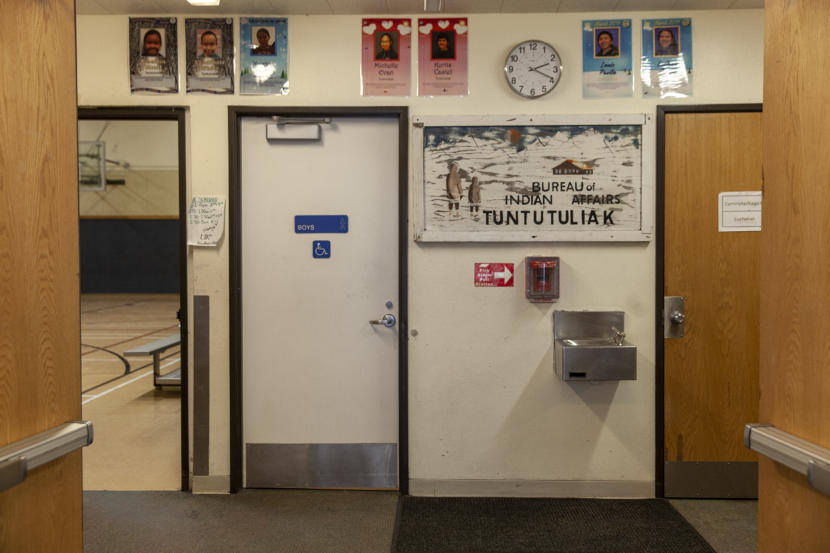
A sign from the former Bureau of Indian Affairs School hangs in the new school on April 3 in Tuntutuliak.
Central Alaskan Yup’ik — that’s the dialect spoken in the Fitka’s area of the Lower Kuskokwim River — is the most widely spoken of the state’s Native languages, according to the Alaska Native Language Center at the University of Alaska Fairbanks.
But there has been a decline in the number of fluent speakers. That drop can be seen throughout the state. Data from the Alaska Native Language Preservation and Advisory Council shows there are simply fewer people in the state speaking Indigenous languages fluently.
In the last decade or so, Fitka noticed a shift in her young students: More of them are speaking English at home.
“I feel very sad that nowadays there are some young couples in the village here — that I have taught, you know, they are fluent in their Yup’ik language. They teach their kids to speak only English,” she said.
Fitka said that thinking in Yugtun and thinking in English are not the same.
She tells the story of an Elder in the village who used to come sit in her classroom.
“He used to like to come in and just sit down and just watch me with my students,” she said.
Megan Evan, 10, and Christine Aguchak, 9, play basketball after school on April 3 in Tuntutuliak.
He asked her if she watched the kids who speak English at home and those who speak Yugtun. He told her they act differently.
“Now that I’m over the hill, you know, I can see it. The kids that are fluent in their first language, it’s like they’re more aware,” Fitka said.
Each morning, when the children come into the classroom to see her, the ones who are fluent in Yugtun — who speak it at home and are immersed in the language and the culture — speak to her differently.
“They’ll come in, and they’ll tell me in Yugtun what the weather is like out there,” Fitka said. “And that’s what the Elders did a long time ago. That’s what they used to ask the little kids when they came in after being out. It taught you to be aware of your surroundings.”
She worries that if the Yugtun language isn’t passed along, children will lose touch with their cultural heritage too.
“Our language is like a rope, you know, and if you look at a rope, if you take it apart, it has many strands in there, you know. It’s what makes it strong. If it was just a little skinny strand, it can’t pull a sled, it can’t tie a boat down. And our language is like that rope, you know. It has how to raise a child. It tells us how to be. How to preserve food, how to prepare food. All in Yup’ik.”
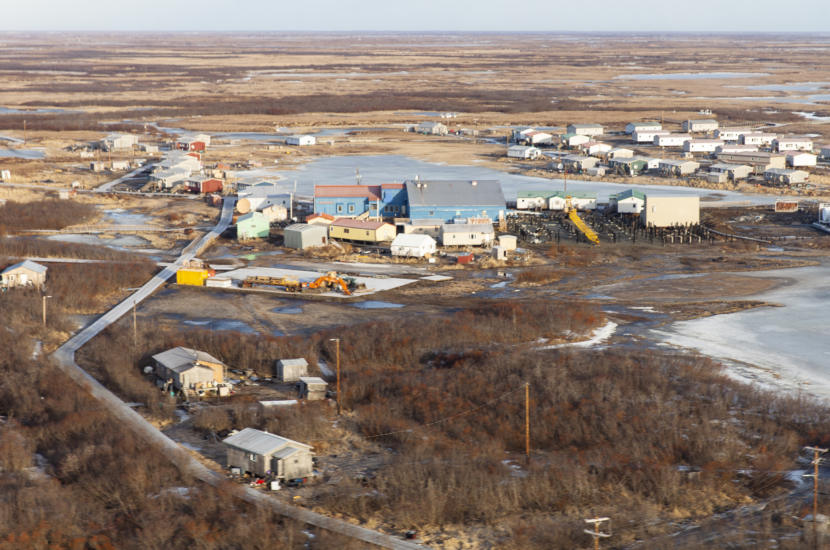
The Lewis Angapak Memorial School stands abve other buildings in Tuntutuliak.
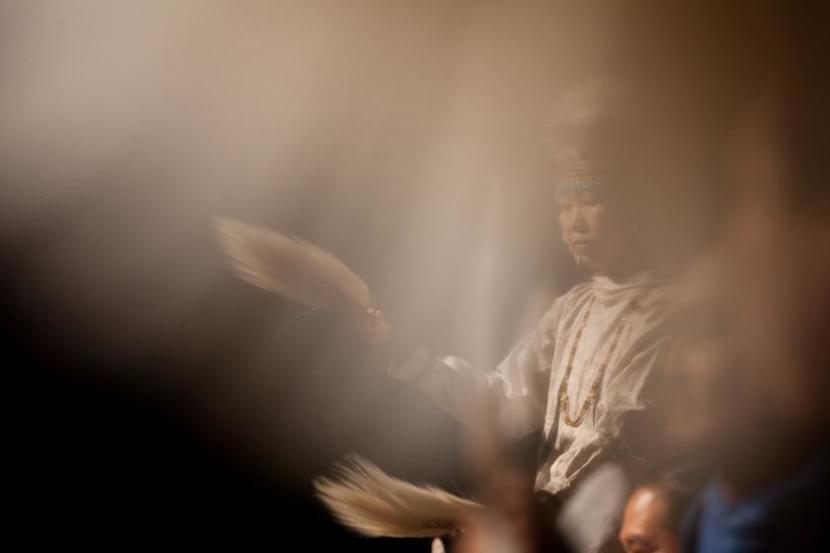
Cungak Simone Tununchuk dances during the Cama-i dance festival on Sunday, March 31, 2019 in Bethel, Alaska. (Photo by Rashah McChesney / KYUK/Alaska’s Energy Desk)
On the Yukon-Kuskowkwim Delta, Yup’ik dance has undergone a renaissance. Everything that goes along with it, from intricate beading, headdresses to mukluks, dance fans to masks, has a story.
Julia Lewis, whose late husband Walter Lewis was honored by the festival this year, wore a pair of handmade mukluks to dance with her family from Chefornak. They weren’t hers, though. She borrowed them from one of her daughters. As she rocked back on her heels on the stage at Cama-i, swaying to the drums, red and blue beads bounced on the calfskin. After her dance, as Lewis talked about the boots, she rubbed her hand along the fur. Typically the darker fur is beaver, but she said it could also be otter.
“It feels soft. I think when you feel it, it makes you relax,” she said.
Lewis said that the mukluks were made by another woman from Chefornak. She tapped gently on the bearded seal soles. The boots are new, but she’s worn them in enough that the soles aren’t smooth. It’s a key part of getting new mukluks because the soles are slippery.
“So you’ve got to be careful, especially on ice,” she said.
Still, it’s easy to tell that they’re new when she taps on the soles.
“Hollow, right? They sound hollow because they’re hard. Once they start wearing them and walk on them and they kind of get soft, then it won’t be as – you won’t hear that much of that,” she said.
Some buy regalia from local crafters, but for many it’s a family affair. A piece can be borrowed, like Lewis’ boots, or made especially for them, like Lyric McIntyre’s.
Lyric McIntyre, who is five, danced for the first time with a group from Bethel’s Yup’ik immersion school. From the tips of her white-feathered dance fans, to her headdress, to her belt, McIntyre’s regalia was made by her family. Her uncle, Chuna McIntyre, said that it was a momentous occasion that called for special ceremonial regalia.
“Because this is her first dance, and because she’s named after our late mother, of course she would be decked out,” he said.
McIntyre says that Lyric’s first dance is just as important for her living family as it is for her ancestors.
“You see, we dress up as Yup’ik people. Not just for ourselves or for the audience, we also dress up for our ancestors,” he said. “That’s the way it was explained to me by my late grandmother, because our ancestors are watching us during these momentous events. So we dress up for them too,” he said.
For the first time in 12 years, dancers from Scammon Bay returned to the Cama-i stage. Alice Rivers walked offstage in her regalia after the group’s historic dance and sat down, sweating.
“Hot. I’m hot,” she said, tugging at her wolf and beaver headdress. “I didn’t start dancing until I was a grandma, so this headdress was given to me by my brother’s wife because I started dancing,” she said. “It’s good to have a headdress before you dance because it makes you look different.”
Rivers says that she dances better when she has her nasqurrun, her headdress, and her dance fans.
Later in the evening, another audience favorite gathered on stage. The Mt. St. Elias Dancers, a Tlingit group from Yakutat in Southeast Alaska, brought formline blankets and copper-detailed regalia out. Kai Monture stood above the rest with a large, egg-shaped traditional Tlingit battle helmet. It was a gift. The helmets are carved out of a burl: a very large, hard knot on a tree.
“It’s usually where the wood on the tree is the hardest, because the grain grows in multiple directions,” Monture said. “We specifically chose to make our helmets out of these because they are nearly unbreakable. It doesn’t crack like normal wood if you strike it.”
Typically, there’s also a crest.
“It’s common to see helmets with bears, wolves, or ravens on them because those represent the warriors of the clan, and they would often make those sounds during battle,” Monture said. “So if you had a wolf on your helmet, you would make wolf howls while you were fighting.”
Monture’s helmet has a snarling face carved into the top of it. It also has traditional human hair and shells for teeth. Monture says that the helmet weighs about 7 to 8 pounds. Combine that with the rest of his armor and his heavy stone hammer, and Monture says that it’s a kind of strength training.
“It really, really makes me appreciate how strong my ancestors were since they were able to wear this in battle, and this armor in battle for hours at a time,” he said. “I can’t even imagine.”
Among all of the feathers, warm furs, thick headdresses, and qaspeqs of the Yup’ik and Inupiat who attended the festival, the Seneca and Muscogee Sampson Family from the Northeastern part of the United States stood out.
Lumhe Micco Sampson has a strong name. It means “Eagle King,” and his dancing style matches. As his brother Samsoche Sampson plays the flute, Micco crawls and contorts his body. His muscles tense as he leaps suddenly and almost impossibly high into the air, all while spinning a set of white hoops that he and his family use to dance.
One of the more intricate pieces of Micco’s regalia is a belt that loops loosely around his waist and holds two long panels with raised beadwork that catch the light when he spins. Audience members get flashes of a heron here, wolf there; a small blue bird stitched into the sky above a deer’s antlers. His mother, Darice Sampson of the Seneca Cattaraugus reservation, holds the belt and points to each piece of the belt to explain.
“Way back, we used to have long houses and they were done by clans. In each family there’s eight clans, with the Senecas, and you have your birds, which consist of the hawk, the heron, the snipe, and then we have the deer,” she said. “The reason they call deer a bird is because the deer literally has all four feet off the ground when it leaps through the air. Then we have the four-leggeds, which is the wolf, the bear, the turtle, and the beaver.”
Sampson does all of the beadwork for the group. Each piece represents hours of work. She says that she gets a lot from watching her sons perform in regalia that she made.
“Oh, it feels great when my sons are out there and I sew all our outfits,” she said. “It just almost brings me to tears, but it’s tears of joy, tears of being proud, and I’m so glad they’re carrying on who we are and keeping us as indigenous people alive.”
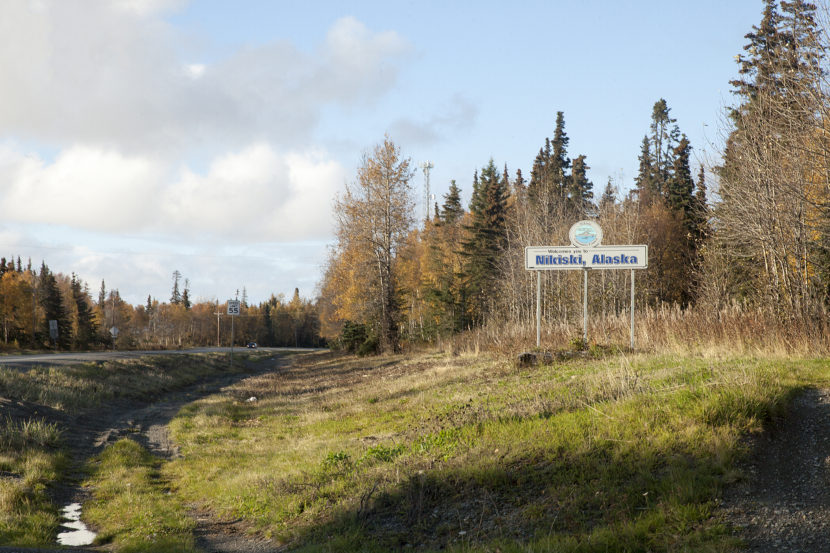
Nikiski, Alaska, where the Alaska LNG project plans to site a liquefaction facility at the end of an 800-mile long pipeline bringing natural gas from the North Slope to tidewater before exporting it to markets in Asia. The Federal Energy Regulatory Commission announced on Feb. 28, 2019, that it is pushing back the timeline to finish an environmental review and authorization to build for the megaproject. (Photo by Rashah McChesney/Alaska’s Energy Desk)
The federal agency reviewing Alaska’s ambitious North-Slope-to-Asia LNG export project has pushed back the timeline for finishing that review.
The Federal Energy Regulatory Commission, or FERC, announced on Feb. 28 that it has pushed back the deadline for its final decision by four months.
“The new schedule indicates that the final permit for the Alaska LNG project will be delivered in June of 2020,” said Alaska Gasline Development Corporation spokesperson Tim Fitzpatrick.
In its notice, staff at FERC attributed the delay to the state’s gasline corporation. The corporation has filed hundreds of thousands of pages of environmental and engineering data to the federal agency — all in the quest to get that final permit to build the 800-mile long pipeline and plant.
But the federal commission is still waiting for information on everything from fire safety and underwater pipeline crossings to maps showing seismic hazards near the pipeline.
A final decision from the federal commission is contingent upon the state corporation providing all of the data that it wants — so the schedule could still be revised.
The $43 billion project has seen some upheaval in the last few months. Negotiations with potential buyers and investors in China were scheduled to end in December. That deadline passed with no deal.